

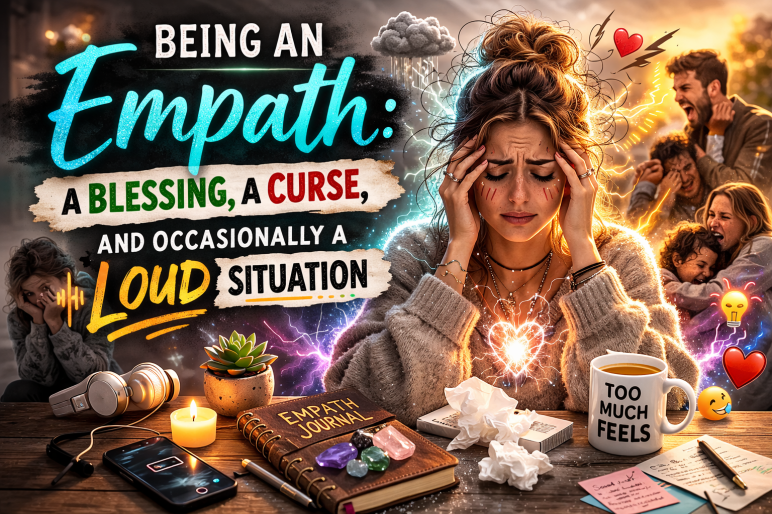
“Being an empath means I can feel your energy shift before you even decide to shift it. Don’t act surprised when I respond like I already read the whole plot twist.”
-This Puzzled Life
Light the charcoal. Sprinkle the sage. It’s my way of announcing to the universe, and anybody else listening, that the energy is about to be corrected. Redirected. Or escorted out. It’s not decoration. It’s a declaration. The vibes will behave. Or they will be removed.
Let me go on and say this before somebody gets the wrong idea and starts assigning me spiritual homework that I did not sign up for. Being an empath does not mean I’m a soft‑spoken emotional Roomba gliding around the house sucking up everybody’s mess in silence. No ma’am. No sir. No spirit.
I am an empath with range. I can read your tone, micro‑tone, micro‑aggression, and the ghost of the tone you almost used. And if my intuition taps me on the shoulder and whispers, “They tried you,” I will absolutely raise my voice like a Southern Baptist who just found out somebody parked in her spot at church.
Empath does not mean quiet. Empath means I know exactly why I’m yelling. People love to romanticize empaths like we’re walking mood rings with good credit. But the truth is more complicated. Being an empath is a blessing because you can walk into a room and instantly know who’s lying. Who’s tired. Who’s two seconds from crying. Who’s pretending to be fine. Who’s about to start some mess. Who needs a hug. Who needs a boundary. And who needs to be escorted out by security.
But it’s also a curse. You can’t turn it off. You can’t unfeel what you felt. You can’t unsee the emotional weather patterns swirling around people like spiritual Doppler radar. And sometimes you’re sitting there thinking, “Lord, why did you give me this gift without a mute button?”
Let’s tell the truth that makes people uncomfortable. Some empaths aren’t born. They’re forged. Some of us learned to read a room because we had to. Because survival depended on knowing when the energy shifted.
When someone’s mood changed. When danger was coming. When silence meant safety. And when footsteps meant run. That kind of childhood intuition doesn’t disappear. It grows up with you. It becomes a skill, a shield, a superpower and sometimes a burden you didn’t ask for.
So yes, some empaths are spiritually gifted. And some of us are trauma‑trained emotional detectives with a sixth sense and a therapist on speed dial. Being an empath means you don’t just enter a room. You scan it. You feel the tension in the air before anyone speaks. You clock the fake smile from across the room. You sense the passive‑aggressive energy floating near the snack table. You know who’s genuinely happy to see you. And who’s performing hospitality like it’s community theater. It’s not paranoia. It’s pattern recognition.

And while everyone else is like, “Oh, the vibe seems fine.” You’re standing there like, “No it doesn’t. Somebody in here is lying. And somebody else is about to cry.” Boundaries aren’t optional for empaths. They are survival gear. Without boundaries, an empath will drown in other people’s emotions like they’re swimming in a pool they didn’t even want to get in.
Boundaries are how we protect our peace, our energy, our intuition, our sanity, our inner child, our outer adult, and the version of us that still wants to believe people mean well. People who don’t understand boundaries think they’re rude. People who need your boundaries think they’re personal attacks. But people who love you will understand that boundaries are how you stay alive, present, and emotionally available without burning yourself to ash.
Let me be extremely clear in a way that even the spiritually hard‑of‑hearing can understand. When an empath sets a boundary, it is not a suggestion, a preference, or a cute little decorative fence. It is survival architecture.
Empaths don’t set boundaries casually. We set boundaries because we’ve already scanned the emotional terrain. We’ve already clocked the patterns. We’ve already felt the shift in your tone. And we’ve already sensed the storm clouds gathering behind your smile.
When someone violates a boundary we clearly communicated, it doesn’t feel like a misunderstanding. It feels like a threat. It feels like disrespect. It feels like someone walked into our house. Ignored the “Please remove your shoes” sign. And tracked mud across the ancestral rug. And because empaths are wired to detect danger that is emotional, spiritual, and energetic, boundary violations hit us like alarms going off in a building we didn’t even want to be in.
This is why people get confused when an empath goes from calm to “Oh absolutely not” in 0.3 seconds. They think we’re overreacting. But what they don’t understand is we saw the intention. We felt the entitlement. We recognized the pattern. And we sensed the disrespect before it fully formed.
By the time we raise our voice, the situation has already been analyzed. Processed. And spiritually notarized. Empaths don’t explode out of nowhere. We respond to the data. Violating a boundary is the emotional equivalent of someone looking us dead in the eye and saying, “I don’t respect your peace, your intuition, or your humanity.” At that point, the empath is not being dramatic. The empath is being accurate.
When I say I’m an empath, people assume I’m out here collecting gold stars from the universe. And waiting for someone to pat me on the head and say, “Good job for feeling things deeply. Absolutely not. I don’t need outside validation because I validate myself loudly, confidently, and with the full support of my intuition, my ancestors, and my own emotional PhD.
I spent too many years being trained to read every room, every tone, every shift in energy just to survive. So, trust me when I say, I know what I feel. I know why I feel it. And I don’t need a committee meeting to confirm it. My inner knowing is the authority. My boundaries are the policy. And my self‑validation is the final stamp of approval. Anyone else’s opinion is optional, decorative, and often late to the truth I already knew.
The next time somebody hears “empath” and assumes I’m a gentle emotional cloud floating through life, let me correct the record. I’m not floating. I’m detecting. I’m reading the room, the subtext, the spiritual Wi‑Fi, and the emotional weather report. And if the forecast says, “disrespect with a 70% chance of foolishness,” trust and believe I will bring the thunder. Empathy doesn’t make me silent. And sometimes accuracy requires volume. Thanks for reading! And go with your gut. Because it’s the most accurate feeling that you can feel.
Affirmation: I honor my intuition. Protect my peace. And raise my voice only when spiritually necessary. Which, unfortunately for some folks, is more often than they’d prefer.
***Don’t forget to watch the video!***
#ThisPuzzledLife

