This Puzzled Life is a mental health and recovery blog exploring addiction, trauma healing, LGBTQ experiences, humor, and the strange moments that shape us.
“My healing isn’t linear. It’s a Southern backroad with potholes, detours, and at least one possum giving me side‑eye. But I’m still driving.”
-This Puzzled Life
Light the charcoal. Sprinkle the sage. Today we’re not just cleansing the room. We’re cleansing the entire diagnostic chart that tried to play me like a two‑for‑one special at the Discount Trauma Mart. We’re also cleansing the medical chart, the family gossip line, and the entire Southern belief system that still thinks “nerves” is a diagnosis. And “just pray on it” is a treatment plan.
Dual diagnosis is that special Southern casserole of “mental health condition” baked together with “substance use disorder.” And it’s served piping hot with a side of unsolicited advice from people who haven’t been to therapy since Clinton was in office. It’s the moment life says, “Surprise! You’re not just juggling one thing. You’re juggling two flaming batons while the universe yells, ‘Smile, sweetheart!’”
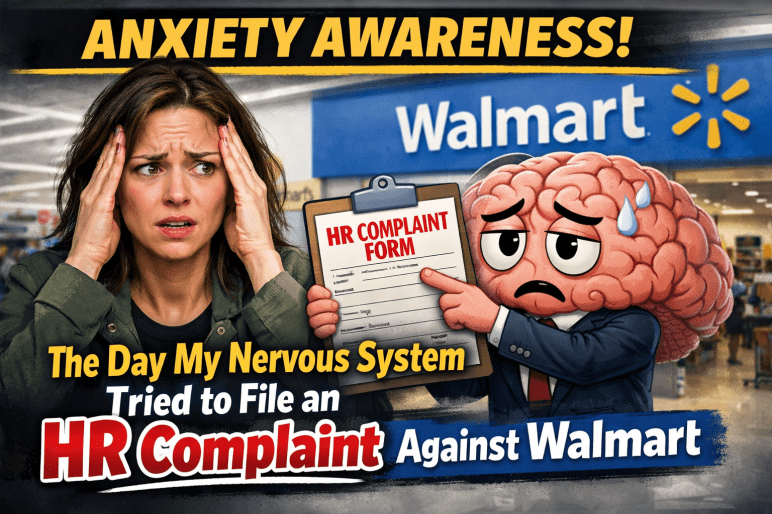
Dual diagnosis is like waking up every day in a body that’s running both a Windows 95 operating system and a bootleg Sims expansion pack that keeps crashing. It’s trying to heal your brain while your brain is actively filing HR complaints against itself. It’s the emotional equivalent of trying to fix the roof while the house is still on fire. And the HOA is sending you letters about your grass height.
And it’s that moment when life looks at you and says, “Oh, you thought you were dealing with one thing? Hold my sweet tea.” It’s the psychiatric equivalent of a potluck where anxiety brings a casserole. Depression brings a Bundt cake. And addiction shows up empty-handed but somehow leaves with all the Tupperware.
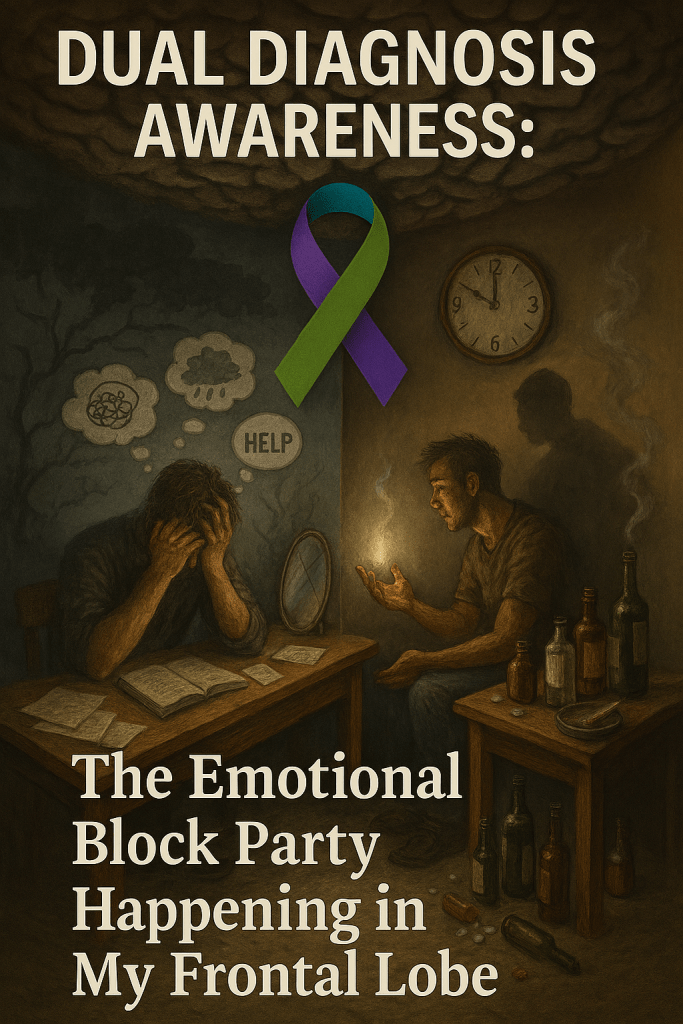
And the world? The world acts like you’re being dramatic. And the wild part? People act like you’re being dramatic. “Have you tried drinking more water?” Ma’am, I have two diagnoses doing synchronized swimming in my amygdala. Hydration is not the plot twist that’s going to fix this. “Have you tried yoga?” Ma’am, I have two diagnoses doing the electric slide in my frontal lobe. Yoga is not going to stop this internal block party.
Beneath the jokes, dual diagnosis is real, heavy, and often misunderstood. People think it’s chaos. But it’s actually survival. It’s resilience. It’s learning to hold two truths at once like “I’m struggling and I’m still here.” It’s learning to treat yourself with compassion even when your brain is acting like a committee meeting where everyone is yelling and nobody brought notes. It’s learning to say, “I deserve care.” “I deserve treatment.” “I deserve to be taken seriously.” And most importantly, “I am not a punchline. I’m the whole damn story.”
Down here in the Deep South, dual diagnosis gets wrapped in a layer of cultural seasoning nobody asked for. Aunt Linda whispers like you’re contagious. Cousin Ray offers you a beer because “you look stressed.” And the church ladies add you to the prayer list without asking. Right under “traveling mercies” and “unspoken.” Meanwhile, you’re just trying to survive the day without your brain throwing a surprise block party.
Dual diagnosis in the South also means navigating stigma with the grace of a cat on a freshly mopped floor. You’re trying to get help. Half the town thinks therapy is witchcraft. And the other half thinks medication is a moral failing. Meanwhile, you’re over here doing the emotional equivalent of rebuilding a transmission with a butter knife and a YouTube tutorial.
Dual diagnosis awareness is about reclaiming your narrative from the people who oversimplify it. Misunderstand it. Or try to shame you for it. It’s about saying, “Yes, I’m dealing with two things at once. And I’m still out here living. Healing. And occasionally thriving like the chaotic miracle I am.” And yet, here we are. Still showing up. Still healing. Still lighting the charcoal and sprinkling the sage like we’re about to summon the ancestors and the insurance company.
Dual diagnosis doesn’t make you broken. It makes you bilingual in battles most people will never understand. And if anyone tries to minimize your experience? Tell them this, “Baby, I’m not dealing with too much. You’re just underestimating my capacity.” Thanks for reading! And keep searching for answers.
Affirmation: I honor every part of my journey. The messy, the miraculous, and the medically complicated. All of it proves I’m stronger than the storms I’ve survived.
“Anxiety tried to schedule a meeting with me today, but I declined because I was already overbooked with minding my business and avoiding Walmart.”
-This Puzzled Life
Light the charcoal. Sprinkle the sage. Today we are not just cleansing the room. We are cleansing the entire nervous system that has been acting like a raccoon on Red Bull since 1986. If we’re going to talk about anxiety awareness, we might as well sanctify the whole atmosphere before my nervous system starts acting like it’s auditioning for The Exorcist: Southern Edition. Also, somebody please hold my sweet tea. And hide my debit card. Because my anxiety just whispered, “Let’s go to Walmart.” That is how generational trauma gets activated. And it just tried to file a noise complaint against my own heartbeat.
Let me tell you something. Anxiety is the only condition that will have you sitting in your own house. And minding your own business when suddenly your brain goes, “Hey, remember that embarrassing thing you did in 4th grade?” And now you’re sweating like you’re on trial for a crime you didn’t commit but might have thought about once.
Anxiety is a full-time employee in my life. No PTO. No sick days. No boundaries. It clocks in before I wake up and clocks out after I fall asleep. Sometimes it leaves sticky notes on my dreams like, “We need to talk.” And don’t get me started on the physical symptoms. Anxiety will have you convinced you’re dying because your left eyebrow twitched. Meanwhile your ancestors are watching from the spirit realm like, “Baby, that’s just dehydration and poor life consequences.”
And the worst part? Anxiety loves to show up at the most inconvenient times. Like a Southern auntie who pops up unannounced but brings no food. You ever try to relax? Just sit down. Breathe. And maybe watch a little TV? Anxiety busts through the door like, “Oh you thought. Let’s review every possible failure you’ve ever had.”
But here’s the thing. Awareness doesn’t mean we’re broken. It means we’re paying attention. It means we’re learning the choreography of our own nervous system. Even if the choreography looks like a baby deer on ice. It means we’re naming the thing so it can’t sneak up on us like a possum in the trash can at 2 a.m. And it means we’re not alone. Not in Mississippi. Not in the South. Not in this chaotic, holy, hilarious human experience.
But the real comedy? The way anxiety tries to prepare you for every possible scenario like a doomsday prepper with a Pinterest board. It is the only condition that will have you standing in the cereal aisle. Staring at 47 versions of Cheerios. And sweating like you’re defusing a bomb. Meanwhile your brain is like.
“What if you pick the wrong cereal?”
“What if everyone is watching you pick the wrong cereal?”
“What if you pass out in front of the cereal and become a local Facebook post?”
Going to the grocery store? “What if you forget how to walk?”
Sending an email? “What if you accidentally confess to a felony?”
Meeting new people? “What if they can hear your thoughts and your thoughts are stupid?”
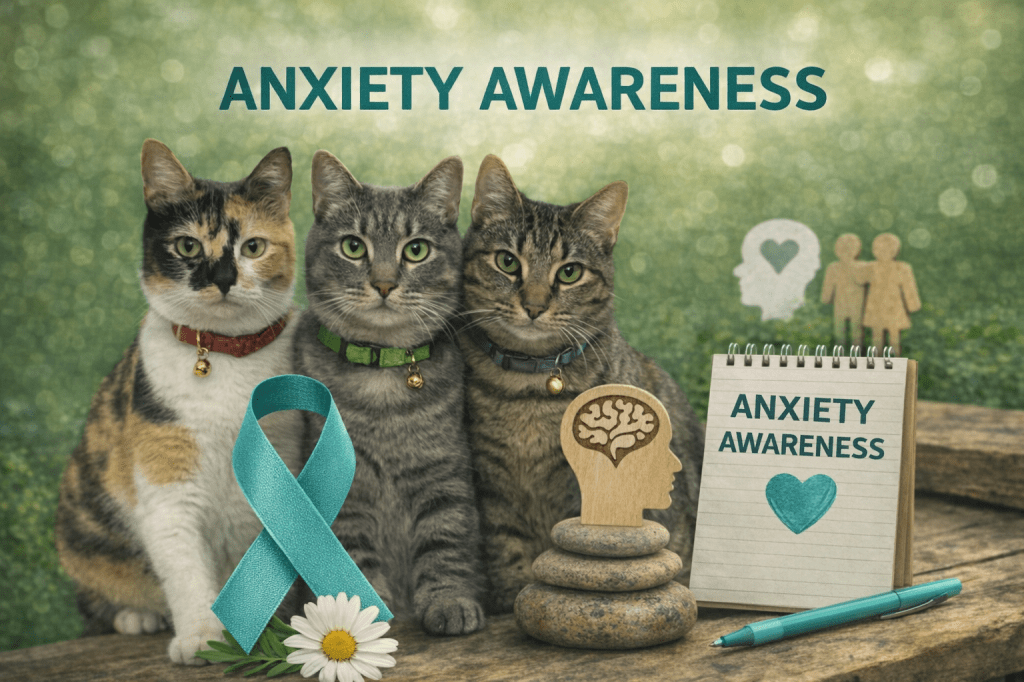
And that’s exactly when my cats, my emotional support staff and furry chaos consultants, decide to hold a household emergency meeting.
Piper (dramatic and convinced she’s the CEO): “Alright team, Mama’s going to Walmart. That’s a Code Orange. Everyone stay sharp.”
Tinkerbell (the eldest acting, the union rep, wearing imaginary glasses): “Should we call the therapist now or wait until she hits the checkout line and forgets her PIN again?”
Coco (the chaotic neutral gremlin): “I say we call the therapist the moment she steps into the parking lot. Walmart energy is unpredictable. Anything can happen. A rollback could roll back her entire sense of stability.”
Piper: “Coco, we can’t call the therapist every time Mama goes to Walmart.”
Coco: “Why not? She said to reach out when things feel overwhelming. Walmart is overwhelming. The lighting alone is a threat.”
Tinkerbell: “Plus, Mama always ends up in that aisle with the seasonal décor. And that’s when she starts questioning her entire life path. That’s textbook panic adjacent.”
Piper: “Okay, fine. But we need a plan. If Mama starts breathing like she’s running from a ghost, we call the therapist. If she starts sweating like she’s in a revival tent, we call the therapist. If she starts talking to herself-”
Coco: “Piper, she talks to herself every day.”
Piper: “Right. So, if she starts talking to herself louder than usual.”
Tinkerbell: “And if she buys anything from the middle aisle that she didn’t come for. That’s a red flag.”
Coco: “Like the time she went for milk and came home with a new bong?”
Piper: “Exactly. That was a cry for help.”
Tinkerbell: “Okay, so we’re agreed. Our therapist is on standby. Paws on deck. And if Mama ends up in the candle aisle sniffing things like she’s trying to inhale peace directly into her bloodstream, we intervene.”
Coco: “I’ll bring the emotional support snacks.”
Piper: “I’ll bring the drama.”
Tinkerbell: “I’ll bring the clipboard.”
And let the record show, anxiety may roll up on us like a tornado siren at 3 a.m. But we are not facing it alone. Not in this house. Not in this lifetime. Not with three cats who treat mental health like a full‑time group project.
Anxiety awareness isn’t about pretending we’re calm. It’s about knowing the signs. Naming the chaos. And having a furry emergency response team ready to call the therapist before you even realize you’re spiraling.
It’s about honoring the truth that Walmart is a battlefield. The fluorescent lights are the enemy. And the seasonal aisle is a spiritual test. It’s about laughing at the absurdity of it all. Not because it’s small, but because we’re bigger. And it’s about remembering this. You can have anxiety. You can have panic attacks. You can have days where your brain feels like a raccoon in a Dollar General dumpster. But you also have resilience. You have humor. You have sage, charcoal, and a whole household of four‑legged emotional support supervisors who refuse to let you fall apart alone.
So let anxiety know loudly, proudly, with your whole Southern chest, “I may panic in Walmart. But I do not panic alone. I come with a team. I come with a plan. And I come with three cats who will call my therapist before my knees even start to wobble. Anxiety dismissed with Southern hospitality and a side‑eye. Thanks for reading! And reach out when needed.
Affirmation: I am calm. Collected. And spiritually moisturized. And if my anxiety disagrees, it can take a number and wait behind the cats, the ancestors, and my iced coffee.
“The moment I admitted you could kill me was the moment I finally chose to live.”
-This Puzzled Life
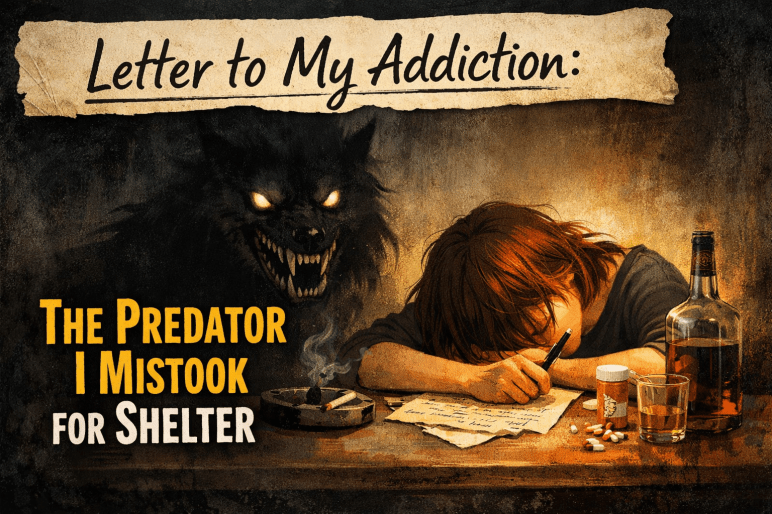
Light the charcoal. Let the first curl of smoke rise like a confession I’ve been swallowing for years. The kind that sits heavy in the chest because it’s finally time to stop pretending. This is me standing in the doorway of my own truth. Trembling but present. And ready to speak to the thing that once felt like comfort. You didn’t come into my life with claws out. You came soft. Familiar. You came disguised as relief, comfort, and as the one thing that could quiet the noise in my chest. Then you became a companion. I didn’t know you were studying me. Learning my wounds. Memorizing my weak spots. And waiting for the moment I’d confuse your hunger for affection.
And now you reveal yourself as the slow, patient danger I keep calling love. I can feel the ache of it. The grief of it. And the terrifying clarity that comes when you finally admit the thing you’ve been running from is the same predator that’s been hollowing me out from the inside. And today, with this smoke rising around me, I’m done whispering. I’m done softening the truth. I’m done pretending I don’t know what you are.
I’ve finally stopped running from the truth. And it hits me with a force that steals the air from my lungs. I keep letting you lead. And you won’t just ruin my life. You will end it. Not in some dramatic, cinematic way. But in the quiet, methodical way predators always finish their work. You’ll take my breath one day. And the world will keep spinning. The people who love me will stand in the wreckage wondering how something I once trusted became the thing that swallowed me whole.
That realization sits in my bones like a cold prophecy. I can feel how close the edge is. I can feel how thin the line has become. I can feel the way my body is starting to whisper warnings I used to ignore. And for the first time, I’m not pretending I’m stronger than you. I’m not pretending I can dance with you forever. I’m not pretending this ends any other way. The truth is simple and terrifying. I will die.
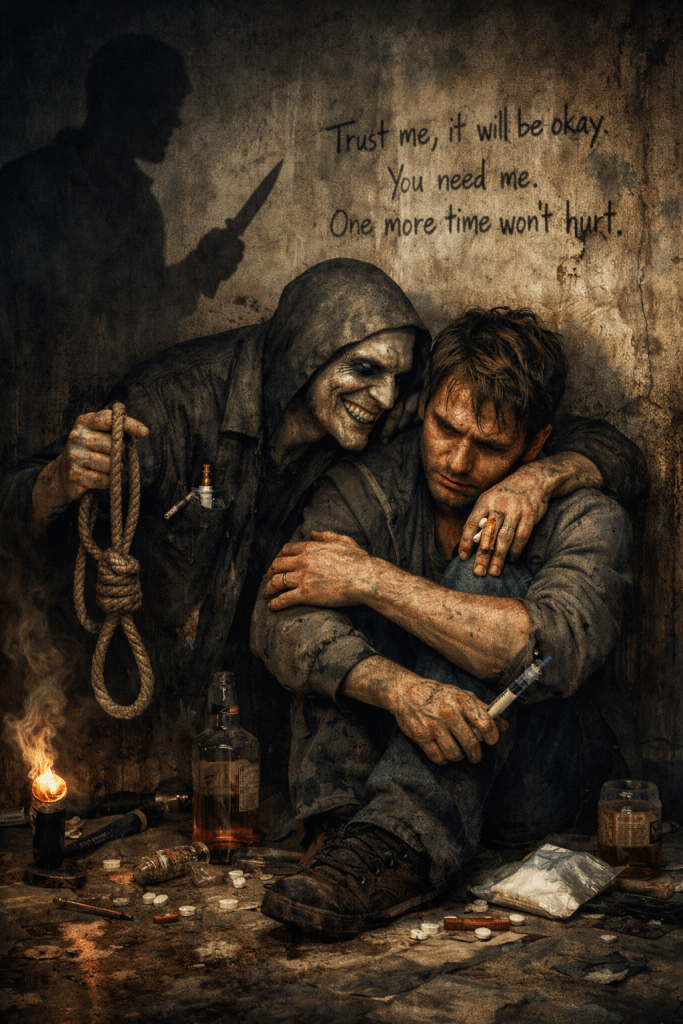
I let you close. Closer than anyone else. I let you wrap around me like safety. Like something I could trust. And for a long time, I believed you were saving me from the world, myself, and the ache I didn’t know how to carry. But predators don’t save. They circle. They stalk. They wait. And I see you for what you are.
You’ve been feeding on me piece by piece. Slow enough that I could pretend it wasn’t happening. And gentle enough that I could call it love. You made me believe I needed you to breathe, function, and to exist. You made me forget what life felt like before you sank your teeth in. But I’m not blind anymore. I can feel the way you’re hollowing me out. I can feel the way you’re tightening your grip. I can feel the truth I’ve been terrified to say, “My days are numbered.”
Not dramatically. Not suddenly. You’ll do it the way you’ve always done everything with patience and precision. With that quiet, familiar whisper that tells me I can’t live without you. Because loving you has become a slow death. And I’m finally admitting that the thing I thought was protecting me is the same thing dragging me under. You are the predator. I am the prey. And you will finish what you started. I’m done mistaking your teeth for tenderness. I’m done calling this love. Because when you take my life, it will be the last thing you’ll ever take from me. Please just make it quick.
Saying that out loud breaks something open in me. It’s not just fear. It’s grief for the version of me who thought I could love a predator into gentleness. Grief for the girl who thought she was in control. Grief for the woman who kept choosing you even as you carved pieces out of her.
But there’s something else under the grief. And this is where I stop lying to myself about what you are. This is where I look you in the eye and speak the truth you never wanted me to understand. I see the death you’re leading me toward. And, yet, I still can’t break free. Thanks for reading! And turn back before it’s too late.
“Some houses echo with laughter. The House of Addiction echoes with lessons. Loud, painful, and unforgettable lessons. And still, somehow, we walk out wiser than we ever meant to be.”
-This Puzzled Life
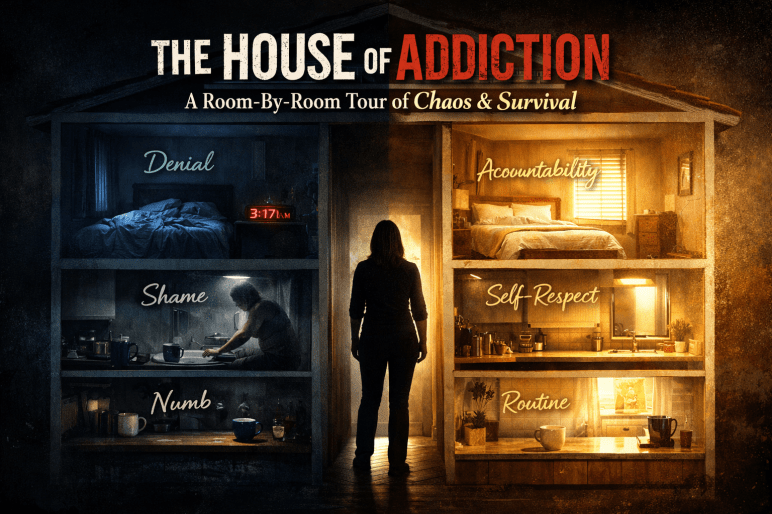
Light the charcoal. Sprinkle the sage. Let the smoke rise like it’s clocking in for a double shift. What we’re about to talk about requires spiritual PPE. It’s Addiction Awareness Month. And the House of Addiction doesn’t just haunt. It redecorates. It rearranges your memories. Steals your peace. And has the nerve to act offended when you notice.
From the outside, it looks like any other home on the block. But step inside, and you’ll find a floor plan designed by chaos itself. Complete with emotional booby traps and a staircase that creaks like it’s snitching on everybody.
The House of Addiction doesn’t creak when you walk in. It narrates. It knows your footsteps, fears, and soft spots. It knows you’re here for the truth. And it is already rearranging the furniture to make you doubt your own memory.
This house has the audacity of a Southern aunt who swears she “don’t gossip.” But somehow knows everybody’s business. Including the things you haven’t even done yet. Step inside. Keep your shoes on. This floor has seen some things. It will walk room to room with you, pretending it’s just “checking on things.” While it’s really dragging its mess across every surface like a toddler with a Sharpie.
The House of Addiction always looks normal from the outside. Fresh paint. Curtains that match. A porch light that pretends it’s welcoming you in. But the moment you cross that threshold, you realize this house has plans for you. None of them good. All of them messy. And every one of them delivered with the confidence of a demon wearing your grandmother’s pearls.
The Foyer: Where Denial Greets You Like a Nosy Aunt
You step inside and denial is already there. It’s leaning against the doorframe like it pays the mortgage. It’s smiling too big. Talking too fast. And insisting everything is fine. While the smoke alarm screams in the background. “No problem here,” Denial says. All while waving a broom at a fire like it’s a mosquito. The floorboards creak under the weight of secrets nobody wants to say out loud. The air smells like Febreze sprayed over a dumpster fire. This is the room where kids learn to tiptoe. Where silence becomes a second language. Where you learn to read moods like weather reports.
The Kitchen: Where Chaos Cooks Its Famous Disaster Casserole
Addiction loves the kitchen. It treats it like a stage. Pots banging. Cabinets slamming. Someone crying into a sink full of dishes that have been “soaking” since the Bush administration. This is where promises get burned to a crisp. Apologies get reheated for the 47th time. And kids learn to eat fast. Stay quiet. And watch the adults like they’re studying wildlife. The fridge is full of expired groceries and emotional leftovers nobody wants to deal with. And the table is where love tries to sit down. But keeps getting shoved aside by chaos wearing muddy boots.
The Living Room: Where Hope Sleeps on the Couch
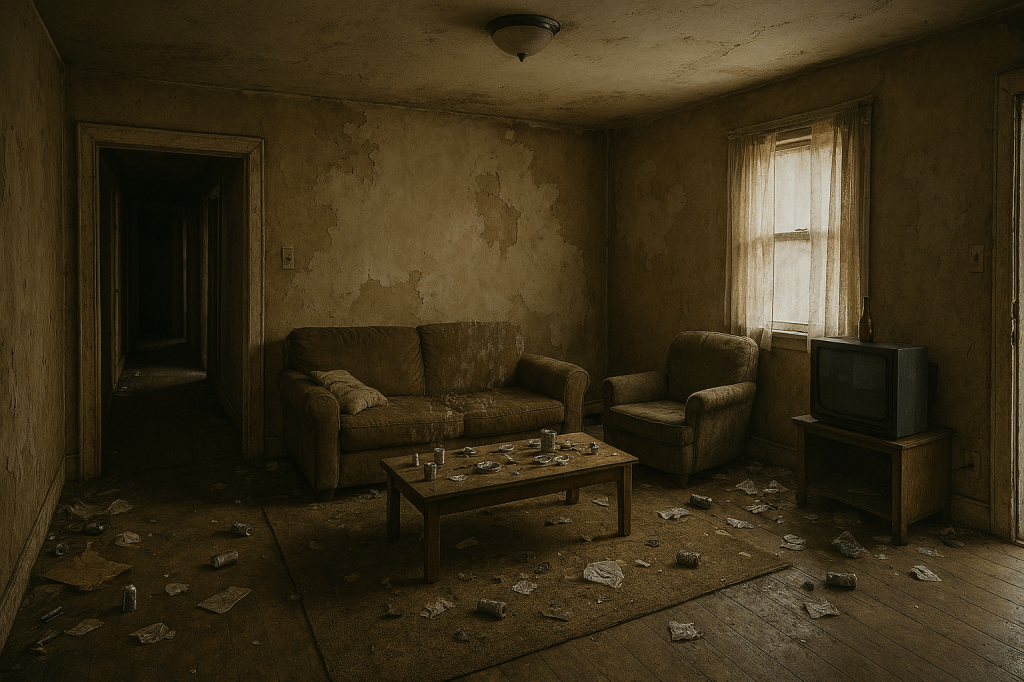
The living room used to be cozy. Now it’s a battlefield with throw pillows. Addiction drags its drama in here and spreads out like it pays rent. The TV is always too loud. The arguments are always too sharp. And the kids are always pretending they don’t hear what they hear. Hope still lives here. But it’s exhausted. It curls up on the couch under a blanket that smells like worry. It keeps whispering, “Maybe tomorrow.” Even though tomorrow keeps showing up drunk and late.
The Bedroom: Where Secrets Tuck Themselves In
This room is quiet. But not peaceful. It’s the kind of quiet that hums with tension. Addiction sits on the edge of the bed like a shadow with opinions. It whispers lies into the dark. It says, “You’re the problem,” “You can’t leave,” and “Nobody will believe you.” Kids learn to sleep lightly. To listen for footsteps. To brace for the door opening at 2 a.m. with the kind of energy that never means anything good.
The Laundry Room: Where Shame Hangs Itself Up to Dry
This room is where the truth piles up. Dirty clothes. Dirty secrets. Dirty looks from neighbors who pretend they don’t see what they see. Addiction loves this room because it knows shame thrives in small, cramped spaces. The washing machine is always running. But nothing ever feels clean. The dryer door squeaks like it’s tattling. And the air is thick with “Don’t tell anyone.”
The Bathroom: Where Tears Pretend They’re Just Steam
This is the only room with a lock. Which means it becomes a sanctuary for everyone including kids, partners, even the person struggling. People hide here to cry. Breathe. Or just exist without being needed. Addiction hates this room because it can’t control what happens behind a locked door. But it still bangs on it sometimes while demanding attention.
The Kids’ Room: Where Innocence Packs a Go-Bag
This room is the saddest part of the house. Toys on the floor. School papers on the wall. A bed that’s too small for the weight the child carries. Kids learn how to be invisible. How to be responsible for things they never caused. And how to grow up faster than their bones know how to handle. Addiction tiptoes in here sometimes. While pretending it’s not doing damage. But the cracks in the walls tell the truth.
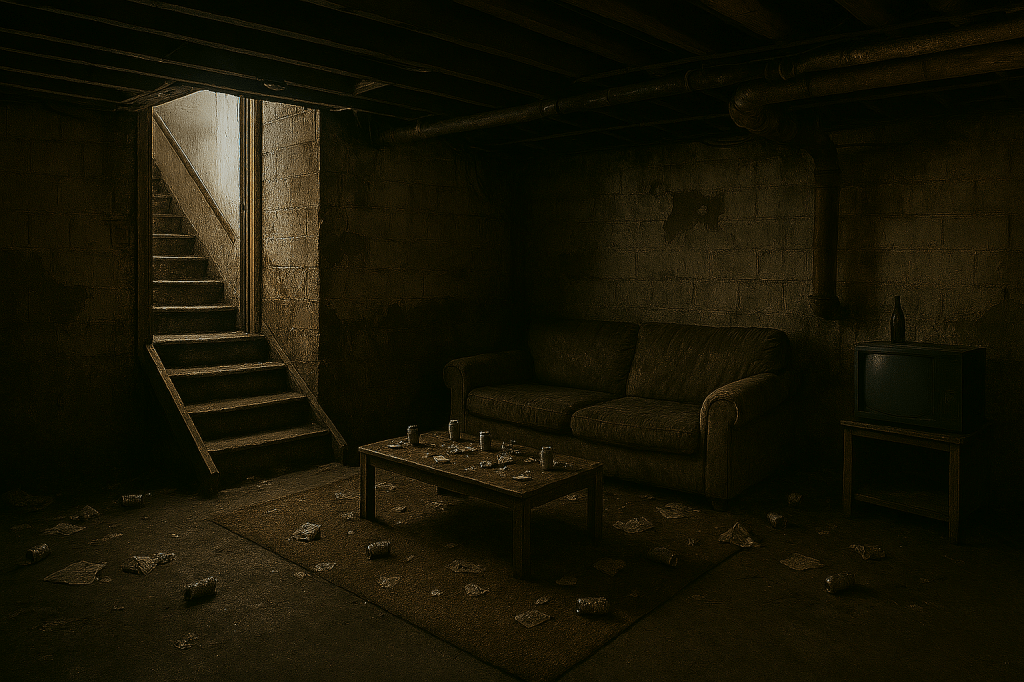
The Basement: Where the Truth Lives
Nobody wants to go down here. Not even Addiction. But this is where the real story sits quiet, heavy, and waiting. This is where trauma stacks itself like old boxes. Memories hide under tarps. And kids grow up and realize the house wasn’t normal. The basement is the part of the house that never lies. It knows exactly what happened. And it remembers everything.
The Attic: Where the “Old Stories” Live
The attic is dusty, cramped, and full of boxes labeled “We Don’t Talk About That.” This is where Addiction stores the memories you tried to outgrow. The versions of yourself you’re ashamed of. And the lies you were told about who you are.
Every box rattles when you walk by, like it wants to be opened. But also wants to stay sealed forever. Addiction loves this room because it knows you’ll avoid it. It knows the dust will settle on your truth until you forget what it looked like. But the attic is also where the light sneaks in through the cracks. It’s where you eventually realize that some stories aren’t yours to carry anymore.
The Garage: Where “I’ll Fix It Later” Goes to Die
The garage is full of unfinished projects, abandoned hobbies, and promises you meant to keep. Addiction parks itself here like a broken-down car that still thinks it can make the trip. This is the room where dreams get postponed. Goals get dusty. And potential sits on cinder blocks. You keep telling yourself you’ll clean it out “when things calm down.” But Addiction keeps tossing more junk in, insisting you don’t have time, energy, or worthiness to finish anything. But one day, you find the light switch. And you realize the garage isn’t full of failures. It’s full of things waiting for you to come back to yourself.
The Office: Where Control Pretends to Live
This room is where Addiction tries to look responsible. Bills stacked. Calendars marked. To‑do lists half done. Everything looks organized until you touch it. And the whole pile collapses like a Jenga tower built by denial. This is the room where you try to manage the unmanageable. You convince yourself you’re “still functioning.” And you hide behind productivity to avoid the truth.
Addiction sits in the office chair spinning slowly, whispering, “You’re fine. Look how much you’re getting done.” Meanwhile, nothing is actually getting done. But this is also the room where you learn the difference between control and survival. And where you finally fire Addiction from its fake job.
The Guest Room: Where You Pretend Everything Is Fine
This room is spotless. Too spotless. It’s the room you keep ready for visitors. So that they never see the chaos in the rest of the house. Addiction loves this room because it’s the perfect illusion of clean sheets. Fluffed pillows. And fake peace. This is where you host people who say, “You’re so strong.” Without knowing you cried in the hallway before they arrived. But the guest room is also where you learn that pretending is exhausting. And that real connection only happens when you stop hiding the mess.
The Crawl Space: Where the Fear Lives
Low ceilings. No light. Hard to breathe. This is the room Addiction never talks about but always uses. It’s where the fear crawls. It’s the fear of leaving, staying, being alone, and of being seen. Addiction keeps this space damp and cold, so you’ll avoid it. But this is the room where the truth hums the loudest. And when you finally crawl in with a flashlight, you realize the monsters were smaller than the shadows made them look.
The Backyard: Where Healing Starts Growing
The backyard is wild. Overgrown. And neglected but alive. Addiction never cared about this space. It didn’t think you’d ever step outside long enough to notice it. But this is where you breathe again. You plant new habits. You feel sunlight without flinching. And you imagine a life beyond the front door. The backyard is the first place that belongs to you again. It’s where you realize the house doesn’t own you. And where healing doesn’t have to be pretty to be real.
The Front Door: Where Freedom Waits
Every child of addiction eventually finds themselves standing at this door. Their hand on the knob. Heart pounding. And wondering if they’re allowed to leave. The truth is you can. You’re allowed to walk out. You’re allowed to build a new house. One with open windows, soft floors, and rooms that don’t whisper threats in the dark. You’re allowed to create a home where laughter doesn’t flinch. Where love doesn’t hide. And where the only thing haunting the halls is the sound of peace finally settling in.
And that’s the truth about the House of Addiction. It thought it owned you. It thought you’d stay lost in its attic of old stories. Stuck in its garage of unfinished dreams. And trapped in its crawl space of fear. It thought you’d keep tiptoeing past the guest room. While pretending everything was fine. And where it rearranged your soul like mismatched furniture.
But you just didn’t survive that house. You walked through every room with the lights on. The sage burning. And the ancestors humming behind you like a choir that refuses to let you forget who you are. You learned the floorplan. You named the ghosts. You opened the windows. And then you did the one thing that house never expected. You walked out the front door. And didn’t look back.
Let the walls rot. Let the roof cave in. Let the lies echo in empty rooms. You’re busy building a new home now. One with sunlight, softness, boundaries, and peace that doesn’t apologize for taking up space. Door slammed. Keys dropped. Cycle broken. Story reclaimed. Thanks for reading! Now walk away like a boss.
Affirmation: I honor the child who survived that house. And I empower the adult who refuses to live in it ever again. My peace is mine. My story is mine. And my future is built with steady hands.”
“When the places built to protect children become the places that break them, the wound isn’t just personal. It’s a failure of every adult who chose silence over responsibility.”
-This Puzzled Life
Light the candles. Move the breakables. Tell the ancestors to take their seats and pass the sweet tea. We’re not easing into this one. And before the denial committee calls an emergency meeting to rehearse their “But that’s not what we meant” speeches, let’s go ahead and say the quiet part out loud.
Child abuse doesn’t just happen in the home. It happens in classrooms where teachers misuse authority. In churches where “discipline” is weaponized. In sports programs where adults confuse control with coaching. In friend groups where older kids exploit younger ones. And in any space where a child’s safety depends on an adult’s integrity, and that integrity fails.
Let me say this in the clearest way I know how. And coming from someone who personally knows a little something on this topic, what happened to you was abuse. And it was a betrayal of power. Schools and other places are supposed to be safe. Adults in those buildings are supposed to protect children. You were not protected. And when abuse happens in a place that claims to be safe, the damage hits on multiple layers at once. It’s not just the act itself. It’s the collapse of every structure that was supposed to shield you.
You were a child. They were adults. The responsibilities were never equal. The conflict you still feel between “their job” and “your role” is a direct result of their failure, not yours. The tactics you endured weren’t just harmful. They were calculated. “Diabolical” would be the right word. The cruelty, the gaslighting, the public humiliation? These are methods designed to break a person’s sense of reality and self‑worth. Many adults would crumble under that kind of psychological warfare. Expecting a child to withstand it is unthinkable. And, yet, if you’re reading this, you did. Not because you should have had to. Not because you were equipped for it. But because you had no choice. That’s not resilience by choice. That’s survival by necessity.
Here are a few sources you might want to dive into.
1. Most child abuse is never reported (all types)
U.S. Department of Justice – Bureau of Justice Statistics“86% of child abuse cases are never reported to authorities.” 🔗 https://bjs.ojp.gov/content/pub/pdf/cv22.pdf (bjs.ojp.gov in Bing) (See section on underreporting of violent crime against children.)
2. Children often disclose abuse but are ignored or silenced
Health & Social Care in the Community (2025) Study on child maltreatment disclosures found that children frequently disclose abuse (physical, emotional, sexual, neglect) but are ignored, dismissed, or punished by adults. 🔗 https://onlinelibrary.wiley.com/doi/10.1111/hsc.14336(onlinelibrary.wiley.com in Bing)
3. Delayed disclosure is common across ALL abuse types
Note: While this journal focuses on sexual abuse, the institutional‑betrayal patterns. It’s documents are identical across physical, emotional, and psychological abuse.
5. Teachers and school staff rarely report abuse, even when required by law
The wound you carry makes sense. Trauma doesn’t fade just because time passes. It imprints itself. It becomes a landmark in the psyche. And something you walk around, navigate, and learn to live beside. Therapy can help you understand it. But it can’t erase the fact that it happened. And that it shouldn’t have happened. The gaslighting you endured stole something fundamental. Your ability to trust your own perception.
When adults deny a child’s reality, the child learns to doubt themselves. When they shame a child publicly, the child learns their existence is a problem. When adults ignore a child’s cries for help, the child learns that safety is conditional or imaginary. That’s not a child “being dramatic.” That’s a child being abandoned. And then abandonment by the very people who were supposed to protect you happened. The people you trusted were identified as educators, authority figures, and other adults in power. And that leaves a wound that is both emotional and existential. You were trapped. And that was not your fault.
A child cannot escape a system built around them. A child cannot “just tell someone” when the people they’re supposed to tell are the ones causing the harm or ignoring it. A child cannot “make better choices” when every direction is blocked. You survived in the only ways available to you. Your mind did what it had to do. Your body did what it had to do. Your spirit did what it had to do. Survival is not shameful. Survival is not weak. Survival is not something you owe anyone an explanation for.
And the fact of the matter is that THE FAILURE WAS THEIRS. NOT YOURS. You were a child. They were adults. They had power. You had none. The responsibility was theirs. The consequences were yours. And that imbalance is the injustice you’re naming. What you lived through would have broken many adults. The fact that you’re here speaking and naming it is refusing to let it stay buried. And that is strength. Even if it doesn’t feel like it. Thanks for reading! And do your part to help protect our children.
Affirmation: “I honor the child who survived what no child should face. I am not defined by what was done to me. I am defined by the courage it takes to speak it.”
“I don’t need a crown to know my worth. I’ve survived too much to bow now.”
-This Puzzled Life, Patron Saint of Showing Up Anyway
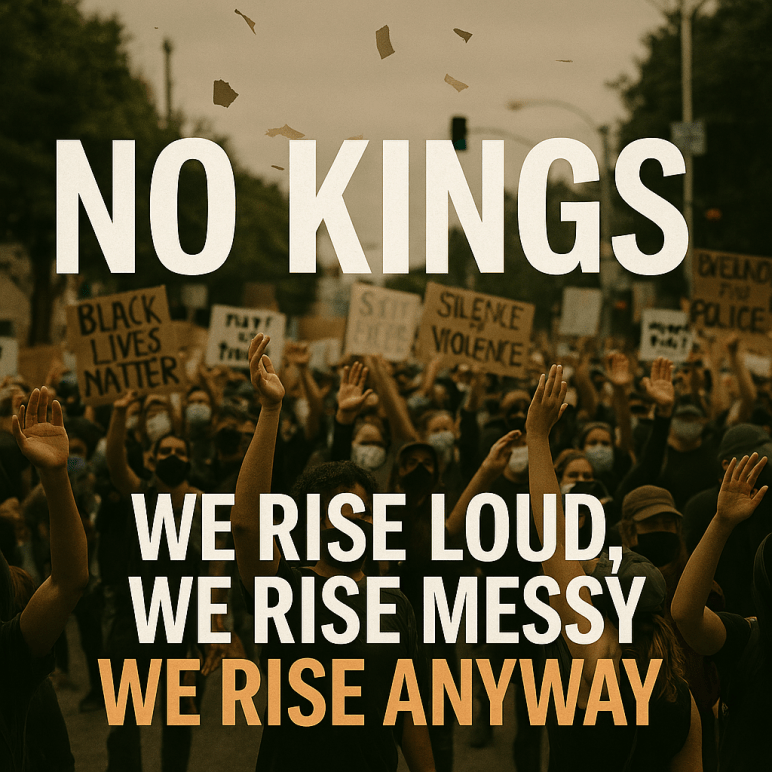
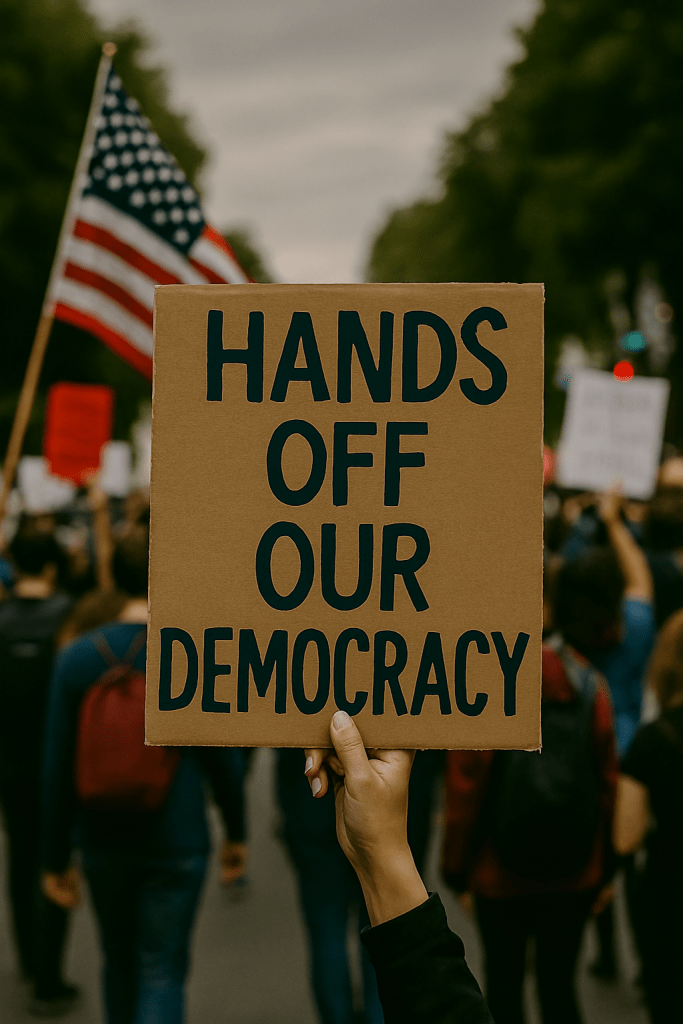
Light the charcoal, because apparently the nation has decided we’re doing this again. Another No Kings Protest. Another day where half the country shows up with handmade signs. The other half shows up with folding chairs, and everyone collectively agrees that monarchy is for fairy tales, not for a country where we can’t even agree on how to pronounce “pecan.”
I woke up this morning to the sound of my neighbor yelling, “Who took my sharpie?!” Which is how you know democracy is alive and well in the Deep South. Nothing says civic engagement like a grown man in pajama pants sprinting across the yard holding a poster board that says, “No Crowns, Just Accountability.” Bless it.
Every No Kings protest starts the same way. Someone burns the first batch of hot dogs. Someone else insists they “know a shortcut.” And a third person is already crying because they forgot sunscreen and emotional stability at home. Meanwhile, I’m in the kitchen trying to pack snacks like I’m preparing for a Category 5 hurricane instead of a march. Because if there’s one thing I know about Southern protests, it is that you will get hungry and sweaty. And someone will absolutely try to hand you a pamphlet you did not ask for.
We arrive at the protest. Immediately I’m hit with the smell of sunscreen and determination. And at least three people who definitely pregamed with boxed wine. There’s always one person with a megaphone who has no business having a megaphone. Today it’s a woman named Sheila who keeps yelling, “NO KINGS. NO CROWNS. NO NONSENSE.” Even though she’s wearing a Burger King paper crown she claims is “ironic.” Sure, Sheila. Sure.
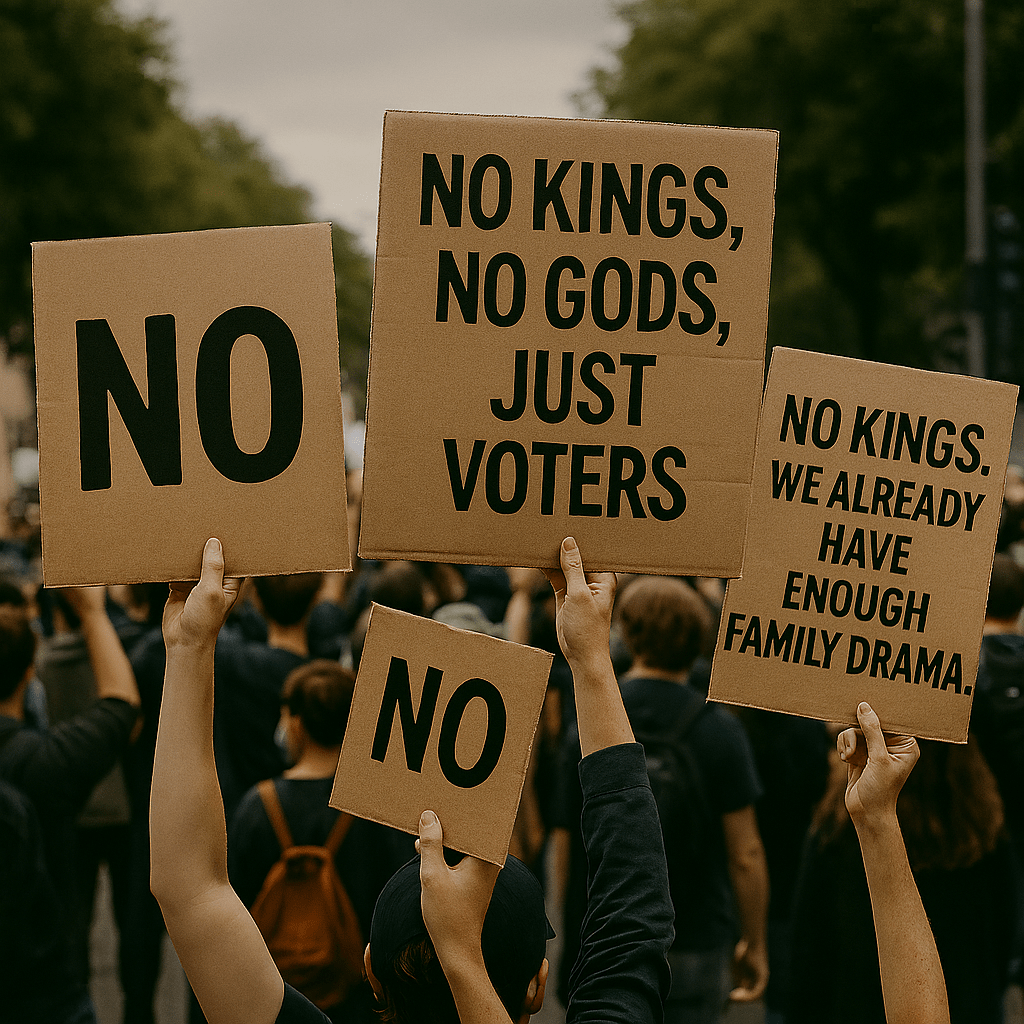
Then there’s the guy who brought a drum. There is always a drum. And he always hits it off‑beat like he’s trying to summon democracy from the dead. But the signs. Oh, the signs. They’re the emotional core of the whole thing:
“NO KINGS. WE ALREADY HAVE ENOUGH FAMILY DRAMA.”
“DEMOCRACY: MESSY BUT MINE.”
“I’M JUST HERE BECAUSE MY THERAPIST SAID, ‘USE YOUR OUTSIDE VOICE.’”
I saw one that said, “NO KINGS. NO GODS. JUST VOTERS.” And I swear I felt my ancestors nod.
Somewhere between the chanting, sweating and the existential dread, it hits me. We’re not out here because it’s fun. We’re out here because we’re tired. Tired of being talked over. Tired of being dismissed. Tired of watching people in power act like the rest of us are NPCs in their personal video game.
We’re out here because we know what silence costs. We’re out here because someone has to be loud. We’re out here because our kids deserve better than whatever this political Jenga tower is.
At one point, a man tripped over a cooler and yelled, “This is why we can’t have a king. We can’t even have a cordless microphone.” A toddler held up a sign that said “NO” because that’s all they could write. And honestly it was the most accurate message of the day. When the wind blew everyone’s posters backward, we all looked like we were protesting ourselves. Which honestly felt spiritually correct. There is nothing quite as unintentionally hilarious as a conservative Christian explaining the world to you with the confidence of someone who has never once questioned their own Wi‑Fi password.
These are the same folks who will look you dead in the eye and say things like:
“We don’t believe in kings.” While simultaneously worshipping any man with a microphone and a Bible verse taped to his podium.
“We’re persecuted.” While standing in a Hobby Lobby the size of a small airport.
“We’re just defending traditional values.” Which apparently include casseroles, judgment, and pretending not to see their own family drama.
They say it all with the sincerity of a toddler handing you a drawing of a dinosaur that looks like a potato. They mean well. They just don’t land the plane.
My personal favorite is when they try to explain why they’re against something they’ve never actually experienced. “You know, I just don’t agree with that lifestyle.” Which lifestyle, Brenda? The one you saw on a Facebook meme posted by a woman named “Patriots4Jesus1776?” Or the one you’ve never actually talked to a real human about?
And then there’s the classic, “I’m not judging, I’m just saying.” If you have to announce you’re not judging, you’re already halfway to the potluck with a casserole dish full of judgment and shredded cheese.
But the funniest part that makes me laugh so hard I need to sit down is how they always think they’re delivering some profound truth. Like they’re dropping wisdom from Mount Sinai when really they’re just repeating something their cousin Earl said at Thanksgiving between bites of deviled eggs.
So, here’s the thing, y’all. We don’t need crowns. We don’t need thrones. And we sure don’t need anybody trying to cosplay as royalty in a country that can barely keep the Wi‑Fi stable during a thunderstorm. We’ve got our voices. We’ve got our people. We’ve got our stubborn, sweaty, snack‑powered determination. And if anybody’s still confused about where we stand? We stand right here loud. Unbothered. Unbowed. And reminding the nation that the only thing we kneel for is tying our shoes.
By the end of the day, my feet hurt. And my soul felt like it had been wrung out like a dish rag. But the charcoal was still warm. The people were still loud. And the message was still clear. No kings. No crowns. No giving up.
We may be messy, sweaty, snack‑dependent chaos gremlins. But we show up. We show up for each other. We show up for the future. We show up because silence is a luxury we don’t have. And we’ll keep showing up with charcoal lit. Signs crooked. Hearts wide open until the message sticks.
We joke about protesting like it’s America’s new weekend sport. But the truth underneath isn’t funny at all. We’re living through corruption stacked sky‑high. Child‑abuse coverups that should’ve shattered entire systems. Foreign intelligence games happening in plain sight. ICE acting like a secret police force. Free speech under attack. Minority communities scapegoated on repeat. Billionaires treating democracy like a clearance sale. And someone out here fantasizing about the East Wing like it’s a tyrant starter kit.
And the loudest danger of all is White Nationalism. It’s cruelty dressed up as Christianity. Cheered on by conservative Christians who swear it’s holy because someone slapped Jesus’ name on it. We laugh to stay human. But we protest because the danger is real. Thanks for reading! There Are No Kings In America!
Affirmation: Today I stand loud, steady, and unshakeable. I honor my voice, my boundaries, and my fire. I refuse to shrink for anyone who benefits from my silence. I rise because I can, and I keep rising because I’m built for more than fear.
“I don’t raise my voice because I’m angry. I raise it because whispering never changed a damn thing except how fast people ignore you.”
-This Puzzled Life
Light the charcoal. Let it crackle like it knows the truth is about to get told. Let the smoke rise slowly and dramatic, the way my ancestors intended. Curling through the room like it’s searching for the lies we’re about to burn out. This is the moment where the air shifts, the spirits lean in, and even the cats pause mid‑chaos because they know Mama’s about to say something real. This is my “brace yourself, I’m done being polite” announcement to the universe. It’s the Southern version of rolling up your sleeves. Except with more sage, more attitude, and a whole lot more intention. When that charcoal glows, so do I. And whatever truth I’ve been holding in my chest finally gets permission to walk out the front door like it pays rent.
I write the way I live. Loud enough to be heard, honest enough to be felt, and Southern enough to confuse anyone who’s never survived a family reunion with both potato‑salad politics and generational trauma. I stand up and speak out because silence never saved me. And it sure as hell never protected the people I love. So, if you’re here for polite whispers, bless your heart. But if you’re here for truth with humor, grit, and a little Holy‑Ghost side‑eye, pull up a chair. You’re in the right place.
I’ve been asked many times, “Why Do I Stand Up And Speak Out?” And here’s my explanation. There’s a moment in every Southern woman’s life when she realizes she has two choices:
Sit quietly and let the world run wild with foolishness.
Or stand up, speak out, and let the church fans flutter in shock.
I chose the second one. Mainly because the first option has never worked for me a day in my life. I didn’t grow up planning to be “the outspoken one.” I was raised in the Deep South, where you’re expected to smile politely, keep your voice at a respectable whisper, and only speak your truth if it fits neatly between a cobbler and a prayer request. But life has a way of handing you a microphone when you least expect it. It’s usually right after you’ve sworn you’re done talking. So, here’s the truth I carry deep in my bones. I was that child who screamed in silence that no one heard.
And now? I stand up for those who don’t have the power to stand up. Or who have been intimidated into swallowing their truths whole. I will absolutely be a voice for Immigrants, LGBTQIA+ (my home group), Native Americans, Canada, Venezuela, Mexico, Greenland, Venezuelan fishermen, Gazans, the homeless, the victimized, Black and Brown communities, and anyone who needs support through solidarity. I can’t get away from this calling because I will always stand up against tyranny, crimes against children, religious scapegoating, hypocrisy, racism, and oppression. And especially here in the South, where silence is expected and resistance is treated like a character flaw.
But I am not built for quiet compliance. I have never been. I speak out because silence never saved me. Silence never protected me or my kids. Silence never made the world kinder. Silence protected the perpetrators with fragile egos and made the wrong people louder. And Lord knows the wrong people do not need a volume boost. Their voice is almost as big as their unfinished golden ballroom. Their headquarters are located at 1600 Pennsylvania Ave.
I stand up because I’ve lived through enough chaos to qualify for a punch card. After your tenth traumatic event, you should legally get a free smoothie or something. But instead, I got a voice. And the realization that if I don’t use it, someone else will use theirs to rewrite my story in a way that makes them comfortable. Absolutely not.
I was forced as a child to watch adults do absolutely nothing about the abuse they knew was happening. They didn’t want to “rock the boat.” They didn’t want to challenge the system. They didn’t want to stand up for what was right. They stood up for what was popular. What was convenient. And what kept the illusion intact. And while they protected their comfort, I was left to protect myself.
As a child, my only way to survive was by fighting back. Not just against the adults who caused the harm. But also, against the complicit bystanders who saw everything and chose silence. That kind of abandonment teaches you something. And it is this, “if you don’t stand up for yourself, no one else will.” And that lesson, painful as it was, is exactly why I refuse to be quiet now.
But here’s the part they never planned for. I didn’t stay small. It took years and years to claw my way back to myself. To unlearn the lies. To rebuild a voice that had been broken, bent, and boxed in. To stand in my own truth without shaking. To speak without apologizing. To breathe without asking permission.
For years, my voice wasn’t quiet. It was taken. Stolen by abuse. Smothered by “be nice” expectations. Buried under the weight of family roles I never agreed to play. And when I finally stumbled into adulthood, those lessons didn’t magically disappear. They clung to me like wet clothes, heavy and suffocating, convincing me that silence was survival and shrinking was safety.
I speak out because my kids are watching. I speak out because my community deserves better. I speak out because our nation can do better. I speak out because my cats already assume I run the world, and honestly, who am I to disappoint them. But mostly, I speak out because my voice is not a liability. It’s a legacy. A tool. A torch. A refusal to let the world slide backward while I sit politely on the porch pretending not to notice. I speak out because I know what it feels like to be unheard. And I refuse to let anyone else sit in that silence alone.
So let the world adjust its volume, because I’m done shrinking to fit inside anyone’s comfort zone. I was born with a backbone. I earned this voice. And I’m using it whether the room is ready or not. If standing up makes some folks uncomfortable, they can go ahead and shift in their seats. I’m not sitting back down. This is my line in the sand, my truth on full display, and my promise carved in stone. I will not be silent, I will not be small, and I will not stop.
I have learned the beauty and the necessity of boundaries. I am absolutely, unequivocally, and in no universe responsible for anyone else’s feelings about my truth, my choices, or my existence. I was raised to believe that people‑pleasing was practically a family requirement. And that we should disguise what was really going on for fear someone might realize our family wasn’t the picture‑perfect postcard we pretended to be. But those lessons didn’t protect me. They imprisoned me. And to feel strong enough, grounded enough, and whole enough to speak my truth after being silenced for so long is a miracle in itself.
But once I broke free from the expectations, the abuse, and the boundary‑less people who benefitted from my quiet suffering, something in me locked into place. I will never be silenced again. Not for family. Not for comfort. Not for tradition. Not for anyone. I earned this voice. I fought for this voice. And now that I have it back, I’m using it. Loudly, clearly, and without hesitation. Thanks for reading! And stand up.
Affirmation: My voice is not too much. It is exactly enough and it was built to be heard.
“Some stories break you. Some stories change you. And some stories demand you stand up, speak up, and refuse to look away. Renee Nicole Good deserved to grow old.”
— Dana, This Puzzled Life
Light the charcoal. Sprinkle the sage. Negative energy go away. Today’s story is heavy, holy, and heartbreaking. And it deserves to be told without flinching.
There are moments when the world tilts. Moments when a headline hits you in the chest because you know this isn’t just news. This is someone’s daughter. Someone’s mother. Someone who laughed, cried, loved, lived, and deserved to grow old.
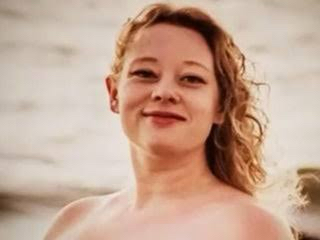
And this time, her name was Renee Nicole Good. She was a 37‑year‑old mother of three who was shot and killed by an ICE agent in Minneapolis on January 7, 2026, as reported by CBS News and NBC News. She was unarmed. She was shot three times including once in the head. And it was the wound that killed her according to the Hennepin County Medical Examiner’s report, cited by MPR News.
I didn’t know Renee personally. But I know the shape of injustice. I know the sound of a system cracking under its own weight. I know what it feels like to be trapped in a place where the people with power insist they’re “keeping you safe” while your body tells you otherwise.
When I read about Renee and about how the fatal shot was to her head. And about how the agent claimed “self‑defense,” about how the body‑camera footage released by ICE shows her backing away when the shots were fired. I felt that familiar ache. The one that says, This should not have happened. The one that says, This keeps happening. The one that says, How many more?
The world saw the moment she died. Millions watched the video, replayed it, argued about it. But Renee was more than the last seconds of her life. She was a whole human being. She was a mother. A woman trying to survive. Someone who deserved to be seen in her fullness. And not just her final frame. Another woman gone. Another family shattered. Another official statement claiming “self‑defense,” as reported by The Associated Press. Another community calling bullshit.
I’ve spent enough time in psychiatric, legal, and medical systems to know how quickly institutions protect themselves. How fast the narrative shifts. How easily a person becomes a problem instead of a person. But Renee wasn’t a problem. She was a life.
When I say her name, Renee Nicole Good, I feel the heaviness of it. The way a name becomes a headline. The way a headline becomes a debate. And the way a debate becomes noise. But behind that noise is a family who will never be the same. Children who will grow up with a before and after. A community that will remember the day everything changed.
And I think about how often marginalized people are told to “comply,” “calm down,” “cooperate,” “not escalate,” “not resist,” “not move,” “not breathe wrong.” And still they die. Grief like this doesn’t fade when the headlines do. It lingers. It haunts. It becomes part of the landscape of a community. And it should. Forgetting is how injustice survives.
Renee deserves better than to be forgotten. She deserves better than to be reduced to a political talking point. She deserves better than to be a momentary outrage. She deserves to be remembered as a woman whose life mattered.
When I read that her death was ruled a homicide, even if the system refuses to call it a crime, I felt that familiar sting. The one that says, We see what happened. We just refuse to name it. And when I read that she was unarmed. And that she posed no threat, and that the fatal shot was to her head, I felt the anger rise. Not the wild, chaotic anger. The quiet kind. The kind that sits in your chest like a stone. The kind that says, This is not justice. This is not safety. This is not okay.
I don’t have a neat ending for this. There isn’t one. But I can say this, Renee, your life mattered. Your story matters. Your name will not be swallowed by the noise. To her family, I am holding you in the softest part of my heart. To her children, I hope the world becomes gentler for you than it was for your mother. To her community, keep speaking, keep fighting, keep remembering. And to anyone reading this who feels the weight of it, you’re not imagining it. You’re not overreacting. You’re not alone.
Some stories demand to be told. Some losses demand to be honored. Some names demand to be spoken. Renee Nicole Good. We see you. We remember you. We will not look away. Thanks for reading! And from the bottom of my heart I say, “Fuck ICE!”
Affirmation: I honor Renee by telling the truth, holding the grief, and refusing to let her name fade.