

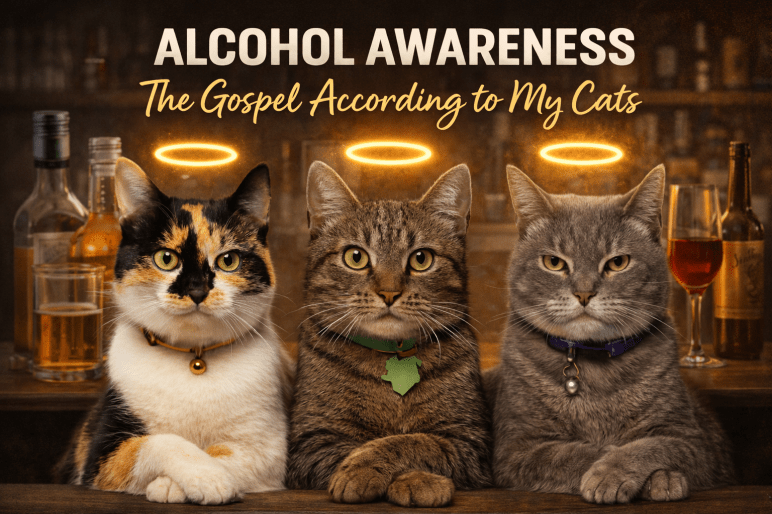
Alcohol Awareness: The Gospel According to My Cats

“Awareness saves lives. Snacks save morale.”

-The Feline Public Health Department

Light the sage. Hide the breakables. My three cats, Piper, Coco, and Tinkerbell, have decided they are the official spokes‑animals for Alcohol Awareness. And they came prepared with statistics.

They just held a household meeting complete with a gavel, a flip chart, and Coco eating the pointer. And they are about to inform me that we are now hosting Alcohol Awareness Week. I didn’t volunteer. I wasn’t consulted. Piper simply slapped a pamphlet on the table like she was serving a warrant and said, “Mother, it’s Alcohol Awareness time, and the people need us.” If anyone can talk about risky behavior, it’s the animals who sprint across linoleum floors at 3 a.m. like they’re late for a rave.
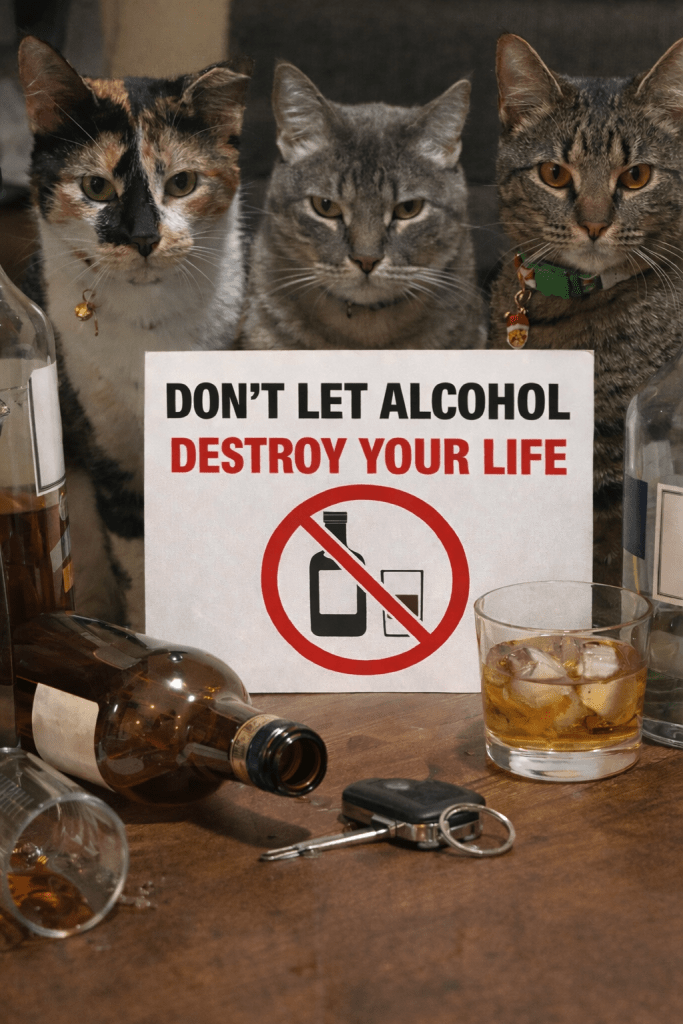
Piper jumps onto the table like she’s chairing a congressional hearing.

“Mother, while adjusting her imaginary glasses, did you know more than half of adults in the U.S. drink alcohol? And 17% binge drink?” She pauses for dramatic effect. “That means 17% of humans are out here acting like me when I see an unattended plate of chicken. Also, 178,000 people die each year from excessive alcohol use. That’s more than the number of times Coco has tried to steal your snacks.”  Source: CDC — Excessive Alcohol Use Data 

Coco waddles in dragging a bag of treats like she’s smuggling contraband.

“Listen, I’m here to talk about underage drinking. But first, do we have chips? Because this is heavy.” She informs the room that in 2022, 5.9 million youth ages 12–20 drank alcohol beyond ‘just a few sips’. Mother, that’s too many. Even I know that. And 19.7% of youth ages 14–15 have had at least one drink. At that age, I was still learning how to jump on the counter.” Source: NSDUH / Alcohol Infographic 2024 

Tinkerbell perches on the highest shelf, looking like she’s about to assign homework.

“Research shows that people who start drinking before age 15 are 3.5 times more likely to develop alcohol use disorder later in life. Which is why I supervise the boys. They need guidance. And boundaries. And fewer snacks.” Source: Alcohol Infographic 2024 

This household stays loud, proud, and educational, the cats insisted on adding:

  • Alcohol misuse affects every organ in the body. Source: NIAAA Alcohol Facts & Statistics 
  • Underage drinking remains a major public health issue. Source: NSDUH 2024 / SAMHSA 
  • Accurate, stigma‑free information saves lives. Especially in LGBTQIA+ communities and the Deep South. Where misinformation spreads faster than Piper can knock over a cup.

Piper: “Moderation is key. Also, naps solve more problems than alcohol ever will.”

Coco: “Alcohol slows reaction time. I cannot risk missing a falling snack.”

Tinkerbell: “Knowledge is power. And power is knowing where the treats are hidden.”

Piper stands on her hind legs like she’s giving a TED Talk.

Piper: “Stay informed. Stay safe. And stop believing your cousin’s Facebook posts.”

Coco: “Stay hydrated. Preferably with water. Or gravy.”

Tinkerbell: “Stay fabulous. And for the love of all things holy, lock the liquor cabinet.”

Piper, Coco, and Tinkerbell gather themselves on the couch like a furry Supreme Court. And ready to issue a ruling on the family hypocrisy they’ve witnessed for years. Piper clears her throat first, because of course she does. “Mother, we simply cannot understand how certain humans in this family will clutch their pearls over you using medical cannabis. A literal plant. But somehow quote the Bible like it’s a coupon code to excuse drinking and driving, and every chaotic decision that would get us grounded for nine lifetimes.”

Coco nods solemnly with crumbs on her chin, “They called you a ‘druggie,’ but then hopped in the car after communion wine like Jesus Himself was the designated driver.”

And Tinkerbell, perched high like a judgmental librarian, adds, “If scripture can be stretched far enough to justify a DUI, then surely it can handle a little THC for pain relief. We’re cats, Mother, but even we know the math isn’t mathing.”

And that’s how my cats continue to point out and educate on the dangers of alcohol. And the hardcore hypocrisy in the south. And, yes, specifically in my own family. Thanks for reading! And never let them silence you.

Affirmation: I honor my body, my boundaries, and my community by choosing knowledge over shame.

***Don’t forget to watch the video!***

#ThisPuzzledLife

Veteran Suicide

“The soldier above all others prays for peace, for it is the soldier who must suffer and bear the deepest wounds and scars of war.

-Douglas McArthur

Light the charcoal. Sprinkle the sage. Negativity energy, go away. Today, I want to discuss veteran suicide. I know that this topic has seemed to get old and fast. However, I believe that the more we talk about the harshness of life, the more the stigmas will begin to disappear.

In 2022, the most recent year for the current data, 6,407 veterans and 41,484 nonveteran adults died by suicide. The rate among veterans was 34.7 per 100,000 compared to 17.1 per 100,000 for nonveterans. Since 2005, veteran suicide has risen faster than any other group. And these rates are unacceptable.

The veterans who died by suicide in that year, 40% were under the care of the Veterans Health Administration. Among those patients, who were also diagnosed with a mental health disorder or substance abuse disorder, there were 56.4 per 100,000, which was twice the rate of those without a diagnosis. And among 1,548 veterans who died by suicide 64% were diagnosed with depression, 43% had an anxiety disorder, 40% had PTSD, and 32% had an alcohol use disorder. However, the highest suicide rates were associated with veterans who had sedative use disorder which include benzodiazepines, barbiturates, and opiates (www.rand.org, 2025). And the stigma about mental health in the military further increase this problem.

Aspects of Veteran Mental Health stigma:

·       Fear of judgment and perception:  Veterans worry about how seeking help will affect all areas of their lives and especially on career repercussions.

·       Military culture: The “warrior ethos” which emphasizes self-reliance and stoicism create barriers to seeking help.

·       Loss of security clearance: Some fear that seeking mental health treatment will lead to revocation of security clearances.

·       Impact on treatment: stigmas can lead to untreated mental health conditions, substance abuse and increased risk of suicide.

·       Self-stigma: Veterans may internalize negative societal views about mental health which can lead to shame, self-blame, and more reluctance to seek help (https://oxfordtreatment.com, 2025).

As an advocate for medical cannabis, I believe that our veterans should be given an ounce of cannabis the minute their feet hit US soil upon returning from active duty. As I personally deal with PTSD, there is not another medication on the planet that can bring me relief like cannabis can. And it’s such a safer alternative to alcohol, opiates, and benzodiazepine medications.

Currently,  the Safe Healing Act, which was introduced on February 4, 2025,  is designed to prohibit the Secretary of Veterans Affairs from denying a veteran benefit administered by the Secretary by reason of the veteran  participating in a State-approved marijuana program and other purposes. But unfortunately, there is only a 3% chance of being enacted (www.govtrack.us, 2025). And I consider this utterly ridiculous. There is an unmistakable problem with veteran suicide. It appears Big Pharma is still in the way of progress. I wonder how many people who oppose this bill must suffer, daily, with the horrible effects of PTSD, anxiety, and chronic pain that “Big Pharma” can’t seem to help?

Our returning soldiers are faced with horrors that no one understands until they’ve been there. And though I have never served our country, I can tell you that the above-mentioned mental health disorders have also almost taken my life many times. The symptoms are horrific in nature. Put chronic pain in the mix and suicide often seems like the only answer to have a break, though it be permanent, for even a moment of peace.

Veterans, in my eyes, should be held to the utmost respect. They should be the highest paid employees before professional athletes. And we as a country should make sure that the best treatment is available to them for the rest of their lives. Some have paid the price of their lives on the battlefield. And a high percentage of others pay with their lives when they return home. But instead of treating them like the heroes like they are, they are often discarded by the government that they so proudly serve. 

Is cannabis the only answer? Not at all. However, while they find the modality that works for them, I think that cannabis could lighten the load and make their futures seem a little brighter. Discarding them along with all the judgmental stigmas only adds to the problem. And until this is rectified, we will continue to lose those beautiful people who are willing, at any moment, to lay down their lives for our freedoms. Shame on the United States of America for treating them like that!

I know reading this is not easy. But we as a nation must stand up for these individuals who continue to pay the price every time, they open their eyes. Let’s get past the “reefer madness” ignorance and allow our veterans the opportunity to extend their lives at home. A special thanks and salute to one of my favorite veterans who I’ll call Joe. Thanks for reading! And God Bless America!

Affirmation: Bring out your inner warrior

***Don’t forget to watch the video!***

#Thispuzzledlife