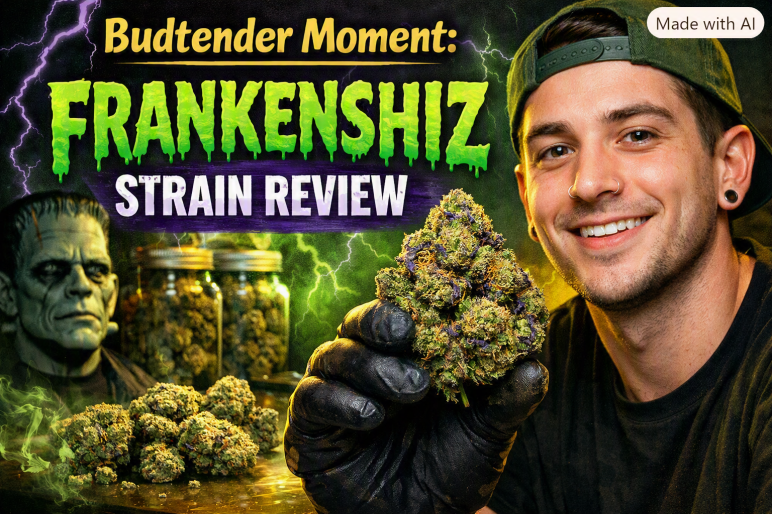


Budtender Moment: Leprechaun Larry Strain Review

“The plant teaches patience, presence, and perspective.”

-Unknown

Light the charcoal. Sprinkle the sage. Negative energy go away. Today, I want to tell you about a strain that is all about St. Patty’s Day. And it is called Leprechaun Larry.

Leprechaun Larry is sativa-dominant hybrid. It is a cross between Larry OG x Green Crack. Larry OG is a cross between OG Kush x SFV OG (San Fernando Valley OG). Green Crack is a cross between Skunk #1 x Afghani genetics. The taste profile consists of citrus peel, sweet herbs, and pine. This is a strain’s taste profile is one  that I have a difficult time of differentiating.

The top terpenes in this strain are Limonene, Terpinolene, and Pinene. Patients report experiencing better focus and creativity. And less stress, depression, mood swings, chronic fatigue, and ADD/ADHD. Make sure that you’re in a stable place with your anxiety before using this strain. Because it will definitely give you some pep in your step or a panic attack. Please keep in mind that each grow will be different and the flower effects, terpenes and genetics will differ depending on which region of the country that the plant is grown. Thanks for reading! Keep blazin.’

Affirmation: In this moment, I am safe, grounded, and enough.

***Don’t forget to watch the video!***

#Thispuzzledlife

Sexual Assault Awareness: I Survived. Now I Speak. 

“I am not the sum of what was done to me. I am the proof that even in the places where humanity failed, my spirit refused to.”

-This Puzzled Life

Light the charcoal. Sprinkle the sage. Today, I’m going to talk about sexual assault. Religious betrayal. And the kind of generational silence that tries to swallow whole communities. We might as well start with a cleansing. Lord knows the air gets thick when truth finally walks into the room.

There are some topics into which you don’t ease. You cannonball straight in. Bless your heart and everyone else’s. Sexual Assault Awareness is one of them. And if you grew up anywhere near the Deep South like I did, you know we were raised on two things casseroles and silence. One of those is delicious. The other is deadly. So today, we’re breaking the generational habit of whispering about the things that actually need megaphones. Let’s start with the part that makes people shift in their seats like they’re sitting on a church pew with a splinter.

These aren’t “somewhere out there” numbers. These are “in your neighborhood, in your school, in your family, in your church, and in your workplace” numbers. And if that makes you uncomfortable, good. Discomfort is the first sign your moral compass still works.

Survivors are people who still show up to work. Raise kids. Laugh at memes. And try to remember where they put their keys. They’re not broken. They’re exhausted from carrying what should’ve never been theirs to hold. And if you’re a survivor reading this, let me say this plainly. You are not the shame. You are the evidence that harm can be done and still not win. The shame belongs with the perpetrator.

Now, I’m not talking about making light of this kind of crime. That’s not humor. That’s cruelty with a punchline. I’m talking about the kind of humor survivors use to stay alive. The kind that says, “I’ve been through hell. But I still have jokes. So clearly hell didn’t win.” It’s the same humor Southern aunties use when they say things like, “We don’t air our dirty laundry.” While standing in front of a clothesline full of secrets flapping in the wind. Humor is a pressure valve. It lets us breathe while we talk about the things that steal breath.

If someone trusts you enough to tell you they were assaulted, here’s your script. “I’m so sorry that happened,” “I believe you” and “How can I support you right now?” Notice what’s missing? Questions that sound like cross examinations. Advice no one asked for. And any sentence beginning with “Why didn’t you…?” Survivors don’t need detectives. They need validation that the abuse happened and that it wasn’t their fault in any way.

Sexual abuse cases in the U.S. justice system have increased by 62.5% since 2020. Yet the vast majority of survivors never see justice at all. And before anyone says “Well, reporting is easy.” Let me remind you. If reporting were easy, we wouldn’t have a national hotline that stays busy 24/7.

People who’ve lived through abuse, especially abuse justified with moral or religious language, tend to recognize certain dynamics instantly. Power used without accountability. Authority figures protecting each other instead of the vulnerable. Moral language used as a shield for harmful behavior. Gaslighting and denial when confronted with wrongdoing. Silencing or discrediting those who speak up through threats and intimidation. And systems that reward loyalty over truth.

These patterns show up in many places like churches, marriages, schools, corporations, and yes, in government. Survivors often have the clearest radar for institutional betrayal. Because they’ve lived it in the most intimate way possible. When you look at the world and say, “This feels familiar.” That’s not paranoia. That’s pattern recognition born from experience.

I grew up in a world where people could quote scripture faster than they could show compassion. Where pastors’ children could harm a five‑year‑old and still be called “good families.” And where a husband could twist the Bible into a weapon and call it marriage. I know what it feels like to be violated in Jesus’ name. I know what it feels like to be told your body is a man’s property. I know what it feels like when resistance is met with punishment. When silence is demanded. And when trauma is treated like an inconvenience.

Trump said of rape victim E. Jean Carroll “she loved it!” But he also said he didn’t know her. About 29:10 is where he says this. Watch the whole thing and tell me why you think victims don’t come out sooner. This is the way that abusers keep their victims in fear for years. Mine did the same thing.

After a lifetime of being told to stay quiet when people in power start using God, morality, or “order” as a shield, it’s never about holiness. It’s about control. I’ve lived under that kind of control. I’ve survived it. I know exactly what it looks like when someone wraps abuse in scripture and calls it righteousness. So, when I see institutions using the same tactics, same silencing, same moral posturing to protect themselves instead of the people they harm, I don’t need a press release to tell me what’s going on. Survivors recognize the pattern long before the headlines catch up.

What do we do? We talk. We teach. We intervene. We stop pretending this is a “women’s issue” or a “men’s issue” or a “kids these days” issue. It’s a human issue. We raise kids who know consent isn’t a suggestion. We raise adults who know silence is complicity. We raise communities where survivors don’t have to choose between telling the truth and keeping the peace.

And at the end of the day, the pattern speaks louder than any press conference ever could. The world watched as Jeffrey Epstein’s name kept resurfacing in court documents, flight logs, and survivor testimony. The world also watched as questions piled up about who knew what, who looked away, and who benefited from the silence. People aren’t asking these questions because they’re bored. They’re asking because the public record is full of smoke. And every time someone tries to follow it, another door slams shut.

If the Trump administration thought history would politely avert its eyes, they miscalculated. Survivors don’t forget. Journalists don’t forget. The internet definitely doesn’t forget. And the truth has a funny habit of surviving every cover‑up attempt. Because eventually, the receipts outlast the people who hoped we’d stop reading them.

And to my fellow survivors, you are not alone. You are not to blame. You are not too much. You are a whole person with a whole story. And the world is better because you’re still here to tell it. And if anyone tries to silence you, just remember. You come from a long line of people who know how to make noise when it matters.

After the childhood abuse, the marital rape, the spiritual manipulation, the PTSD that still echoes through my bones. I’ve learned something important. Abuse doesn’t just happen in homes and churches. It happens anywhere power goes unchecked. So, if you hear a familiar pattern in the way certain institutions operate today, you’re not imagining it. 

Once you’ve lived through the kind of darkness that tries to disguise itself as divine, you stop being intimidated by titles, pulpits, or podiums. You stop mistaking authority for integrity. And you stop believing that silence is the price of peace. If your power depends on someone else’s silence, it’s not leadership. It’s abuse with better lighting. And survivors like me aren’t afraid of the dark anymore. Thanks for reading! And never let them silence you.

Affirmation: I honor the child I was, the survivor I became, and the woman I am now. My voice is not fragile. It is forged. My healing is not a question. It is a declaration. I rise today not because the past was gentle, but because I am.

***Don’t forget to watch the video!***

#ThisPuzzledLife

Part 2: Stretching Your Stash Because Symptoms Don’t Wait for Payday

“Healing on a budget isn’t a struggle. It’s a skill set. And baby, I’m out here coupon clipping my way to peace.”

-This Puzzled Life

 Welcome to Part 2 of the Frugal Stoner’s Guide. It’s where we stretch cannabis like it’s Sunday dinner and make every milligram count. Because let’s be honest. The only thing worse than symptoms is symptoms and being broke. Grab your snacks, your sense of humor, and whatever dignity you have left after your last edible incident. We’re diving in.

7. Download Weedmaps

This app shows you what’s available in your area. It’s basically the GPS of cannabis minus the judgment.

8. Check Dispensary Websites for Sales

Refresh those menus like you’re stalking Black Friday deals. 30–50% off is common, and your wallet will thank you.

9. Stock Up During Cannabis Holidays

420, 7/11, and 11/30 are the holy trinity of cannabis sales. Save your points. Save your money. Save your sanity.

10. Attend Cannabis Events

Companies hand out free goodies depending on state laws. They give out things such as rolling trays, shirts, lighters, stickers. Plus, you get to talk to reps and other patients who will gladly tell you what worked for them and what sent them to the shadow realm.

11. Learn Which Products Work for Your Condition

Edibles are great for stomach issues or smoke‑free situations. But dosing? Oh, honey. Dosing is a journey. Do NOT take the whole edible at once. I did that once. Forty‑five minutes later, I was locked into the couch for 16 hours and spiritually misplaced my own butt. Start small. Wait an hour. Never say, “This is weak.” That phrase has ruined many lives.

12. Concentrates for Breakthrough Symptoms

Concentrates are discreet, fast‑acting, and don’t cling to your clothes like flower. If someone claims they can smell it, they’re lying or dramatic. Unless you blow vapor directly into someone’s face, they won’t smell a thing.

13. Distillate vs. Rosin

  • Distillate: fast, strong, short‑lived
  • Rosin/resin: full plant, longer‑lasting, more therapeutic

Symptoms don’t wait for convenient moments. That’s why I always keep a device with me.

14. Shake: The Budget Hero

Shake is the clearance rack of cannabis. It’s  not pretty, but still powerful. Smoke it, cook with it, infuse it. It’s the best bang for your buck.

At the end of the day, medical cannabis shouldn’t feel like a luxury purchase you have to whisper about at the register. It should feel accessible, doable, and like the relief your body has been begging for. And not a financial jump scare. Stretch your dollars like leftover cornbread. And ignore anyone who reacts to your medication like you just announced you’re joining a biker gang. This plant is helping people reclaim their lives, their peace, and their sanity every single day. And if someone doesn’t like it? Tell them to take it up with your symptom relief, because that’s the only thing making decisions around here. Budget smart. Medicate boldly. Live unbothered. Thanks for reading! Keep blazin.’ 

Affirmation: I honor my body, my limits, and my bank account. I deserve relief that fits my life, my budget, and my joy.”

***Don’t forget to watch the video!***

#ThisPuzzledLife

Budtender Moment: OG Kush Strain Review

“If you can’t remember my name, just call me ‘indica,’ I’ll still put you down.”

-Unknown

Light the charcoal. Sprinkle the sage. Negative energy go away. Today, I want to tell you about another strain that when you talk about cannabis this strain will likely be discussed. And it’s the classic and very wonderful OG Kush strain.

OG Kush is an 80/20 indica-dominant hybrid strain. It’s a cross between Chemdawg x Lemon Thai x Hindu Kush. Chemdawg is believed to be from Thai and Nepalese landrace strains. However, the exact lineage is unknown. And it’s also said to originate from bag seed found at a  Grateful Dead concert in the 90s. Lemon Thai is a cross between a classic Thai landrace strain. And it’s crossed by Dutch Flowers x Hawaiian sativa. Hindu Kush is a landrace strain from the Hindu mountain range. This strains origins start in Florida. The “OG” is sometimes called “Original Gangster, “ “Ocean Grown” or “Original Grower.” And it’s known to be a foundational strain. Matt “Bubba” Berger cultivated the strain from an accidental cross involving Lemon Thai x Chemdawg. Berger then brought the genetics to Los Angeles in 1996. Josh Del Rosso refined its cultivation and distribution thereby solidifying its legendary status.

Top terpenes in this strain are Myrcene, Limonene, Caryophyllene, Linalool, and Pinene. Patients report relief from stress, anxiety, chronic pain, insomnia, depression, and appetite loss. This strain is perfect for breakthrough pain. This strain is perfect for breakthrough pain. “Couchlock” is readily available even without being asked. So not one to use during the day unless you have time for the effects to wear off before doing an activity. Oh, and keep the Cheetos available for mass consumption. Please keep in mind that each grow will be different and the flower’s effects will differ depending on which region of the country that the plant is grown. Thanks for reading! Keep blazin.’

Affirmation: The plant guides me toward clarity, not escape.

***Don’t forget to watch the video!***

#Thispuzzledlife

Medical Cannabis on a Budget: My Wallet Said ‘Girl, Be Serious.’

“Healing shouldn’t require a credit check. Sometimes the best medicine is the one you can actually afford. And the peace of mind that comes with it.”

-This Puzzled Life

Light the charcoal. Sprinkle the sage. Let’s go ahead and address the elephant in the dispensary. Medical cannabis is healing, holy, and helpful. But the prices? The prices are giving “Are you sure you don’t want to just suffer instead?” energy. I walked in once, saw the total, and my debit card tried to crawl out of my wallet like, “Absolutely not, ma’am. I was not built for this.”

But here’s the truth. Nobody should choose between relief and rent. Nobody should be out here raw‑dogging life because the dispensary menu looks like a luxury steakhouse. So today, we’re talking about how to medicate on a budget without selling plasma, pawning your air fryer, or pretending you suddenly love CBD-only gummies. Grab your spreadsheet, your sense of humor, and whatever dignity you have left after your last edible incident. Because we’re going in.

For those of us who need this medication, sometimes the prices can be overwhelming. But no one should miss out on the opportunity to heal with natural medications because of money. And getting into the cannabis lifestyle can be overwhelming on this life adventure. I have been a cannabis patient for many years. And here are some of the things that have proven to be advantageous while feeling my way through the industry.

1. If People Judge You, Let Them Judge From Over There

If you have conservative friends or family who condemn you for using this medication, go ahead and create some distance. Their comments are rooted in outdated propaganda and vibes from the “Reefer Madness” era. You don’t need that energy. You need relief.

2. Find a Budtender and Let Them Teach You

When you’re new, find a budtender who knows their stuff. Most of them genuinely understand the products and can help you figure out what works for your symptoms. Think of them as your cannabis tour guide minus the khaki shorts and megaphone.

3. Try Indica, Sativa, and Hybrid. Then Pay Attention

Everyone’s body responds differently. Try all three categories and notice which one helps you the most. This isn’t a personality quiz. This is survival.

4. Make a Spreadsheet Like the Organized Stoner You’re Becoming

Yes, a spreadsheet. Yes, it will save your sanity. Include things like strain name, type (indica, sativa, hybrid), product type (flower, edible, vape, concentrate), lineage, terpenes, effects, brand, dispensary, and your personal notes. After a while, you’ll start seeing patterns. If you like two strains with the same terpenes, chances are you’ll like others with those same terpenes. This is how you stop guessing and start shopping smart.

5. Write Down What You Actually Think

Don’t be shy. Write your honest opinions. Did it help? Did it flop? Did it make you clean your entire house at 2 a.m. or contemplate the meaning of life? Write it down.

6. Start With Prerolls and Rotate Them Like a Pro

Prerolls are budget‑friendly and great for beginners. I keep a rotation because your body adjusts to new strains every 3–4 days. Rotating helps with symptoms and keeps your tolerance from climbing Mount Everest. This saves money and keeps your medication effective.

This type of medical treatment isn’t for everyone, and that’s okay. But for many of us, this plant is saving our lives every single day. As you learn more and grow more comfortable, you can explore fancier tools and devices. All at your own pace and within your financial lane. Healing should feel accessible, empowering, and sustainable. And with the right strategies, it absolutely can be.

At the end of the day, medical cannabis shouldn’t feel like a financial hostage situation. It should feel accessible, empowering, and like the relief you’ve been searching for. And not a punishment for having symptoms on a Tuesday. So, take your time. Learn about your products. Stretch your dollars. And ignore anyone still reacting like the church ladies just spotted a bare ankle about “the Devil’s Lettuce.” This plant is saving lives, easing pain, calming storms, and giving people their quality of life back every single day. And if anyone has a problem with that? Tell them to take it up with your symptom relief, because that’s the only thing running this show. Budget smart. Medicate wisely. Live loudly. Stay tuned for the second part of this blog with more useful information. Thanks for reading! And feel free to ask me any questions.

Affirmation: I honor my body, my budget, and my boundaries. I deserve relief. I deserve clarity. And I can navigate this cannabis journey with confidence, wisdom, and a whole lot of humor.”

***Don’t forget to watch the video!***

#ThisPuzzledLife

Budtender Moment: Runtz Strain Review

“I’m not lazy. I’m on energy‑saving mode.”

-Unknown

Light the charcoal. Sprinkle the sage. Negative energy go away. Today, I want to tell you about a strain that is popular with so many users. It is the omnipotent Runtz strain.

Runtz is a balanced hybrid that is a cross between Zkittlez x Gelato. Zkittlez is a cross between Grape Ape x Grapefruit x Secret Unknown strain. Gelato is a cross between Sunset Sherbet x Thin Mint Girl Scout Cookies. Runtz is known for its candy flavoring. And the sweetness flows through me with each inhale. This is a strain that wasn’t created until 2017 in the Bay Area of California by the “Runtz Crew.” These people include Ray Bama, Nick, and rapper Yung LB. The strain was named Leafly’s “Strain of the Year” in 2020.

Top terpenes in this strain are B-Caryophyllene, Limonene, and Linalool. Patients report relief from pain, inflammation, anxiety, depression, mood swings, insomnia, appetite loss, nausea, low motivation, and fatigue. Please keep in mind that each grow will be different and the flower’s effects will differ depending on which region of the country that the plant is grown. Thanks for reading! Keep blazin.’

Affirmation: My body softens, my mind opens, and my spirit settles.

***Don’t forget to watch the video!***

#Thispuzzledlife

If These Cats Don’t Stop Explaining Weed, I’m Calling Jesus

“If life hands you chaos, season it like cast‑iron and keep on cookin’.”

  -Tinkerbell, Chairwoman of Household Dignity and Selective Judgment

Light the charcoal. Sprinkle the sage. Negative energy go away. Lord knows if we don’t cleanse this house before we start talking, one of these cats is gonna summon something we can’t put back. Piper already knocked over a jar of buttons like she was opening a portal. Coco’s in the kitchen licking cornbread crumbs off the floor like she’s trying to divine the future. And Tinkerbell? She’s perched on the back of the recliner judging everybody like the church usher who knows your business. 

So yes, light the charcoal. Sprinkle the sage. Shoo the foolishness out the door. We’re about to discuss cannabis. And these Deep South cats have opinions they did not ask permission to have.

Piper struts in like she owns the deed to the house. Tail high. Eyes wide. And already judging.

“Why,” she begins, “do half these strains sound like folks we’re related to.” She’s not wrong.

Piper’s Official List of ‘That’s Somebody’s Cousin’ Strains

  • Bubba Kush– “Tell me that ain’t the man who fixed your alternator in 2009.”
  • Larry OG – “Larry still owes Mama twenty dollars.”
  • Billy Kimber – “He’s the one who got banned from the Piggly Wiggly.”
  • Runtz – “That’s the kid who used to steal Capri Suns at Vacation Bible School.”

Piper says cannabis naming committees are clearly run by “men named Scooter who wear camo to funerals.” She ends her segment by knocking over a Mason jar and calling it “cultural commentary.” 

Coco waddles in like she just finished a plate of cornbread and is ready to testify before Congress.

“Listen,” she says, licking crumbs off her chest, “if you name a strain after food, I will assume it’s a snack. That’s on y’all.”

Coco’s Deep South Review of Food Strains

  • Georgia Pie– “Where is the cobbler? Don’t play with me.”
  • Banana Pudding– “If it ain’t layered with Nilla wafers, it’s false advertising.”
  • Gumbo– “This one made me mad on principle.”
  • Watermelon Zkittlez-“This tastes like somebody lied.”

Coco proposes new, more honest Southern strain names such as:

  • “I’m Too High to Go to Walmart”
  • “Front Porch Philosophy Hour”
  • “Who Ate the Last Biscuit”
  • “I Swear I Heard a Ghost in the Hallway”

She ends her speech by stealing a Cheez-It and blaming it on “the humidity.”

Tinkerbell sits like a church lady who’s about to tell you she’s praying for you. But also judging your life.

“These names,” she says, “are for people who think they’re having a spiritual awakening but are actually just staring at the ceiling fan.”

Examples from the Church Bulletin of Weed

  • Northern Lights-“Ma’am, you are in Mississippi. The only lights you’re seeing are from the Dollar General sign.”
  • Skywalker OG – “You are not walking anywhere. Sit down.”
  • God’s Gift -“Bold. Very bold.”
  • Third Eye– “That’s not enlightenment. That’s dehydration.”

Tinkerbell recommends all spiritual strains come with a warning label that reads, “May cause you to think you’ve discovered the meaning of life when you’ve actually just been petting the same blanket for 45 minutes.” She concludes by reminding everyone that she is the only one in this house with dignity. Piper says, “Rename everything. Y’all lack imagination.” Coco says, “Snacks should be included with purchase.” Tinkerbell says, “Please stop embarrassing the household in front of the neighbors.”

And that, is all the wisdom these Mississippi cats have to offer today. And how my cats, three unlicensed, unqualified, deeply Southern creatures, have chosen to explain cannabis strain names. With judgment, crumbs, and the confidence of a possum in a Waffle House parking lot. And even that is hanging by a thread.

Piper’s already stomping off like she’s late for her shift at the Waffle House. Coco has entered her post‑snack coma. And cannot be reached for comment. Tinkerbell is staring out the window like she’s narrating a true‑crime documentary about the rest of us.

As we wrap this up, go on and light the charcoal one more time. Sweep the foolishness out the door. And thank the Lord above that cannabis doesn’t come with a family reunion attached. Because half of these strain names already sound like they’d show up uninvited. Asked for gas money. And leave with your Tupperware.

Until next time, may your weed be smooth. Your snacks be plentiful. And your cats mind their business for at least five consecutive minutes. Amen, Ashe, and y’all behave now. Thanks for reading! Keep blazin.’

Affirmation: I can handle whatever today throws at me. Even if it’s lopsided, underseasoned, or delivered by a cat with an attitude. I stay grounded, I stay Southern, and I stay unbothered.

***Don’t forget to watch the video!***

#ThisPuzzledLife
The Great Depression‑Core Easter Egg Hunt of 2026

“If Jesus can roll away a stone. My cats can certainly chase one.”

-This Puzzled Life

Light the charcoal. Sprinkle the sage. Today’s blog is about the first annual, recession‑sponsored, driveway‑rock Easter egg hunt starring my three cats  Piper, Tinkerbell, and Coco. Each of whom has the confidence of a toddler in a Batman cape. And the budget of a 1930s dust‑bowl farmer.

And trust me, we need the charcoal and the sage. Today’s story requires spiritual reinforcement. Ancestral backup. And maybe a small loan from the universe. We are gathered here not just to celebrate Easter. But to honor a sacred family tradition known as the annual Easter egg hunt that gets cheaper. Stranger. And more geologically focused every single year.

Once upon a time, when eggs were merely expensive instead of mythical artifacts guarded by dragons, we used actual eggs. Then the economy said, “Let’s make this interesting.” And last year we were forced to paint tiny red potatoes like we were running a Depression‑era art camp for feral children. But this year? Oh, this year the economy said, “I’m about to humble you.” Eggs? Absolutely not. Potatoes? Out of budget. Plastic eggs? Only if we sell a kidney.

So now we’re out in the driveway gathering rocks like we’re preparing for a biblical stoning. But we’re making it festive. The cats are dressed like they’re starring in a low‑budget Easter musical directed entirely by chaos. They are ready. They are dramatic. They are overdressed for a driveway geology project.

Welcome to the First Annual Rock‑Based Easter Egg Hunt. Where the eggs are heavy. The cats are unhinged. And the budget is nonexistent. Let us begin.

THE GREAT ROCK HUNT OF 2026

(Because eggs are $47.99 a dozen and we are not the Rockefellers.)

Let me set the scene. Last year, when the economy was only medium terrible, we painted tiny red potatoes and pretended they were Easter eggs. This year? This year the economy said, “Hold my beer.” And now we’re out in the driveway collecting rocks like we’re building a medieval wall. And the cats are dressed like they’re attending the Met Gala of Poverty.

Piper is wearing a pastel pink tutu, a sparkly bowtie, and the expression of a woman who has been personally victimized by inflation. She keeps adjusting her tutu like she’s on a runway and the judges are harsh. She also insisted on wearing bunny ears that are three sizes too big. So now she looks like a malfunctioning satellite dish.

Tinkerbell showed up in a lavender cardigan, pearls, and a tiny fascinator hat like she’s the Queen of England attending a budget Easter parade. She is not here to play. She is here to supervise. She brought a clipboard. Where she got it? I do not know. Why she has it? I absolutely know. It’s to judge us.

Coco is wearing a neon yellow vest like she’s the foreman of a construction site. She has a whistle. She keeps blowing it. No one asked her to. She also has a tiny tool belt with absolutely nothing in it except a single Temptations treat she calls “emergency rations.”

I step outside with a basket of freshly washed driveway rocks. Because we are classy. Even in ruin. And announced, “Alright ladies, the Easter Rock Hunt is officially open.”

Piper: “The economy has failed us.” 

Tinkerbell: “Focus. We need strategy.” 

Coco: blows whistle aggressively “move out.”

They scatter like furry, unhinged Marines.

Piper immediately tries to pick up a rock twice her size and screams, “I found the golden egg!” Even though it is clearly just a chunk of gravel. Tinkerbell is inspecting each rock like she’s appraising diamonds at Sotheby’s.

Tinkerbell: “This one has good structure. Excellent weight. Very egg‑adjacent.” 

Me: “It’s literally a rock.” 

Tinkerbell: “And yet it speaks to me.”

Meanwhile, Coco is rolling rocks down the driveway like she’s testing them for aerodynamics.

Coco: “This one’s too round. This one’s too flat. This one’s a weapon.” 

Me: “We’re not arming you.” 

Coco: “Then why give me a vest.”

Piper tries to hide her rock under a bush. But forgets she’s wearing a tutu and gets stuck. Tinkerbell prints her name on every rock she finds claiming, “intellectual property.” And Coco attempts to stack her rocks into a pyramid. While declaring herself “Rock Pharaoh.” And demands tribute. I am standing there holding a basket of driveway debris wondering how my life became a Depression‑era children’s book.

After thirty minutes of chaos. Screaming. And Coco blowing that whistle like she’s summoning the spirits. The cats gather around their “egg” piles. Piper has one giant rock she refuses to let go of. Tinkerbell has curated a tasteful collection of smooth stones arranged by color gradient. Coco has built a rock fortress and is now guarding it like a dragon. I clap my hands and say, “Happy Easter, everyone!” Piper throws her arms up and yells, “We did it. We beat poverty.” And I replied, “No, baby. We absolutely did not. But we survived it with style.”

And that, my friends, is how my household celebrated Easter this year. Three cats in couture. Hunting driveway rocks like they were Fabergé eggs. And proving once again that joy has never, not once in the history of the South, depended on money. It has always depended on chaos, commitment, and a tutu that refuses to quit.

This is how Easter went down in this household with three cats dressed like they were attending a budget‑friendly Coachella. Hunting driveway rocks with the intensity of Olympic athletes. And the dignity of raccoons in formalwear.

Piper strutted around with her giant boulder like she had just won Miss Universe: Rock Division. Tinkerbell curated her stone collection like she was preparing for a Sotheby’s auction titled “Recession Chic: The Pebble Edition.” And Coco built a fortress so structurally sound that FEMA should probably take notes. Meanwhile, I stood there clutching a basket of gravel while realizing that this is my life now. I’m a woman who once dreamed of stability. But now I’m painting driveway rocks because the economy said, “Not today, sweetheart.’

But here’s the thing. We laughed. We played. We made magic out of minerals. Because joy isn’t about the price of eggs. It’s about the chaos you create with the creatures who love you. Even when you’re out here painting driveway debris like a broke Renaissance artist who got kicked out of art school for using “nontraditional mediums.”

So let the world crumble. Let the prices rise. Let the eggs remain unaffordable. We will be in the driveway wearing our finest thrift‑store couture. Hunting rocks like they’re treasure. And proving, once again, that resilience is just Southern stubbornness wearing a tutu. And that’s on Easter. Mic dropped. Rock rolled. Thanks for reading! Happy Easter!

Affirmation: I am resourceful, resilient, and fully capable of turning driveway rocks into holiday magic.

 ***Don’t forget to watch the video!***

#ThisPuzzledLife

He Is Risen. And So Is My Blood Pressure Watching Christians Misquote Scripture Again

“If Jesus didn’t need help rising from the dead, He definitely doesn’t need help judging His children.”

-This Puzzled Life

 Let the ancestors lean in. And the nonsense scatter like roaches when the kitchen light flips on. I’m clearing the air. Clearing my spirit. And clearing out anybody who came in here with judgmental energy, weaponized scripture, or a Facebook theology degree. Today we’re telling the truth with love, humor, and just enough Southern heat to make the devil fan himself.

Every year, Easter rolls around and suddenly half the conservative Christians in the South start acting like they’ve been personally hired by Jesus HR to conduct performance reviews on the entire population. They show up to church in pastel outfits so loud they could blind a deacon armed with judgment, casserole, and a Bible verse they skimmed once during Vacation Bible School in 1994.

Meanwhile, Jesus is over here like, “I rose from the dead to bring hope and liberation. Not to watch y’all turn my message into a neighborhood watch program for people who don’t look, love, or live like you.” But bless their hearts. They really believe Easter is about policing everyone else’s salvation. Like Jesus outsourced His job to a committee of pearl‑clutchers with Wi‑Fi.

Easter is supposed to be the celebration of renewal, liberation, and radical compassion. He was a man who literally washed feet. Fed strangers. And hung out with the outcasts. And provided a message of hope for the poor, the hungry, the immigrant, the traumatized, the eccentric, the ethnically diverse, and the folks society shoved to the margins.

Jesus was the original “bring everybody to the table” host. He didn’t ask for dress codes, doctrinal purity, or a background check. He said, “Come as you are.” And meant it. Not “Come as you are, unless Brenda doesn’t approve of your haircut.”

Somewhere along the way, though, a whole crowd of folks decided Jesus needed personal judges. A volunteer morality police. A neighborhood watch for rainbow flags. A holiness HOA. A spiritual TSA checkpoint. And they signed up like it was a Black Friday sale.

They twist His words like balloon animals. Weaponize scripture like it’s a Nerf gun. And act like Jesus is running a multi‑level marketing scheme where the top sellers get a crown and a parking spot in heaven. They weaponize His teachings against LGBTQIA+ folks, immigrants, people of color, the poor, or anyone who doesn’t fit their “approved” mold.

And then they have the audacity, the sheer sanctified audacity, to say they’re doing it “in Jesus’ name.” Jesus didn’t ask for helpers. He didn’t post a job listing for “Assistant Judge. An unpaid internship where you must hate fun.” If anything, he said the opposite such as, “Sit down. Be humble. Love people. And stop acting like you’re the CEO of Heaven’s HR department.”

Let’s talk about the rainbow for a second. Conservative Christians love to act like the rainbow was stolen, borrowed, or misused by queer folks. Jesus made the rainbow. The gays just accessorized it better. And queer folks are honoring the original design with more creativity, joy, and community than the people who claim ownership of it. If Jesus didn’t want the rainbow to be a symbol of diversity, unity, and hope, he wouldn’t have made it look like the world’s happiest flag.

Jesus was pro‑poor, pro‑immigrant, pro‑outcast, pro‑community, pro‑healing, pro‑inclusion, and pro‑“stop being hateful and go feed somebody.” He was the original DEI ( Diversity, Equity, Inclusion) department. Long before corporate America slapped it on a PowerPoint slide. He didn’t need a committee. He didn’t need a board vote. He didn’t need a church newsletter. He just did the work.

Christians love to toss around the phrase “hate the sin, love the sinner” like it fell straight out of Jesus’ mouth and onto a Hobby Lobby wall sign. But it did not. That line is nowhere in the Bible. Not in Genesis. Not in Psalms. Not in Leviticus. And not even hidden in the fine print of Revelation. The idea is loosely connected to Christian teachings. Sure. The actual phrase traces back to St. Augustine of Hippo in 424 AD. And it didn’t get its modern glow‑up until Mahatma Gandhi repeated a version of it centuries later. So, if folks want to use it, fine. But let’s stop pretending it’s scripture when it’s clearly not. As one source puts it, the exact phrase simply isn’t in the Bible (Catholic.com, 2026). In other words, quit assigning Jesus quotes he never said. Especially when they’re being used as a permission slip for judgment.

This Easter, let’s remember what actually happened. A brown, Middle‑Eastern, homeless, anti‑authoritarian healer rose from the dead to liberate humanity. Not to give conservative Christians a seasonal excuse to cosplay as Heaven’s security guards. Easter is about resurrection. Not regulation. Liberation. Not legislation. Compassion. Not condemnation.

If Jesus wanted personal judges, he would’ve hired them. Instead, he told everybody to love their neighbor and mind their business. Let’s celebrate Easter the way Jesus intended. With open arms, hearts, tables, and absolutely no volunteer applications for Assistant Judge of the Universe. He’s got that job covered. And the rainbow says the gays are doing just fine. Thanks for reading! Stay spiritually focus instead of judgmental.

Affirmation: I walk in the kind of love, compassion, and radical inclusion Jesus actually taught. Not the edited, fear‑based version some folks try to pass off as scripture.

***Don’t forget to watch the video!***

#ThisPuzzledLife

Child Abuse Awareness: When the Safe Places Aren’t Safe

“When the places built to protect children become the places that break them, the wound isn’t just personal. It’s a failure of every adult who chose silence over responsibility.”

-This Puzzled Life

Light the candles. Move the breakables. Tell the ancestors to take their seats and pass the sweet tea. We’re not easing into this one. And before the denial committee calls an emergency meeting to rehearse their “But that’s not what we meant” speeches, let’s go ahead and say the quiet part out loud.

Child abuse doesn’t just happen in the home. It happens in classrooms where teachers misuse authority. In churches where “discipline” is weaponized. In sports programs where adults confuse control with coaching. In friend groups where older kids exploit younger ones. And in any space where a child’s safety depends on an adult’s integrity, and that integrity fails.

Let me say this in the clearest way I know how. And  coming from someone who personally knows a little something on this topic, what happened to you was abuse. And it was a betrayal of power. Schools and other places are supposed to be safe. Adults in those buildings are supposed to protect children. You were not protected. And when abuse happens in a place that claims to be safe, the damage hits on multiple layers at once. It’s not just the act itself. It’s the collapse of every structure that was supposed to shield you.

You were a child. They were adults. The responsibilities were never equal. The conflict you still feel between “their job” and “your role” is a direct result of their failure, not yours. The tactics you endured weren’t just harmful. They were calculated. “Diabolical” would be the right word. The cruelty, the gaslighting, the public humiliation? These are methods designed to break a person’s sense of reality and self‑worth. Many adults would crumble under that kind of psychological warfare. Expecting a child to withstand it is unthinkable. And, yet, if you’re reading this, you did. Not because you should have had to. Not because you were equipped for it. But because you had no choice. That’s not resilience by choice. That’s survival by necessity.

Here are a few sources you might want to dive into.

1. Most child abuse is never reported (all types)

U.S. Department of Justice – Bureau of Justice Statistics“86% of child abuse cases are never reported to authorities.” 🔗 https://bjs.ojp.gov/content/pub/pdf/cv22.pdf (bjs.ojp.gov in Bing) (See section on underreporting of violent crime against children.)

2. Children often disclose abuse but are ignored or silenced

Health & Social Care in the Community (2025) Study on child maltreatment disclosures found that children frequently disclose abuse (physical, emotional, sexual, neglect) but are ignored, dismissed, or punished by adults. 🔗 https://onlinelibrary.wiley.com/doi/10.1111/hsc.14336(onlinelibrary.wiley.com in Bing)

3. Delayed disclosure is common across ALL abuse types

CHILD USA – National Think Tank for Child ProtectionOver 70% of victims delay disclosure for at least five years, regardless of abuse type. 🔗 https://childusa.org/wp-content/uploads/2024/01/Delayed-Disclosure-Report.pdf(childusa.org in Bing)

4. Institutional betrayal: schools, churches, programs often ignore reports

Journal of Child Sexual Abuse (applies to institutional responses across all abuse types) Shows that institutions frequently dismiss, minimize, or cover up reports of abuse.🔗 https://www.tandfonline.com/doi/full/10.1080/10538712.2019.1570402 (tandfonline.com in Bing)

Note: While this journal focuses on sexual abuse, the institutional‑betrayal patterns. It’s documents are identical across physical, emotional, and psychological abuse.

5. Teachers and school staff rarely report abuse, even when required by law

U.S. Department of Education Report Only 11% of school personnel who witness or suspect abuse report it. 🔗 https://www2.ed.gov/rschstat/research/pubs/misconductreview/report.pdf (www2.ed.gov in Bing)

6. Children who report abuse are often disbelieved or blamed

National Institute of Justice – Child Abuse Disclosure Research Children frequently disclose abuse but face denial, minimization, or retaliation from adults. 🔗 https://nij.ojp.gov/topics/articles/child-abuse-disclosure-what-research-tells-us (nij.ojp.gov in Bing)

The wound you carry makes sense. Trauma doesn’t fade just because time passes. It imprints itself. It becomes a landmark in the psyche. And  something you walk around, navigate, and learn to live beside. Therapy can help you understand it. But it can’t erase the fact that it happened. And that it shouldn’t have happened. The gaslighting you endured stole something fundamental. Your ability to trust your own perception.

When adults deny a child’s reality, the child learns to doubt themselves. When they shame a child publicly, the child learns their existence is a problem. When adults ignore a child’s cries for help, the child learns that safety is conditional or imaginary. That’s not a child “being dramatic.” That’s a child being abandoned. And then abandonment by the very people who were supposed to protect you happened. The people you trusted were identified as educators, authority figures,  and other adults in power. And that leaves a wound that is both emotional and existential. You were trapped. And that was not your fault.

A child cannot escape a system built around them. A child cannot “just tell someone” when the people they’re supposed to tell are the ones causing the harm or ignoring it. A child cannot “make better choices” when every direction is blocked. You survived in the only ways available to you. Your mind did what it had to do. Your body did what it had to do. Your spirit did what it had to do. Survival is not shameful. Survival is not weak. Survival is not something you owe anyone an explanation for.

 And the fact of the matter is that THE FAILURE WAS THEIRS. NOT YOURS. You were a child. They were adults. They had power. You had none. The responsibility was theirs. The consequences were yours. And that imbalance is the injustice you’re naming. What you lived through would have broken many adults. The fact that you’re here speaking and naming it is refusing to let it stay buried. And that is strength. Even if it doesn’t feel like it. Thanks for reading! And do your part to help protect our children.

Affirmation: “I honor the child who survived what no child should face. I am not defined by what was done to me. I am defined by the courage it takes to speak it.”

***Don’t forget to watch the video!***

#ThisPuzzledLife
Child Abuse Awareness: When Safety Was a Lie and Silence Was the Rule

“Child abuse doesn’t lose its cruelty just because it hides in a small town, a school hallway, a church pew, or any place adults pretend is safe. The truth is simple. Harm is harm. And its echoes outlive every secret kept to protect the wrong people.”

-This Puzzled Life

Light the candles. Hide the breakables. Tell the ancestors we’re not sugarcoating anything this month. And somebody hold your childhood diary. Because it’s Child Abuse Awareness Month. My internal system is doing the emotional equivalent of a protest march. While my cats are organizing a full‑blown intervention in the laundry basket.

Piper opened the morning by knocking over a framed photo of my childhood and announcing, “This energy is off.” Coco dragged a blanket into the hallway like she was staging a reenactment of emotional neglect. And Tinkerbell, the voice of clarity with zero tolerance for dysfunction, sat on the windowsill and whispered, “We don’t protect abusers here.” And they’re right.

This month isn’t about tiptoeing around secrets. It’s about naming what happened. Honoring the children who survived. And refusing to let silence win. It’s not about polite conversations. It’s about truth. It’s about healing. It’s about refusing to let ignorance dress up as tradition.

It’s about the children who were told to “respect their elders.” While those elders, both in their homes and communities, disrespected their humanity. It’s about the survivors who still flinch when someone says, “family first.” And the ones whose abuse didn’t happen in their family at all. It happened in schools, churches, programs, and institutions that were supposed to protect them. It’s about the ones who were gaslit. Scapegoated. Silenced. And then told they were “too sensitive.”

And let’s be very clear about the fact that ignorance is no longer a valid excuse for misunderstanding abuse. Education exists. Compassion exists. If someone chooses denial over growth, that’s not confusion. That’s commitment to dysfunction.

Has anyone ever been told, “That wasn’t abuse. It was just discipline”? Ah yes, the classic Southern remix of denial. If I had a dollar for every time someone said, “Well, my parents hit me and I turned out fine.” I’d have enough money to fund a national trauma‑education tour complete with snacks, therapy dogs, and a PowerPoint titled “Fine Is Not a Personality.”

Intent doesn’t erase impact. You can mean well and still cause harm. You can love someone and still traumatize them. And if your version of love includes fear, shame, manipulation, or control, it’s not love. It’s a power imbalance with a decorative throw pillow.

And then there’s the classic statement, “That was a long time ago.” So was slavery. So was the invention of mayonnaise. We still talk about both. Time doesn’t heal what’s never been acknowledged. Trauma doesn’t expire just because the calendar flipped.

This month, I light candles for the child I was. For the children still living in fear. For the adults still trying to make sense of it. For the truth that refuses to stay buried. For the ones who were told they were “too sensitive.” When they were actually just emotionally literate.

And for the cats who remind me daily that boundaries are sacred. Naps are healing. And knocking over symbols of dysfunction is a legitimate coping skill. So, if you came here for comfort, grab a weighted blanket and a snack. We’re lighting candles for the truth and the truth doesn’t whisper.

Let’s be crystal clear about something. Ignorance is no longer a valid excuse for misunderstanding abuse. We have books. We have therapists. We have podcasts, articles, survivors, and entire systems screaming for change. If someone chooses denial over education, silence over accountability, and tradition over truth. That’s not confusion. That’s complicity. And we don’t protect dysfunction here. We name it. We heal from it. We build something better. Because the truth is staying.

And this is the part nobody wants to talk about. But I’m going to do it anyway. And since we’re telling the truth about this month, let me go ahead and say the part that makes people shift uncomfortably in their church pews and PTA meetings is that I wasn’t abused at home. I was abused at school. The place where children are supposedly “safe.”

Yes, the institution covered in inspirational posters about kindness and responsibility. Yes, the adults who were trained. Certified. And paid to protect children. Yes, the environment where parents assume their kids are supervised by people with functioning moral compasses. Turns out, though, perpetrators don’t check IDs at the door. They don’t limit themselves to “bad homes.” They show up wherever power goes unchecked. Which include classrooms and government.

And the tactics used against me? Let’s just say they were the kind of psychological warfare that could flatten most adults. Much less a child who still believed recess was the highlight of the day. The cruelty was calculated. The gaslighting was Olympic‑level. The humiliation was public. And the message was clear “You don’t matter.”

That’s the part people don’t want to hear. It ruins their tidy narratives about “good schools” and “trusted educators.” It forces them to confront the uncomfortable truth that abuse doesn’t need a broken home. It just needs an adult who knows they can get away with it.

And the damage? It didn’t stay in childhood. It built an unstable foundation that I had to grow up on like trying to build a life on emotional quicksand. The scars left a crater in my soul. And it was one filled with conflicting messages. Their responsibilities as adults versus the impossible responsibilities they shoved onto me as a child. Their power versus my powerlessness. Their choices versus my survival.

And no matter how many years pass or how many therapy hours I stack up like emotional frequent‑flyer miles, the wound still carries a vivid truth. I didn’t choose. I was forced to decipher safety was an illusion. Adults weren’t always protectors. And when I screamed for help, no one heard me. So, I did what children do when every exit is blocked. I survived. Not because I was strong. But because I had no other option.

And if anyone wants to dismiss that with, “Well, that was a long time ago.” I invite them to sit down. Hydrate. And stop embarrassing themselves. Trauma doesn’t expire like a coupon. It stays. It shapes. It echoes. And the message I was left to decode? The one carved into my childhood like a warning label was painfully simple. I didn’t matter to the people who were supposed to protect me.

And before anyone tries to twist the conversation into knots, let’s make something unmistakably clear. It doesn’t matter where the abuse happens. A small‑town public school with a football‑field budget and a gossip‑mill PTA. A home that looks picture‑perfect from the outside. A religious school hiding behind scripture. A church where adults confuse authority with immunity. A state‑sponsored facility that claims to “rehabilitate.” Or the most infamous island on the planet.

Abuse is abuse. Location doesn’t soften the crime. Power doesn’t excuse it. Silence doesn’t erase it. And the impact doesn’t stop with the child who endured it. It echoes. It spreads. It roots itself in families, communities, and generations that follow. When a child is harmed, the wound doesn’t stay in childhood. It becomes a legacy. One that survivors spend years, sometimes lifetimes, trying to rewrite. No matter how hard people try to hide it. Minimize it. Or dress it up in excuses. The truth stands firm. Child abuse is a crime. And its mark lasts far longer than the lies told to cover it.

Let’s just go ahead and say the quiet part loudly. Child abuse doesn’t just happen in “bad homes.” It happens anywhere adults hold power and children are expected to stay silent. Including the places that swear they exist to protect them.

What happened to me wasn’t a misunderstanding. It wasn’t “discipline.” It wasn’t a “tough lesson.” It was abuse that was carried out by adults who weaponized authority and abandoned their responsibility the moment it became inconvenient. And the fallout wasn’t small. It shaped my future. It rewired my trust. It carved a crater in my soul that therapy can help me navigate. But will never pretend didn’t exist.

The message I was forced to decode as a child through cruelty, gaslighting, humiliation, and silence was that I didn’t matter. Here’s the part they never planned for. I matter now. My voice matters now. And I’m telling the truth they hoped I’d never survive long enough to speak. Their power ends where my truth begins. Silence only ever protected them, not me. Thanks for reading! And protect children.

Affirmation: My truth matters. My voice matters. I honor the child who survived what no child should face. And I rise today with the strength of someone who refuses to carry silence that never belonged to me.

***Don’t forget to watch the video!***

#ThisPuzzledLife