

What Are Cannabinoids?

“I’m high on life. Oh, wait, sorry, that’s just marijuana.”

-Unknown

Light the charcoal. Sprinkle the sage. Negative energy go away. Today, I want to talk to you about cannabinoids. And with terpenes this medicine is saving lives.

What are cannabinoids? They are a group of chemical compounds found primarily in the Cannabis sativa plant. And the plant contains about 540 chemical substances. They interact with the body’s endocannabinoid system, which regulates various functions that include mood, appetite, pain, and sleep. And there are also different types of cannabinoids (https://www.nccih.nih.gov, 2025).

Types of Cannabinoids

·        Phytocannabinoids: Naturally found in the cannabis plant such as THC and CBD

·        Endocannabinoids: Cannabino9ids produced by the human body, as anandamide and 2-arachidonoylglycerol (2-AG).

·        Synthetic cannabinoids: Man-made cannabinoids designed to mimic the effects of phytocannabinoids such as “K2” and “Spice” (https://nida.nih.gov, 2025).
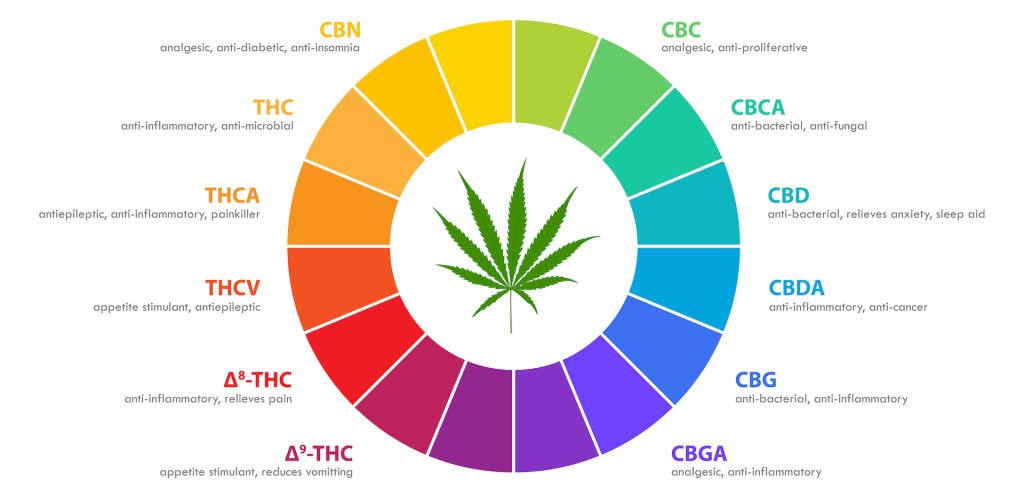
What are specific phytocannabinoids and their functions?

·        Tetrahydrocannabinol (THC): psychoactive compound that produces euphoric “high:. It also helps with nausea, pain, and appetite stimulation.

·        Cannabidiol (CBD): Non-psychoactive compound known for its anti-inflammatory, analgesic, and anxiolytic (anxiety-reducing) properties.

·        Cannabigerol (CBG): Known as the “mother of all cannabinoids” because others are synthesized from its acidic form CBGA. It is non-psychoactive and is being researched for potential neuroprotective, anti-inflammatory, and antibacterial effects.

·        Cannabinol (CBN):  A minor cannabinoid that forms as THC ages and degrades. It is mildly intoxicating but primarily known for its sedative properties and p[potential use as a sleep aid. I can tell you that I search for strains high in CBN for severe insomnia. The strain that almost instantly puts me to sleep is Purple Cheisel. 

·        Cannabichromene (CBC): A non-psychoactive cannabinoid that’s being studied for its potential effects on pain and inflammation. This one will definitely help with chronic pain.

·        Tetrahydrocannabinolic Acid (THCA): The non-psychoactive precursor to THC, found in raw cannabis. When heated it converts to THC. It has potential anti-inflammatory and neuroprotective properties.

·        Cannabidolic Acid (CBDA): The raw, unheated precursor to CBD, found in fresh cannabis. When heated it converts to CBD. It may have stronger anti-inflammatory and anti-nausea effects than CBD in its raw form.

·        Delta-8 THC: A psychoactive compound similar to THC, though its effects are less potent. It occurs in small quantities in the cannabis plant but can be synthetically produced from CBD (https://www.ncbi.nlm.nih.gov, 2023). I don’t personally have a problem with the idea of delta-8 and delta-9 products. What I do have a problem with is the fact that they are not regulated and are sold in gas stations to people making them sick. Those products are not safe at all. Because we don’t know what all is in them.

The topic of cannabinoids has a lot of information available. And I won’t bore you with all the very distinct information. As I have said about terpenes, get to know your cannabinoids. It’s imperative when seeking to fine tune your cannabis regimen. Thanks for reading! And keep blazin.’

Affirmation: My mind, body and spirit are my top priority. Cannabis aids with each.

 ***Don’t forget to watch the video!***

#Thispuzzledlife

Quit Buying Your Kids Fake Vape Carts!!!

“Real happiness is cheap enough, yet how dearly we pay for its counterfeit.”

-Hosea Ballou

Light the charcoal. Sprinkle the sage. Negative energy go away. Today, I want to talk to you about the dangers of fake cannabis vape carts. Most people do not know how to spot the differences. Many parents give their kids money or go personally and buy these vapes. This can be a very costly and even deadly mistake. Even though it is widely accepted for vaping, not all vapes are regulated for safety.

What are fake vapes? They are unregulated, counterfeit products that pose very serious health risks due to unknown and harmful ingredients. They lack safety testing and can contain dangerous chemicals, heavy metals, or inaccurately labeled substances. There is very little, if any, quality control, and safety taken when creating these products (https://southbeachsmoke.com, 2025).

Here are just some of the chemicals and other cutting agents that are used to produce versus legitimate and controlled vapes.

·        Vitamin E acetate: A thickening agent found in illicit THC cartridges strongly linked to  2019 EVALI outbreak which caused lung injuries associated with vaping. Thousands were hospitalized and dozens died.

·        Pesticides: Lab tests on black market vapes have revealed pesticide levels of a thousand times higher than legal limits.

·        Synthetic cannabinoids: Fake THC vapes contain unpredictable synthetic cannabinoids (like K2 or Spice) which have been linked to anxiety, paranoia, seizures, and psychosis.

·        Fentanyl and other drugs: Vapes purchased from illicit sources have sometimes been found laced with lethal opioids like fentanyl which can lead to overdose and death.

·        Formaldehyde: Some fake vapes have be found to contain levels of carcinogenic chemicals like formaldehyde and acetaldehyde which are found in cigarette smoke.

·        Industrial solvents: Other harmful cutting agents like medium-chain triglycerides (MCT) oil and propylene glycol, can become toxic when inhaled.

·        Toxic leaching: heating elements and coils of these devices can leach heavy metal like lead, nickel, and antimony into the vape liquid.

·        Severe health effects: Inhaling heavy metals can cause neurological damage, respiratory issues, organ failure, and increase cancer risk (https://springboardcenter.org, 2025).

·        Lack of Regulation: Fake vapes bypass regulatory checks (https://www.haypp.com, 2025).

How to spot a fake vape

·        Poor packaging: Examine the box for blurry printing, misspelled words, inconsistent logos, or a lack of safety seals.

·        Missing authentication: Check for a QR code, batch number, or serial number on the package. Reputable brands offer a way to verify product’s authenticity.

·        “Too good to be true” price: If a vape is priced significantly cheaper than retailers, it’s likely a counterfeit.

·        Unlicensed seller: Only buy from trusted, licensed dispensaries or reputable retailers. Avoid street vendors “plugs” or unverified online sources.

·        Odd performance or smell: If the vapor tastes burnt, metallic, or chemically unusual, stop using immediately.

·        Suspicious liquid: High-quality vape is typically thick and golden or amber. If the liquid is thin, runny, or unnaturally colored, it could be fake (https://vaping360.com, 2024).

These are products that have been widely accepted among teens and adults. Whenever possible, please by your products from a reputable dispensary versus a smoke or vape shop which are only in the business for money rather than safety. Too many people have been seriously injured or died from fake vapes. Thanks for reading and please make educated decisions about these products.

Affirmation: I prioritize my health and safety  by choosing products from reputable sources.

***Don’t forget to watch the video!***

#Thispuzzledlife