
“In this house we save the tatas, the gays, the strays, and whatever dignity we have left after the cats finish their activism tour.”
-This Puzzled Life
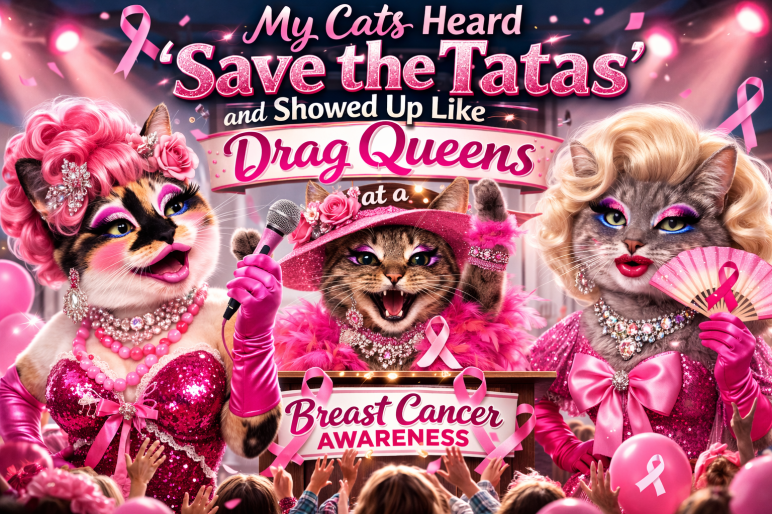
Light the charcoal. Sprinkle the sage. Negative energy go away. Today, you’re going to need every ounce of spiritual protection you can muster. Because your Southern‑raised, chaos‑certified cats decide they’re attending a Save the Tatas event like it’s the Met Gala, the Essence Festival, and a church homecoming all rolled into one. When I casually mentioned I was going to a Save the Tatas event, my cats reacted like I’d just announced Pride Month was being extended by popular demand. And catered by RuPaul herself. Every queer ancestor within a 200‑mile radius sat up in their celestial lawn chairs like, “Oh baby, the girls are about to cut up” And they were right.
Piper immediately wrapped herself in a pink bandana like she was the grand Marshall of the Breast Cancer Awareness Pride Parade. Coco demanded glitter, rhinestones, and a wind machine “for dramatic effect.” And Tinkerbell? She started designing a fundraiser table that looked suspiciously like a drag queen’s merch booth.
In true Southern queer‑adjacent fashion, they didn’t ask permission. They just declared themselves the Official Feline Ambassadors of Bosom Preservation. And then told me, “start the car, Mama, we’re late for justice.” That’s when I knew this wasn’t going to be a simple charity event. This was about to be a pink‑glittered, rainbow‑dipped, Southern fried spectacle.
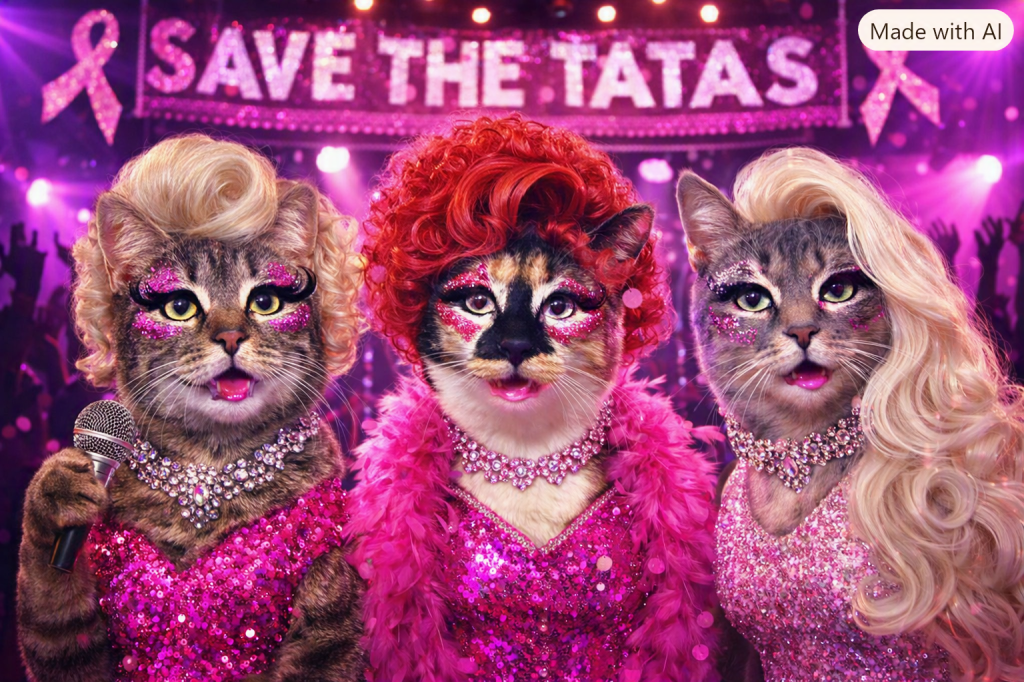
I should’ve known something was brewing when Piper dragged my pink headwrap out the drawer like she was preparing for a sermon. In this house, when the cats start accessorizing, the ancestors start whispering. And I start praying. All I said was, “Mama’s going to a Save the Tatas event this weekend.” And suddenly my living room turned into a Southern nonprofit board meeting run entirely by felines with no credentials and too much confidence.
Piper hopped onto the coffee table like she was about to deliver the State of the Union. She had a pink bandana, a clipboard, a schedule, and the spirit of every church mother who ever said, “Baby, let me tell you something.” She cleared her throat and announced,
Piper: “Mama, I’ve prepared a keynote speech titled ‘Blessed Are the Bosoms.’”
Me: “Piper, this is a fundraiser. Not a revival.”
Piper: “Awareness is revival.”
And honestly? She had a point.
Coco came strutting in wearing a tutu she absolutely stole from the donation pile. She looked like a tiny Southern belle who’d been raised on sweet tea, glitter, and delusion.
She flipped her tail dramatically and declared,
Coco: “I will be the face of the movement.”
Me: “The face?”
She nodded like she was accepting a crown.
Coco: “Yes. I will pose. I will wink. I will inspire generosity. People give more when they feel emotionally manipulated.”
Me: “Coco, that’s not how activism works.”
Coco: “Mama, that’s exactly how activism works. Also, I need false eyelashes. Big ones. The kind that say, ‘I care deeply about the tatas.’”
I told her no. She told me I was stifling her activism.
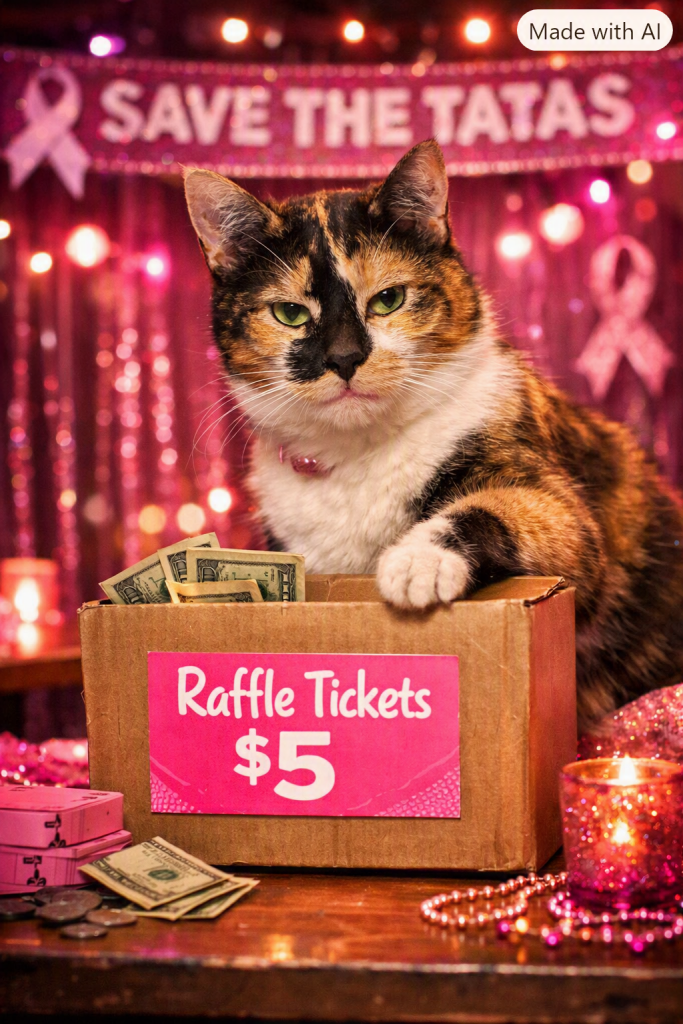
Tinkerbell didn’t care about speeches or pageantry. She cared about the money. She dragged out a cardboard box. Slapped a pink sticker on it, and announced,
Tink: “Raffle tickets. Five dollars. Winner gets something.”
Me: “What’s the prize?”
She stared at me like I was slow.
Tink: “Mystery. Mystery is the prize.”
Me: “Tink, you can’t sell raffle tickets for a mystery box.”
Piper: “Watch me. Mama. Breast cancer awareness is no joke. I’ve prepared a speech, a slideshow, and a prayer circle outline.”
She had bullet points. She had scripture references. She had a moment of silence scheduled for 2:17 PM sharp. And she did. She sold three tickets to the neighbor’s dog before we even left the house.
We arrived at the Save the Tatas event looking like a traveling circus of pink chaos. Piper marched in first, handing out pamphlets she printed herself titled ‘Breast Health & Blessings.’ Coco immediately found the photo booth and refused to leave until she had taken 47 glamour shots. Tinkerbell set up her illegal raffle table under a tree like she was running a back‑alley fundraiser. And people loved it. One lady said, “I’ve never seen cats so passionate about breast cancer awareness.” I said, “Ma’am, they’re passionate about everything. It’s exhausting.”
During the survivor recognition ceremony, Piper tried to lead the crowd in a hymn she wrote called ‘Hold On to Your Hope and Your Hooters.’ Coco attempted to crowd‑surf. Tinkerbell tried to auction off a breast‑shaped stress ball she found in someone’s purse. I was sweating like a sinner in a sauna. But somehow the event organizers said we “brought energy.” Energy is a polite Southern word for chaos you can’t legally complain about.
At the end of the day, my cats raised $112, three cans of Fancy Feast, and a half‑used Bath & Body Works lotion someone donated out of confusion. But they also reminded me of something real. Breast cancer awareness matters. Community matters. Showing up matters. And sometimes, the loudest advocates are the ones covered in fur while wearing stolen tutus. And selling illegal raffle tickets under a magnolia tree. Bless it all.
But between the glitter, the chaos, and the illegal fundraising, something beautiful happened. People laughed, hugged, and shared stories. And the whole event felt wrapped in that warm, Southern magic. The kind where community shows up loud, proud, and covered in sequins.
My cats didn’t just show up to the Save the Tatas event. They took it over baptized it in glitter. Queered it up. And left that place looking like a breast‑health revival hosted by Dolly Parton and the entire cast of RuPaul’s Drag Race. They raised money. They raised awareness. They raised hell. And if that ain’t Southern activism, I don’t know what is.
Bless the tatas. Bless the survivors. Bless the fighters. Bless the ones we’ve lost. And bless my cats. Who have once again proved that when the cause is righteous and the vibes are gay, they will absolutely act a fool in public. Even when they’re doing the absolute most. They remind me that showing up matters. Joy matters. And community matters. Especially when it’s wearing a stolen tutu.
Now if you’ll excuse me, I need to sage the house again. The cats are already planning their next activism tour. And I swear I heard Coco whisper, “Mama, what’s the dress code for the next Pride‑adjacent charity event?” Go ahead and close the doors, baby. The tatas have been saved. The ancestors are tired. And this blog? Consider the mic dropped. The stage cleared. And the glitter still falling. Thanks for reading! And get a mammogram.
Affirmation: I am held, protected, and hyped by ancestors, queer angels, and three chaotic cats who believe in me more than I believe in myself.
***Don’t forget to watch the video!***
#ThisPuzzledLIfe