
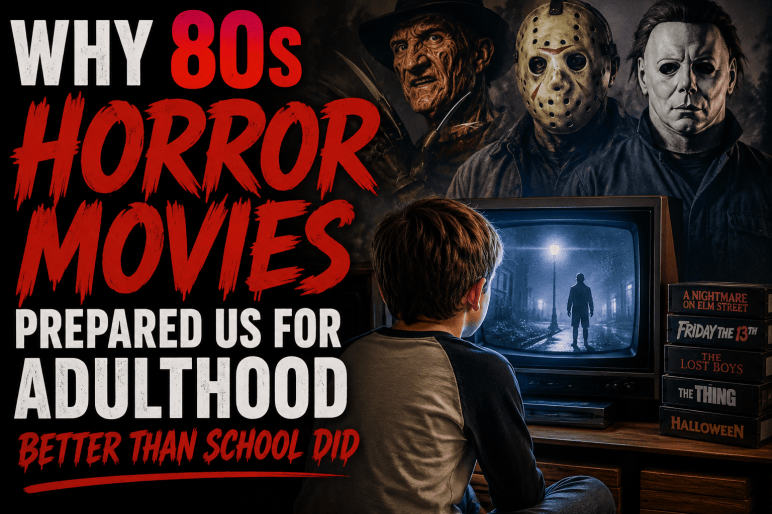
Why 80s Horror Movies Prepared Us for Adulthood Better Than School Did

“80s horror didn’t scare us. It trained us.”

-This Puzzled Life

Light the charcoal. Today we’re roasting the true educational system that raised us which was the 1980s horror movies. School taught us long division. How to cover a textbook with a brown paper bag. And that the overhead projector bulb would always blow out right before your turn to present. But 80s horror taught us survival. Situational awareness. And never to trust a foggy forest, a malfunctioning flashlight, or a friend named Chad who says, “Let’s split up.”

Those low‑budget masterpieces didn’t just entertain us. They prepared us for adulthood better than any guidance counselor ever did. Because nothing says “real‑world readiness” like watching a monster made of dryer lint and Elmer’s glue chase teenagers who clearly had no business being outside after dark. Let’s honor the cinematic chaos that shaped our reflexes, our instincts, and our ability to identify the dumbest person in the group within 0.3 seconds.
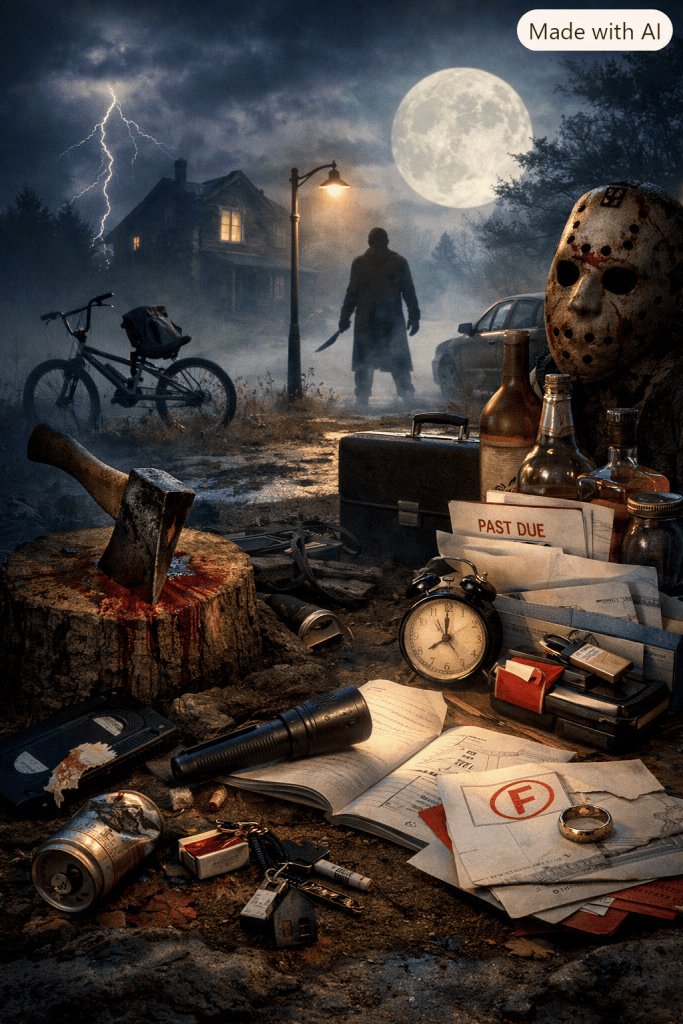
Low‑Budget Horror Lessons & Their Beautifully Terrible Monsters

1. The Fog Machine Budget Was 90% of the Film

Every 80s horror movie had fog thicker than Mississippi humidity in August. 

Monster: Michael Myers (Halloween series) walked slower than a church deacon but still caught everybody. 

Life lesson: If you can’t see three feet ahead, turn around. Immediately.

2. The Blood Looked Like Kool‑Aid

It was neon. It was watery. It was suspicious. 

Monster: Jason Voorhees (Friday the 13th) the man, the myth, the hockey‑masked menace. 

Life lesson: If the vibes are off at summer camp, leave.

3. The Killer Always Appeared in a Doorway They Weren’t Near

Teleportation was free in the 80s. 

Monster: Freddy Krueger (A Nightmare on Elm Street)  the crispy king of dream‑based foolishness. 

Life lesson: Get sleep, but not too much sleep.

4. The Special Effects Looked Like a Middle School Science Fair

Rubber masks, visible wires, and monsters that jiggled when they weren’t supposed to. 

Monster: The Blob was basically a giant fruit snack with an attitude problem. 

Life lesson: If it wiggles toward you, don’t touch it.

5. The Dumbest Friend Always Died First

Every. Single. Time. 

Monster: Chucky (Child’s Play) a doll that should’ve been thrown in the dumpster behind K‑Mart. 
Life lesson: Choose your circle wisely.

6. The House Was Always Haunted AND Cheap

Realtors in the 80s were bold. 

Monster: The Poltergeist clown doll was the reason we all slept with the lights on. 

Life lesson: If the house is too affordable, ask why.

7. The Creature Was Clearly a Guy in a Suit

And we loved him for it. 

Monster: Gill‑man (Creature‑feature sequels)  looked like a scuba diver who got lost. 
Life lesson: Don’t underestimate a man committed to a costume.

8. The Sequel Count Was Disrespectful

Every franchise had at least 47 sequels and a reboot nobody asked for. 

Monster: Pinhead (Hellraiser) the original “Don’t touch my stuff” villain. 

Life lesson: Some problems return because you didn’t solve them the first time.

9. The Teenagers Never Locked a Door

Not once. 

Monster: Ghostface prototype energy from every pre‑Scream slasher. 

Life lesson: Lock. Your. Doors.

10. The Final Girl Had the Strength of a Thousand Suns

She survived everything: monsters, explosions, bad perms. 

Monster: The Xenomorph Queen (Aliens) terrifying, iconic, and probably unionized. 

Life lesson: Women will save the world. Again.

11. Everyone Tripped Over Absolutely Nothing

Sidewalk? Flat. Forest floor? Flat. Living room rug? Flat. Did they fall anyway? Yes. Did they look back at the invisible obstacle like it personally betrayed them? Also yes. 

Life lesson: If you panic, gravity will snitch on you.

12. Women Never Wore Bras — Not Even Once

Running from a monster? No bra. Investigating a noise? No bra. Walking into a clearly haunted basement? Still no bra. 

Life lesson: Support was optional in the 80s. Both emotionally and structurally.

13. The Young Victims Were Always Showering or Mid‑Romance

If two teenagers so much as held hands, you could hear the horror soundtrack warming up like an orchestra tuning before a concert. 

Life lesson: If you’re vulnerable, distracted, or naked, the universe will test you.

14. The Perfectly Working Vehicle Suddenly Refused to Crank

You left it running. You left the keys in it. It was purring like a kitten. But the moment you needed it? Click. Click. Dead. Meanwhile the monster is speed‑walking toward you like he’s late for a dentist appointment. 

Life lesson: Trust issues begin with 80s car scenes.

And that, my dear Southern scholar of chaos, is why 80s horror movies prepared us for adulthood better than any standardized test ever could. School taught us how to diagram a sentence. Horror movies taught us how to diagram an escape route. School taught us the mitochondria is the powerhouse of the cell. Horror movies taught us the basement is the powerhouse of bad decisions.

We grew up on monsters made of latex, corn syrup, and pure ambition. And now we call them classics. We still watch every sequel, reboot, and “re‑imagining.” Because deep down we know those films raised us with more honesty than any textbook. Light the charcoal again, baby. The 80s taught us to survive anything. Even adulthood. Thanks for reading! Do you remember anything else about the low budget films of that era?

Affirmation: I move through life with Final Girl energy and the wisdom to never investigate a strange noise.

***Don’t forget to watch the video!***

#ThisPuzzledLife
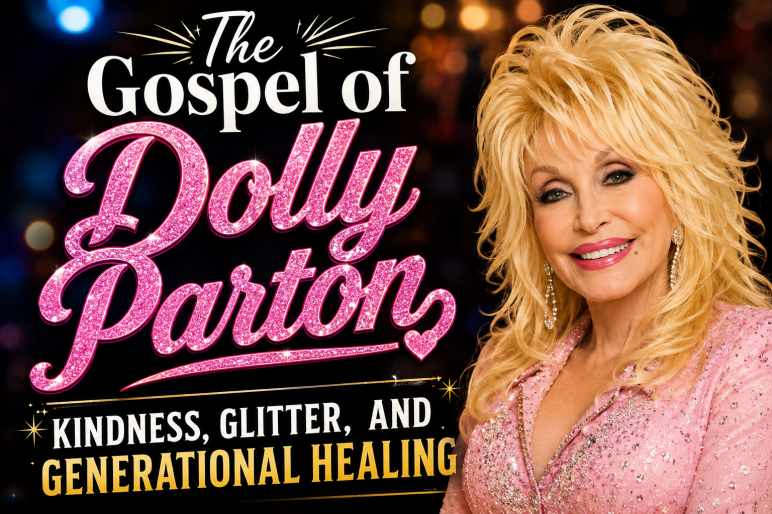
The Gospel of Dolly Parton: Kindness, Glitter, and Generational Healing

“Find out who you are and do it on purpose.” 

-Dolly Parton

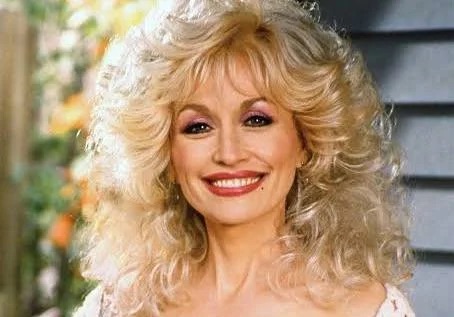
Light the charcoal. Pull up a chair. And let’s call the ancestors. Today, we’re about to talk about a woman whose legacy smells like warm biscuits, rhinestones, and generational healing. Dolly Parton wasn’t just a country singer. She was a walking love letter to humanity. A Southern phoenix who rose from the Smoky Mountains with a voice full of honey and a heart full of fire. And Lord, did she use that fire to light the way for all of us.

When we speak Dolly Parton’s name, we’re not just telling a story. We’re summoning a legacy stitched into the bones of the South, the nation, and every child who ever held a book and felt their world crack open with possibility.

Dolly wasn’t just a singer. She was a healer. A mountain-born miracle. A Southern woman who took her own childhood that was poor, barefoot, brilliant, and turned it into a mission to make sure no child, anywhere, ever felt small because of their circumstances.

She carried the Smoky Mountains in her voice. It was the sass of every Southern auntie who ever said, “Bless your heart. But fix your life.” And the tenderness of a mama who knows what it means to struggle and still show up with love. And when it came to children, Dolly didn’t play. She built an empire of hope one book, one song, one act of kindness at a time.

10 Things Dolly Did for All Communities (Especially the Ones Society Overlooked)

  • She created the Imagination Library, sendingover 200 million free books to children in rural, urban, poor, wealthy, Black, white, immigrant, Indigenous, disabled, LGBTQ+ families, and everyone. Dolly said literacy wasn’t a privilege. It was a birthright.
  • She made sure those books were culturally inclusive. They featured stories with diverse characters, languages, and experiences so every child could see themselves reflected in the pages.
  • She funded vaccine research by helping save lives during a global crisis without needing applause or credit.
  • She uplifted LGBTQ+ communities by loving loudly. Defending boldly. And showing up long before it was “safe” or trendy.
  • She championed women’s empowerment by proving you can be glamorous, soft, and still run an empire with steel in your spine.
  • She protected Appalachian culture by honoring the stories, music, and people who shaped her. And making sure the world respected them too.
  • She donated millions to disaster relief, especially in overlooked Southern and rural communities that often get left behind.
  • She built Dollywood, creating thousands of jobs and economic stability for families who needed hope and opportunity.
  • She supported literacy and education beyond books, funding scholarships, schools, and programs for children who grew up like she did full of potential but lacking resources.
  • She modeled radical kindness, showing the world that compassion is not weakness. It’s world-changing power.

Dolly didn’t just give books. She gave children a future. She gave parents hope. She gave communities pride. She gave generations a chance to dream bigger than their circumstances.

Dolly Parton walked through this world like a rhinestone-wrapped blessing. She didn’t ask permission to shine. She just did. And she made sure everyone around her felt the warmth of that glow. She was the kind of woman who could take her own childhood poverty and turn it into a global literacy movement. Who could take her pain and turn it into poetry. Who could take her sass and turn it into strength.

She taught us that kindness is a revolution. She taught us that generosity is a legacy. She taught us that beauty is not about perfection. It’s about authenticity. She taught us that you can be underestimated your whole life and still outwork, out love, and outshine every last person who doubted you. She didn’t just leave behind songs. She left behind libraries. She left behind hope. She left behind a blueprint for how to live with grace, humor, and unapologetic sparkle.

So, light the charcoal. Let the ancestors hum. Let the mountains echo her name. Because Dolly Parton didn’t just change country music. She didn’t just change philanthropy. She didn’t just change the South. She changed humanity one child, one book, one act of love at a time. Mic dropped. Sequins scattered. Legacy eternal.

Affirmation: I shine boldly. Give generously. And build a legacy of love just like Dolly taught me.

***Don’t forget to watch the video!***

#ThisPuzzledLife
It’s Mental Health Awareness Month

“What mental health needs is more sunlight, more candor, and more unashamed conversation.”

-Glenn Close

Light the charcoal. Sprinkle the sage. Negative energy go away. Okie dokie! Today is the first day of the month of May, which is also Mental Health Awareness Month. And unfortunately, the topic of mental health is often skirted or disregarded as something that isn’t acknowledged because of the “shame factor.” However, it is not a topic to be ashamed about. Mental health is such an integral part of being human and is something that must be discussed.

What are the issues surrounding the topic of mental health? Well, part of the problem involves societal stigmas, fear of judgment, and a lack of understanding. And the stigma usually surrounds negative stereotypes, incorrect information and cultural beliefs or a sign of personal failure. Give me a second to go a little more in depth about these issues.

1. Lack of Understanding-most people have little knowledge about mental health conditions which can lead to misconceptions and fear. And this includes immediate family, friends, co-workers, medical personnel and acquaintances. I have tried in my own ways to educate people about mental illness, as my daily living has revolved around the mental health system for the majority of my life. But no matter how much you try to explain things to people, they just can’t seem to let go of old ideas and opinions.

2. Negative stereotypes-Thanks to social media, mental illness is portrait in the media that mental illness is considered a sign of weakness, dangerous or violent. This further solidifies negative attitudes. While some of this is true regarding violent individuals, the majority of us are not dangerous people. And religious affiliation can also be another source of negative stereotypes. You wouldn’t believe some of the nasty and fearful looks that I get from simply wearing a baseball cap about PTSD. Sometimes I get asked, “What branch of the military were you in?” I simply tell them, “I didn’t serve our country. I developed PTSD because I’ve been abused for a large majority of my life. So, technically, I’ve been fighting a war my entire life.” They usually silently turn around and back away. Some have asked, “Why do you tell people?” And my answer is always, “Because I’m not ashamed of having a mental illness. It is what it is. And I’m not responsible for other’s ignorance. I simply state the true facts and give the shame back to where it belongs. 

3. Fear of judgment-many people fear judgment for their mental illness. One thing you have to understand is that people are usually their own worst critic. So, your judgment will never be as potent and the person with the mental illness. In my case, telling someone that I have Multiple Personality Disorder makes people retract, mainly because their only source of reference is through Hollywood. And we all know that Hollywood never really tells a story accurately. It induces the “fear factor” in most people. And when I speak this truth, most people are also taken aback because I’m so forth coming with my own  struggles. You might notice my quirkiness at times. However, you would never know when my other parts switch out unless you are around me and I explain who they are and their function. I don’t fear judgment from people. I embrace their ignorance and do my best to “stomp out stupidity.”

4. Fear of discrimination-people fear losing jobs, housing or other opportunities due to their condition. Look, I have lived under a cloud of discrimination since the day I was born. I’m gay. I have a mental illness. And I love to smoke weed. But I’m also very educated. And somehow when you are “out and proud” that automatically puts a label on you. And well, that’s their problem not mine. Even within my own family, I face discrimination. And when I speak about mental health topics, I’m revered as not being nearly as intelligent as others. Even though I have a master’s degree in counseling psychology which qualifies me to be able to diagnose. Make no mistake, I might’ve done a lot of stupid things in my life, but I am in no way dumb. And I face discrimination head on. 

I completely understand that everyone isn’t at the same level of progress with these issues. And it has taken years of therapy to bring me to the point where I am. Mental illness is nothing to be ashamed of. And most people have mental illness in varying degrees. However, a lot of it has never been diagnosed. Individuals hide and suffer in silence because of the shame that they carry regarding this topic. And you absolutely shouldn’t be. Mental health is just as important and maybe more so than physical health. Because poor mental health can also cause physical discomfort.

Embrace what is and be responsible enough to get in therapy. You will be glad you did. Cannabis has increased my quality of life much better than pharmaceuticals. And this is another topic that is shame based. There are those still who are “closeted” cannabis users who also reap the benefits of the plant. And as someone who lived in a closet for many years, I can tell you that no one is meant to be smothered and silenced. Everyone deals with mental illness and fears the repercussion of others differently and at their own pace. I can’t speak for anyone else, but with me, you will always be accepted. 

Educate yourself about your own mental illness not based on movies, other people’s subjective opinions, but on the scientific research and real truth. Face your fears and get involved in therapy and do the challenging work that will benefit you overall. And let the opinions of others roll off your back like water on a duck. Their opinions are just that. They are not facts. It is purely unadulterated ignorance. But that can change if they are willing to do so.

If you are an ally on the topic of mental illness but still have questions, we won’t cook you or eat you. Respectfully ask for some clarification. It is a horrible feeling to suffer in silence over half truths and out right lies regarding mental illness. And sadly, I have had friends who refused to go to therapy for those reasons. And they are now dead from suicide. But everyone is entitled to love, care and compassion. And, yes, that also includes you. Thanks for reading! Stay healthy. Stay happy. Keep smiling. And keep reading this blog.

Affirmation: I trust myself  to make decisions that align with my values and goals.

***Don’t forget to watch the video!***

#Thispuzzledlife