
Trauma Awareness Month: The Stories We Carry, The Healing We Claim

“Trauma doesn’t make you weak. It makes you a witness to your own survival.”

-This Puzzled Life

Light the charcoal. Sprinkle the sage. Let the smoke rise like it’s clocking in for a shift. And let the air shift like it’s bracing itself for whatever truth you’re about to drag into the daylight. Today isn’t about pretending everything’s fine or slapping a smile on top of a wound. It’s not about the vibes, snacks, or cats doing interpretive dance in the sunbeam. It’s about trauma awareness. It is about naming the things we survived. The things we carried alone. The things we laughed through so we wouldn’t crumble. It’s a Southern‑fried, emotionally honest, and funny enough to keep you from dissolving into a puddle on the kitchen floor. 

Trauma Awareness is the kind that hides in your shoulders, jaw, breath, memories, and your jokes. And if we’re going to talk about it, we’re going to do it the only way I know how. Complete with honesty, humor, and the kind of emotional courage that feels like taking your bra off after a long day. It’s painful, relieving, and absolutely necessary.

There’s a moment right before you talk about trauma where your whole spirit goes, “Are we sure we want to do this?” It’s the same tone you use when someone says, “Let’s just run into Walmart real quick.” You know it’s not going to be quick. You know you’re going to see something you can’t unsee. You know you’re going to come out changed. Talking about trauma is like that. Except instead of a man in pajama pants buying raw chicken and fireworks, it’s your nervous system holding up a sign that says, “We’ve been through some things, ma’am.”

Trauma doesn’t just show up when you’re ready. Trauma is that one cousin who arrives early. Eats all the good snacks. And then says, “Why you look stressed?” It pops up at the worst times especially when you’re trying to relax. When you’re trying to sleep. When you’re trying to enjoy a sandwich. When you’re trying to mind your business. And when you’re trying to be a functioning adult for five minutes. Trauma will tap you on the shoulder like, “Hey bestie, remember that thing from 1998? No? Well, I do.” And suddenly you’re staring at the wall like it owes you money.

Your body remembers everything. Even the stuff you tried to bury under humor, iced coffee, and pretending you’re fine. You’ll be walking through Wal-Mart. Touching a throw pillow. And your body will whisper, “Hey, remember that time?” And you’re like, “No I do not. I am touching a pillow. Let me live.” But trauma doesn’t care. Trauma is like a Southern grandmother with a memory like a steel trap. And no sense of timing.

People talk about healing like it’s a spa day. Let me tell you something. Healing is not cucumber water and a robe. Healing is crying in the shower because your shampoo smells like 2007. Healing is realizing you’ve been clenching your jaw since the Bush administration. Healing is sitting in your car after therapy like you just got hit by an emotional freight train. Healing is messy. Healing is loud. Healing is quiet. Healing is confusing. Healing is holy. Healing is exhausting. Healing is worth it. But cute? Absolutely not.

So, buckle up. Because the cats have decided it’s Trauma Awareness Hour. And apparently they’ve all been waiting their whole lives to trauma dump with the enthusiasm of a group therapy circle run by toddlers. And today is the day they ask deeply personal questions with the emotional sensitivity of a toddler holding a chainsaw. They have formed a circle. They have snacks. They have opinions. And apparently, they have questions about my trauma.

Me: “Okay, girls. Today we’re talking about trauma. Share whatever you feel comfortable with.”

She raises paw like she’s in kindergarten

Piper: “I’ll go first because my story is the most dramatic. Obviously.”

Coco: “Oh lord.”

Tinkerbell: “Let the child speak. She needs this.”

Piper: “So picture this. Me and my siblings. In a metal box. In the Mississippi heat, basically sautéing like tiny furry cornbread muffins.”

Me: “Baby, that’s awful.”

Piper: “I know. I was basically a rotisserie chicken with trauma.”

Coco: “You were a sweaty raisin with opinions.”

Piper: “Anyway, I survived because I’m dramatic and stubborn. And now every time the sunbeam hits me wrong, I flop over like a Victorian woman fainting at a garden party.”

Tinkerbell: “You faint because you forget to breathe when you get excited.”

Piper: “Trauma. Tinkerbell. Let me have this.”

Coco clears throat like she’s about to deliver a TED Talk

Coco: “My siblings and I were found under a house. A house. Do you know what lives under houses? Darkness. Ghosts. Tax evasion. I was basically a feral raccoon with trust issues.”

Me: “You’ve come so far.”

Coco: “Yes. And now I cope by judging everyone. It’s called growth.”

Piper: “You judge me the most.”

Coco: “You give me the most material.”

Tinkerbell: “I don’t remember my trauma.”

Me: “At all?”

Tinkerbell: “No. I simply chose not to be present. I was spiritually unavailable.”

Coco: “You had worms.”

Tinkerbell: “Yes, apparently my intestines were hosting a music festival.”

Piper: “You pooped like you were trying to summon something.”

Tinkerbell: “I was summoning peace. And a vet. Preferably both.”

Me: “You really don’t remember anything?”

Tinkerbell: “I remember diarrhea. And then I remember you. Everything else is optional.”

Me: “Well, we’ve all been through some things.”

Piper: “Yeah, but now we’re together! A family! With two crazy brothers who scream at dust!”

Coco: “We are a support group. A dysfunctional one, but still.”

Tinkerbell: “We heal one memory at a time. Preferably with snacks.”

Piper: “And naps!”

Coco: “And boundaries. Mostly for Piper.”

Piper: “I don’t believe in boundaries.”

Tinkerbell: “We know.”

Piper: “Sometimes I get scared when it’s hot outside. So, I cope by yelling at the sun.”

Coco: “I cope by staring at people until they feel bad.”

Tinkerbell: “I cope by leaving my body spiritually whenever something stressful happens. Like when the vacuum turns on. Or when Piper breathes too loud.”

Piper: “I have big emotions.”

Coco: “You have no volume control.”

Tinkerbell: “You have the energy of a toddler who drank a Red Bull.”

Piper: “Momma, what is your trauma about?”

Me: “Oh absolutely not. We are not opening that can of worms. We’ll be here until this time next year. And I don’t have enough snacks or emotional stamina.”

Coco: “Is that why you have panic attacks in Walmart?”

Me: “Yes.”

Tinkerbell: “But what’s scary about going to the pharmacy?”

Me: “Everything.”

Piper: “Everything?? Like the shelves? The people? The lighting?”

Me: “Yes.”

Coco: “The lighting is aggressive.”

Tinkerbell: “The vibes are hostile.”

Piper: “The blood pressure machine is a demon.”

Me: “Exactly.”

Coco: “So what did our therapist tell you?”

Me: “She said, ‘I’ll see you in another couple of days.’”

Tinkerbell: “Translation: ‘You’re a lot. But I believe in you.’”

Piper: “Translation: ‘You have so many issues we need a punch card.’”

Coco: “Translation: ‘You’re keeping the lights on in that office.’”

Me: “But look at us now. We’re safe. We’re loved. We’re healing together.”

Piper: “And we have snacks!”

Coco: “And stability.”

Tinkerbell: “And indoor plumbing.”

Me: “We survived things we never should’ve had to survive. And now we get to build something soft and silly and sacred together.”

All Three Cats: “Group hug!”

Coco: “But don’t touch me too long.”

Piper: “I’m crying!”

Tinkerbell: “I’m dissociating!”

Me: “Perfect. Exactly the emotional range I expected.”

In small Southern towns, admitting trauma is treated like a social crime. The moment you name what happened, you’re not just telling your story. You’re “disgracing the family,” “embarrassing the community,” and threatening the carefully polished illusion of stability that everyone works so hard to maintain. The culture teaches people to swallow their pain. Protect the reputation of the town at all costs. And never, under any circumstances, call out the people who caused the harm. And because the “good ole boy” network is alive and well. And sitting in every position of authority from the courthouse to the church pews, the truth gets buried right alongside the accountability. Even when the perpetrators are known. Especially when they’re known. Nothing is done. The silence is enforced. The victims are shamed. And the town keeps smiling for the church directory photo like nothing ever happened. But the truth doesn’t disappear just because the town refuses to look at it. It lingers in the air, the families, the generations, waiting for someone brave enough to break the cycle and say, “This happened. And it mattered.” And I am that one in my family who refuses to stay quiet about the trauma that happened in the small city of Petal, MS.

Trauma will have you doing things that make absolutely no sense. Things like apologizing to furniture when you bump into it. Jumping at sounds that aren’t even loud. Overthinking texts like you’re decoding ancient scripture. Saying “I’m fine” in a tone that suggests you are, in fact, not fine. And crying because someone said, “I’m proud of you.” And your body wasn’t prepared for that level of kindness. Trauma will also make you emotionally attached to random objects. A mug. A blanket. A rock you found on a walk. A pen that writes really smooth. Your brain will be like, “This is my emotional support spoon. Touch it and perish.”

Trauma awareness isn’t about reliving the pain. It’s about naming it, so it stops owning you. It’s about understanding why you react the way you do. It’s about giving yourself grace for surviving things you never should’ve had to survive. It’s about learning that your triggers aren’t flaws. They’re evidence that you lived through something real. And it’s about knowing you’re not broken.

You’re healing. You’re growing. You’re learning how to breathe again. You’re learning how to trust softness again. You’re learning how to exist without bracing for impact. That’s not weakness. That’s strength with stretch marks.

May your healing be gentle. May your memories lose their sharp edges. May your nervous system unclench one muscle at a time. May your heart learn safety. May your voice return to you. May your laughter come back louder. May your story be yours again. And not something that happened to you. But something you rose from.

So, if no one told you today. You’re not dramatic. You’re not broken. And you’re not “too much.” You’re a whole human who lived through storms that would’ve snapped lesser souls in half. And you’re still here healing. Laughing. Unlearning, Softening. Reclaiming. That’s not survival. That’s resurrection. And baby, if that isn’t holy, I don’t know what is. Drop the sage. Keep the truth. And walk away knowing this. Your story didn’t end in the dark. You did.

Affirmation:  I honor the parts of me that survived. I honor the parts of me that are still healing. I am allowed to grow, to rest, to feel, and to reclaim my peace. And I can do it one breath at a time.

***Don’t forget to watch the video!***

#ThisPuzzledLife
Addiction Awareness: The Lover That Cuts Deep and Comes for Everything

“Addiction is a quiet predator. It’s patient. Calculated. Always hungry. And waiting for the moment you’re weakest to take the biggest bite out of your life.”

-This Puzzled Life

 Light the charcoal. Sprinkle the sage. Because when we talk about addiction awareness, the air needs to be thick with truth, protection, and the kind of courage that makes your voice shake but keeps going anyway. This isn’t a pretty conversation. It’s not a gentle unveiling. It’s not polite. It’s not something you whisper behind closed doors like a family secret wrapped in shame. It’s the kind of truth that shakes the floorboards and rattles the bones of anyone who’s ever lived it. Loved someone through it. Or buried someone because of it. This is a front porch, bare soul, trembling‑hands kind of truth. And today, we’re telling it out loud.

Addiction doesn’t walk into a home quietly. It barges in like a storm. It tracks mud across every memory. It rearranges the furniture of your life. And convinces you that chaos is normal. It teaches you to apologize for things you didn’t break. To shrink yourself so its shadow can stretch across the room. And to pretend you’re fine when your insides feel like shattered glass. And the cruelest part? Addiction doesn’t just take from the person struggling. It takes from everyone who loves them.

Families learn to tiptoe. Children learn to decode moods like weather patterns. Partners learn to carry burdens that were never meant for one set of shoulders. And the person battling addiction, learns to hide their pain behind a smile that fools everyone except the people who know them best. Addiction awareness isn’t about statistics or slogans. It’s about the people who wake up every day fighting a war no one else can see.

There are the battles fought in bathrooms, parked cars, and bedrooms with the door locked. The battles fought in silence because shame is louder than the truth. The battles fought by people who are terrified to ask for help because they don’t want to be judged. Dismissed. Or treated like a problem instead of a person.

Addiction awareness means saying, “You are not alone. You are not broken beyond repair. You are not the worst thing you’ve ever done.” It means recognizing that recovery isn’t linear. It’s messy. It’s painful. It’s full of relapses, restarts, and revelations. But it is possible. I tasted that freedom many years ago, during a moment in life that now seems like it never existed. 

Let’s talk about the people that love them too. The ones who hold the line when the person they love can’t. The ones who pray. Cry. Scream. Hope. And repeat. Addiction awareness means honoring their resilience. Their heartbreak. Their bravery. Loving someone through addiction is its own kind of battle that deserves to be seen.

Addiction is not a moral failure. It is not a character flaw. It is not a sign of weakness. It’s a neurological hijacking. And once it gets inside, it takes the controls and refuses to give them back. It’s a thief. A liar. And a weight that no one should carry alone.

Awareness is the first step toward compassion. Compassion is the first step toward healing. Healing is the first step toward freedom. And freedom? Freedom is the birthright of every single person touched by addiction. It doesn’t matter whether they’re fighting it. Surviving it. Or loving someone through it.

I have been an addict in one form or another since I was a very young teen. That’s the part people don’t see. The way it starts before you even understand what “coping” means. Before your brain is fully formed. Before you know that one decision can echo for decades. Some things I let go of and never touched again. But others? Others I’m still married to. Still controlled by. And still waking up beside like a partner I never meant to vow my life to. I’ve stood on every side of this issue. I’ve been a patient, professional, survivor, and witness. I’ve buried friends and family. And I’ve found the bodies of patients. I’ve even sat in classrooms learning the science. And I’ve sat on bathroom floors learning the consequences. 

One of the biggest debates is whether addiction is a disease. And honestly? I see both sides. But I can attest to this. What I know in my bones is that addiction will pick up exactly where it left off. It doesn’t forget you. It doesn’t forgive you. And it doesn’t loosen its grip just because you got tired.

It progresses like a slow-moving fire. Consuming everything until it shuts down every functioning cell in your body. It’s the lover that kisses your forehead while holding a knife behind your back. And it’s like trying to pet a rattlesnake and hoping it suddenly cares about your well-being.

There are no social crack users. No social heroin users. No social meth, fentanyl, or “just once in a while” users of the things that hollow you out from the inside. I’ve known too many who didn’t make it. Too many funerals. Too many empty chairs. Too many stories cut short. And the truth is brutal. Addicts are not the type who typically live to be 80. The statistics confirm what our hearts already know. That many have died. And many more will die.

And process addictions? Eating disorders, self-harm, gambling, sex addiction, etc. are not softer versions. They are simply different roads to the same grave. Addiction doesn’t care about the method. It cares about the destruction. And it will be done in totality emotionally, socially, spiritually, and physically.

It strips you down until you’re a shell of what once resembled a human being. It destroys your life and the lives orbiting yours. That’s the goal. It wants no interference. And no one slowing its roll. It wants you wrapped around its finger in a relationship so co-dependent it feels cellular. It doesn’t care how many relationships are ruined as a result. Addiction is about the next fix. Whatever that fix is. And you will chase it until the line between living and dying blurs. 

The saddest part is that you don’t know you’re susceptible until you’re already in it. Addiction does not discriminate. It shows no mercy to clergy, billionaires, politicians, Hollywood actors, musicians, doctors, lawyers, nurses, or the people just trying to keep the lights on and food on the table.

And the idea that you can outthink addiction? Outsmart the chemical, emotional, and neurological machinery it hijacks? That’s the thinking of fools. And I say that with compassion. Not judgment. There is nothing more heartbreaking than watching someone, yourself included, need their “drug” so badly that they would burn down every good thing in their life for another taste of something that is killing them.

Let the truth rise with the smoke. Addiction is not romance. It is not rebellion. It is not escape. It is suicide on an installment plan. And for every person who struggles, it has a bullet with their name on it. Even mine. Speaking the truth out loud is how we start breaking the cycle that wants us silent. Awareness is the first crack of light. Awareness is the first act of rebellion. Awareness is the first step toward choosing life. Even when the addiction whispers otherwise. It’s a story of survival in a world that doesn’t teach us how to hold our pain. 

Your days of hiding in silence are over. We’re speaking your name. Shine light in your corners. And refusing to let shame be your shield. This is awareness. This is courage. This is the moment we stop whispering and start healing. And it’s for every soul who deserves a life bigger than their battle. Thanks for reading! And ask for what you need.

Affirmation: I honor the battles I’ve survived, and I refuse to let the shadows that once claimed me write the rest of my story. I rise with clarity, courage, and a spine made of truth.

***Don’t forget to watch the video!***

#ThisPuzzledLife
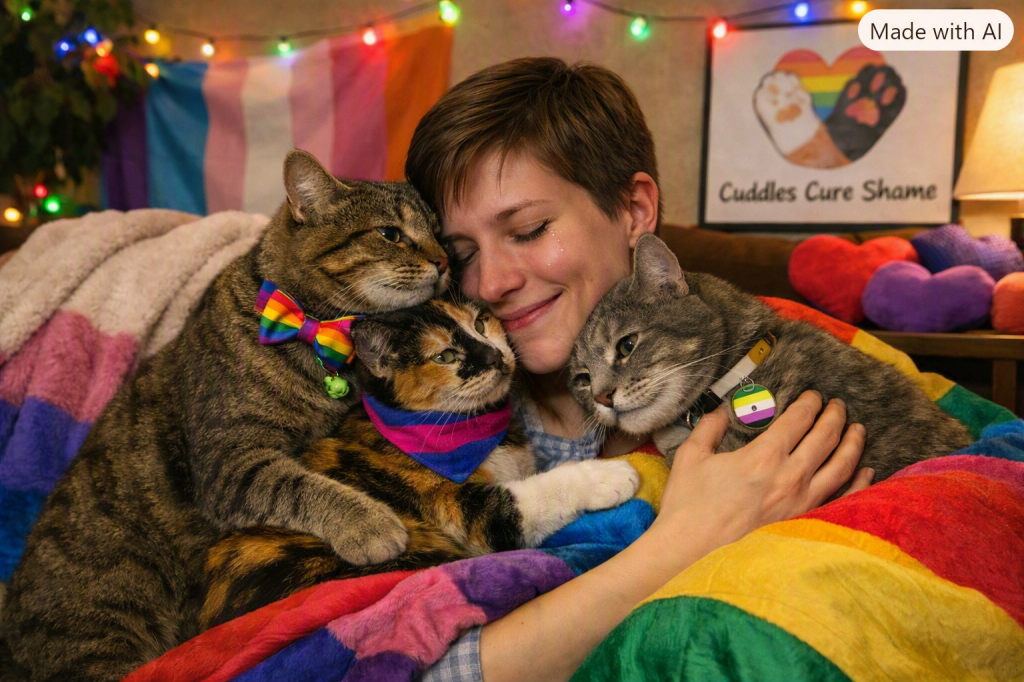
My Cat Tried to Call the Therapy Coach and Now We’re in a Full‑Blown Feline Intervention

“My system handles trauma like professionals. But the cats handle drama like they’re auditioning for a reality show called Real Housewives of the Litter Box.”

-This Puzzled Life

Light the charcoal. Sprinkle the sage. Secure the breakables. Today’s episode of This Puzzled Life features a full‑blown feline committee meeting after Piper, chaos in fur form, announced that she “might have Dissociative Identity Disorder.”

I have Dissociative Identity Disorder. Piper, however, is simply dramatic. And Tinkerbell and Coco are done with her antics. Welcome back where the sage is burning. The humidity is disrespectful. And the cats are holding more meetings than a Mississippi school board.

This morning started like any other. I was minding my business. Drinking my coffee. And trying to keep my nervous system from filing a complaint with HR. When Piper strutted into the room and announced that she “might have Dissociative Identity Disorder.” Before I could even blink, she was paw‑dialing my therapy coach like she had Blue Cross Blue Shield and a co‑pay. And that’s when Tinkerbell and Coco called an emergency meeting. Because apparently, in this house, I’m not the only one with a system. I’m just the only one with a diagnosis.

Tinkerbell climbed onto the arm of the couch like she was chairing a Mississippi church committee.

Tinkerbell: “This meeting will now come to order. Piper has made a claim. A bold one.”

Piper: “Ok. Well, there is no easy way to say this. I have DID.”

Tinkerbell: “Piper, having nine lives is not the same thing as having nine personalities. Stop confusing reincarnation with psychology.”

Coco: “Yeah, girl. Nine lives just means you make nine bad decisions. Not that you need nine therapists.”

Piper gasps, fluffs up, dramatic tail twitch

Piper:  “Wow! So, nobody believes me? Nobody supports my journey? I’m being silenced. This is oppression. I’m calling coach right now!”

Coco: “You can’t even remember where you left your toy mouse. Sit down.”

Piper: “I am a complex being with layers!”

Tinkerbell: “You’re a lasagna with fur. Calm down.”

Coco flicked her tail like she was swatting away generational trauma.

Coco: “She doesn’t have DID. She has Too Much Drama Disorder.”

Piper, sprawled across a pillow like a Victorian widow, sighed dramatically.

Piper: “Sometimes I feel like different versions of me.”

Tinkerbell blinked slowly. The kind of blink that says, Lord, give me strength.

Piper sat up, whiskers trembling with self‑importance.

Piper: “Sometimes I’m sweet. Sometimes I’m spicy. Sometimes I’m feral. That’s at least three personalities.”

Coco rolled her eyes so hard she almost saw her past lives.

According to Piper, and only Piper, she “dissociates” at least three times a day. To everyone else in the house, she simply forgets what she’s doing because she’s Piper.

This morning, she was walking toward her food bowl with purpose, confidence, and the swagger of a cat who believes she pays rent. Halfway there, she froze. Stared into the void. And blinked like she’d just been unplugged and rebooted.

Tinkerbell watched her with the patience of a grandmother who’s seen too much.

Tinkerbell: “She’s not dissociating. She’s buffering.”

Coco flicked her tail

Coco: “That’s not a switch. That’s a brain fart.”

But Piper insisted.

Piper: “I think I dissociated. I forgot what I was doing.”

Tinkerbell sighed

Tinkerbell: “Sweetheart, you forget what you’re doing because you have the attention span of a dust bunny.”

Coco“If staring at the wall counts as dissociating, then every cat on Earth needs a therapist.”

Piper, unbothered, continued staring into the middle distance like she was receiving messages from the universe.

Piper: “I just drifted away.”

Tinkerbell: “You drifted because you saw a dust particle and got confused.”

Coco: “You’re not dissociating. You’re daydreaming with commitment.”

Coco: “That’s called being a cat.”

Tinkerbell nodded

Tinkerbell: “You’re not special, darling. You’re just enthusiastic.”

Piper gasped like someone insulted her casserole at a church potluck.

Piper: “So you’re saying I’m dramatic?”

Coco: “I’m saying you’re Piper.

This is where things went off the rails. Piper marched over to my phone. Tapped the screen with her paw, and said,

Piper: “I’m calling our therapy coach. I need a professional opinion.”

Tinkerbell nearly fell off the couch.

Tinkerbell: “Absolutely not. You are not dragging a licensed human into your nonsense.”

Coco leapt forward like she was blocking a football pass.

Coco: “Put the phone down. You don’t even know the passcode.”

Piper: “I know it’s numbers.”

Tinkerbell: “That is not enough.”

Piper: “I just want to ask if I have DID.”

Coco: “You don’t even have object permanence.”

Tinkerbell gestured toward me like she was presenting a case study.

Tinkerbell: “Our mom has DID. That’s a real thing. A trauma thing. A serious thing.”

Coco nodded, suddenly solemn

Coco: “She’s strong. She’s healing. She’s doing the work. You, on the other hand, tried to eat a rubber band yesterday.”

Piper: “It looked like a noodle.”

Tinkerbell: “It was not a noodle.”

Coco: “You’re not dissociating. You’re just unsupervised.”

Tinkerbell cleared her throat like a judge delivering a sentence

Tinkerbell: “Piper does not have DID. What she does have is excessive enthusiasm, poor impulse control, a flair for the dramatic, and a mother who spoils her.

Coco: “Case closed. Someone bring snacks.”

Piper: “I still think I should call the therapy coach.”

Tinkerbell: “If you touch that phone again, I’m calling Jesus.”

And as we wrap up this episode of Cats Who Need Supervision, I’ve realized something important. Living with DID is complex, sacred, and deeply human. But living with these cats is a full‑time job with no benefits and no union representation.

Some days my system is grounded and organized. Other days it’s buffering like a Dollar Tree Wi‑Fi router in a thunderstorm. And meanwhile, Piper is over here diagnosing herself with conditions she found on TikTok. Tinkerbell is exhausted. Coco is judging everyone. And Piper is still trying to call the therapy coach.

To all of us I wish healing, much laughter, surviving, and keeping the phone away from the cat who thinks she needs a treatment plan. And Piper? She’s grounded from the phone until further notice. Thanks for reading! Hug a cat if they let you.

Affirmation: Every part of you is powerful and worthy. And Piper, in all her chaotic glory, fully supports your healing while acting like she’s the self‑appointed spokesperson for your system.

***Don’t forget to watch the video!***

#ThisPuzzledLife
Affirmations Of A Badass #1

“My affirmations are so powerful that even my self‑doubt takes notes.”

-Unknown

Light the charcoal. Sprinkle the sage. Negative energy go away. Today, we’re stepping into a sacred space of Affirmations of a Badass. This is where the vibes are strong, the confidence is loud, and the only thing fragile is your last excuse.

This isn’t your grandma’s affirmation circle. No one here is whispering “I am enough” while sipping chamomile tea and staring at a beige wall. This is the kind of affirmation practice where you look in the mirror. Hype yourself up like you’re about to perform at the Super Bowl halftime show. And remind your soul that you are the main character.

This is you hyping yourself up just enough to function like a semi‑responsible adult. It’s self‑talk that says:

  • “I can do hard things.”
  • “I deserve good things.”
  • “I am powerful, even if I’m also a hot mess.”
  • “I’m allowed to take up space without apologizing.”

Badass affirmations are about self‑belief, resilience, and getting out of your own way. They don’t put anyone else down. They don’t require an audience. They don’t demand worship. They’re basically emotional caffeine. And let’s be honest, in 2026, we Americans need our emotional bank accounts overflowing, not overdrawn.

And for those of us who’ve lived through trauma, our confidence wasn’t just shaken. It was bulldozed, set on fire, and then politely kicked into a ditch. So, It’s our responsibility to rebuild what was lost. Sometimes daily. Sometimes hourly. Sometimes between sips of coffee. That’s why we walk into every day like we own the place. Because honestly, at this point, the universe should probably be paying us rent.

My power is loud. My confidence spreads faster than gossip in a small town. And my energy refuses to shrink just because someone else forgot their sparkle. I am a badass in progress. A masterpiece in motion. And anyone who can’t handle that, can step to the side while I strut.

And no, before anyone gets confused, this is not narcissism. Narcissistic Personality Disorder is dangerous, not a vibe. It’s not confidence. It’s a fragile ego wrapped in glitter.

Narcissism says:

  • “I’m better than everyone.”
  • “Rules don’t apply to me.”
  • “If you don’t praise me, you’re wrong.”
  • “Your feelings are optional. Mine are mandatory.”

Narcissism needs constant validation, lacks empathy, and treats people like props in a one‑person show. It’s not empowerment. It’s entitlement.

Badass affirmations, on the other hand, kick the door open, hand you a metaphorical crown, and say, “Get up! We’ve got a world to set on fire.” Being a badass isn’t about perfection. It’s about showing up even when your hair looks like it’s been negotiating with humidity for three days straight. It’s about believing in yourself even when your brain is like, “Girl… really?” And it’s about knowing that beneath the chaos, the caffeine, the weed, and the questionable life choices, you are powerful, capable, and slightly unhinged in the best possible way. Now, take a deep breath. Center your spirit. And prepare your soul. We’re about to affirm the absolute hell out of ourselves.

The first affirmation for we badasses is this:

“I walk into every day like I own the place, because honestly… I do. My power is loud, my confidence is contagious, and my energy is too big to shrink for anyone. I am a badass in progress and a masterpiece at the same time.”

Translation: “I don’t just enter a room. I arrive like a dramatic wind gust that knocks over a plant and makes everyone wonder if they should applaud.” It’s the energy of someone who wakes up, looks in the mirror, and says, “Yes, I am the creator of my universe,” then immediately trips over their own shoe but recovers like it was part of the dance.

It’s the vibe of a person who walks into a retail giant like they’re the CEO and buys absolutely nothing they came for because their confidence whispered, “Do You Boo Boo!”

It’s the spiritual equivalent of wearing sunglasses indoors. Not because you need them. But because your aura is too bright for the general public. It’s the declaration of someone who is simultaneously building themselves, hyping themselves, and confusing everyone around them with their chaotic, unstoppable energy. Basically, you’re a masterpiece who occasionally forgets where you put your keys, but you do it with swagger.

And there you have it. Your first dose of “I’m unstoppable and mildly dangerous in a charming way.” If anyone doubts your power after this, simply slow‑blink at them like a cat who knows it owns the house. Because you do. You absolutely do.

Remember that being a badass isn’t about having it all together. It’s about walking into the day with confidence, resilience, and the kind of energy that makes people wonder what you know that they don’t. It’s about hyping yourself up even when life feels like a group project and you’re the only one doing the work. It’s about choosing yourself unapologetically.

Don’t worry. Rebuilding confidence is the state that I’ve been in for many years. It’s not instantaneous. It’s something that will require diligence, patience and perseverance even on days when you don’t want to. So go forth, you magnificent Tasmanian devil of chaos. Speak kindly to yourself. Strut like the universe belongs to you. And if all else fails, repeat after me: “I am a badass, and the world will adjust accordingly.” Thanks for reading! Now Manifest It.

Affirmation: I affirm my affirmations with such confidence that even my doubts are like, ‘Okay fine, she clearly means business.’

***Don’t forget to watch the video!***

#ThisPuzzledLife
Domestic Violence: Why Didn’t They Just Leave?

“Trauma Bonding is like being a hostage who has developed an irrational affection for your captor. They can abuse you, torture you, even threaten to kill you, and you’ll remain inexplicably and disturbingly loyal.”

– Ann Clendening.

I posted this today to help give you a voice to your own abuser/abusers. I have been in therapy for many years, and sometimes, I even doubt these words. The problem is that we were so indoctrinated with their beliefs, comments, gas lighting, manipulation, and co-dependency that we formed a something called “trauma bonding.”

Trauma Bonding is an unhealthy emotional attachment that develops between a victim and their abuser. It is a complex issue that occurs in different abusive situations that include physical, sexual, and emotional abuse. But it’s also important to note that not everyone who goes through abuse forms a trauma bond. However, some people may be more prone to forming a trauma bond due to the early experiences as a form of repetition compulsion https://www.attachement project.com, 2025). This can happen in domestic abuse, child abuse, elder abuse, exploitative employment, kidnapping or hostage-taking, human trafficking, and religious extremism or cults (https://medical newstoday.com, 2023).

Characteristics of Trauma Bonding:

·        Intermittent Reinforcement: The abuser cycles between periods of abuse and kindness creating a sense of hope and dependence in the victim. Victims of abuse may be waiting for that next “feel-good moment” in the relationship that also keeps them trapped in a cycle of abuse and relief (https://www.domesticshelters.org, 2021).

v  This is also how many addictions keep you stuck. If everything were bad all of the time, you would grow tired and leave. But the intermittent reinforcement is how they maintain control.

·        Isolation: The abuser often isolates the victim from their support system, making them more vulnerable and reliant on the abuser ((https://medical newstoday.com, 2023).

v  I was not completely isolated physically from my support systems. But emotionally I was very isolated. He constantly told me that my friends and family didn’t have my best interest at hand. He would make up lies about things they said and assassinate their character behind their backs.

·        Fear and Insecurity: The victim experiences constant fear and insecurity, leading them to believe that they cannot escape the abusive situation (https://www.savantcare.com,2023).

v  The constant fear and insecurity that I experienced was, in fact, my prison cell. And I was afraid to leave even when the door was wide open.

·        Justification: The victim may rationalize the abuser’s actions or blame themselves for the abuse (https://thriveworks.com, 2024).

v  I was conditioned to believe that everything I did that made him angry was my fault. And it wasn’t. Now, I can see that his actions were because of his behavior, not mine.

·        Emotional Manipulation: The abuser uses emotional manipulation to control the victim’s thoughts, feelings, and behaviors (https://wondermind.com, 2023).

v  This right here was the #1 key factor for why I wouldn’t leave. He even told me, “No other man would ever put up with the things that I have to deal with in you. All of the good things about you, which aren’t many, are because of me. You are useless without me. I have given you everything you wanted. And disobeying me is the thanks that I get? Why do you need anti-depressants when there is no reason that you should be depressed.

Consequences of Trauma Bonding:

·        Difficulty leaving the abusive relationship.

·        Feelings of guilt, shame, and self-blame.

·        Low self-esteem and trust issues.

·        Mental health problems, such as depression, anxiety, and PTSD (https://www.savantcare.com,2023).

Trauma bonding kept me trapped in an abusive situation. People have said, “Why didn’t you just leave?” The problem lies in the way they you manipulate you into believing that everything bad that happens, no matter how minor, is the victim’s fault. And day after day, their hold strengths without you even realizing it. And in my case, I felt as though I was responsible for their thoughts and feelings. I constantly strived to be “good enough” or “well deserving enough” to see the person that he told and showed me he could be when we met. And quite frankly, it was always just a game. Their abusive self is “the real them.” Believe your instincts and the colors in which they present themselves. For that is who they truly are.

If you have read through this and have never been in a situation where everything you do is being controlled, consider yourself lucky. But don’t you dare sit there and say, “It was their own fault that they didn’t leave.” That is one of the most callous things that you can say to someone who is currently trying to survive and those that have survived finally leaving that situation no matter how long it took.

You have absolutely no right to tell me or anyone else how we should feel simply because you have not experienced it. I stayed much longer than I should’ve. And there are times when I still beat myself up for it. Now though, I give myself some grace for not knowing how to leave or recognizing what was going on in plain sight. It’s not just one event that causes this. It’s something that happens every single day methodically planned and executed by the warden in the relationship.

Once you leave, I highly recommend getting into therapy. Just because you think that no damage has occurred, doesn’t mean that it hasn’t happened. Even now, 19 years later since I left him, I have phobias, anxiety, depression, difficulty concentrating, and difficulty making decisions. He has left a mark that will last a lifetime. And some of the things that he did I’ll never recover from. He once told me, “You’ll never be without me no matter what you do!” And the truth is that, while he still doesn’t have total control over me, I still allow parts of him to live rent free in my head.

The next post will be something that represents those of us who have managed to leave and have an understanding through therapy how and where to put the responsibility where it truly belongs, on them.

To those who are still in these types of relationships, I see you even when you don’t openly identify yourself. To those who have left and still live in fear, I see you and you’re not alone. To those of us who continue to strive to change those hard-core beliefs that were instilled by way of threats, intimidation, and violence, I see you as well. None of you are alone. And not all relationships are like this. 

Find a therapist that you trust and open your soul to them. Coach has been a lifeline of compassion and understanding for me that I’ve rarely experienced. And she has never made fun of or questioned why I didn’t leave. Unconditional support and her teachings have made life possible for me many lonely nights. I will probably always struggle with some things and that’s ok. This process is certainly a marathon instead of a sprint. And there is no time limit for healing. The whole point is to continue showing up and moving forward in whatever way that might take shape. You are not on an island like you think. There are millions of us both male and female who struggle with the effects and consequences of domestic violence and abuse.

You are loved. You are wanted. And you deserve the good things that life has to offer. Thanks for reading! And I hope you look for the next blog in a couple of days that I post that will help you begin to find your voice. The power to heal is now and ours.

Affirmation: My story has power and inspiration through it.

***Don’t forget to watch the video!***

 #Thispuzzledlife

Domestic Violence And Animal Cruelty

“The connection between domestic violence and animal cruelty is so significant that it is commonly referred to simply as “the Link.” Perpetrators of domestic violence often threaten harm or bring actual harm to their victims’ pets in order to control them, keep victims from leaving, or to punish them for actually leaving or attempting to leave.”

-ASPCA.org

Light the charcoal. Sprinkle the sage. Negative energy go away. Today, I want to discuss domestic violence and pets. I won’t pretend that this topic is going to be easy to digest. However, it’s one that needs to be brought into the light.

Many of us sometimes love our animals more than people. I know, speaking only for myself, that my animals have always been a source of comfort, unconditional love, and understanding that many people can’t fully embody. They have never spoken a word as their compassion is in their eyes. And all they ask for is to be fed and also loved in return. That is, it. Nothing more. Nothing less.

My personal experience with domestic violence is knowing that absolutely nothing is off limits. And it is their cruelty that can always get worse. Do some abusers change? Yes. But if they are not willing to do self-reflection and to look at their own traumas and behaviors, then they will not change. And most blame their actions on the victim.

Please Read The Following:

     Up to 75% of women entering DV shelters report that their abuser threatened, harmed, or killed their pets in the presence of children (safehouse.org, 2024).

     Up to 65% of domestic violence victims and 48% of battered women remain in abusive homes out of fear for their pets.

     Only around 5% of U.S. shelters have any kind of housing for pets of domestic violence victims (https://www.drmartybecker.com, 2017).

Why Do Abuser Use Pets To Terrorize Their Human Partners?

·        Creating fear: Abusers may torture or kill a pet to demonstrate what they are capable of doing to their human victim or their children.

v  There were many times when I saw and heard my ex-husband’s violence against my animals. He would muzzle my outside dogs all night long most of the time. And he would beat my cats with a belt if they meowed at night. He also scared my cats so much with a broom that they began to have a very strong fear reaction for many years following me leaving him.

·        Leverage to prevent escape: Many women fear for their pet’s safety is the primary reason they delay leaving an abusive relationship.

v  One of his favorite things to say was, “One day you’re going to look up and all of your animals will be gone. You just might come home one day, and they will have vanished.”

·        Punishment and retaliation: Abusers may harm a pet as punishment for a perceived transgression or in retaliation for a partner trying to leave.

v  After 13 years of being in a domestic violence situation, and over a year of planning my departure, I left him hoping things would cool down enough to go back and get my animals as a way of saying, “I’m done.” Two weeks later, I went back to retrieve my animals, and most had been starved. There was no water. A few of the ones remaining had been eaten by other animals or were mysteriously cut in half. On that day, I was able to get out two cats and my African Grey parrot. Only three of the many that I owned. My cats were starving and had old, moldy food. My bird had moldy food and dirty water. My outside cats were nowhere to be found. And my dogs had been shot which was witnessed by a neighbor. And the sights and smells can never be undone.

·        Forcing participation: Some women survivors tell about how they were forced to participate in illegal acts under threat of harm to their pets.

v  Luckily, I was never forced to do this. Because they would’ve had to do something for me. Because I don’t have the capability to hurt my pets.

“Seeing her hurt was more than I could bear. 

I couldn’t and wouldn’t leave my pets.”

-Sarah, DV Victim

Women have reported:

“He kicked the dog repeatedly until it was howling in pain.”

“He put his hand into the goldfish bowl in front of my five-year-old daughter and squashed the goldfish, for no apparent reason.”

“I can remember an instance when he picked the cat up and with full force drop-kicked it from the back door. He did it because he saw the cat on the workshop. I thought the cat might die.”

“He would refuse to allow us to feed the dog-saying he was ugly.” (https://pmc.ncbi.nlm.nih.gov, 2008).

Resources for victims who want to leave with their pets:

·        National Domestic Violence Hotline 1-800-799-SAFE (7233).

·        The Purple Leash Project

o   Our goal: To see 25% of domestic violence shelters become pet-friendly by 2025.

·        Safe Havens for Pets

o   For pets are sheltering services that help individuals who are experiencing domestic violence or homelessness with a companion animal (https://www.safehavensforpets.org, 2023).

·        RedRover Relief

o   Mission is to “bring animals out of crisis and strengthen the bond between people and animals through emergency sheltering, disaster-relief services, financial assistance, and education.

·        URINYC PALS (New York City)

·        Paws for Safety (Rockland County, New York)

·        Praline’s Backyard (Snellville, Georgia)

·        Ahimsa House (Georgia)

·        Shelter our Pets (New Jersey)

·        Network for Pets of Domestic Violence Victims (www.npdvv.org).

·        This is a list of pet-friendly domestic violence shelters (https://saftprogram.org2025).

I completely and unapologetically understand the fear that abusers instill in victims about their victims and their pets. I encourage you to seek help by way of organizations that are listed here and the many others that I don’t have the space to acknowledge. Animal abuse is a crime in all 50 states. And  each state has anti-cruelty statutes that include felony-level provisions for acts of violence against animals. 

And they will “love bomb”  and abuse you until you concede. That is part of their “reign of terror.” They are master manipulators and will suck the soul from your mind and body. And then tell people that you enjoyed it. It is imperative for you and those you love, including your pets, to find a way out of that situation. I beg you to please continue searching for help in every way possible. Because they will do it again. And candy and flowers won’t make it better.

Thanks for reading even though difficult it may be. Please seek help for those you love even if that is for yourself. You and your pets are worth the love and compassion that is waiting for you all. Keep reading. Keep hope alive.

Affirmation: I forgive myself for believing all relationships are abusive and violent.

***Don’t forget to watch the video!***

#Thispuzzledlife


Domestic Violence Myths

“Leaving is so hard because your confidence is destroyed. You feel trapped.”

-Unknown

Light the charcoal. Sprinkle the sage. Negative energy go away. Today, I want to talk to you about some common misconceptions about domestic violence. Sit tight. These myths and truths will help to dispel some of the things that you might have been told.

1.        Myth: Domestic abuse is a “family matter” and the community should not interfere.

Fact: Domestic abuse is against the law making it everyone’s business.

2.        Myth: Domestic abuse affects only a small percentage of the population.

Fact: One-third of American women report being physically or sexually abused by a partner.

3.        Myth: Only men abuse women.

Fact: Statistics show that 85% of domestic abuse victims are women and 95% of perpetrators are men. However, men are abused by women also. And the rate of  Gay, Lesbian, Bisexual and Transgender communities are at the same rate as heterosexual relationships.

4.        Myth: Only low-income families and minorities experience domestic abuse.

Fact: Domestic abuse in every area of society. Most previously recorded statistics are skewed due to the numbers coming from public agencies, city hospitals, police departments, social service agencies, and the courts.

5.        Myth: Abusers are violent in all their relationships.

Fact: Most abusers are only abusive to a targeted intimate partner. Some abusers are successful in their professions and are very charming. And this is how they maintain power and control. This was how my ex-husband introduced himself. In front of people, he appealed to many. It was once we were not in front of people that the abuse occurred.

6.        Myth: Domestic abuse is caused by mental illness.

Fact: Personality disorders, mental illness, poor impulse control, and generational abuse do not cause domestic abuse. Even in cases where a particular mental illness may cause a person to be abusive, the abuse is not specifically targeted at one person but to everyone around during the episode.

7.        Myth: Domestic abuse is caused by drugs and alcohol use.

Fact: Where drugs and alcohol are often associated with domestic abuse, they do not cause the violence. My ex-husband never used drugs and alcohol. He was just mean and very controlling.

8.        Myth: Abusers are violent because they cannot control their anger and frustration.

Fact: Abusers use anger as an excuse to rationalize or blame their abusive behavior: anger is not a cause of abuse; it is a conscious choice made by them. I was always told that “I was the cause of his anger.” So, in some way, I was made responsible for his behavior. When in actuality, he is responsible for his own behavior.

9.        Myth: Therapy will stop the violence. If he/she goes to therapy, it will be safe at home.

Fact: Referral of a batter to is one of the strongest predictors that a victim will return to violence. However, research on the effectiveness of treatment  for batters are inconclusive. What is known is that there’s a 50% drop out rate in these programs by those who do enroll.

10.   Myth: Boys in violent homes will grow up to be battered and girls will be victims.

Fact: Not all children who grow up in homes where there is domestic abuse are directly abused or grow up to  become victims or abusers. It is important to note that children from homes where domestic violence abuse occurs are at greater risk for all of these outcomes than children from homes where  there is no violence.

11.   Myth: Even if he/she is violent, it is better for the children to have both parents. Children aren’t negatively affected by domestic abuse unless they are actually abused.

Fact: Witnessing violence as a child is associated with adult reports of depression, trauma-related symptoms and low self-esteem among women, and trauma-related symptoms among men. Child witnesses of domestic abuse on average exhibit more aggressive and antisocial behaviors, fearful and inhibited behaviors, anxiety, depression, trauma symptoms, temperament problems, and lower social competence, than children who do not witness such violence. Youth who witness domestic abuse are more likely to attempt suicide, abuse drugs, and alcohol, run away from home, commit other delinquent behavior, engage in teenage prostitution, and commit sexual assault crimes (https://law.arizona.edu/sites/default/files/myths_and_realities_of_domestic_abuse.pdf, 2003).

I hope that you’ve been able to put some of these myths to rest. From someone who has gone through domestic violence, my perpetrator never though that he was doing anything wrong. And when I presented the need for therapy I was told, “I don’t need to go to therapy because you are the problem.” When the actual problem was that he didn’t want to look at the reality of his own actions and behaviors. And he continues to be that way. Keep reading and stay safe!

Affirmation: I forgive myself for believing I have to stay in the relationship until the person changes.

***Don’t forget to watch the video!***

#Thispuzzledlife

National Domestic Violence Awareness Month

“Never stop fighting for your freedom, you are worth it.”

-DA Survivor-Anon

Light the charcoal. Sprinkle the sage. Negativity energy, go away. Today is the beginning of Domestic Violence Awareness Month. This month is when our voices from all over the globe will be heard. We as victims, survivors and warriors bring to light the horrors of domestic violence and the impact that it leaves on our lives and those around us. Let’s take time out for a little education on a few of the topics surrounding domestic violence.

Domestic Violence is a topic that I know a lot about. Well, I know how to function in it. And I know how to get away from it. But living with the aftereffects reveal a whole other set of problems. Where domestic violence used to be seen as something that only happens to women and their partners. There is more awareness on the abuse of men by their partners. No matter how you identify. It also happens to the most innocent, children and pets. This happens in all forms of relationships. And the statistics are staggering.

Domestic violence is violence committed by someone in the victim’s domestic circle. Which include partners and ex-partners, immediate family members, and other relatives and family friends (https://www.UN.org, 2025). The behaviors can include such things as:

·        Physical

·        Sexual

·        Emotional

·        Financial

·        Psychological actions or threats of actions that influence another person.

This includes any behavior that intimidate, manipulate, humiliate, isolate, frighten, terrorize, coerce, threaten, blame, hurt, injure, or wound someone. The repetitive exposure to violence teaches children that violence is a normal way of life (https://dvcc.delaware.gov, 2025). And for those of us who leave, constant confusion and every minute of no knowing when something else will happen again, is our normal. And the many years of programming by our abusers takes years of therapy to de-program ourselves. But you will never be who you used to be.

Recovery is not for the faint of heart. It is hard and uncomfortable. And it takes years to undo the damage that was caused on so many levels. I was one of the lucky ones. Long story short, I survived. But the mental damage that was caused has left me crippled in some ways. And through the sleepless nights filled with tears, therapy, psychiatric medications, body memories, flashbacks, phobias, and panic attacks, I have learned that I have a voice that deserves to be heard. And no matter what people say or believe, I can validate my own story regardless of the opinions of others. Because I lived it. 

The main thing I want to say to other women and men across the globe who are still in their own processes, “YOU ARE NOT ALONE!” Because it happened to me too. Thanks for reading! Keep smiling and pushing forward.

Affirmation: My light shines even in the dark.

***Don’t forget to watch the video!***

#Thispuzzledlife

These Beautiful Walls (Poetry)

These Beautiful Walls
8.3.19
Some people see what others can’t see
These beautiful walls that keep me safe from me.
People think this is where we come to hide
But this is where I find members of a “trauma tribe.”

We are people who have been through more than most.
And more than not several of us have a host.
For we have seen and been a part of the evils of life.
And for us it has caused lots of strife.

We have fingers and we have toes
But with that comes many woes
Listen to me as I begin to close
We come here beaten down and come to
recognize ourselves as heroes.

By: Dana Landrum-Arnold
#thispuzzledlife

Lessons From A Squirrel

Lessons From A Squirrel

“Some people talk to animals. Not many listen though.
That’s the problem.”
― A.A. Milne

Today when I got home from therapy I went immediately to the patio and sat like I often do. I was looking and listening for movement that I could watch while half-heartedly searching eBay and trying to decompress from the latest session with coach. I began to hear a popping sound that I begin looking for the origin. I look up and one lonely and might I say hungry squirrel was sitting and eating the kernels off the corncob that I had thrown out into the yard. Apparently, like most other humans and animals the heat has drawn us mostly indoors except to go to the grocery store which this little squirrel was certainly doing to the best of its ability.

As I watch closely, I start to see a similarity between the way he eats and the way I eat. Animals, being part of a food chain, instinctively watch for predators as a way of survival. We, on the other hand, can fix our own food and sit and eat with or without company. I’ll take a little bit of food and feverishly try to get the pieces of food eaten before anyone notices. I will also build forts out of menus to give me privacy if eating in public or I’ll just leave.

animals

This squirrel was simply eating because it knows that it needs fuel for survival. It doesn’t care who’s watching it eat if you’re not a predator. And trust me, the backyard wildlife DO NOT fear me even though I’m considered a predator. They somehow seem to know that all they’ll get from me is Pandora songs and singing. They’ve become so comfortable with me, in fact, that when I go out on the patio sometimes, I have a visitor sprawled out on its belly looking at me like it’s on “The Biggest Loser” desperately wanting a snack.
I look at this little squirrel and say, “Do you have eating disorders too?” It raises its head as if to listen and then calmly lays its head back down.

The squirrel just simply wants more food without another thought about how it’s eating or who’s watching and what I might be thinking. I, too, long for the day that I can eat a meal to enjoy it for its flavors and the feeling of being satisfied without feeling the want and need to purge as a way of self-sabotaging my health. Until then I’ll continue to fight these ugly eating disorders and the horrible words and actions that caused them to form. I, as a human being, have the right to enjoy food and the action of eating without any torment. And I will make it happen because I don’t want to live my life as a squirrel or any other animal waiting for someone or something to attack it.

“Nothing tastes as good as healthy feels.”
—Unknown
#thispuzzledlife