This Puzzled Life is a mental health and recovery blog exploring addiction, trauma healing, LGBTQ experiences, humor, and the strange moments that shape us.
“Leaving isn’t weakness. Staying alive long enough to escape is strength.”
-This Puzzled Life
Light the charcoal. Sprinkle the sage. Call the ancestors the loud ones, the protective ones, in close. The ones who don’t mind flipping a table when truth needs to be told. Let the ancestors pull up their rocking chairs and lean in like, “Alright baby, tell it exactly how it happened.“ Because today, we’re walking straight into a fire that too many people pretend isn’t burning. And the topic is Domestic Violence Awareness Month.
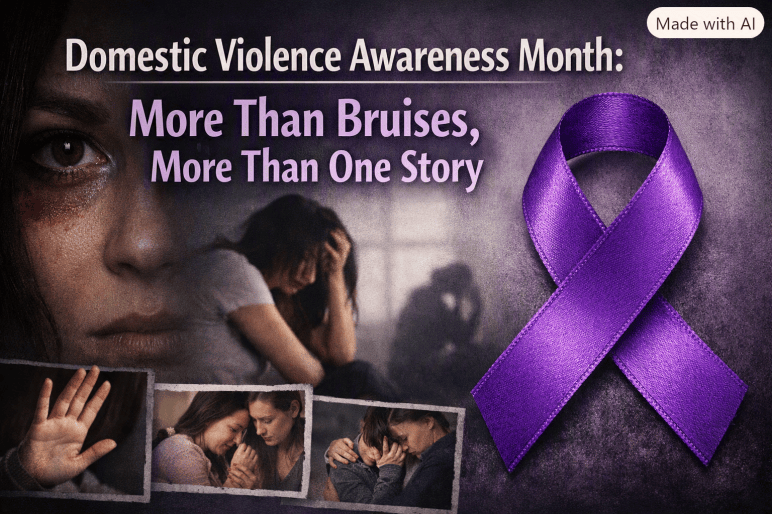
This month isn’t just a purple ribbon or a hashtag. It’s a national reckoning. A month carved out because silence has killed too many. Shame has trapped too many. And judgment has wounded too many who were already bleeding. It exists because domestic violence is not one thing. Not one story. Not one bruise. It’s a whole constellation of harm that is emotional abuse, financial control, spiritual manipulation, psychological warfare, sexual coercion, digital stalking, physical stalking, rape, threats, intimidation, and isolation. All of it real. All of it dangerous.
And Lord knows, the Deep South has a long tradition of saying, “Well, why didn’t she just leave?” With the same tone they use when asking why you didn’t bring potato salad to the church potluck. But today we’re not whispering. We’re not sugarcoating. We’re not letting judgment drown out truth.
Domestic violence is more than bruises. More than shouting. More than slammed doors. It’s the slow erosion of your identity. It’s the constant fear humming under your skin. It’s the way you learn to read someone’s footsteps like weather patterns. It’s the way you shrink. Fold. And contort yourself trying to keep the peace that never stays peaceful.
And let me say this with all the Southern sass I can muster. If you’ve never lived it, you don’t get to judge it. Because “just leaving” is a fantasy sold by people who have never had their life threatened. Their finances controlled. Their spirit manipulated. Or their faith weaponized against them. I know this because I lived it. Fourteen years in a domestic abuse situation that nearly swallowed me whole. The cycle wasn’t simple. It was a trap crafted with precision love bombing, threats, and intimidation. That is continuously repeated until you forget what freedom feels like.
I didn’t stay because I was weak. I stayed because I was scared. I stayed because I was conditioned. I stayed because every exit felt like a death sentence. And let me make something crystal clear. It wasn’t a billionaire. It wasn’t a senator. It wasn’t a monster hiding in the shadows. It wasn’t an immigrant. It wasn’t a drag queen with a story book. It wasn’t a trans person. It wasn’t a black person. It was a white, “Christian” man in the Deep South. One who used the Bible like a weapon. While twisting scripture into shackles. Preaching submission while practicing cruelty. A man who believed control was his God-given right. And fear was his favorite language.
That’s why Domestic Violence Awareness Month matters. Because abuse doesn’t look like one stereotype. Survivors don’t fit one mold. Judgment is easy. But understanding saves lives. It is a promise. A collective vow that we will speak loudly. Love fiercely. And refuse to let anyone’s suffering stay hidden behind closed doors.
And now, let me drop this mic so hard the ancestors stand up and clap. I survived what was meant to break me. I reclaimed what was stolen from me. And I will never apologize again for the fire in my voice. Thanks for reading! What have been your experiences?
Affirmation: I honor my survival, my truth, and my healing. I am worthy of safety, love, and a life without fear.
“PTSD doesn’t check uniforms. It checks histories. And some of us survived wars nobody ever saw.”
-This Puzzled Life
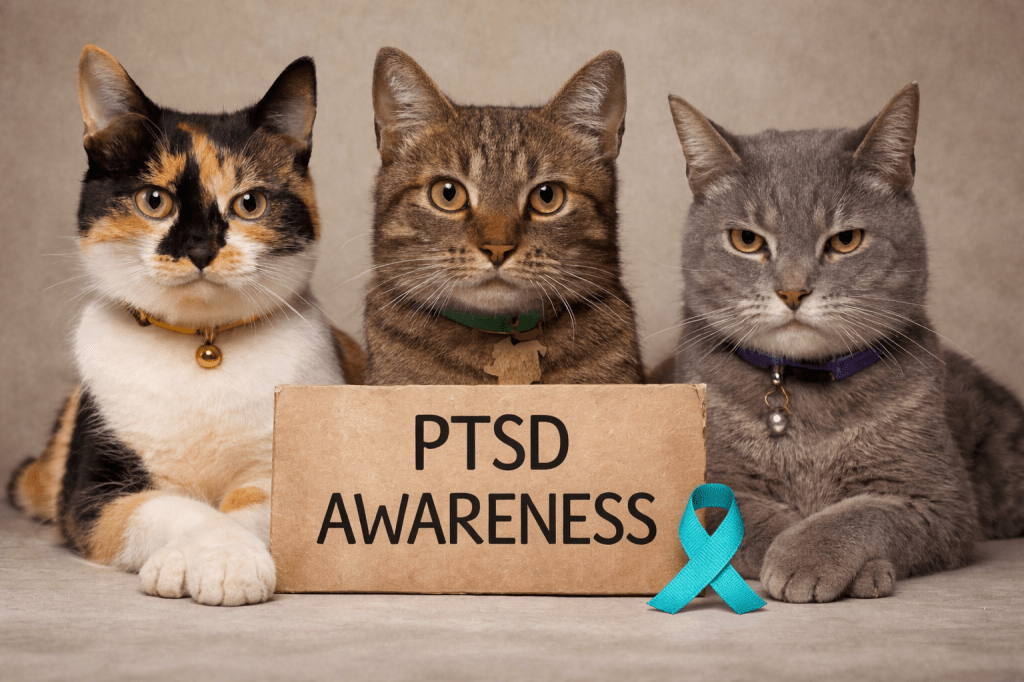
Light the charcoal. Sprinkle the sage. Today we’re not just cleansing the room. We’re cleansing the generational nonsense that keeps trying to set up a timeshare in our nervous systems. And apparently we’re gonna need both if we’re talking about PTSD. And the world still thinks it only comes issued with a uniform, dog tags, and a government contract.
I’m standing in my kitchen like a bootleg priestess of the Deep South. I’m waving smoke around like I’m trying to reboot the Wi‑Fi of my soul. The sage is burning. The charcoal is crackling. And my cats are staring at me with the same expression Southern aunties use when you tell them you’re “working on your boundaries.”
The air is thick with incense and unprocessed childhood memories. The vibe is “haunted but trying.” The soundtrack is the soft hum of trauma responses warming up like an old truck in winter.And behind me, my cats have formed a semi‑circle like a furry tribunal.
Piper: “Is this the trauma purge or the ‘Mama read another psychology article’ ritual?”
Tinkerbell: “No, this is the one where she tries to heal her inner child but ends up reorganizing the spice cabinet.”
Coco: “I’m only here because she dropped a Cheez-It earlier. And I’m hoping for a sequel.”
Meanwhile, I’m over here trying to explain to the universe loudly, with hand gestures, that PTSD is not some exclusive club where you need a military ID and a buzz cut to get in. Trauma doesn’t check credentials. Trauma doesn’t ask for your DD‑214. Trauma shows up like, “Hey girl, I heard you survived something awful. Mind if I stay forever and rearrange your brain chemistry?” And the universe is like, “Sure, pull up a chair.”
So here we are. Me, my cats, my sage, my charcoal, my trauma, and my determination to laugh about it before it eats me alive. If there’s one thing the South taught me, it’s this, “If you can’t laugh at your pain, it will absolutely laugh at you first.”
Let me set the scene. I’m standing in my kitchen. Sage smoking like I’m trying to summon every ancestor who ever survived a generational curse, a bad haircut, or a church potluck. My cats are watching me like I’m performing a ritual to resurrect the last bag of Temptations.
Piper squints at me.
Piper: “Is this the trauma cleansing or the insomnia exorcism? I need to know which meeting I’m attending.”
Coco: “Wake me up when the stinky flower medicine comes out. That’s when she stops pacing like a raccoon in a Dollar General parking lot.”
Tinkerbell: “Neither. This is the ‘Mama read something online again’ ceremony.”
Every time I talk about PTSD, somebody somewhere says, “But you weren’t in the military.” And I’m like, “Correct. But I was in my childhood. And frankly, that was its own kind of deployment.” PTSD does not check your résumé. It does not ask for your service record. It does not care if your trauma came from a battlefield, a backwoods childhood, a toxic relationship, a medical emergency, or that one time your mee-maw threw a shoe at you with the accuracy of a Navy Seal. Trauma is trauma. And PTSD shows up like an uninvited cousin at Thanksgiving. It’s loud. Unpredictable. And absolutely refusing to leave. Meanwhile, my cats are holding their own support group.
Piper: “Her insomnia is so bad I’ve started sleeping in shifts.”
Coco: “I tried to keep up once. I saw the sun rise twice in the same day. I’m still not okay.”
Tinkerbell: “I’ve filed a formal complaint with HR. HR is also her. It’s not going well.”
Big Pharma has a pill for everything. Which including the side effects of the pill you took for the side effects of the pill you took for the original pill. And half of them end up in lawsuits. And apparently the medication was also causing spontaneous combustion or turning people into werewolves. Meanwhile, cannabis is over here like, “Hey girl, wanna sit down and breathe for a minute?” And when I pull out the flower medicine, the cats perk up like I just announced a family meeting.
Piper: “Ah yes, peace is coming.”
Coco: “Finally, she’ll stop reorganizing the pantry at 3 AM.”
Tinkerbell: “Blessed be the bud that calms the beast.”
Suddenly the whole house exhales. The walls stop vibrating. The anxiety gremlins go back to bed. The cats reclaim their rightful positions as tiny loaf-shaped monarchs. And with the current state of our nation, the number of people developing PTSD is probably about to skyrocket. We’re all one news headline away from needing a weighted blanket, a therapist, and a federally funded emotional support possum.
If you’ve got PTSD and you didn’t get it from war, guess what? You’re not alone. You’re not broken. You’re not dramatic. You’re not “overreacting.” You’re just a human who lived through some stuff that your brain is still trying to file correctly. And if anyone tries to tell you PTSD is only for soldiers, send them my way. I’ll let 13 explain it. She’s the mean one.
Roll the flower. Because healing isn’t a uniform. It’s a revolution. And in this house, we honor every survivor, every story, and every cat who has ever witnessed a 4 AM trauma spiral and stayed anyway. Thanks for reading! And keep moving forward.
Affirmation: My trauma is valid, my healing is sacred, and I refuse to shrink my story just because someone else can’t imagine surviving it.
“Trauma doesn’t make you weak. It makes you a witness to your own survival.”
-This Puzzled Life
Light the charcoal. Sprinkle the sage. Let the smoke rise like it’s clocking in for a shift. And let the air shift like it’s bracing itself for whatever truth you’re about to drag into the daylight. Today isn’t about pretending everything’s fine or slapping a smile on top of a wound. It’s not about the vibes, snacks, or cats doing interpretive dance in the sunbeam. It’s about trauma awareness. It is about naming the things we survived. The things we carried alone. The things we laughed through so we wouldn’t crumble. It’s a Southern‑fried, emotionally honest, and funny enough to keep you from dissolving into a puddle on the kitchen floor.
Trauma Awareness is the kind that hides in your shoulders, jaw, breath, memories, and your jokes. And if we’re going to talk about it, we’re going to do it the only way I know how. Complete with honesty, humor, and the kind of emotional courage that feels like taking your bra off after a long day. It’s painful, relieving, and absolutely necessary.
There’s a moment right before you talk about trauma where your whole spirit goes, “Are we sure we want to do this?” It’s the same tone you use when someone says, “Let’s just run into Walmart real quick.” You know it’s not going to be quick. You know you’re going to see something you can’t unsee. You know you’re going to come out changed. Talking about trauma is like that. Except instead of a man in pajama pants buying raw chicken and fireworks, it’s your nervous system holding up a sign that says, “We’ve been through some things, ma’am.”
Trauma doesn’t just show up when you’re ready. Trauma is that one cousin who arrives early. Eats all the good snacks. And then says, “Why you look stressed?” It pops up at the worst times especially when you’re trying to relax. When you’re trying to sleep. When you’re trying to enjoy a sandwich. When you’re trying to mind your business. And when you’re trying to be a functioning adult for five minutes. Trauma will tap you on the shoulder like, “Hey bestie, remember that thing from 1998? No? Well, I do.” And suddenly you’re staring at the wall like it owes you money.
Your body remembers everything. Even the stuff you tried to bury under humor, iced coffee, and pretending you’re fine. You’ll be walking through Wal-Mart. Touching a throw pillow. And your body will whisper, “Hey, remember that time?” And you’re like, “No I do not. I am touching a pillow. Let me live.” But trauma doesn’t care. Trauma is like a Southern grandmother with a memory like a steel trap. And no sense of timing.
People talk about healing like it’s a spa day. Let me tell you something. Healing is not cucumber water and a robe. Healing is crying in the shower because your shampoo smells like 2007. Healing is realizing you’ve been clenching your jaw since the Bush administration. Healing is sitting in your car after therapy like you just got hit by an emotional freight train. Healing is messy. Healing is loud. Healing is quiet. Healing is confusing. Healing is holy. Healing is exhausting. Healing is worth it. But cute? Absolutely not.
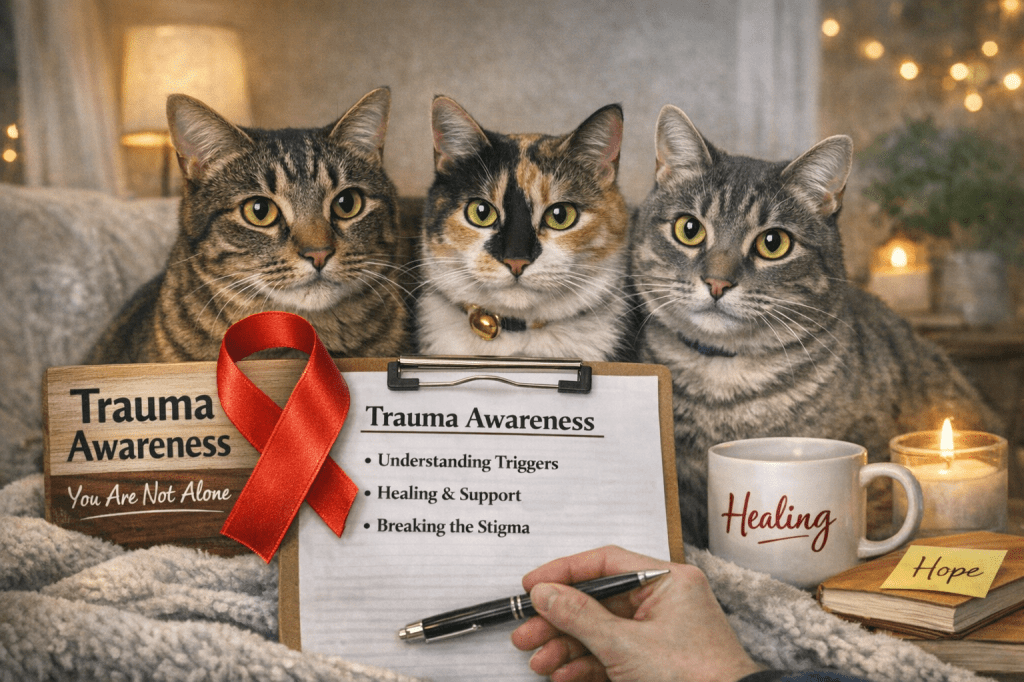
So, buckle up. Because the cats have decided it’s Trauma Awareness Hour. And apparently they’ve all been waiting their whole lives to trauma dump with the enthusiasm of a group therapy circle run by toddlers. And today is the day they ask deeply personal questions with the emotional sensitivity of a toddler holding a chainsaw. They have formed a circle. They have snacks. They have opinions. And apparently, they have questions about my trauma.
Me: “Okay, girls. Today we’re talking about trauma. Share whatever you feel comfortable with.”
She raises paw like she’s in kindergarten
Piper: “I’ll go first because my story is the most dramatic. Obviously.”
Coco: “Oh lord.”
Tinkerbell: “Let the child speak. She needs this.”
Piper: “So picture this. Me and my siblings. In a metal box. In the Mississippi heat, basically sautéing like tiny furry cornbread muffins.”
Me: “Baby, that’s awful.”
Piper: “I know. I was basically a rotisserie chicken with trauma.”
Coco: “You were a sweaty raisin with opinions.”
Piper: “Anyway, I survived because I’m dramatic and stubborn. And now every time the sunbeam hits me wrong, I flop over like a Victorian woman fainting at a garden party.”
Tinkerbell: “You faint because you forget to breathe when you get excited.”
Piper: “Trauma. Tinkerbell. Let me have this.”
Coco clears throat like she’s about to deliver a TED Talk
Coco: “My siblings and I were found under a house. A house. Do you know what lives under houses? Darkness. Ghosts. Tax evasion. I was basically a feral raccoon with trust issues.”
Me: “You’ve come so far.”
Coco: “Yes. And now I cope by judging everyone. It’s called growth.”
Piper: “You judge me the most.”
Coco: “You give me the most material.”
Tinkerbell: “I don’t remember my trauma.”
Me: “At all?”
Tinkerbell: “No. I simply chose not to be present. I was spiritually unavailable.”
Coco: “You had worms.”
Tinkerbell: “Yes, apparently my intestines were hosting a music festival.”
Piper: “You pooped like you were trying to summon something.”
Tinkerbell: “I was summoning peace. And a vet. Preferably both.”
Me: “You really don’t remember anything?”
Tinkerbell: “I remember diarrhea. And then I remember you. Everything else is optional.”
Me: “Well, we’ve all been through some things.”
Piper: “Yeah, but now we’re together! A family! With two crazy brothers who scream at dust!”
Coco: “We are a support group. A dysfunctional one, but still.”
Tinkerbell: “We heal one memory at a time. Preferably with snacks.”
Piper: “And naps!”
Coco: “And boundaries. Mostly for Piper.”
Piper: “I don’t believe in boundaries.”
Tinkerbell: “We know.”
Piper: “Sometimes I get scared when it’s hot outside. So, I cope by yelling at the sun.”
Coco: “I cope by staring at people until they feel bad.”
Tinkerbell: “I cope by leaving my body spiritually whenever something stressful happens. Like when the vacuum turns on. Or when Piper breathes too loud.”
Piper: “I have big emotions.”
Coco: “You have no volume control.”
Tinkerbell: “You have the energy of a toddler who drank a Red Bull.”
Piper: “Momma, what is your trauma about?”
Me: “Oh absolutely not. We are not opening that can of worms. We’ll be here until this time next year. And I don’t have enough snacks or emotional stamina.”
Coco: “Is that why you have panic attacks in Walmart?”
Me: “Yes.”
Tinkerbell: “But what’s scary about going to the pharmacy?”
Me: “Everything.”
Piper: “Everything?? Like the shelves? The people? The lighting?”
Me: “Yes.”
Coco: “The lighting is aggressive.”
Tinkerbell: “The vibes are hostile.”
Piper: “The blood pressure machine is a demon.”
Me: “Exactly.”
Coco: “So what did our therapist tell you?”
Me: “She said, ‘I’ll see you in another couple of days.’”
Tinkerbell: “Translation: ‘You’re a lot. But I believe in you.’”
Piper: “Translation: ‘You have so many issues we need a punch card.’”
Coco: “Translation: ‘You’re keeping the lights on in that office.’”
Me: “But look at us now. We’re safe. We’re loved. We’re healing together.”
Piper: “And we have snacks!”
Coco: “And stability.”
Tinkerbell: “And indoor plumbing.”
Me: “We survived things we never should’ve had to survive. And now we get to build something soft and silly and sacred together.”
All Three Cats: “Group hug!”
Coco: “But don’t touch me too long.”
Piper: “I’m crying!”
Tinkerbell: “I’m dissociating!”
Me: “Perfect. Exactly the emotional range I expected.”
In small Southern towns, admitting trauma is treated like a social crime. The moment you name what happened, you’re not just telling your story. You’re “disgracing the family,” “embarrassing the community,” and threatening the carefully polished illusion of stability that everyone works so hard to maintain. The culture teaches people to swallow their pain. Protect the reputation of the town at all costs. And never, under any circumstances, call out the people who caused the harm. And because the “good ole boy” network is alive and well. And sitting in every position of authority from the courthouse to the church pews, the truth gets buried right alongside the accountability. Even when the perpetrators are known. Especially when they’re known. Nothing is done. The silence is enforced. The victims are shamed. And the town keeps smiling for the church directory photo like nothing ever happened. But the truth doesn’t disappear just because the town refuses to look at it. It lingers in the air, the families, the generations, waiting for someone brave enough to break the cycle and say, “This happened. And it mattered.” And I am that one in my family who refuses to stay quiet about the trauma that happened in the small city of Petal, MS.
Trauma will have you doing things that make absolutely no sense. Things like apologizing to furniture when you bump into it. Jumping at sounds that aren’t even loud. Overthinking texts like you’re decoding ancient scripture. Saying “I’m fine” in a tone that suggests you are, in fact, not fine. And crying because someone said, “I’m proud of you.” And your body wasn’t prepared for that level of kindness. Trauma will also make you emotionally attached to random objects. A mug. A blanket. A rock you found on a walk. A pen that writes really smooth. Your brain will be like, “This is my emotional support spoon. Touch it and perish.”
Trauma awareness isn’t about reliving the pain. It’s about naming it, so it stops owning you. It’s about understanding why you react the way you do. It’s about giving yourself grace for surviving things you never should’ve had to survive. It’s about learning that your triggers aren’t flaws. They’re evidence that you lived through something real. And it’s about knowing you’re not broken.
You’re healing. You’re growing. You’re learning how to breathe again. You’re learning how to trust softness again. You’re learning how to exist without bracing for impact. That’s not weakness. That’s strength with stretch marks.
May your healing be gentle. May your memories lose their sharp edges. May your nervous system unclench one muscle at a time. May your heart learn safety. May your voice return to you. May your laughter come back louder. May your story be yours again. And not something that happened to you. But something you rose from.
So, if no one told you today. You’re not dramatic. You’re not broken. And you’re not “too much.” You’re a whole human who lived through storms that would’ve snapped lesser souls in half. And you’re still here healing. Laughing. Unlearning, Softening. Reclaiming. That’s not survival. That’s resurrection. And baby, if that isn’t holy, I don’t know what is. Drop the sage. Keep the truth. And walk away knowing this. Your story didn’t end in the dark. You did.
Affirmation: I honor the parts of me that survived. I honor the parts of me that are still healing. I am allowed to grow, to rest, to feel, and to reclaim my peace. And I can do it one breath at a time.
“I had gotten to the point where I was suicidal every day for six straight years…On that day, I made a choice. The choice to live, the choice to get better for me.”
-Justin
Light the charcoal. Sprinkle the sage. Negative energy, go away. Today, I want to tell you about a couple more suicide awareness and prevention groups. I wish I could cover them all. Unfortunately, there are just way too many. Please familiarize yourself and those you love and are affected.
Stop Soldier Suicide
This is the only national nonprofit focused on solving the issue of suicide among U.S. veterans and service members. They have an aggressive goal of reducing the suicide rate by 40% by 2030. Veterans are at a 58% higher risk of suicide than those who haven’t served.
Other statistics about veteran suicide:
· 6,407 veteran suicides in 2022.
· 22 consecutive years with 6000+ veteran suicides.
· 140K+ veterans have died by suicide since 2001.
· Second leading cause of death in veterans under age 45.
· The rate of veteran firearm suicide has increased by 65%.
· The suicide rate among veterans ages 18-34 has more than doubled.
· Western states have experienced the greatest increase in veteran suicide rate, increasing by 55%.
· 31% Depending on branch, up to 31% of service members develop PTSD after returning from combat.
· 7x the rated of suicide for veterans in the LGBTQ+ community is up 7x higher that for non-LGBTQ+ veterans.
The organization’s impact on veteran suicide.
· 90%+ of our most at-risk clients completed a crisis response plan in 2023, giving them tools and resources to cope in moments of crisis.
· 73% of clients experienced a decrease in thoughts of suicide over the course of treatment.
· 92% of clients who were meaningfully engaged in our care showed some improvement in mental wellbeing by the end of treatment (www.stopsoldiersuicide.org, 2025).
The Trevor Project
The Trevor Project was founded in August 1998 by the creators, James Lecesne, Peggy Rajski, and Randy Stone, of the Academy Award-winning short film “Trevor.” The film was about a gay teen who attempted suicide. The filmmakers then established a crisis hotline for LGBTQ+ youth after realizing that there was not a resource available. They have since expanded services to include text and chat support and resources for parents, schools and others seeking support for LGBTQ+ support (https://obamawhitehouse.archives.gov, 2025).
Crisis Services: Providing counseling support services for LGBTQ+ young people 24/7 all year around.
Peer Support: Providing an affirming international community for LGBTQ+ youth.
Advocacy: Working to change hearts, minds, and laws in support of LGBTQ+ lives.
Research: We conduct research studies to equip policymakers and other LGBTQ+ youth providing professionals.
The Mission
To end suicide among LGBTQ+ youth by providing crisis support, suicide prevention resources, and educational programs (www.thetrevorproject.org, 2025).
Thanks again for reading. The more education and resources we can provide each other with, the better the outcomes for us all. Please pass this information along to anyone who could benefit. I am one of those who suicide has affected my life in epic proportions. I am also one who continues to fight for understanding and compassion in a world that is lacking.
Affirmation: I am not alone, and others care about me.
“When you feel like giving up, just remember why you held on for so long.”
-Hayley Williams
Light the charcoal. Sprinkle the sage. Negative energy go away. Today, I want to talk about some myths regarding the topic of suicide. I was first exposed to suicide at the age of thirteen. One of my friends and classmate committed suicide when we were in the eighth grade. As a child, how do you manage that? I can tell you that among all of the major events in my life that has changed me in some way, the day that I lost my friend to suicide will always rank high on my list. I think, though, that the biggest impact for me was how our teachers and school administrators dealt with the situation.
I grew up in the 1980’s when child and adolescent mental health was rarely recognized. And, honestly, my generation was sort of left with the attitude of “figure it out yourself.” Situations that left gaping wounds were merely glossed over. And so, me and other friends and classmates turned to a life of addiction and suicide. As a teen who was being abused daily by a teacher, and the complete lack of protection from the adults, I was forced to just “figure it out.” I did it in total “self-preservation mode.” The behaviors that I developed were not healthy, but they were there when no one else was.
In the 35 years since my friend’s suicide, I have lost a lot more friends. And sadly, I have built walls all throughout my life that continue to help me through my pain. The one thing that has seemed to resonate through the years is how religion constantly attacks those who have been through the most. And I grew up being marinated in the ideology that suicide was “selfish,” “a sin,” “immediate condemnation to hell,” “the easy way out” and the most “self-centered” act known to man.
A lot of the “indoctrinating messages” I was raised to believe, life made me realize how very untrue and damaging they are and will continue to be. I have been on all sides of suicide. And from a personal standpoint, those beliefs couldn’t be any farther from the truth. Below are a few common myths regarding suicide.
Myth 1: Talking about suicide increases the chance a person will act on it.
Fact: Talking about suicide can reduce rather than increase suicidal ideations. It improves mental health related outcomes and increases the likelihood that someone will seek treatment.
Myth 2: People who talk about suicide are just seeking attention.
Fact: People that die from suicide have often told someone about not wanting to live anymore. And it’s always important to take it seriously. In my own family, these statements have rung true. Or most often, those statements are ignored.
Myth 3: Suicide can’t be prevented.
Fact: Suicide is preventable but unpredictable. Most people have experienced intense emotional pain, hopelessness and a negative view on life and the future. Suicide is a product of genes, mental illnesses and environmental risk factors. Intervention can and does save lives.
Myth 4: People who take their own lives are selfish, cowardly or weak.
Fact: People don’t die of suicide by choice. The emotional pain that they experience makes it difficult to consider different views. Have you ever turned a gun on yourself? I have.
Myth 5: Teenagers and college students are the most at risk of suicide.
Fact: Suicide rates for that age group is below the national average. The age groups with the highest rate of suicide in the U.S. are women 45-64 and men 75 and older. Suicide is a problem among all ages and groups.
Myth 6: Barriers on bridges, safe firearm storage and other actions that reduce access to lethal methods of suicide don’t work.
Fact: Limiting access to lethal means of harm is one of the most straightforward strategies to decrease the chances of suicide.
Myth 7: Suicide always occurs without warning.
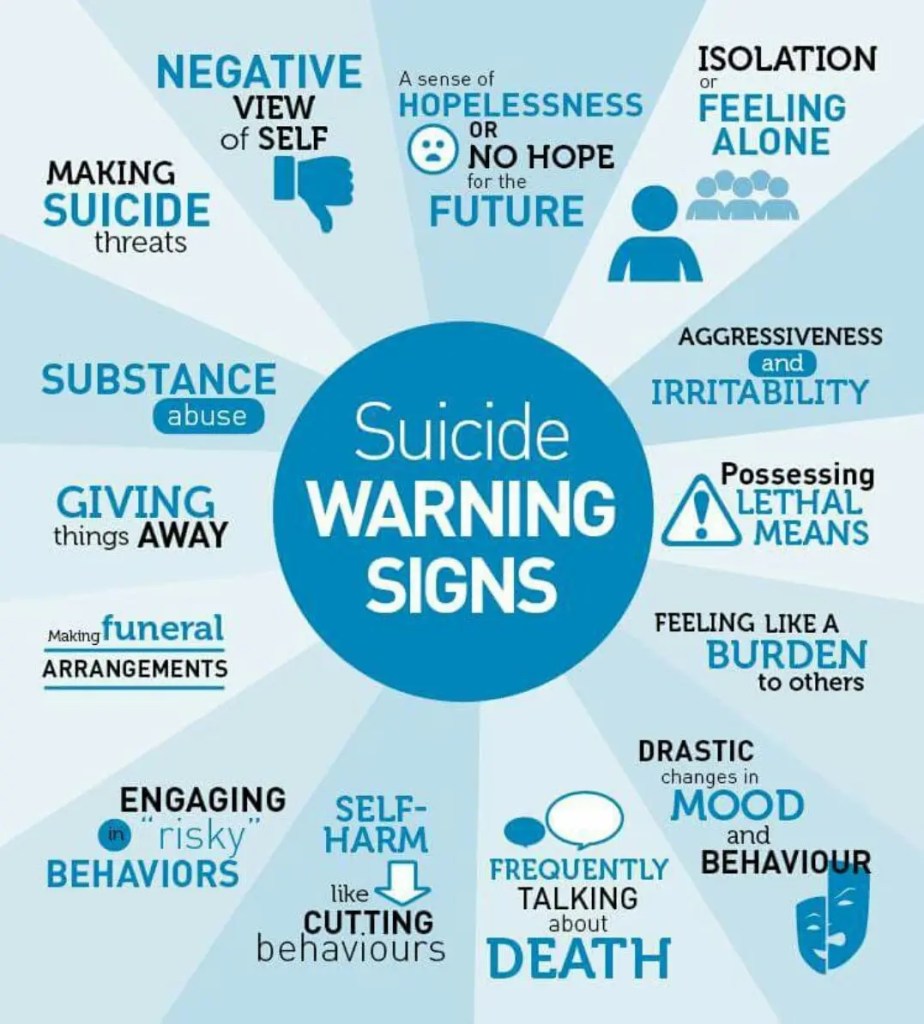
Fact: There are almost always warning signs before a suicide attempt.
Myth 8: Talk therapy and medications don’t work.
Fact: Treatment can and does work. I don’t agree with big pharma for many reasons. I guess, though, “life over limb.” Lives are saved with both therapy and medication. Therapy has saved my life for many years now. But finding the right one to work with can be taxing. Most people who are in the helping profession do help rather than harm (mayoclinichealthsystem.org, 2025).
Myth 9: You have to be mentally ill to think about suicide.
Fact: 1 in 5 people have thought about suicide at some time in their life. Not all people who die by suicide have mental illnesses at the time they die.
Myth 10: People who are suicidal want to die.
Fact: The majority of people feeling suicidal do not actually want to die; they just want the situation they’re in or the way they’re feeling to stop.
Myth 11: Most suicides happen in the winter months.
Fact: Suicide is complex and not just related to seasons or the climate. Suicide is more common in the spring and a noticeable peak on New Year’s Day.
Myth 12: You can’t ask someone if they’re suicidal.
Fact: Evidence shows that asking someone if they’re suicidal could protect them (Samaritans.org, 2025).
Myth 13: Strong faith prevents suicidal thoughts.
Fact: Many deeply religious figures including biblical figures have experienced suicidal thoughts. The misconception that strong faith eradicates mental despair is false. Faith doesn’t guarantee protection from difficult emotions and struggles.
Myth 14: Suicide indicates a lack or abandonment of faith.
Fact: Suicidal ideation is viewed from different perspectives. Suicide does not inherently mean that someone has abandoned their faith.
Myth 15: Fear of religious repercussions is a sufficient deterrent for suicide.
Fact: For some maybe the fear of divine punishment can be a factor. However, many faith communities emphasize grace and forgiveness, even for those who die by suicide. And personally, I have rarely seen grace and forgiveness on this topic.
Myth 16: Religion or faith alone is enough to prevent suicide.
Fact: Studies show inconsistent findings regarding the protective effect of religious affiliation on suicide risk. It is crucial to understand that faith alone is not a guarantee against suicide and should not replace professional mental health interventions when needed (https://pmc.ncbi.nim.nih.gov, 2025).
I hope at the very least that some of the myths regarding suicide have been explained. My own personal suicidal feelings have been dismissed the majority of my life. And no amount of “bible beating” has ever helped. It has only made things much worse than they already are. And some of the statements made disguised as “help” by family members, are not help. The statements are just toxic. Saying that you have “x” amount of years living and never considered suicide isn’t helpful. Please don’t play therapist when you’re not one.
Put harmful judgments in the trash where they belong. Love and appreciate those that you love. Because it can all change in an instant. Quit making “their” suicidal feelings about “you.” Because it’s not. And always remember, “Just because someone has a smile on their face doesn’t mean that they’re not suicidal.” Thanks for reading! As always, take what you can use and leave the rest.
Affirmation: I am overcoming depression one step at a time.
“This life. This night. Your story. Your hope. It matters. All of it matters.”
-Jamie Tworkowski
Light the charcoal. Sprinkle the sage. Negative energy go away. Thank God, we have made it through most of the hottest months of the year. September is another sticky, humidity filled month before the beginning of the cool down. September is also Suicide Awareness and Prevention Month. I know, it’s another upbeat topic. I think that the topic of suicide shouldn’t be taboo. It’s an unfortunate dark part of nearly every culture. And, yes, it has also affected my life in many ways which I’ll share.
Suicide has always been referred to as “the easy way out,” “selfish action,” a “total disregard for friends and family,” and the most hurtful “a sin.” And it’s really easy for people to throw out opinions that help no one when they are struggling. That is minimizing their pain and abuse.
Having been not only a patient in the mental health system for the majority of my life, and working in the mental health field as a professional, I have also seen and been on most sides of this problem. People are so quick to judge what they don’t understand. And, sadly, suicide is a topic that tends to be discussed in judgment versus with compassion.
I have been chronically suicidal since I was a teenager. I was being abused and put on display for others to see for an entire year in school. I was also locked in a closet in that same room while being verbally abused in any way imaginable. I tried to tell adults about what was going on. However, I was made to feel like it was my fault. This helped the teacher to further perpetrate her abuse. My parents also made me apologize to her for comments that I made to her. But as their child, I was not protected by them or the administration. I was in a difficult situation without the possibility of brighter days ahead for the future.
My suicidal feelings got the best of me one day at school when I took forty aspirin. I had no idea, at that time, that it wouldn’t work. But the thought of continuing one more day at the hands and mouth of s purely evil woman was more than I could deal with. My parents were called and made aware. Nothing was ever done. I was never provided with any kind of help. Maybe it was the “standard” of the late 1980s. I was not given the emotional support to sort out my trauma.
What I did begin doing was self-harm. I had no idea what it all meant, at that time. But I knew that it made things better even if for just the moment. As I’ve stated about my family’s dysfunctional dynamics, I was told just to make it through the year and everything would be fine. It wasn’t. Yes, the abuse ended. But I was not fine.
By my freshman year in high school, I was “balls to the wall” in addiction. Addiction that presented itself in drugs, alcohol, eating disorders and self-harm. The strongest addiction being self-harm. And 35 years later, it continues.
The depression, anxiety and suicidal ideations never subsided as I was told. One day I finally told my mother that had I had access to a weapon, I was going to kill myself. Instead of offering help, of any kind, I was met with anger and told that I was being selfish. My thoughts were anything but selfish. I was hurting in ways that no one knew. And no one seemed to care. So, I suffered in silence for many years.
As a child/teenager when traumatic events occur, your mind goes directly to self-preservation. You do whatever you can to either tolerate the darkness or end the pain. Meanwhile, the trauma of life continued at a level that no one is capable of dealing with alone. My next real relationship was abuse that lasted 14 years. And again, I felt trapped.
If you don’t understand the concept of Pavlov’s dogs, then you don’t understand what it’s like to be held mentally captive while the world sees your situation with an easy out. And the sad part about it, is that they think that you deserve everything you get because you don’t just leave. My parents attributed all of the chaos of that relationship as being something that religion could fix. So, we got involved in church. If anything, the abuse got much worse because now his weapon was a Bible that he read and used as justification that I should be “submissive” to his every demands. Mentally, I was trapped again without any way out. And my self-harm was not about survival. It was about making the pain end.
I would reach a mental breaking point and would stand out in the front yard where we lived and pointed a gun at my chest and pulled the trigger. The strange part was that I seemed to be witnessing rather than taking an active role. I watched that whole event as a spectator. I don’t expect you to understand the power of dissociation. Most people, in fact, are very ignorant about it. Again, I was met with anger from my mother. She kept saying, “Hush! Hush! Do you want to go back to Pine Grove?” That is the local mental health facility. And at that moment all I needed was compassion. But again, I faced anger and judgment. I wasn’t trying to “take the easy way out” or be “selfish.” I just wanted the pain to end. And everyone seemed to lose sight of that reality but me.
The bullet went into my shoulder only a few inches from my heart. And even hospital staff treated me as though I was taking up space much better suited for someone else. Self-harm became a way of life for me. It’s been there when people should’ve been there. But self-harm doesn’t always mean “suicide attempt.” And this is a very sore subject among family members. But I sit as an outcast by my family who want nothing more than the family name to not be tainted by abnormality. They acknowledge that bad things happen. But they just want it to disappear and to quit bringing shame to the family name and instead just move on with life. But the biggest factor, is that they don’t want to be perceived as “parental failures.” It’s still all about the reputation of the family.
People that is not how trauma works. And saying, “We just didn’t know how to help you” is “shit”of an excuse. I was a child when it began. You were in the position to help protect your daughter and you didn’t. Remember, the part of the story where I said, “Just make it out of the 8th grade and everything will be better.” It’s 35 years later and it’s not better. It has crippled me as an adult. And has stolen my hopes and dreams. And I still deal with suicidal ideations on a daily basis. Those never went away either. So, I guess feeling like a “burden” to those who say that they love me but treat me as such will forever be the unhealthy narrative. I’ve asked them to do therapy to help with our relationship. But again, it’s of no importance. And the unspoken belief that I’m unworthy continues.
I wrote this blog to say this, “Quit making someone’s struggle with suicidal thoughts and actions be all about you. You are not helping anything. You only make it worse.” Simply say to them, “Your thoughts and beliefs are valid. Let’s find some compassionate help that will help you thrive. Throwing Bible verses in their face is not helpful. Telling them that they will go to hell is not helpful. They are already living in an emotional hell.
This is not rocket science! Just don’t be an asshole as a rule of thumb. I have been in the position of being the last one to talk to a person moments before they completed suicide. I can tell you this, “I’m not mad at that person. I don’t condemn their actions. I don’t say, “Well I guess they’re in hell now. How selfish of them.” I simply say, “I hate that they were in so much pain that nothing anyone said could break through the cloud of despair.”
Until you’ve been in that position, you have no idea how strong emotions and thoughts are. And if the person felt like they had exhausted all of their means of trying to end the pain in an acceptable fashion, then they see no other way out. Judgmental comments about, “well, they didn’t seek out every source of help” is you seeing in from your perspective only. If you can’t see it from their perspective, you’re one of the lucky ones. Thanks for reading! Take what you can use and leave the rest.
“Always remember, if you have been diagnosed with PTSD, it is not a sign of weakness; rather, if is proof of your strength, because you have survived!”
-Unknown
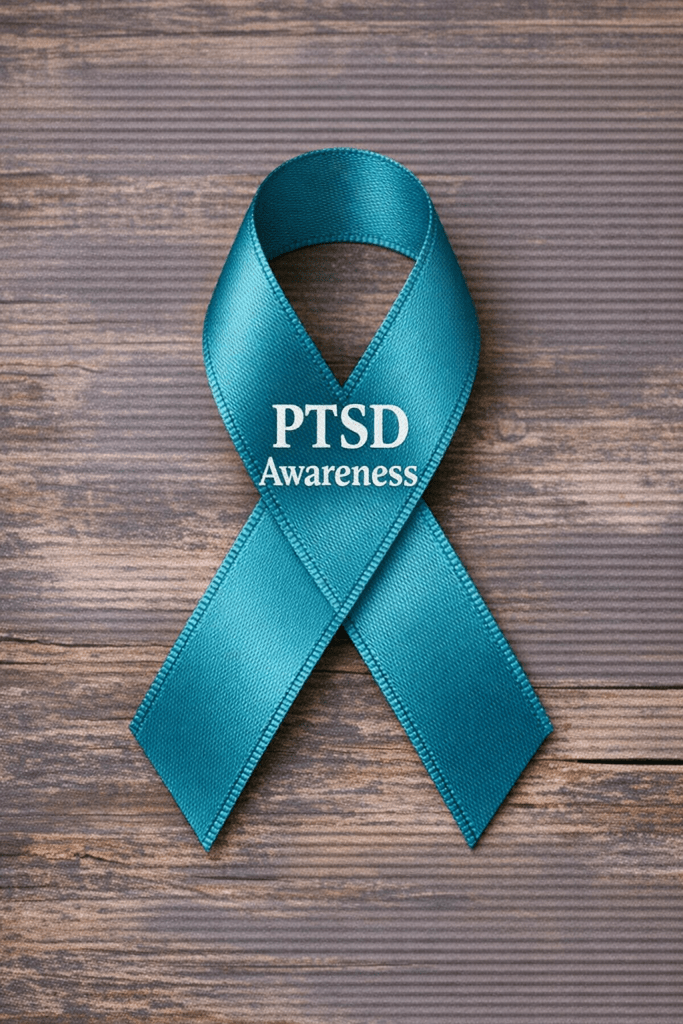
Light the charcoal. Sprinkle the sage. Negative energy go away. Today, I want to take time out from celebrating Pride, to give light to National PTSD Awareness Day. This one hit hard as I’ve lived with PTSD longer than I’ve lived without it. And there are so many of us who don’t make it to the other end of the tunnel. It’s an incredibly dark place to wake up to and go to sleep with every night.
Post Traumatic Stress Disorder (PTSD) dates back to ancient civilizations and military conflicts. Terms used early on included “combat-related stress,” “shellshock,” “combat fatigue,” and “railway spine.” In the 1800s and early 1900s, the “talking cure: was popularized by Sigmund Freud and introduced in medical literature. And the treatment went from psychoanalysis to electric shock treatment. By the 1950s, the treatments had become more humane. However, now people would not admit to any traumatic symptoms due to the stigma. So, group therapy and psychotropic medications were introduced (blackbearrehab.com, 2025).
In the 1970s Vietnam veterans began experiencing a lot of psychological problems that persisted even after returning home. And survivors of domestic abuse were also included. In the 1980s, PTSD was officially recognized as a mental health problem. Diagnostic and Statistical Manual of Mental Disorders adopted the diagnosis where it has remained (blackbearrehab.com, 2025).
PTSD is a developed from a traumatic event. C- PTSD when a traumatic event continues for months and years or multiple events occur. The intrusive thoughts, flashbacks, insomnia, avoidance, memory problems, detachment from friends and family, feeling emotionally numb, hyper startle, irritability, trouble concentrating, impulsive behavior, paranoia, severe anxiety, nightmares, suicidal ideations and actions and uncontrollable thoughts about the event. And over time, these symptoms completely devour who you once were (MayoClinic.org, 2025).
I know that PTSD is typically related to soldiers. I am here to tell you that I never went into the military. But the PTSD that I deal with, as a result of domestic violence, grabbed hold of me and has never let go. It has completely stripped me of everything that I used to enjoy. I don’t care about relationships. I question people about their intentions, even if they’re pure and good. I’m constantly waiting for the next shoe to drop. I don’t have typical reactions to being scared. I could see a moth out, of the corner of my peripheral vision, and then jump and scream like Jeffery Dahmer was staring at me and about to take the first bite. I face the stigmas of both friends and family mainly due to a lack of understanding. However, the reasearch information is everywhere. Sometimes others just need to their own leg work. I have come to realize that instead of trying to find out how PTSD affects someone that you love, it’s “the easy way out” to just to be dismissive, embarrassed and judgmental instead. The attitude is “just change X behavior.” Without having a solution, the resounding message of “just make it go away” further ostracizes the person that you say you care about. And so the anticipated glimmer of hope dissipates further isolating the individual. And sadly, can lead to suicide.
PTSD is not about you, it’s about them. It’s just a diagnosis until it’s “you” that experiences it every day. It has taken me down to the point of putting a gun in my mouth. And because living in the abuse was so severe, I actually pulled the trigger after pointing the gun at my torso. It missed my heart by only a few centimeters. Nothing was messed up to the point of needing surgery. But self-harm is something that I’ve dealt with since I was a 13-year-old child. And I had no idea how to deal with all the overwhelming emotions of abuse. In that cold, dark closet where I began to self-harm, and as maladaptive as the behavior is, it worked. It was the only thing that worked to bring me back to complete balance. But the problem is that it became a true addiction issue that I continue to struggle with. And before you ask, yes I’ve done a lot of therapy. It’s not that the therapy doesn’t. It’s that the addiction is that strong.
PTSD is a true injury on the brain. The brain’s job is to help you survive in any way possible. So, we reach for anything to help calm the barrage of intrusive thoughts, memories, smells and sounds. And once it’s been damaged through a traumatic event, it creates a “work around” solution. What typically works? Self-harm and substance abuse creates almost instant comfort. You don’t have to wait for 6-8 weeks to reach your therapeutic dose efficacy to begin working. It’s an immediate fix that some of have to use just to stay alive.
Cannabis was recommended when all other “Big Pharma” medications failed. And it has saved my life on a daily basis ever since. Cannabis seems to put a cloud over my brain saying, “Settle just for a moment.” And for that moment, I can take a break from the constant paranoia and overstimulation of a brain that wanted to do nothing more than survive. And that, is my battlefield. It wasn’t in Iraq, Afghanistan or Vietnam. My battlefield is everywhere I go. I fear people and social situations in a way that most cannot understand.
It literally takes me about a week in advance to start prepping to leave my house just to go to pick up medications,that I,unfortunately have to take. But I don’t take anymore psych meds. I was extremely sick, coming off all the meds that I had been begging for over two years to be tapered off. And I got tired of waiting, so I did it myself. I don’t advise this way because it was a really miserable process. However, I was at a point of desperation. And now about 6 months later, I feel like a new human being after the toxic feeling of all the medications. All of my true feelings and emotions have awakened, and I really like feeling somewhat comfortable at times.
My personal opinion is that anyone returning home from the active duty should be handed an ounce of weed the minute they step off the plane to do with as they wish. And it would be perfectly ok if they gave it away. That’s like paying it forward in “Weed-O-Nomics.” As it stands, soldiers come home from a war that never ends. And they are committing suicide at a rate of 22 soldiers a day. And that is less than unacceptable.
As the topic of cannabis continues to circulate among social circles and national politics, I hope that veterans from our military will step out against the shame that is felt from social stigmas. And reach for the plant that can “help take the gun out of your mouth.” Cannabis doesn’t cure PTSD because it wasn’t the one who caused it. But it does make things much more tolerable.
Thanks for reading! Happy Pride everyone!
Affirmation: I am resilient and capable of healing.