This Puzzled Life is a mental health and recovery blog exploring addiction, trauma healing, LGBTQ experiences, humor, and the strange moments that shape us.
“Renaming the world doesn’t rewrite history. It just highlights who’s afraid of it.”
-This Puzzled Life
Light the charcoal, y’all. The ancestors are pacing the porch. The church ladies have armed themselves with holy water. And I’m over here personally apologizing to every ally nation we’ve ever had.
I’m talking to Canada, Mexico, the U.K., France, Germany, Japan, South Korea, Australia, New Zealand, Italy, Spain, Portugal, Ireland, Norway, Sweden, Finland, Denmark, Ukraine, Poland, the Netherlands, Belgium, Greece, Turkey, India and any other I might’ve missed. And honestly anyone else who has had to witness this administration rename the world like it’s labeling leftovers. To our allies, “I’m sorry.” Not all of America has been gaslit into believing every bizarre, ego‑inflated proclamation that comes out of this administration. Some of us still have functioning smoke detectors for nonsense. Let’s begin with the geography crimes.
The Gulf of Mexico → The Gulf of America
Mexico, I’m sorry. We didn’t approve this. We didn’t vote on this. We didn’t even get a group text.
Lake Ontario → Lake of America
Canada, bless your polite hearts. You deserved better than waking up to find your lake rebranded like a discount theme park.
Renaming the Pacific and Atlantic Oceans
The ancestors are clutching their pearls. The religious folks are sprinkling holy water on globes. The oceans themselves are filing cease‑and‑desist letters.
The Strait of Hormuz → “Trump Strait”
To our Middle Eastern allies, “I apologize on behalf of every American who still knows how maps work.”
New Mexico → New America
New Mexico, you are perfect as you are. You don’t need a rebrand. You need this administration to stop treating the U.S. map like a coloring book.
Mt. Rushmore Wants No Part of This
The mountain said “no.” The granite said “no.” The ancestors said, “absolutely not.”
Palm Beach International Airport → Donald J. Trump International Airport
To travelers everywhere: I’m sorry. I’ll walk. I’ll hitchhike. I’ll ride a goat. I’m not stepping foot in an airport renamed during a tantrum.
The Kennedy Center Tantrum
A building honoring a president known for leadership, dignity, and actual public service. Is now being eyed for a name addition that history itself is side‑eyeing. And if not, he wants to tear it down. To the Kennedy family, to historians, to every ally who admired American cultural diplomacy, “I apologize.” Some of us still know the difference between legacy and branding.
ITEMS TRULY WORTHY OF HIS NAME
The National Registry of Unnecessary Renaming
The Federal Complex for Misplaced Documents
The Museum of Executive Tantrums
The Center for Advanced Ego Management
The Department of Unfinished Promises and Overfinished Branding
The National Orange Alert System (for ego emergencies)
The Institute for Mispronouncing Basic Geography
The Hall of “Who Approved This?” Decisions
The Donald J. Trump Memorial Porta‑Facility at Every State Fair
The Trump–Epstein Archive of Investigative Records
The Federal Correctional Complex for High‑Profile Accountability
Rename your oceans. Rename your lakes. Rename your airports. Rename your socks if it helps you sleep at night. But America’s allies? We see you. We respect you. And we apologize for every moment you’ve had to witness this administration treating global geography like a personal scrapbook. History doesn’t bend for branding. Legacy isn’t built with Sharpies. And America, the real America, doesn’t confuse ego with leadership.
The ancestors have spoken. The church ladies have nodded. And the rest of us are still here. Still somewhat sane. And still refusing to call the Pacific Ocean anything but the Pacific Ocean. Thanks for reading! Keep unifying!
Affirmation: I speak truth with humor, courage, and clarity. I honor my allies, my ancestors, and my sanity by refusing to accept delusion as destiny. I stay grounded, powerful, and ungaslit.
“Any government that talks more about genitals than healthcare is not protecting you. It’s projecting.”
-This Puzzled Life
Light the charcoal. Today, we are summoning every ancestor who ever clutched their pearls. Hid their good china. Or whispered, “Lord have mercy” when the preacher said something inappropriate. We are calling forth Aunt Magnolia, Uncle Rufus, Cousin Pearl-with-the-bad-attitude, and every ghost who ever lived through a scandal. But NOT the children and NOT the animals. Unless you want to work for the FBI. Because what we’re about to discuss is not fit for tender souls or creatures who rely on us for kibble. They don’t deserve this level of anatomical chaos.
Today, under the glow of Mississippi humidity and charcoal smoke, we gather to confront a national mystery so bizarre it deserves its own Netflix docuseries. Why is the current administration obsessed with genitals? Not healthcare. Not infrastructure. Not education. Not diplomacy. Nope. Just genitals. Your genitals. My genitals. Genitals they legislate, regulate, investigate, and allegedly crash Grindr with.
Ten Examples Of The Administration’s War On Genitals
1. Bathroom Legislation.
Some administrations build bridges. This one builds bathroom flowcharts. They’ve spent more time deciding who pees and poops where, rather than fixing anything that actually matters. My ancestors are pacing the spirit realm whispering, “Why are grown men so invested in toilets? Why are grown men spending more time thinking about where people pee and poop than fixing anything? If you’re this invested in toilets, go work at Home Depot.
2. The Historic Tradition of Grabbing People by the Genitals
A moment that will live in infamy. A moment that should’ve ended careers. A moment that instead became a personality trait. Sir, that is not a handshake. That is a felony.
3. The Grindr Crashes Heard Across the Nation They swear they’re “traditional.” They swear they’re “family values.” Yet somehow Grindr crashes every time a cabinet meeting ends. Coincidence? That ain’t coincidence. That’s congestion. And every time a Republican Convention gathers, Grindr goes down like it’s been hit by a cyberattack. Y’all keep saying ‘family values,’ but the server logs say, ‘thirsty chaos.’
4. The War on Trans Bodies
Bathroom bans. Sports bans. Medical bans. Everything except banning their own obsession with other people’s anatomy. My ancestors are lighting sage and muttering, “Leave folks alone.” If you’re writing laws about someone else’s anatomy, you’re not protecting anything. You’re just proving you think about genitals more than your own job.
5. The Cabinet of ‘Family Values’ That Keeps Getting Credibly Accused of Everything BUT Family Values
Every week it’s a new scandal. A new accusation. A new “misunderstanding.” My ancestors are exhausted. They need PTO. Family values? The only thing y’all value is plausible deniability.”
6. The Obsession With Policing Drag Shows
Food insecurity? Healthcare? Housing? Nope. Let’s talk about genitals again. My ancestors are throwing sweet tea at the wall. Men in wigs scare you? My mee-maw wore three wigs to church every Sunday. And our founding fathers wore wigs. Grow up.
7. The ‘Protect the Children’ Rhetoric While Ignoring Actual Threats
Men in wigs? Women in wigs? Everyone in wigs? Apparently wigs = danger. If you cared about kids, you’d fix schools. And hold the president, billionaires, and other politicians accountable for crimes against women and children. Not stalking bathrooms like a mall cop with a pelvic fixation.”
8. The Homoerotic Wrestling Events That Follow Anti-LGBTQ Speeches
They scream about anatomy while ignoring actual harm. My ancestors are filing celestial restraining orders. You can’t yell ‘traditional values’ and then host an event that looks like the opening scene of a Grindr hookup. Pick a lane.”
9. The Constant Commentary on People’s Bodies
Sweaty men rolling around in cages. Grunting. Flexing. Followed by an afterparty that mysteriously aligns with Grindr server outages. My ancestors are fanning themselves dramatically. Why do y’all talk about anatomy like it’s a weather report? ‘Today’s forecast: scattered genitals with a chance of hypocrisy.’
10. The Attempt to Regulate Genitals Instead of Governing
Every speech. Every rally. Every interview. Somehow it circles back to genitals. My ancestors are begging for silence. Fix the roads. Fix healthcare. End the “Epstein War on Iran.” Fix literally anything. Stop trying to run a country like it’s a pelvic inspection.”
As the charcoal crackles. And the ancestors lean in like they’re watching a soap opera, let us acknowledge the truth. This administration is not governing. They’re running a full‑time genital surveillance program. They legislate genitals. They comment on genitals. They grab genitals. They crash Grindr with their own genitals. They accuse others of immoral genitals. While their own are out here doing extracurricular activities that would make a church deacon faint.
Meanwhile, the American people are standing here like, “Can y’all please stop talking about crotches and start talking about the country?” But no. The obsession continues. The hypocrisy continues. The scandals continue. And the server outages? Those continue too. Charcoal smoldering. Ancestors dismissed. I delivered every comment like a Southern Beyoncé with a sociology degree and a grudge. Thanks for reading!
Affirmation: My body is not your battleground. My autonomy is not your agenda. My voice is loud. My boundaries are blessed. And my humor is lethal.
“Love is not holy if it requires your child to shrink.”
-This Puzzled Life
Light the charcoal. Invoke the ancestors. Because Lord, they’ve been watching this mess unfold for generations and they are tired. I can practically hear Big Mama in the spirit realm, fanning herself with a church program and whispering, “Baby, go on and say it. They need to hear it.” So, I’m writing this letter. This holy‑ghost‑powered, Southern‑fried, and emotionally charged letter to the parents of LGBTQIA+ kids everywhere. And I’m writing it in the voice of every queer ancestor who had to survive Sunday School shame, back‑pew gossip, and family reunions where the potato salad had more acceptance than they did.
This is a letter from me, a queer adult who lived through the fire. Walked through the brimstone. And still came out smelling like sandalwood and resilience. And I’m not holding back. Sit back while I speak some truth.
Dear Parents, before you bring a child into this world biologically, adoption, or through the “God told me to foster” pipeline, you need to sit with yourself and ask one question, “Am I going to love this child more than my beliefs?” If the answer is anything other than a full‑bodied, chest‑thumping, hallelujah‑shouting yes, then you don’t need children. You need a devotional, a therapist, and maybe a long walk through the woods to talk to Jesus directly.
Let me be clear. Jesus, the actual Jesus, not the one y’all weaponize, never bullied a child. He never told a kid they were going to hell. He never said, “Love thy neighbor unless they’re gay.” He never threw stones at queer folks. He only threw shade at hypocrites. So, if you’re out here being your child’s first bully, oppressor, heartbreak, first source of shame, you are not parenting. You are spiritually vandalizing a soul God trusted you with. And I’m here to tell you with all the ancestors nodding behind me, that is not holy. That is not righteous. That is not love.
10 Beliefs That Mean You Should Not Have Children
If your religion means more to you than your child’s humanity, you should not have children. Jesus didn’t die on the cross so you could weaponize Leviticus like a spiritual flyswatter.
If you plan to be your child’s first bully, you should not have children. Kids deserve parents. Not mean girls with mortgages.
If you believe your grandchildren are “tainted” because their parents are gay, you should’ve never had children yourself. The family tree didn’t rot. Your mindset did.
If you teach your child to hate LGBTQIA+ family members, you should not have children. Hell is not the destination here. But your behavior is the road map.
If you think “unconditional love” comes with fine print, you should not have children. God doesn’t do contracts. He does covenants.
If you believe queer kids are a punishment instead of a blessing, you should not have children. That’s not theology. That’s ignorance with a Bible cover.
If you think “pray the gay away” is a parenting strategy, you should not have children. Prayer is for healing. Not conversion therapy cosplay.
If you’d rather lose your child than lose your church friends, you should not have children.Jesus ate with outcasts. You’re worried about potluck politics.
If you think shame is a teaching tool, you should not have children. Shame doesn’t save souls. It breaks them.
If you believe love must be earned, you should not have children. Children are not employees. You are not their boss. Love is not a performance review.
Let me take a deep breath. Pull up a rocking chair on the porch of truth. And say this slow enough for even the folks in the back pew. This is for the ones who pretend they’re reading scripture. But are really scrolling Facebook to understand. If your love cannot stretch wide enough to hold a queer child, then your love is not love. It is fear dressed up in Sunday clothes.
And I’m going to tell you something the ancestors have been whispering for decades. Children come through you. Not for you. They are not born to validate your beliefs, your image, your reputation, or your standing in the church bulletin. Children are not your emotional support trophies. They are not your redemption arc. They are not your second chance at being the person you wish you were. They are not your spiritual PR campaign.
They are souls that are whole, holy, and handcrafted by the same God you claim to worship. And if you cannot love them without conditions, ultimatums, threats of hellfire, “pray it away” nonsense, and shame disguised as righteousness, then you are not parenting. You are performing. You are auditioning for approval from people who wouldn’t show up for you if your house caught fire. You are sacrificing your child’s mental health on the altar of “What will the church ladies think?” You are choosing doctrine over devotion. Fear over family. And ego over empathy.
Let me say this louder with the ancestors stomping their feet like a praise break behind me. Jesus never asked a child to shrink so a parent could feel tall. Jesus never told a child to hide so a parent could feel holy. Jesus never demanded silence from the oppressed to comfort the oppressor.
If your child comes out to you in fear, trembling, hope, desperation, and your first instinct is to shame them. Correct them. Punish them. Or “fix” them. Then you have misunderstood the entire point of parenthood.
And if your response is, “Well, I love them. But I don’t support their lifestyle,” let me lovingly, sarcastically, and spiritually inform you. Your child does not have a lifestyle. They have a life. And you are either in it, or you are not.
If you think rejecting your child is righteous. I promise you that Jesus is looking down at you like, “That’s not what I said.” If you think your child’s identity is a sin. But your cruelty isn’t. You might want to reread the red‑letter parts of the Bible. The ones where Jesus actually speaks. Because he spent his entire ministry calling out people who acted exactly like that.
If you think your child’s queerness is a burden. But your judgment isn’t. You need to sit with that. If you think your child’s truth is dangerous. But your silence isn’t. You need to sit with that. If you think your child’s love is wrong. But your rejection is holy. You need to sit with that.
And while you’re sitting, let me offer you the kind of truth that makes the ancestors nod and Jesus raise an eyebrow. Queer kids do not break families. Parents who choose fear over love do. Queer kids do not destroy homes. Parents who weaponize scripture do. Queer kids do not cause generational trauma. Parents who refuse to evolve do. And heterosexual parents create gay children. They don’t create themselves.
Queer kids do not walk away from families lightly. Parents who make home unsafe push them out. And if you lose your child because you could not love them fully, freely, and fiercely. That is not their sin. That is your consequence. If you cannot love a queer child. You are not ready to love any child. If your heart cannot expand. Your family cannot grow. If your faith cannot bend. Your relationships will break. If your compassion cannot stretch. Your legacy will shrink.
And one day you will look back and realize that the child you rejected was the one who could’ve taught you the most about love. But by then, they’ll be gone. And they’ll be loved somewhere else. Fully. Joyfully. Safely. And without conditions. Ancestors humming. Jesus nodding. And the truth standing tall. Thanks for reading! What are your thoughts?
Affirmation: I honor my truth, identity, and my worth. And I refuse to let anyone’s fear masquerading as faith define me.
“When misinformation rises, let your ancestors steady your spirit and your sass sharpen your truth.”
-This Puzzled Life
Light the charcoal. Let it crackle like your last nerve at Thanksgiving when Uncle Red-Hat started yelling about “Socialism Turning Us Into Communists!” Sprinkle the sage. Invoke the ancestors especially Big Mama, who survived segregation, three husbands, and that one church lady who kept stealing her potato salad recipe. Today, we are gather in the sacred, smoky glow of your living room m. To address the aggravation, frustration, and the spiritual constipation caused by folks who insist that socialism → democratic socialism → communism → gulags → the end of biscuits and freedom. The ancestors are already pacing. PawPaw whispered, “Lord give me strength.” And reached for his flask. And your great-aunt is clutching her pearls so hard they might turn into diamonds.
Let’s talk about the red-hat choir who believes any government program that doesn’t involve tax breaks for billionaires is “communism.” These are the same folks who cash Social Security checks. Use Medicare. Drive on publicly funded roads. Send their kids to public schools. And call the fire department when Earl deep-fries a turkey indoors. But the moment someone says, “Hey, maybe people shouldn’t die because they can’t afford insulin,” suddenly it’s, “Communism, Martha! Grab The Bible And The Bug-Out Bag!”
Pumpkin spice patriot, communism is not hiding behind your Kroger pharmacy waiting to jump out and seize your property. The ancestors are tired. Our spirit guides are tired. And even our pets are tired. It is emotionally exhausting watching people scream “Communism” at things that are literally not communism. It’s like watching someone confidently shout the wrong answers on Jeopardy. Or watching a toddler insist the moon is a cookie. Or watching your cat try to fight its own reflection. You want to help. You want to explain. But you also want to lay face-down on the floor and let the ancestors take you home.
Here’s the truth. Democratic socialism is not communism. Not historically. Not economically. Not ideologically. Not spiritually. Not even in the same group chat. Democratic socialism says, “Let’s keep democracy, elections, private businesses, and capitalism. But also make sure people don’t die because they can’t afford healthcare.” Communism says, “Let’s abolish private property. Centralize production. And run everything through the state.” These ideologies would not sit together at Thanksgiving. They wouldn’t even sit together at the DMV. Try telling that to someone who thinks “Karl Marx” is the name of a NASCAR driver.
11 Ways Socialism, Democratic Socialism, and Communism Are Not the Same Thing
1. Private property exists in socialism & democratic socialism. Not in communism. Your house? Yours. Your business? Yours. Your lawnmower? Still yours. Communism says, “The lawnmower belongs to the people.”
2. Democratic socialism requires elections. Communism does not. If you can vote for someone other than the ruling party, congratulations. That is not communism.
3. Socialism & democratic socialism use mixed economies. Communism uses central planning. One is capitalism with guardrails. The other is “the government decides how many shoes get made this year.”
4. Democratic socialism protects civil liberties. Communism historically restricts them. If you can complain about the government on Facebook without disappearing, that’s not communism.
5. Socialism & democratic socialism allow private businesses. Communism does not. Under socialism/democratic socialism, you can open a bakery. Under communism, the state owns the bakery, the flour, the ovens, and possibly the cats.
6. Democratic socialism focuses on social welfare. Communism focuses on class abolition. One says, “Let’s help people.” The other says, “Let’s restructure society from scratch.”
7. Socialism & democratic socialism keep markets. Communism eliminates them. If you can choose between Target and Walmart, you’re not in communism.
8. Democratic socialism works with capitalism. Communism replaces it. One is “Let’s fix the leaky roof.” The other is “Let’s burn the house down and rebuild it.”
9. Socialism & democratic socialism allow wealth differences. Communism seeks to eliminate them. Jeff Bezos still exists under socialism. Under communism, Jeff becomes “Citizen Jeff, warehouse worker.”
10. Democratic socialism preserves individual rights. Communism prioritizes collective control. One says, “You have rights.” The other says, “We’ll let you know what your rights are after the meeting.”
11. Socialism & democratic socialism operate within democratic frameworks. Communism does not. One keeps elections, courts, and civil liberties. The other historically centralizes power in the state.
So, the next time someone looks you dead in the eye usually while wearing a shirt with an eagle, a flag, and a Bible all photoshopped together and says, “Socialism leads to communism!” I want you to pause. Take a breath. Let the sage smoke swirl around your head like you’re summoning every ancestor who ever had to explain something obvious to someone determined to misunderstand it. Then smile. Not a regular smile. A Southern smile. The kind that says, “Bless your heart,” without ever using the words. And respond, gently but firmly by saying, “If socialism leads to communism, then your Social Security check is a gateway drug.”Watch their face do that little twitch. You know the one. The twitch that means their brain is trying to reboot like an old Dell computer from 1998.
Then continue. Because this is your moment. “If democratic socialism leads to communism, then your Medicare card is a communist passport. Your public school is a Marxist training camp. And the fire department that saved Earl’s house when he deep-fried that turkey indoors? That’s a taxpayer-funded socialist miracle.”
Let it sink in. Let the silence marinate like chicken in buttermilk. Because you are not arguing with facts. You are arguing with feelings dressed up as fear. Sprinkled with misinformation. Wrapped in Facebook memes. And deep-fried in cable news.
And you have survived far worse. You have survived humidity so thick it feels like soup. You have survived hurricanes, power outages, and men who say, “I’ll fix it later.” You have survived PTA meetings, school fundraisers, and children who wait until 10 PM to tell you they need poster board for a project due tomorrow. You can survive this conversation.
So, walk away. Let the charcoal crackle behind you like applause. Let the ancestors cackle like they’re watching a soap opera. Let your spirit guides fan you with palm leaves and whisper, “You did good, baby.” Because trying to have a conversation with people who are willfully ignorant, are usually the very ones who ate boogers and glue during their childhood. And never outgrew those behaviors.
Because we, at This Puzzled Life, are armed with humor, truth, and the kind of ancestral backup that could move mountains. And when misinformation rises, you rise higher. Mic dropped. Mic shattered. Mic reincarnated as a wiser mic. Thanks for reading! What other political nonsense would you like for me to address?
Affirmation: I speak truth with humor, courage, and ancestral backup. I am unshaken. Unbothered. And fully hydrated.
“When you stop people‑pleasing, you don’t become unkind. You become un-owned.”
-This Puzzled Life
Light the charcoal. Sprinkle the sage. Today we’re not just cleansing the air. We’re cleansing the generational rot that tried to bury us alive. While I also smile sweetly and was asked if I wanted more casserole.
There’s a special kind of exhaustion that comes from being raised in a culture where your worth is measured by how small you can make yourself. Where “good manners” means “don’t make anyone uncomfortable.” Even if you’re bleeding out emotionally. Where “respect” means “don’t you dare speak the truth out loud.” And the South? The South will hand you a monogrammed apron, a church bulletin, and a generational trauma starter pack before you can even walk. But today we’re unpacking all of it.
Let’s talk about people‑pleasing. Not the cute kind where you bring someone banana pudding because you love them. But the dangerous kind. The kind that rewires your nervous system. The kind that teaches you to abandon yourself so thoroughly that you forget you ever had needs in the first place.
People‑pleasing is not a personality trait. It’s a survival skill. A trauma response. A generational inheritance wrapped in a bow of “be sweet” and “don’t cause trouble.” And in the South, it’s practically a rite of passage.
We’re taught early don’t speak up. Don’t contradict. Don’t embarrass the family. Don’t make waves. Don’t question authority. Don’t tell the truth if the truth makes anyone uncomfortable. Don’t you dare put yourself first. That’s selfish. And for the love of all things holy, don’t let the church ladies hear you say “no.”
People‑pleasing becomes the currency of acceptance. The ticket to belonging. The price of being considered “good.” But here’s the sinister part. People‑pleasing trains you to betray yourself before anyone else even gets the chance. You learn to anticipate everyone’s needs but your own. You learn to apologize for existing. You learn to smile through pain so convincingly that even you forget you’re hurting. You learn to make yourself small enough to fit inside other people’s expectations. And the world, especially the Southern world, rewards you for it. Until you stop.
The moment you stop people‑pleasing. The moment you say “no,” or “that’s not okay,” or “I’m not doing that anymore.” The moment you choose yourself? Suddenly you’re the villain in a story you didn’t write. Suddenly you’re “difficult.” Suddenly you’re “ungrateful.” Suddenly you’re “too sensitive,” “too outspoken,” “too much,” “too emotional,” “too opinionated,” “too educated,” “too aware,” and “too alive.” But the truth is simple. You’re not too much. You’re just finally enough for yourself. And that terrifies people who benefited from your silence.
People‑pleasing is dangerous because it teaches you that your safety depends on your compliance. It teaches you that love must be earned through self‑abandonment. It teaches you that your needs are negotiable. But everyone else’s are sacred. When you grow up in a culture that worships politeness more than honesty. Appearances more than integrity. And reputation more than reality. You learn to disappear. Until one day, you don’t.
And here’s where it gets personal. This isn’t theory for me. This isn’t something I read in a book or heard in a podcast. This is lived experience that was carved into my bones. Stitched into my history. And dragged behind me for decades like a cross I never volunteered to carry.
On a personal note, my family marinated me in people‑pleasing my entire life. And when you don’t comply? You get labeled the troublemaker. The problem. The one who “changed.” The one who “thinks she’s better.” The one who “needs to calm down.” The one who “makes everything difficult.” But not teaching me boundaries while simultaneously demanding I people‑please was dangerous. Not inconvenient. Not uncomfortable. Dangerous.
I have almost died multiple times because I gave more of myself than I had to give. I was trained to prioritize everyone else’s happiness over my own survival. I was taught that my needs were optional. But their approval was oxygen. And in the South, it’s a shameful way of life to even question this dynamic.
I had to come to a point, not helped by their expectations, where I finally put myself first. And now that I have strong boundaries, my family and the community think I’m “nasty” because I tell them I don’t need their validation. They want me to “cow tow” to their needs while never expecting the same from them. And that, my friends, is the pinnacle of hypocrisy and controlling behavior. And at this point in my life, I can say with confidence that I’ll never allow myself to be controlled by someone else ever again.
Let me make this plain in a way even the most selectively‑forgetful, Bible‑thumping, reputation‑worshipping, boundary‑hating folks can understand. I am no longer available for my own destruction. I am no longer the family sponge soaking up everyone else’s dysfunction. I am no longer the emotional punching bag for people who refuse to face their own shadows. I am no longer the scapegoat for sins I didn’t commit. I am no longer the child who learned to survive by disappearing. I am no longer the adult who thought love meant self‑sacrifice. I am no longer the woman who begged for crumbs of acceptance from people who never learned how to love without conditions. I am done.
I’m done with the gaslighting. Done with the hypocrisy. Done with the “good Christian” performances. Done with the selective morality. done with the selective compassion. Done with the silence that protects abusers. Done with the shame that was never mine to carry. Done with the generational curses disguised as tradition. And done with the expectation that I should shrink so others can feel tall.
I am not here to make anyone comfortable. I am not here to uphold anyone’s illusion. I am not here to play the role they assigned me. I am not here to be palatable, agreeable, or quiet. I am here to live. Fully. Boldly. Truthfully. Unapologetically. And if my boundaries offend you? If my healing threatens you? If my voice rattles your cage? If my truth exposes your lies? That’s not my burden. That’s your mirror.
So let me end this with the clarity of a woman who has crawled out of the grave they dug for me. I didn’t lose my family. I lost my captors. I didn’t lose my community. I lost my chains. I didn’t lose my identity. I reclaimed it. And I will never, ever, ever hand it back. Lights out. Thanks for reading! To thine own self be true. What are your experiences with this?
Affirmation: My boundaries are sacred. My truth is valid. My life belongs to me now fully and forever.
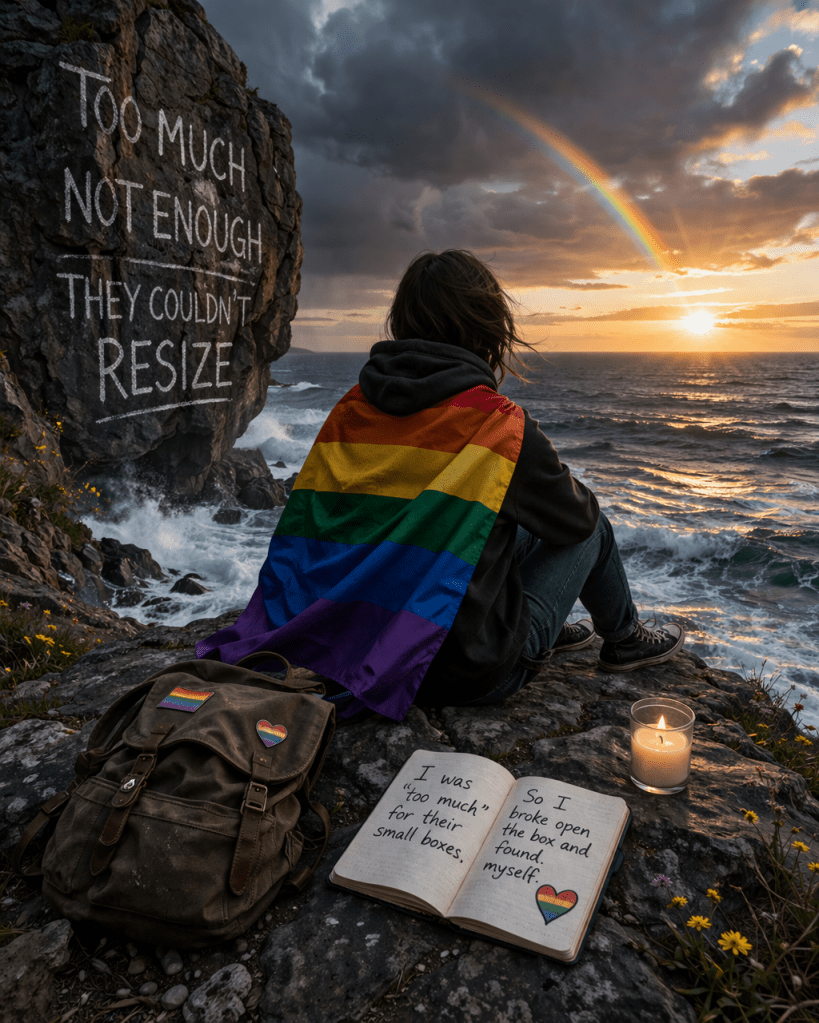
“Let them call you too much. Some people only say that because they’ve never met someone who refuses to live on mute.”
-This Puzzled Life
Light the charcoal. Sprinkle the sage. Let the smoke rise like it’s clocking in for its shift. Like it’s ready to escort every dusty opinion, every unsolicited critique, and every generational expectation straight out the front door. The moment somebody decides to inform you that you are either “too much” or “not enough,” that’s when the ritual begins. That’s when you cleanse the room. Clear the energy. And prepare yourself for the comedy of errors that is other people trying to regulate a spirit they did not create. And once that sage hits the air? The truth comes out like it’s been waiting backstage with a mic and a spotlight.
You know that moment when your family, your friends, and the entire Southern social order gather around like a committee of porch‑sitting elders. And they proceed to inform you, very gently, very prayerfully, that you are either too much or not enough? That’s the moment you realize you were never the problem. The problem was the committee.
It always starts with someone holding a casserole like it’s a moral authority. They pull you aside and say, “We’re just worried.” Worried about what? Your volume? Your opinions? Your refusal to shrink yourself into a polite, beige, church‑approved silhouette?
They’ll say, “You’re too loud,” “You’re too emotional,” “You’re too confident,” And “You’re too honest.” And then, without even inhaling, they’ll pivot to, “You’re not grateful enough,” “You’re not humble enough,” “You’re not patient enough,” And “You’re not quiet enough.” Am I a Category 5 hurricane or a lukewarm drizzle? I cannot be both the storm and the drought.
There is nothing like being raised in a culture where people will literally say, “Bless your heart,” while handing you a personality correction like it’s a church bulletin. They want you to be authentic, as long as, your authenticity fits inside their emotional carry‑on bag. They’ll warn you “Tone it down,” “Don’t rock the boat,” “Don’t embarrass the family,” and “Don’t say that out loud.” Meanwhile, the family has been embarrassing you since 1986.
One day, you wake up and realize you are not auditioning for the role of “Acceptable Human #3” in someone else’s life. You stop editing your personality for people who don’t even proofread their own lives. You stop shrinking your joy to fit someone else’s comfort zone. You stop apologizing for existing at full wattage. And suddenly the same people who said you were “too much” start whispering, “She’s changed.” No, you haven’t. You just stopped offering the discounted version of yourself.
People call you “too much” when they’ve built their lives around being less. People call you “not enough” when they want you small enough to manage. People call you “intimidating” when they’re used to being unchallenged. People call you “dramatic” when they’re used to you swallowing your feelings like communion wafers. You are not too much. You are not, not enough. You are exactly the right amount for the life you’re meant to live.
Let’s start by rewriting the script. If they say you’re too loud. Maybe they’re too quiet. If they say you’re too emotional. Maybe they’re emotionally constipated. If they say you’re too confident. Maybe they’re allergic to self‑esteem. And if they say you’re too honest. Maybe they’re used to lies dressed as manners. You are not a problem to be solved. You are a whole person with a whole personality or many. And if that rattles the folding chairs at the family reunion, then let them rattle.
The next time somebody tries to hand you a personality correction like it’s a bulletin from the usher board, just smile. Adjust your crown. And keep walking. Because if being fully yourself shakes their table. Flips their pew. And rattles their casserole. Maybe the problem isn’t your volume. Maybe it’s their weak foundation. Opinions are like buttholes. We all have them. And they all stink. Thanks for reading! And keep letting your light shine no matter what they say.
Affirmation: I honor the fullness of who I am. I expand anyway, shine anyway and take up the space my spirit was built for.
“The truth didn’t break my family. The pretending did.”
-Unknown
Here’s the bigger picture. I didn’t grow up in a family that heals. Problems don’t get solved. They get buried alive. And then resurrected during holidays like emotional zombies. Now that me and my sister are adults, childhood resentments still pop up like whack‑a‑mole. And nobody wants to pick up a mallet. Let’s all smile in public so we don’t “defame the family.” Which honestly, does a fantastic job defaming itself.
And my family isn’t special. Dysfunction is everywhere. I have enough mental health education in my background to recognize the patterns. But they’ll swear I’m the problem. If you look past the church smiles, the whole system is sick. I would genuinely rather be hit by a car than attend “family time.” And because my kids were born into a lesbian family, they get treated like they came with a moral recall notice.
You can’t throw money at children and then take no active part in their lives the rest of the time. Especially, when you do the opposite with the other children in the family. The kids notice. I’ve tried talking about it for 17 years. And the truth is this. They just don’t care.
I have a master’s degree in counseling psychology. Yet somehow I’m the ignorant one. They don’t want insight. They don’t want help. They want silence. And mine has officially expired. I defend myself and my kids however I see fit. Respectfully? No. Effectively? Absolutely.
They want healing without effort. They’re emotional pillow princesses that want the benefits of growth while doing absolutely nothing but blinking dramatically. And when truth bruises their egos, accountability never shows up. Meanwhile, my dad plays messenger pigeon flying information back and forth between me and the rest of the family so that the dysfunction stays perfectly preserved.
Here’s the part they’ll never admit. Family therapy requires guts and transparency. And those two things they treat like forbidden sins. Instead, they’ve built a giant sand pile where they can bury their heads. And pretend nothing is wrong. That’s their comfort zone. Not truth. Not healing. Just sand. Neck‑deep and breathing through a straw of selective memory.
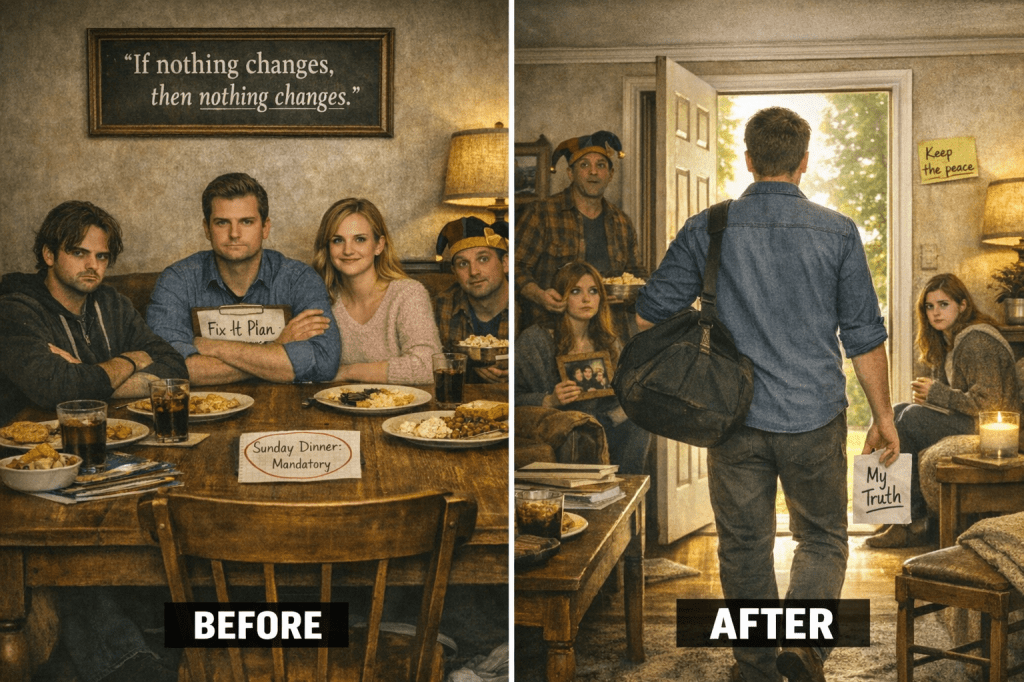
My favorite quote says it best, “If nothing changes, then nothing changes.” And I refuse to be silenced because their comfort depends on my suffering.
Our family lives in what I call comfortable dysfunction. It’s the emotional recliner they refuse to replace even though the springs are broken. And the fabric smells like denial. It’s easier than accountability. Easier than honesty. Easier than saying, “Maybe the gay daughter isn’t the downfall of civilization.”
And as if being the rainbow sheep wasn’t enough. I’m also the green sheep of the family because I’m a medical cannabis patient. And the family’s translation is that I’m “druggin’ and thuggin’.” The “bad influence.” And the “one who needs prayer.” But that’s not even the real issue.
The problem is my refusal to sit quietly in the pew of generational silence. The issue is that I no longer participate in the family’s favorite pastime of pretending. I’m done shrinking myself so other people can stay cozy in their outdated beliefs. I’m done letting conservative Christian values be weaponized against me and my children.
They can keep their selective morality. The kind where my sister thinks being gay is “wrong and evil.” But somehow premarital sex is just the Olympic sport of “being human.” Funny how sin gets flexible when it’s their behavior on the table.
“My family says I’m ‘living in sin.’ Which is wild coming from some of them who wave a red hat like it’s the state flower. They preach about morality and still treat premarital sex, drinking, and hypocrisy like they’re covered under the ‘Jesus forgives me’ warranty.”And trust me. They act like I graffitied the Ten Commandments in rainbow glitter.
Being gay automatically made me the family’s “problem child.” Even though the real problems have nothing to do with what gender I love. And everything to do with the fact that I refuse to pretend. My sister can have premarital sex. Drink like she’s hydrating for the Olympics and drive afterward. And micromanage her child like she’s running a dictatorship. But somehow I’m the moral crisis.
Meanwhile, my sister’s shot glasses stays full. Her judgment stays loud. And her hypocrisy stays undefeated. Funny how cannabis for medical reasons is “dangerous.” But alcohol with a side of denial is “just being human.” I’m the rainbow sheep because I live authentically. I’m the green sheep because I choose a legal, doctor‑recommended treatment. And I’m the scapegoat because I refuse to shrink so other people can stay comfortable in their dysfunction. If being myself makes me the rainbow‑green hybrid sheep of the family, then so be it. At least I’m not grazing in the pasture of hypocrisy.
So no, I’m not stepping back into the box they built for me. I’m not dimming myself, so their comfort stays intact. I’m not carrying the weight of a family that refuses to lift a finger for its own healing. They can keep their comfortable dysfunction. They can keep their silence. They can keep their outdated beliefs wrapped in Bible verses that only apply to me.
Today I honor my inner rainbow‑green sheep. I’m fabulously queer. I’m medically lifted. And completely unbothered by the opinions of people who confuse hypocrisy with holiness.”
I’m choosing truth over tradition. I’m choosing growth over guilt. I’m choosing my children, my peace, and my sanity. And if my existence shakes the foundation of their worldview. Then the foundation was weak to begin with. Thanks for reading! Do you and let the others do them.
Affirmation: I bless my rainbow‑green sheep soul today queer, medicated, and thriving. While certain relatives clutch their red hats and pearls at my existence. But don’t blink twice at their own chaos, contradictions, or alcohol fueled commandments.
“My family says I’m ‘living in sin.’ Which is hilarious coming from people who treat denial like a spiritual gift. And premarital sex like a community service.”
-This Puzzled Life
Light the charcoal. Sprinkle the sage. Negative energy, get your shoes on and leave. Today we’re diving into one of my favorite dysfunctional family topics. Family roles. Those unofficial job titles we never applied for. Never wanted. And yet somehow ended up performing like we were on salary. Take a moment and see where you and your people fall. And here’s the spoiler. If you’re reading this, you already know.
Before we get started, let me warn you. This is not a gentle stroll through family history. This is a full‑blown guided tour through a Southern household. That’s been held together with casserole, denial, and conservative Christian values. That seem to get applied with the accuracy of a toddler using glitter glue.
I grew up in a family where “we don’t talk about that” wasn’t a suggestion. It was the eleventh commandment. Emotions were treated like illegal fireworks. Everyone had them. Nobody handled them correctly. And something always exploded at the worst possible time.
In my house, honesty was considered aggressive. Accountability was considered disrespectful. And therapy? Therapy was treated like witchcraft performed by people who “don’t know Jesus personally.”
Meanwhile, the dysfunction strutted around the living room in broad daylight wearing a name tag and a church hat. And everyone pretended they couldn’t see it. If denial were a sport, my family would have Olympic medals and a sponsorship from Hobby Lobby.
So, buckle your emotional seatbelt. And prepare yourself. Because once you recognize the roles in a dysfunctional family. It’s like spotting roaches. You can’t unsee them. And suddenly they’re everywhere.
Family roles are the expected behaviors, responsibilities, and emotional acrobatics each person performs to keep the family circus running. These roles shift depending on culture, family size, and personality. But the classics are Hero, Scapegoat, Golden Child, Lost Child, Mascot. And I show up everywhere like glitter after a craft project.
Let’s begin.
1. The Hero (a.k.a. The Family PR Department) The Hero’s job is to make the family look normal, stable, and “blessed and highly favored” to the outside world. According to theraplatform.com (2025), they take on excessive responsibility to gain approval. This is my mother’s role. Or at least the role she auditions for. She is attention-seeking. Reputation-obsessed. And allergic to accountability. She delivers passive-aggressive comments like she’s handing out communion wafers. And then acts shocked when people get upset.
Her signature move? “The Dummy Card.” Suddenly she “doesn’t remember,” “didn’t mean it like that,” or “doesn’t know what you’re talking about.” But trust me, she knows. And right after she stirs the pot. She gives my dad the “rescue me” look. As if she didn’t just season that pot with cayenne, spite, and generational trauma. We only have real conversations when she’s mad at my sister, The Golden Child. Otherwise, it’s news, sports, and weather which is the Holy Trinity of Avoidance.
2. The Scapegoat (hi, it’s me) The Scapegoat is blamed for everything wrong in the family. Stubbed toe? My fault. Bad weather? Somehow me. The economy? Probably me too. I don’t conform to their lifestyle. I’m gay. I use medical cannabis. I don’t go to church because there are too many people who support the cruelty of the Trump regime. And align theirselves with the MAGA movement which practices a form of chriatianity that cannot be found in any Bible. And quite frankly, they have a bad reputation for normalizing pedophilia while demonizing being gay. I guess I should be glad that I just can’t understand that rationale.
I talk about taboo topics. And I acknowledge reality instead of pretending everything is fine. And did I mention I’m gay? Because trust me they will. Instead of saying, “She’s our family and we love her no matter the gender of someone she loves and that loves her.” They act like my existence is a PR crisis. The attitude is like, “Remember when Dana destroyed the family by being prouid to be gay and authentic?” I’m also the family whistleblower. I don’t play along with generational nonsense. I’m my own person. And I’m not apologizing for it.
3. The Golden Child (my sister, obviously) The Golden Child is the family’s prized possession. The chosen one. The favorite. And the one who can do no wrong even when she is actively doing wrong. Thriveworks.com (2023) describes this child as obedient, praised, and protected. That’s her. She has been dipped in gold since birth. She follows the script. Holds the same beliefs. And passes them down to her children like heirloom china. She was taught what to think. Not how to think. And the cycle continues. Children aren’t born to hate. They learn it from the adults who raise them. And this is what my sister excels at consistently.
4. The Lost Child (also my sister — she multitasks) The Lost Child avoids conflict like it’s a full-time job with benefits. She withdraws. Stays quiet. And pretends she’s above the chaos. While simultaneously contributing to it. She never acknowledges her harmful behavior. She believes most people are beneath her. And when she talks about someone being gay, she spells it out “G-A-Y” like she’s avoiding summoning a demon. Her emotional range is that of a frozen waffle. And honestly, that’s the family vibe overall.
5. The Mascot (me and my dad) Mascots use humor to distract from the dysfunction. We crack jokes. Lighten the mood. And do not dare fix anything. We just to keep the room from exploding. This doesn’t always work especially when me and my sister are at war like rainbows and bibles. My dad rescues my mom and sister from “big, bad Dana.” Who refuses to sweep things under the rug. I’m the villain because I tell the truth. Imagine that. Kind of sounds like the current government’s level of functioning.
Now you’ve met the cast and the roles they cling to like emotional security blankets. In the next part we’ll zoom out and look at the bigger picture. And it’s the part they refuse to acknowledge.
That concludes our tour of the Family Circus. Please exit through the gift shop. Where denial is half‑off. Accountability is out of stock. And the Scapegoat merchandise is mysteriously overpriced.” Thanks for reading! Keep breaking chains.
Affirmation: Today I honor my emotionally athletic self. The whistleblowing. Boundary‑setting. Truth‑telling legend who refuses to join the family’s Olympic Denial Team. Even though they’ve been training since the womb.
“Trauma doesn’t make you weak. It makes you a witness to your own survival.”
-This Puzzled Life
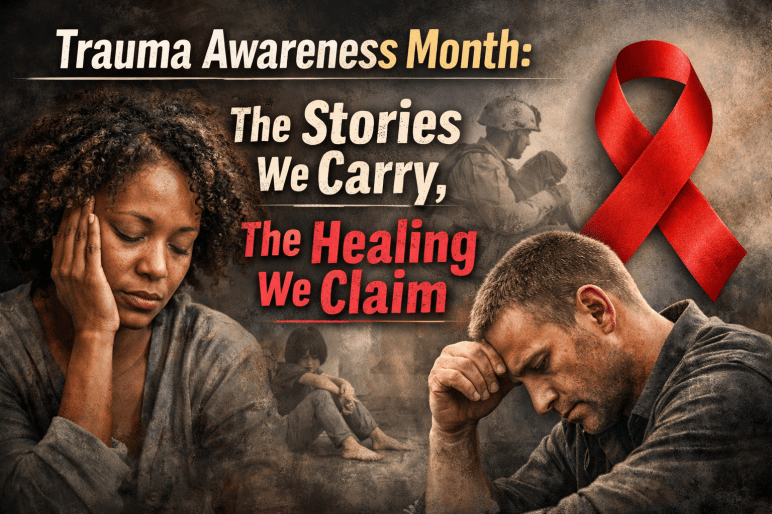
Light the charcoal. Sprinkle the sage. Let the smoke rise like it’s clocking in for a shift. And let the air shift like it’s bracing itself for whatever truth you’re about to drag into the daylight. Today isn’t about pretending everything’s fine or slapping a smile on top of a wound. It’s not about the vibes, snacks, or cats doing interpretive dance in the sunbeam. It’s about trauma awareness. It is about naming the things we survived. The things we carried alone. The things we laughed through so we wouldn’t crumble. It’s a Southern‑fried, emotionally honest, and funny enough to keep you from dissolving into a puddle on the kitchen floor.
Trauma Awareness is the kind that hides in your shoulders, jaw, breath, memories, and your jokes. And if we’re going to talk about it, we’re going to do it the only way I know how. Complete with honesty, humor, and the kind of emotional courage that feels like taking your bra off after a long day. It’s painful, relieving, and absolutely necessary.
There’s a moment right before you talk about trauma where your whole spirit goes, “Are we sure we want to do this?” It’s the same tone you use when someone says, “Let’s just run into Walmart real quick.” You know it’s not going to be quick. You know you’re going to see something you can’t unsee. You know you’re going to come out changed. Talking about trauma is like that. Except instead of a man in pajama pants buying raw chicken and fireworks, it’s your nervous system holding up a sign that says, “We’ve been through some things, ma’am.”
Trauma doesn’t just show up when you’re ready. Trauma is that one cousin who arrives early. Eats all the good snacks. And then says, “Why you look stressed?” It pops up at the worst times especially when you’re trying to relax. When you’re trying to sleep. When you’re trying to enjoy a sandwich. When you’re trying to mind your business. And when you’re trying to be a functioning adult for five minutes. Trauma will tap you on the shoulder like, “Hey bestie, remember that thing from 1998? No? Well, I do.” And suddenly you’re staring at the wall like it owes you money.
Your body remembers everything. Even the stuff you tried to bury under humor, iced coffee, and pretending you’re fine. You’ll be walking through Wal-Mart. Touching a throw pillow. And your body will whisper, “Hey, remember that time?” And you’re like, “No I do not. I am touching a pillow. Let me live.” But trauma doesn’t care. Trauma is like a Southern grandmother with a memory like a steel trap. And no sense of timing.
People talk about healing like it’s a spa day. Let me tell you something. Healing is not cucumber water and a robe. Healing is crying in the shower because your shampoo smells like 2007. Healing is realizing you’ve been clenching your jaw since the Bush administration. Healing is sitting in your car after therapy like you just got hit by an emotional freight train. Healing is messy. Healing is loud. Healing is quiet. Healing is confusing. Healing is holy. Healing is exhausting. Healing is worth it. But cute? Absolutely not.
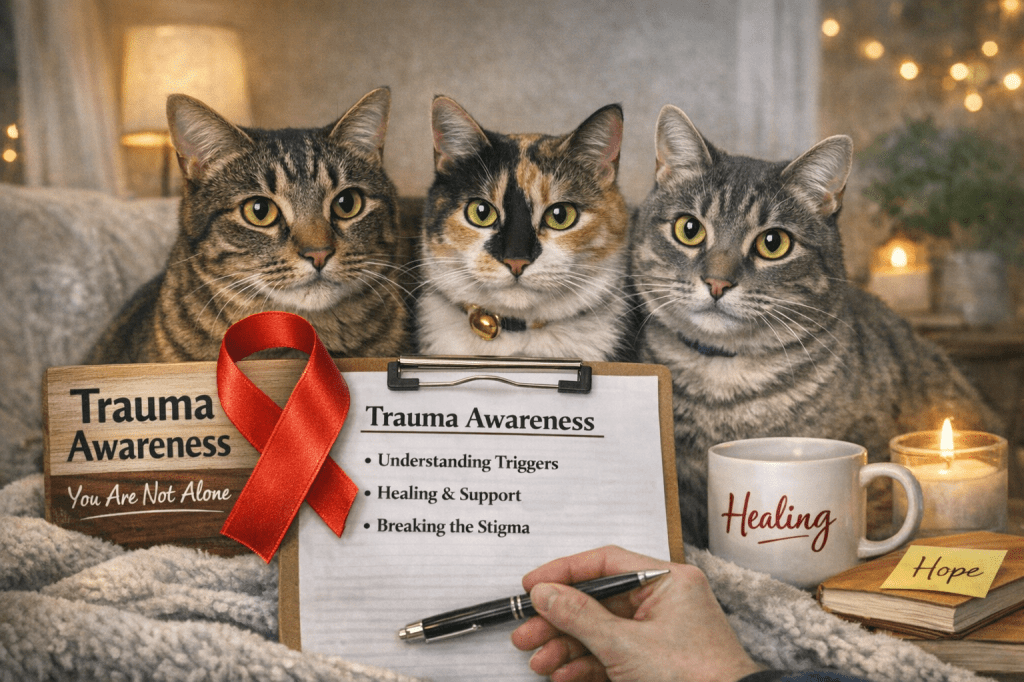
So, buckle up. Because the cats have decided it’s Trauma Awareness Hour. And apparently they’ve all been waiting their whole lives to trauma dump with the enthusiasm of a group therapy circle run by toddlers. And today is the day they ask deeply personal questions with the emotional sensitivity of a toddler holding a chainsaw. They have formed a circle. They have snacks. They have opinions. And apparently, they have questions about my trauma.
Me: “Okay, girls. Today we’re talking about trauma. Share whatever you feel comfortable with.”
She raises paw like she’s in kindergarten
Piper: “I’ll go first because my story is the most dramatic. Obviously.”
Coco: “Oh lord.”
Tinkerbell: “Let the child speak. She needs this.”
Piper: “So picture this. Me and my siblings. In a metal box. In the Mississippi heat, basically sautéing like tiny furry cornbread muffins.”
Me: “Baby, that’s awful.”
Piper: “I know. I was basically a rotisserie chicken with trauma.”
Coco: “You were a sweaty raisin with opinions.”
Piper: “Anyway, I survived because I’m dramatic and stubborn. And now every time the sunbeam hits me wrong, I flop over like a Victorian woman fainting at a garden party.”
Tinkerbell: “You faint because you forget to breathe when you get excited.”
Piper: “Trauma. Tinkerbell. Let me have this.”
Coco clears throat like she’s about to deliver a TED Talk
Coco: “My siblings and I were found under a house. A house. Do you know what lives under houses? Darkness. Ghosts. Tax evasion. I was basically a feral raccoon with trust issues.”
Me: “You’ve come so far.”
Coco: “Yes. And now I cope by judging everyone. It’s called growth.”
Piper: “You judge me the most.”
Coco: “You give me the most material.”
Tinkerbell: “I don’t remember my trauma.”
Me: “At all?”
Tinkerbell: “No. I simply chose not to be present. I was spiritually unavailable.”
Coco: “You had worms.”
Tinkerbell: “Yes, apparently my intestines were hosting a music festival.”
Piper: “You pooped like you were trying to summon something.”
Tinkerbell: “I was summoning peace. And a vet. Preferably both.”
Me: “You really don’t remember anything?”
Tinkerbell: “I remember diarrhea. And then I remember you. Everything else is optional.”
Me: “Well, we’ve all been through some things.”
Piper: “Yeah, but now we’re together! A family! With two crazy brothers who scream at dust!”
Coco: “We are a support group. A dysfunctional one, but still.”
Tinkerbell: “We heal one memory at a time. Preferably with snacks.”
Piper: “And naps!”
Coco: “And boundaries. Mostly for Piper.”
Piper: “I don’t believe in boundaries.”
Tinkerbell: “We know.”
Piper: “Sometimes I get scared when it’s hot outside. So, I cope by yelling at the sun.”
Coco: “I cope by staring at people until they feel bad.”
Tinkerbell: “I cope by leaving my body spiritually whenever something stressful happens. Like when the vacuum turns on. Or when Piper breathes too loud.”
Piper: “I have big emotions.”
Coco: “You have no volume control.”
Tinkerbell: “You have the energy of a toddler who drank a Red Bull.”
Piper: “Momma, what is your trauma about?”
Me: “Oh absolutely not. We are not opening that can of worms. We’ll be here until this time next year. And I don’t have enough snacks or emotional stamina.”
Coco: “Is that why you have panic attacks in Walmart?”
Me: “Yes.”
Tinkerbell: “But what’s scary about going to the pharmacy?”
Me: “Everything.”
Piper: “Everything?? Like the shelves? The people? The lighting?”
Me: “Yes.”
Coco: “The lighting is aggressive.”
Tinkerbell: “The vibes are hostile.”
Piper: “The blood pressure machine is a demon.”
Me: “Exactly.”
Coco: “So what did our therapist tell you?”
Me: “She said, ‘I’ll see you in another couple of days.’”
Tinkerbell: “Translation: ‘You’re a lot. But I believe in you.’”
Piper: “Translation: ‘You have so many issues we need a punch card.’”
Coco: “Translation: ‘You’re keeping the lights on in that office.’”
Me: “But look at us now. We’re safe. We’re loved. We’re healing together.”
Piper: “And we have snacks!”
Coco: “And stability.”
Tinkerbell: “And indoor plumbing.”
Me: “We survived things we never should’ve had to survive. And now we get to build something soft and silly and sacred together.”
All Three Cats: “Group hug!”
Coco: “But don’t touch me too long.”
Piper: “I’m crying!”
Tinkerbell: “I’m dissociating!”
Me: “Perfect. Exactly the emotional range I expected.”
In small Southern towns, admitting trauma is treated like a social crime. The moment you name what happened, you’re not just telling your story. You’re “disgracing the family,” “embarrassing the community,” and threatening the carefully polished illusion of stability that everyone works so hard to maintain. The culture teaches people to swallow their pain. Protect the reputation of the town at all costs. And never, under any circumstances, call out the people who caused the harm. And because the “good ole boy” network is alive and well. And sitting in every position of authority from the courthouse to the church pews, the truth gets buried right alongside the accountability. Even when the perpetrators are known. Especially when they’re known. Nothing is done. The silence is enforced. The victims are shamed. And the town keeps smiling for the church directory photo like nothing ever happened. But the truth doesn’t disappear just because the town refuses to look at it. It lingers in the air, the families, the generations, waiting for someone brave enough to break the cycle and say, “This happened. And it mattered.” And I am that one in my family who refuses to stay quiet about the trauma that happened in the small city of Petal, MS.
Trauma will have you doing things that make absolutely no sense. Things like apologizing to furniture when you bump into it. Jumping at sounds that aren’t even loud. Overthinking texts like you’re decoding ancient scripture. Saying “I’m fine” in a tone that suggests you are, in fact, not fine. And crying because someone said, “I’m proud of you.” And your body wasn’t prepared for that level of kindness. Trauma will also make you emotionally attached to random objects. A mug. A blanket. A rock you found on a walk. A pen that writes really smooth. Your brain will be like, “This is my emotional support spoon. Touch it and perish.”
Trauma awareness isn’t about reliving the pain. It’s about naming it, so it stops owning you. It’s about understanding why you react the way you do. It’s about giving yourself grace for surviving things you never should’ve had to survive. It’s about learning that your triggers aren’t flaws. They’re evidence that you lived through something real. And it’s about knowing you’re not broken.
You’re healing. You’re growing. You’re learning how to breathe again. You’re learning how to trust softness again. You’re learning how to exist without bracing for impact. That’s not weakness. That’s strength with stretch marks.
May your healing be gentle. May your memories lose their sharp edges. May your nervous system unclench one muscle at a time. May your heart learn safety. May your voice return to you. May your laughter come back louder. May your story be yours again. And not something that happened to you. But something you rose from.
So, if no one told you today. You’re not dramatic. You’re not broken. And you’re not “too much.” You’re a whole human who lived through storms that would’ve snapped lesser souls in half. And you’re still here healing. Laughing. Unlearning, Softening. Reclaiming. That’s not survival. That’s resurrection. And baby, if that isn’t holy, I don’t know what is. Drop the sage. Keep the truth. And walk away knowing this. Your story didn’t end in the dark. You did.
Affirmation: I honor the parts of me that survived. I honor the parts of me that are still healing. I am allowed to grow, to rest, to feel, and to reclaim my peace. And I can do it one breath at a time.
“The connection between domestic violence and animal cruelty is so significant that it is commonly referred to simply as “the Link.” Perpetrators of domestic violence often threaten harm or bring actual harm to their victims’ pets in order to control them, keep victims from leaving, or to punish them for actually leaving or attempting to leave.”
-ASPCA.org
Light the charcoal. Sprinkle the sage. Negative energy go away. Today, I want to discuss domestic violence and pets. I won’t pretend that this topic is going to be easy to digest. However, it’s one that needs to be brought into the light.
Many of us sometimes love our animals more than people. I know, speaking only for myself, that my animals have always been a source of comfort, unconditional love, and understanding that many people can’t fully embody. They have never spoken a word as their compassion is in their eyes. And all they ask for is to be fed and also loved in return. That is, it. Nothing more. Nothing less.
My personal experience with domestic violence is knowing that absolutely nothing is off limits. And it is their cruelty that can always get worse. Do some abusers change? Yes. But if they are not willing to do self-reflection and to look at their own traumas and behaviors, then they will not change. And most blame their actions on the victim.
Please Read The Following:
Up to 75% of women entering DV shelters report that their abuser threatened, harmed, or killed their pets in the presence of children (safehouse.org, 2024).
Up to 65% of domestic violence victims and 48% of battered women remain in abusive homes out of fear for their pets.
Only around 5% of U.S. shelters have any kind of housing for pets of domestic violence victims (https://www.drmartybecker.com, 2017).
Why Do Abuser Use Pets To Terrorize Their Human Partners?
· Creating fear: Abusers may torture or kill a pet to demonstrate what they are capable of doing to their human victim or their children.
v There were many times when I saw and heard my ex-husband’s violence against my animals. He would muzzle my outside dogs all night long most of the time. And he would beat my cats with a belt if they meowed at night. He also scared my cats so much with a broom that they began to have a very strong fear reaction for many years following me leaving him.
· Leverage to prevent escape: Many women fear for their pet’s safety is the primary reason they delay leaving an abusive relationship.
v One of his favorite things to say was, “One day you’re going to look up and all of your animals will be gone. You just might come home one day, and they will have vanished.”
· Punishment and retaliation: Abusers may harm a pet as punishment for a perceived transgression or in retaliation for a partner trying to leave.
v After 13 years of being in a domestic violence situation, and over a year of planning my departure, I left him hoping things would cool down enough to go back and get my animals as a way of saying, “I’m done.” Two weeks later, I went back to retrieve my animals, and most had been starved. There was no water. A few of the ones remaining had been eaten by other animals or were mysteriously cut in half. On that day, I was able to get out two cats and my African Grey parrot. Only three of the many that I owned. My cats were starving and had old, moldy food. My bird had moldy food and dirty water. My outside cats were nowhere to be found. And my dogs had been shot which was witnessed by a neighbor. And the sights and smells can never be undone.
· Forcing participation: Some women survivors tell about how they were forced to participate in illegal acts under threat of harm to their pets.
v Luckily, I was never forced to do this. Because they would’ve had to do something for me. Because I don’t have the capability to hurt my pets.
“Seeing her hurt was more than I could bear.
I couldn’t and wouldn’t leave my pets.”
-Sarah, DV Victim
Women have reported:
“He kicked the dog repeatedly until it was howling in pain.”
“He put his hand into the goldfish bowl in front of my five-year-old daughter and squashed the goldfish, for no apparent reason.”
“I can remember an instance when he picked the cat up and with full force drop-kicked it from the back door. He did it because he saw the cat on the workshop. I thought the cat might die.”
Resources for victims who want to leave with their pets:
· National Domestic Violence Hotline 1-800-799-SAFE (7233).
· The Purple Leash Project
o Our goal: To see 25% of domestic violence shelters become pet-friendly by 2025.
· Safe Havens for Pets
o For pets are sheltering services that help individuals who are experiencing domestic violence or homelessness with a companion animal (https://www.safehavensforpets.org, 2023).
· RedRover Relief
o Mission is to “bring animals out of crisis and strengthen the bond between people and animals through emergency sheltering, disaster-relief services, financial assistance, and education.
· URINYC PALS (New York City)
· Paws for Safety (Rockland County, New York)
· Praline’s Backyard (Snellville, Georgia)
· Ahimsa House (Georgia)
· Shelter our Pets (New Jersey)
· Network for Pets of Domestic Violence Victims (www.npdvv.org).
· This is a list of pet-friendly domestic violence shelters (https://saftprogram.org, 2025).
I completely and unapologetically understand the fear that abusers instill in victims about their victims and their pets. I encourage you to seek help by way of organizations that are listed here and the many others that I don’t have the space to acknowledge. Animal abuse is a crime in all 50 states. And each state has anti-cruelty statutes that include felony-level provisions for acts of violence against animals.
And they will “love bomb” and abuse you until you concede. That is part of their “reign of terror.” They are master manipulators and will suck the soul from your mind and body. And then tell people that you enjoyed it. It is imperative for you and those you love, including your pets, to find a way out of that situation. I beg you to please continue searching for help in every way possible. Because they will do it again. And candy and flowers won’t make it better.
Thanks for reading even though difficult it may be. Please seek help for those you love even if that is for yourself. You and your pets are worth the love and compassion that is waiting for you all. Keep reading. Keep hope alive.
Affirmation: I forgive myself for believing all relationships are abusive and violent.