
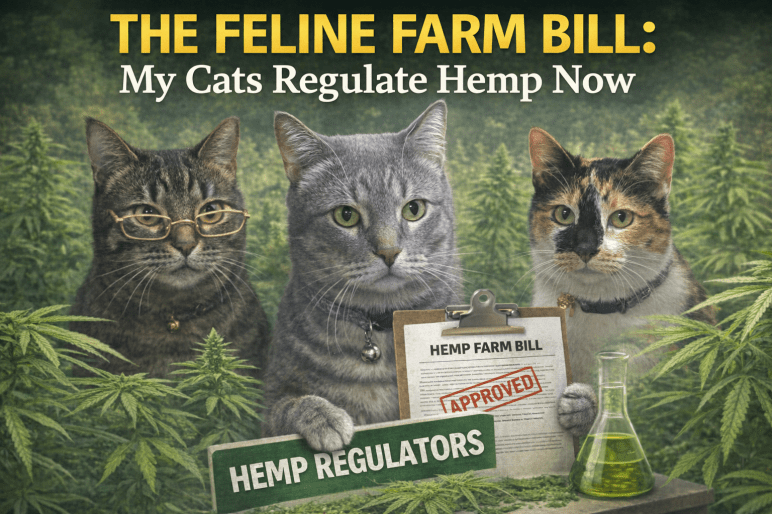
The Feline Farm Bill: My Cats Regulate Hemp Now

“Hemp is strong. Sustainable. And slightly less dramatic than the cats in this house.”

-This Puzzled Life

Light the charcoal. Sprinkle the sage. If we’re going to honor National Hemp Month, we need the ancestors, the angels, and at least three bored saints on standby. The spirits of Southern chaos have already begun circling the living room like they’re waiting for a casserole to come out the oven. The energy in this house is already vibrating like a Dollar General ceiling fan on its last screw. And Piper has been pacing the hallway like she’s waiting for a verdict from the Supreme Court of Snacks.

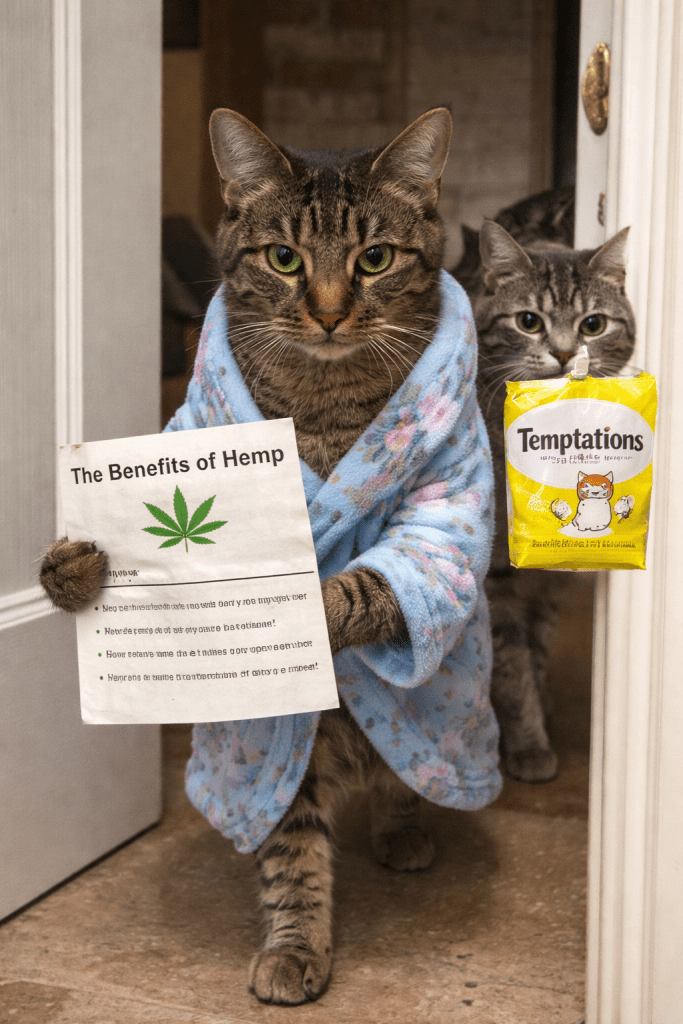
The moment the sage smoke curled upward, Piper burst into the room wearing a bathrobe she absolutely stole from the clean laundry basket. 

She spoke like she was about to deliver a prophecy.

Piper: “Momma, it is Hemp Month. I have prepared a statement.”

Before I could respond, Coco slid in behind her like a baseball player stealing home. She was holding a bag of Temptations in her mouth like a union negotiator arriving with concessions. She mumbled through the bag.

Coco: “I’m here in solidarity, And also because I heard hemp can be used to make rope. And rope can be used to hang treat piñatas.”

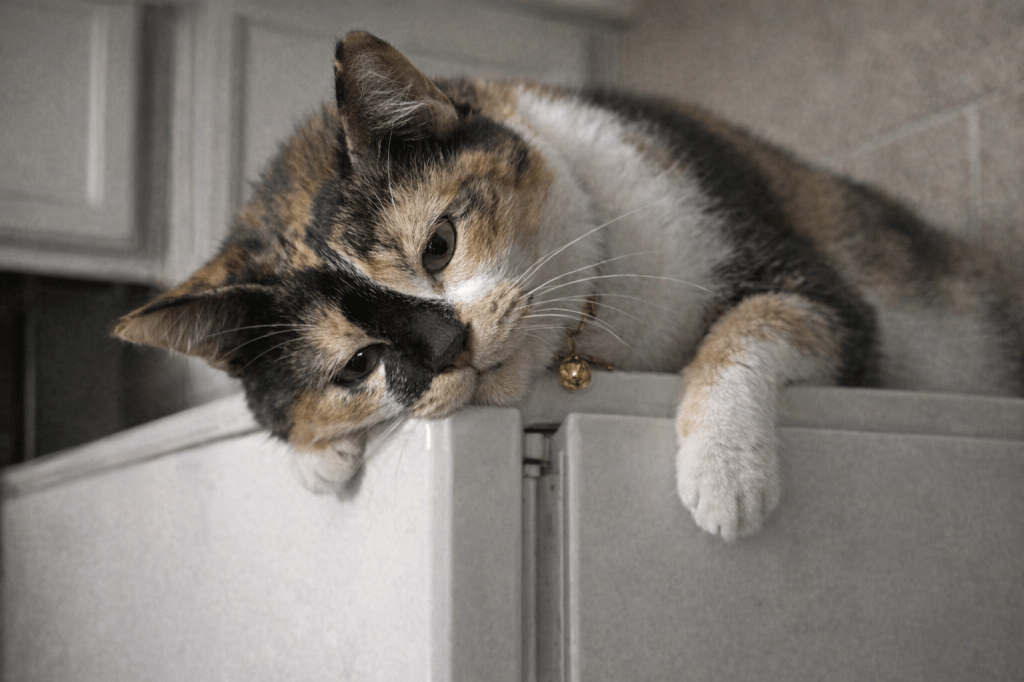
From above us, on top of the fridge, Tinkerbell let out the kind of sigh that only a cat who has read the Constitution twice can produce.

Tinkerbell: “You two are embarrassing. Hemp is an agricultural commodity with a nuanced regulatory framework. Not a snack-based holiday.”
Piper gasped.

Piper: “Everything is a snack-based holiday if you believe hard enough.”

And that’s when I knew that this intro needed to be fortified. This month needed to be fortified. I needed to be fortified. So, I sprinkled more sage. A little more charcoal. And maybe a splash of holy water for good measure.

If National Hemp Month is going to happen in thishousehold, I’m going to need the strength of industrial hemp itself. It’s flexible. Resilient. And capable of withstanding the absolute foolishness of three feline revolutionaries who think they’re about to unionize the living room. And that’s just the intro.

I swear. I was just trying to light a candle and mind my business. And Piper came skidding into the kitchen like she’d been summoned by the Department of Agriculture itself.

Piper: “We must prepare the house.”

Coco peeked around the corner holding a bag of treats like a bribe. 

Coco: “I’m just here to support the movement and also to see if snacks are involved.”

Tinkerbell: “Both of you are unserious. Hemp is a versatile agricultural commodity with a complex regulatory history. And you, she pointed a paw at Piper, are wearing a cape made from a dish towel.”

Piper: “It’s ceremonial.” 
I tried to explain that National Hemp Month is about education, sustainability, and celebrating a plant that has been misunderstood more than a Southern woman who says, “I’m fine.” Piper had already declared herself Hemp Czar and was marching through the house inspecting imaginary crops.

Coco: “Do hemp farmers get snacks? Because I’m willing to pivot careers.”

Tinkerbell rolled her eyes so hard I heard it.

Tinkerbell: “Hemp is federally legal, Coco. You don’t get snacks for following the law.”

Coco: “Then what’s the point?” 

Tinkerbell cleared her throat like she was about to read from the Book of Revelation.

Tinkerbell: “Under the 2018 Farm Bill, hemp was federally legalized as long as it contains no more than 0.3 percent THC. States regulate production through USDA-approved plans. And farmers must test crops to ensure compliance. Some states are stricter. Some are looser. And all of them are confused. Hemp is legal. But only if it behaves.”

Piper: “So if the hemp gets too excited, it becomes a criminal?”

Tinkerbell: “Yes. Just like you after 9 p.m.”

I tried to bring the energy back to something wholesome.

Me: “Let’s honor the plant. Let’s celebrate sustainability, fiber, textiles, and-”

But Piper cut me off.

Piper: “Momma, I have prepared a speech.”

She climbed onto the coffee table. Cleared her throat. And declared,

Piper: “Hemp is the fabric of our future. Also, I request a hemp hammock, a hemp scratching post, and a hemp crown.”

Coco clapped

Coco: “I second the crown.”

Tinkerbell stared at me like, “This is your circus. These are your monkeys.”

By the end of the night, Piper had drafted a “Hemp Bill of Rights.” Coco had eaten half a bag of treats in the name of activism. And Tinkerbell had filed three formal complaints with the imaginary Feline Ethics Committee.

And me? I blew out the sage. Looked at my household of furry legislators. And whispered, “Lord, give me the strength of industrial hemp to withstand the foolishness of this house.” Curtain closed. Hemp Month survived. Thanks for reading! Stay educated. What do you think about the current legislation regarding hemp?

Affirmation: “I honor the plant. Embrace the chaos. And stay grounded even when my cats form a hemp committee without my consent.”

***Don’t forget to watch the video!***

#ThisPuzzledLife

National CBD Month

“It’s CBD. It helps with the healing process and inflammation, stuff like that…it’s make your life a better place.”

-Nate & Nick Diaz, MMA fighters

Light the charcoal. Sprinkle the sage. Negative energy go away. Light the charcoal. Sprinkle the sage. Negative energy, go away. Today is National CBD Month, a time dedicated to raising awareness and educating the public about cannabidiol (CBD).

By now, millions of Americans have learned about the benefits of CBD. However, there are still individuals who choose pharmaceuticals over this natural aid. That is why it’s imperative to clearly state the advantages of using CBD, so others around the world can gain access to it.

CBD has helped many people with both physical and mental health needs, yet it continues to carry a stigma. The main reason for this is the long-standing legal ban on cannabis, since cannabis and CBD are derived from the same plant. When the 2018 Farm Bill federally legalized all hemp products, it clarified that hemp is a part of the cannabis plant containing less than 0.3% THC. With CBD, individuals can experience the benefits of the plant without getting high.

In 2019, the Journal of the American Medical Association (JAMA) reported that CBD ranked fourth in the U.S. for wellness-related Google searches. This demonstrates CBD’s growing popularity and the public’s desire to learn more. Despite this, 35% of Americans were still unfamiliar with it at the time. In 2020, CBDMD founded National CBD Month to celebrate the availability of CBD products and to expand access to them. Their mission has helped highlight why CBD is sometimes prescribed to cancer patients when traditional medications fall short (https://nationaltoday.com/national-cbd-month/?utm_source=chatgpt.com).

Unfortunately, as if recent legislation hadn’t caused enough harm, a clause has been introduced that would ban these products starting in November 2026. While it’s true that some companies produced dangerously unregulated hemp products that were sold to minors and some consumers became sick, the response should have been regulation, not an outright ban. Instead of protecting consumers through oversight and safety standards, lawmakers chose to eliminate access altogether, which is one of many questionable decisions they’ve made.

My hope is that lawmakers will reconvene and recognize that banning this substance entirely will do more harm than good. Proper regulation would protect consumers while allowing people to make healthier choices for their medical and mental health needs.

Thanks for reading, and stay tuned for updates on this issue.

Affirmation: I choose informed, mindful wellness that supports my body and nervous system.

***Don’t forget to watch the video!***

#Thispuzzledlife

What’s Happening To Hemp?

“Policy made without open hearings can lead to unintended harm and fuel the very unregulated market lawmakers aim to prevent.”

-Justin Eve, Hemp Grower

Light the charcoal. Sprinkle the sage. Negative energy go away. Ok, so today I want to tell you about the recent nationwide banning of hemp. And this is about to heavily affect people’s lives. I can say personally that I’m very disappointed. Let me explain everything that is going on and what to keep an eye on.

With the recent government shutdown and eventual reopening, the spending bill called the Continuing Appropriations and Extension Act of 2026 had nestled in its grasp was a new law that changed the THC limit from .3% delta-9-THC to .3% total THC. This action has closed the loophole in the 2018 Farm Bill which allowed for people to find relief when medical cannabis was not available. The new restrictions specifically prohibits products containing  more than .4 mgs of total THC per container and bans the use of synthetic or artificial derived cannabinoids.

What does this mean? This means that the cap on THC will now prevent people from getting much needed relief and, once again, pushes consumers to the black market for products. Now, I was not in favor of these products because they were not regulated and gave cannabis a bad name by allowing irresponsible teens to have access to “gas station” and “headshop” products which have made people very sick. This includes CBD, THCa, delta-8, delta-9, edibles and vapes. As usual, though, instead of creating reforms to protect consumers, they have essentially made the products useless. I’m all about regulation because when it’s not regulated there are no testing safety standards that are required for medical cannabis. Therefore, there’s actually no telling what is in these products.

There are full spectrum products that contain THC and other compounds. Broad spectrum products that contain cannabinoids, which many use synthetics, but not the THC to get you high. And isolate products such as delta-8 and delta-9 which are primarily just isolated THC molecules. 

The opposition states that the products are allowed to continue getting people high. Ok, well, the loophole allowed these products to have THCa because it was not THC. The conversion happens when a heat source like a lighter or an oven is used to release the psychoactive effects of the plant. So, essentially the product was still weed that would get you high. The difference is what stage the plant is harvested.

Many people use CBD, which is a cannabinoid found in the cannabis plant, to help relief the uncomfortable effects of many conditions. So now, because of the limits, this relief would require copious amounts of those same products, which is not practical or affordable. This is set to go into effect on November 18, 2026. You might be asking yourself why so far away?

This allows for further legislation which is already in the works to keep these products on the market safely. However, now this will be a federal ban on hemp products which will supersede state governance. The hemp industry is estimated to be supported by 300,000 jobs. And the economic estimates are $28.4 billion in annual sales. The time period allows industry to adapt and to potentially establish a regulatory framework. It also allows federal agencies like the FDA to clarify specific definitions and for the states to determine how they will interpret the federal restrictions within their own cannabis laws. And  an immediate ban would have caused immediate chaos and economic disruption (www.thehill.com, 2025).

If something isn’t done,  the redefinition of hemp will recriminalize most existing intoxicating hemp products which will now impose new, very low THC limits per container. For patients not living in a medical cannabis state, hemp-derived products were their only legal access to certain cannabinoids. The ban would eliminate the alternative completely. And it would limit patient access to only FDA approved drugs with only CBD and no THC (www.statnews.com, 2025).

And what organizations are funding this bill? You got it! Major alcohol industry companies such as: American Distilled Spirits Alliance, Beer Institute, Distilled Spirits Council of the United States, Wine America, and Wine Institute, pushed towards this ban as well as other retail giants such as Coca-Cola, Nestle, General Mills, Bacardi North America, and Moet Hennessy USA (https:mjbizdaily.com, 2025). Key congressional figures include Mitch McConnell, Dick Durbin, Tammy Duckworth, Brian Mast, and Nancy Mace (https://stateline.org, 2025). Please contact your congress men and women to urge a protective framework rather than a full ban. Those whose quality of life depends on it. Thanks for reading!

Affirmations: My body is filled with healing energy whenever I use hemp products.

***Don’t forget to watch the video!***

 #Thispuzzledlife