
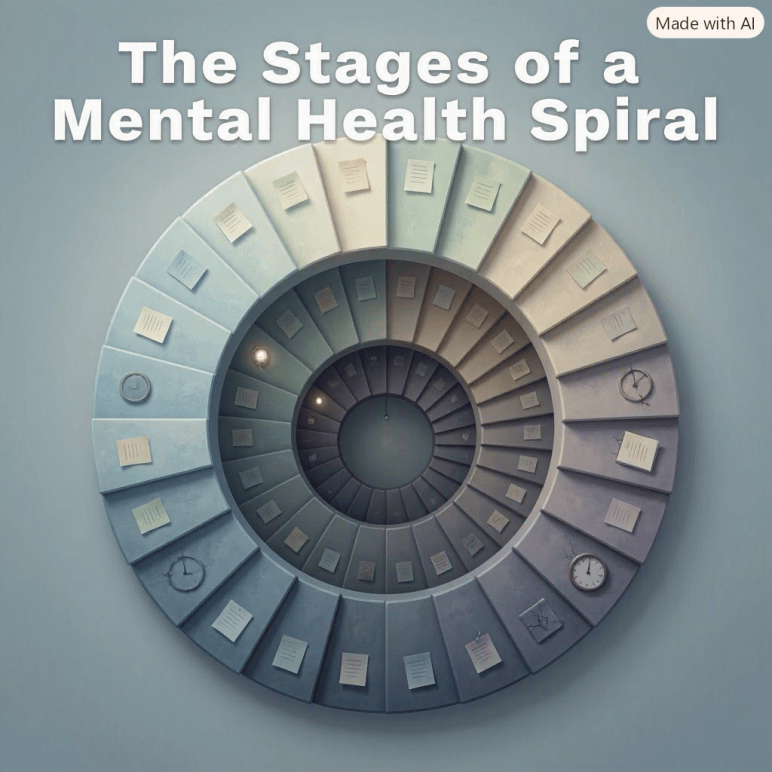
The Stages of a Mental Health Spiral

“Sometimes the spiral isn’t a breakdown. It’s a plot twist.”

-This Puzzled Life

Light the charcoal. Because the ancestors have pulled up lawn chairs. Piper is judging you from the counter. And your last functioning brain cell is wearing Crocs and screaming, “We’re fine.” Today, we’re about to roast our own mental health spiral like it’s Sunday dinner. And the ancestors are already circling the table whispering, “Lord, she’s doing that again.” Today’s sermon: The Stages of a Mental Health Spiral. This is not a gentle descent. This is a Six Flags drop tower operated by a raccoon with a GED and a dream.

You know that moment when you feel something is off? Not enough to call your therapist. But enough to stare at the wall like it owes you money. That’s when the spiral begins. Quietly. Softly. Like a Southern woman saying, “Bless your heart.”  Right before she ruins your life.
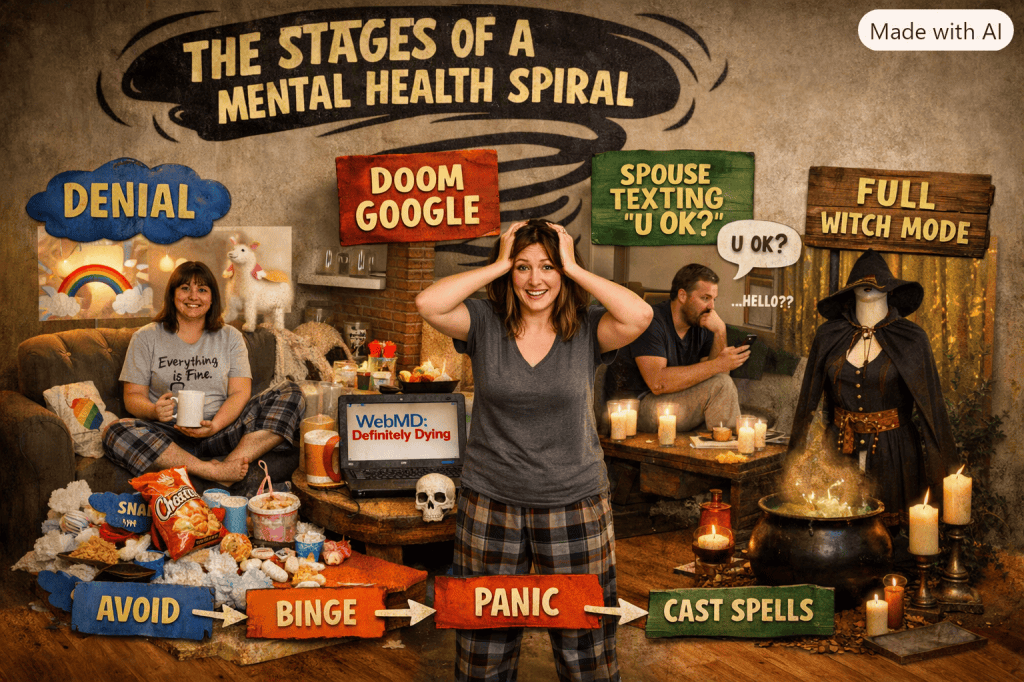
Behold, the official stages of a mental health spiral. The annotated. Dramatized. And spiritually supervised by your ancestors who are shaking their heads in unison.

1. Denial (a.k.a. “I’m fine.”)

You say “I’m fine” with the confidence of a toddler holding a permanent marker near a white couch. Your eye twitches. Your soul leaves your body. But you? You’re “fine.”

2. Snack-Based Coping

You open the fridge like it’s going to reveal the meaning of life. It does not. It reveals cheese. You eat the cheese. You feel nothing. You eat more cheese. You still feel nothing. You consider becoming cheese.

3. Googling Symptoms

You Google one minor sensation. “Why does my left eyebrow feel spicy?” 

Google: You have 14 minutes to live. 

You: “Reasonable.”

4. Texting Your Spouse

You send a message that is 40% panic. 40% apology. And 20% emojis that do not match the situation. Your spouse replies, “Did you eat today?” You did not. You lie anyway.

5. Bargaining With the Universe

You promise to drink water. You promise to stretch. You promise to stop doomscrolling. You do none of these things.

6. Existential Laundry

You stare at a laundry basket like it’s a metaphor for your entire life. You consider folding it. You do not fold it. You put a blanket over it like a Victorian ghost.

7. Deciding to Become a Forest Witch

You Google “how to disappear into the woods legally.” You imagine yourself living among moss, mushrooms, and emotionally stable squirrels. You start pricing cauldrons. You tell your spouse, “I’m going feral.” They say, “Okay, but text me when you get there.”

I told my therapist about the levels of decent into madness. She looked at me over her glasses like she’s trying to decide whether to laugh. Cry. Or call your ancestors for backup. She said, “Dana, you cannot diagnose yourself with 14 conditions. Eat a block of cheddar. And then attempt to join the woodland spirits. That’s not a treatment plan. That’s a Thursday.” Then she adds, “Next time, call me before you Google anything. Or before you buy a cauldron.”

And that, my friend, is the spiral. A journey. A pilgrimage. A spiritual hike through chaos, cheese, and questionable decisions. But you survived. You always do. Because even when my brain is doing NASCAR donuts in a Walmart parking lot, I still show up, I still laugh. And still threaten to become a forest witch at least twice a month. My ancestors are proud. My therapist is tired. My cats are unimpressed. And I’m doing amazing. Thanks for reading! What are things you do when you’re spiraling that isn’t funny at the time? But is now.

Affirmation: I can survive my own brain, one snack, one breath, and one dramatic monologue at a time.

***Don’t forget to watch the video!***

#ThisPuzzledLife
Suicide Awareness Month: When Silence Becomes the Sin

“I don’t blame the people we lost. I blame the silence that swallowed them.”

-This Puzzled Life

Light the charcoal. Sprinkle the sage. Lord knows, if we’re gonna talk about Suicide Awareness Month in the Deep South, we’re gonna need all the spiritual reinforcements we can get. The air gets thick. The whispers get quieter. And the truth starts pacing the room like it’s looking for a way out.

Let me set the scene. It’s September in the Deep South. Humidity thick enough to baptize you against your will. Church signs flashing Bible verses like spiritual traffic tickets. Every conversation about mental health wrapped in a casserole dish of denial. Then Suicide Awareness Month rolls around. And the way conservative Southern Baptists respond? You’d think someone asked them to admit they’ve been depressed since Reagan.

They hit you with the classic, “Thoughts and prayers.” And that’s the entire statement. Full stop. Period. End of sentence. End of conversation. If you try to talk about suicide beyond that? Oh, honey that happens behind closed doors. Whispered like gossip. Treated like sin. And buried under shame so thick you’d need a backhoe to dig it out. That’s how the shaming works down here. Not by yelling. But by refusing to speak at all. And I’m tired of silence being the loudest killer in the room. Suicide isn’t a “them” problem. It’s an all of us problem. And the numbers don’t lie. Even when the people in power do.

Over 49,000 people died by suicide in 2023. And that’s one death every 11 minutes. Suicide rates have climbed back to their previous peak after years of fluctuation. But some groups are hurting more than others. https://www.cdc.gov/suicide/facts/data.html?, 2026

1.American Indian & Alaska Native Communities

These communities have some of the highest suicide rates in the nation. Youth in these groups are disproportionately impacted due to historical trauma. Lack of access to care. And systemic neglect. 

2.LGBTQIA+ Youth

LGBTQIA+ youth face significantly higher suicide risk due to rejection, discrimination, and lack of safe spaces. And let’s be honest. The current political climate isn’t helping. Policies targeting queer and trans youth only increase fear, isolation, and hopelessness.

3.Black Youth

Black youth suicide rates have been rising with unique stressors tied to racism, community stigma, and lack of culturally competent mental health care. 

4.Veterans

Veterans continue to face elevated suicide risk due to PTSD, trauma, homelessness, and lack of adequate support. The VA reports long‑term patterns of high suicide rates among veterans. Especially those facing mental health and substance use disorders. 

5.Young People (15–24)

Suicide is the second leading cause of death for young people. In 2024 alone, nearly 5,915 young people died by suicide. 

I don’t write this from a distance. I write this from the front row of grief and personal struggle.

My life has been touched by suicide from more angles than I ever wanted. I’ve seen it happen to friends and family. People I loved. People I tried to reach. People I didn’t know were hurting until it was too late. And let me say this clearly. I am not mad at them. I do not hate them. I am not angry at what they did.

I am just deeply, sorry that they weren’t able to be reached. Sorry that the world failed them. Sorry that shame kept them silent. Sorry that help wasn’t accessible, safe, or welcoming. Sorry that they believed the lie that their pain was a burden. They deserved better. And so do the people still here.

I’m not here to sugarcoat this. Our nation’s mental health crisis is rising in part because of the current administration’s policies. And the harm they inflict on marginalized communities. When leaders create fear. Strip rights. Target vulnerable groups. And normalize cruelty. The emotional fallout is real. People feel unsafe. People feel hopeless. People feel hunted. And hopelessness is fertile ground for despair. This isn’t partisan. It’s human. And the statistics reflect the pain people are living through.

And here’s the thing I keep coming back to, over and over, like a hymn that won’t leave my bones. We are losing people because we refuse to talk. We are losing people because shame is easier to hand out than compassion. We are losing people because silence is the South’s favorite weapon. And its most deadly.

I grew up watching folks whisper about suicide like it was a scandal instead of a tragedy. I watched churches pray for “healing” while refusing to name the wound. I watched families bury their children and still pretend nothing was wrong. I watched people I loved slip through cracks that should never have existed in the first place. And I’m done pretending that this is normal. I’m done pretending that this is holy. I’m done pretending that this is anything but deadly.

Because the truth is this. People don’t die from weakness. People die from isolation. People die from shame. People die from being told their pain is an inconvenience. And if that stings, good. Some truths are supposed to.

 I have lost people I loved. People I laughed with. People I prayed for. People I would’ve driven across state lines for if I had known they needed me. And I don’t carry anger toward them. I don’t carry resentment. I don’t carry judgment. What I carry is sorrow. A deep, marrow‑level sorrow that they didn’t feel reachable. That they didn’t feel safe. That they didn’t feel like this world had room for their pain. And I will never stop wishing they had stayed. Not because their leaving was wrong. But because they deserved a world that didn’t make leaving feel like the only option.

 Let me say this plainly. Because I’m not sugarcoating a damn thing today. Our country is hurting because our leadership is hurting us. Policies that target the vulnerable create despair. Cruelty from the top trickles down like poison in the water supply. And if that makes someone uncomfortable, they can go ahead and sit with that discomfort. Maybe it’ll teach them something. I’m not here to protect feelings. I’m here to protect lives.

 This is my altar call, benediction, my Southern‑fried truth served hot and holy. We cannot pray away what we refuse to confront. We cannot heal what we refuse to name. We cannot save people we refuse to see. If we want to stop losing our loved ones, we have to stop hiding behind “thoughts and prayers” like they’re bulletproof. We have to talk. We have to listen. We have to show up. We have to fight for the living with the same passion we mourn the dead. Because every single person lost to suicide deserved a world that didn’t break them. So, if you hear me. If you really hear me. Then stand up. Even in the back. Even if your knees pop like bubble wrap. And say it with your whole chest. Thanks for reading! How can you relate to this?

 Affirmation: My voice is a lifeline. My truth is a lantern. I speak so others don’t have to suffer in the dark.

***Don’t forget to watch the video!***

#ThisPuzzledLife
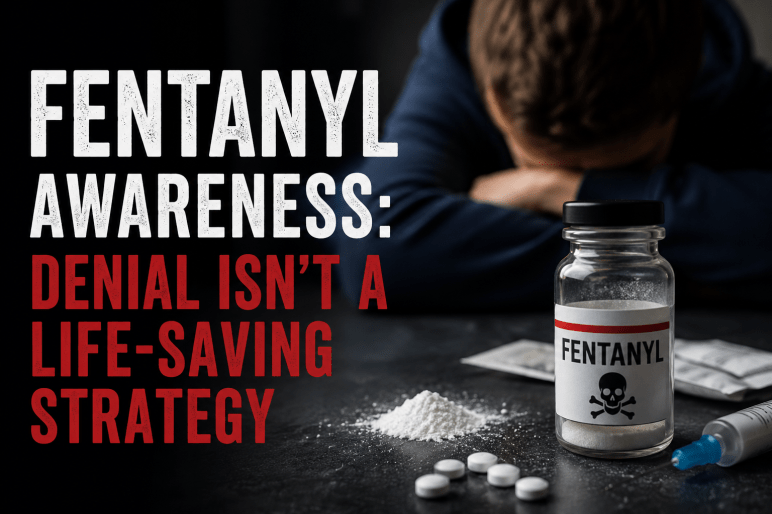
Fentanyl Awareness: Denial Isn’t a Life-Saving Strategy

“Awareness isn’t comfortable, but neither is grief. Choose the discomfort that saves lives.”

-This Puzzled Life

Light the charcoal. Sprinkle the sage. Today, we’re talking about Fentanyl Awareness. And Lord knows some folks need more than sage. They need a whole spiritual intervention. A PowerPoint and maybe a smack from an ancestor with a wooden spoon.

We’re still living in a world where people think fentanyl is something that happens to “other families,” “other communities,” or “those people over there.” Fentanyl doesn’t care about your zip code. Your Bible study attendance record. Or how many casseroles you’ve delivered to the church potluck. It is an equal-opportunity destroyer. And yet, some folks still clutch their pearls and say, “Well, if people didn’t do drugs.” Sweetheart, if ignorance burned calories, half this country would be runway-ready.

Fentanyl isn’t a moral issue. It’s a public health crisis. A grief generator. And a silent killer that slips into communities like humidity in Mississippi. It comes uninvited. Suffocating. And everywhere. But sure, let’s keep pretending it’s just a “bad choice” problem. And just for shits and giggles, I’ll say that bombing people in fishing boats that are clearly are not transporting this substance is not an answer to the problem.

Fentanyl doesn’t knock. It doesn’t ask permission. It doesn’t wait until you’re ready to have your life rearranged. It shows up like a tornado in the middle of a sunny day. It’s fast. Violent. And leaves you standing in the wreckage while wondering how the hell everything changed in seconds.

People aren’t overdosing because they’re weak. They’re overdosing because fentanyl is 50 times stronger than heroin. And 100 times stronger than morphine. They’re overdosing because it’s being mixed into substances without their knowledge. They’re overdosing because the world is heavy. Trauma is real. And coping mechanisms don’t magically appear with a bow on top.

But try telling that to the folks who think addiction is a “willpower issue.” These are the same people who can’t resist a clearance sale at Hobby Lobby. But somehow believe others should resist a chemically engineered substance designed to hijack the brain.

Addiction is not a character flaw. It’s not a spiritual failure. It’s not a lack of discipline. It’s a medical condition. A trauma response. And sometimes a desperate attempt to feel anything other than pain.

And fentanyl? It’s the predator waiting in the shadows. Families are burying children. Parents are burying parents. Communities are burying potential futures and dreams. And still some folks would rather cling to judgment than compassion. Because compassion requires effort. Judgment is free and easy like drive-thru theology.

So, here’s the truth that’s wrapped in Southern sass and tied with a bow of reality. Fentanyl doesn’t care about your opinions. It doesn’t care about your politics. It doesn’t care about your moral superiority complex. But we should care. We should care enough to talk about it. We should care enough to educate ourselves. We should care enough to stop pretending this crisis is happening in some faraway land to people we’ll never meet.

Fentanyl is already here. It’s in our towns, our schools, families, and our communities. And pretending otherwise won’t save a single life. And for the love of all things holy, open your eyes. Denial has never saved anyone. Awareness does. Compassion does. Action does. Try not to trip over it on your way back to reality. Thanks for reading! What are your thoughts?

Affirmation: I choose compassion over judgment. Truth over denial. And awareness over silence. My voice matters. And so does every life touched by this crisis.

***Don’t forget to watch the video!***

#ThisPuzzledLife
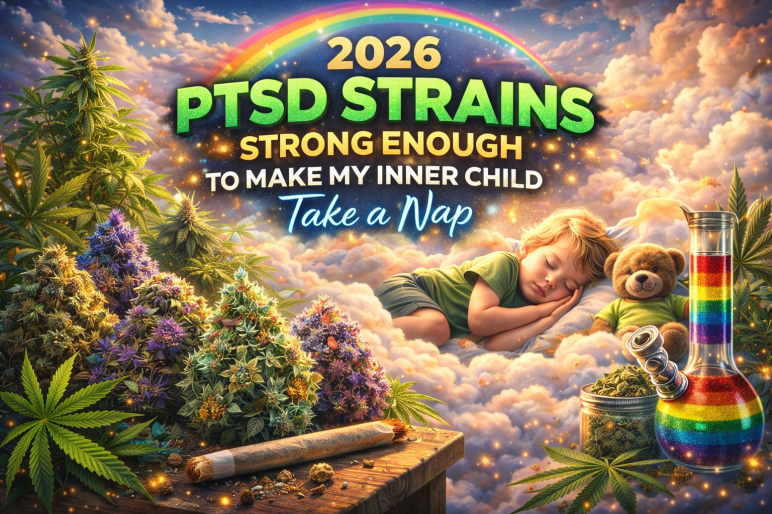
2026 PTSD Strains Strong Enough to Make My Inner Child Take a Nap

“Some folks meditate. Some folks journal. I personally prefer a strain strong enough to make my trauma sit down and hush like it’s in church.”

-This Puzzled Life

 Light the charcoal. Sprinkle the sage. Today we’re not just talking about PTSD. We’re talking about the botanical emotional support squad that keeps half this nation from screaming into a throw pillow at 3 AM. These are the 2026 strains for PTSD. Plus, the classic strains that have held us down since the Bush administration.

Let me tell you something. If PTSD awareness had a mascot. It wouldn’t be a bald eagle, a ribbon, or some inspirational mountain silhouette. It would be a raccoon in a bathrobe holding a half‑charged vape pen and whispering, “You good?”

And before anybody starts with the “PTSD is only for veterans” , it is equal‑opportunity chaos. It hits veterans, yes. But it also hits childhood survivors, domestic violence survivors, medical trauma survivors, and people who grew up in households where the family motto was basically “We don’t talk about that.” And anyone who has ever tried to call customer service during Mercury retrograde.

My PTSD didn’t come from a battlefield. It came from childhood trauma, adult trauma, and a lifetime of being handed emotional assignments I, absolutely, did not sign up for. And guess what? It’s still real. It’s still valid. And it still deserves treatment that doesn’t come with a 47‑page lawsuit attached to it.

Which brings me to medical cannabis. It’s the only medication I’ve ever taken that didn’t require a blood test, a warning label, and a prayer circle. Big Pharma stays in court like it’s a hobby. Cannabis? Cannabis just wants you hydrated, fed, and emotionally stable enough to fold laundry.

And with the way this country is going, the news, the politics, the economy, the general vibe,  the rate of PTSD is about to skyrocket like it’s trying to win a prize. Let’s talk about the strains that are stepping up in 2026 to keep us from losing our entire minds.

2026 NEW STRAINS FOR PTSD

1. Moonwater Mercy (Hybrid)

(Blue Moonshine x Lavender Ghost x Watermelon Gelato)

This strain feels like someone put a weighted blanket on your soul. Expect calm, clarity, and the sudden ability to answer emails without crying. Perfect for: intrusive thoughts, doom spirals, and “Why did I walk into this room?”

2. Velvet Lantern (Indica‑leaning Hybrid)

(Purple Velvet × (Ghost OG × Honeydew Cream))

Soft. Warm. Comforting. Like being hugged by a grandmother who actually went to therapy. Great for nighttime PTSD symptoms and shutting down the brain’s late‑night conspiracy theories.

3. Solar Peach Reprieve (Sativa‑leaning Hybrid)

(Peach Rings × (Super Lemon Haze × Apricot Gelato))

Bright, uplifting, and shockingly functional. This one gives you energy without anxiety — a miracle, truly. Ideal for daytime PTSD management and remembering you’re a whole adult with things to do.

4. Quiet Harbor (Indica)

(Northern Lights × (Harbor Mist × Blue Zkittlez))

This strain is basically emotional noise‑canceling headphones. Your nervous system goes from “car alarm” to “gentle tide sounds” in about ten minutes.

5. Blue Ember Renewal (Balanced Hybrid)

(Blueberry × (Ember Kush × Renewal Cake))

A perfect 50/50 that smooths out mood swings, reduces hypervigilance, and helps you stop side‑eyeing every noise in the house like you’re in a horror movie.

CLASSIC STRAINS FOR PTSD (The OG Emotional Support Crew)

1. Granddaddy Purple

(Purple Urkle × Big Bud)

The strain that tucked half of America into bed. Heavy relaxation, deep calm, and the ability to sleep like you’re being paid for it.

2. Blue Dream

(Blueberry × Haze)

The people’s champion. Creative, calm, and uplifting without making your heart beat like a hummingbird on espresso.

3. Girl Scout Cookies (GSC)

(Durban Poison × OG Kush)

Euphoric, grounding, and perfect for when your brain is doing too much. A classic for emotional regulation and mood stabilization

4. Do‑Si‑Dos

(Girl Scout Cookies (GSC) × Face Off OG)

Deep body calm, mental quiet, and the sudden ability to forgive people you don’t even like. A PTSD staple.

5. OG Kush

(Chemdawg × Lemon Thai × Hindu Kush)

The original “I need to chill before I throw this whole house away” strain. Relaxing, grounding, and reliable.

If you’ve made it this far, you’ve just survived a guided tour through the 2026 PTSD strain lineup. The classics that raised us. And the emotional circus that is living in this country right now. PTSD is real. PTSD is widespread. PTSD is not limited to veterans. And pretending otherwise only hurts the millions of us who survived battles nobody saw.

But here’s the good news. We’re healing. We’re laughing. We’re finding relief in plant medicine that doesn’t come with a lawsuit or a side effect list longer than a CVS receipt. And if the world keeps spiraling the way it’s spiraling, at least we’ll have strains strong enough to keep us grounded, sane, and spiritually moisturized. Trauma may have shaped you, but cannabis is helping you rewrite the ending. Sage still burning. We’re healing anyway. Thanks for reading! Keep blazin.’

Affirmation: I am healing, hydrated, and held together by equal parts resilience and premium-grade cannabis. My peace is non‑refundable. My boundaries are laminate. And my nervous system is finally minding its business.

 ***Don’t forget to watch the video!***

#ThisPuzzledLife
Law Enforcement And Mental Illness

Law Enforcement and Mental Illness

“If we always do what we’ve always done, we’ll always get what we’ve always got.”
— Quote from Tony (Anthony) Robbins, American life coach,
motivational speaker, and bestselling writer.

The topic of Law Enforcement and Mental Illness is one that comes with strong emotions on both sides. However, it’s a topic that needs to be dealt with now. I’ve never been in law enforcement, but I have been a part of Emergency Services from several angles. I have worked side-by-side with different cities and their officers. I worked in Hattiesburg, MS and Petal, MS on an ambulance as an EMT-B. I have also worked in Albuquerque, NM with the homeless at a county funded detox facility. Those jobs guaranteed me working with officers from all police departments. And as my condition with Dissociative Identity Disorder deteriorated in Albuquerque, Mel and our family have dealt with law enforcement sometimes on a regular basis due to some of my behaviors.

I’m not in a position nor will I run down fellow individuals who have worked and continue to work in the field of EMS because I understand the stress, callousness and cynicism that naturally develops just to be able to survive doing that type of work. And I understand that they are police officers not social workers. Most people don’t have a clue about what is seen and experienced in that field. What I will say is this…. there has been and continues to be a lack of education surrounding mental illness. Granted sometimes the behaviors get out of hand and force is needed to keep the individual safe from themselves and others.

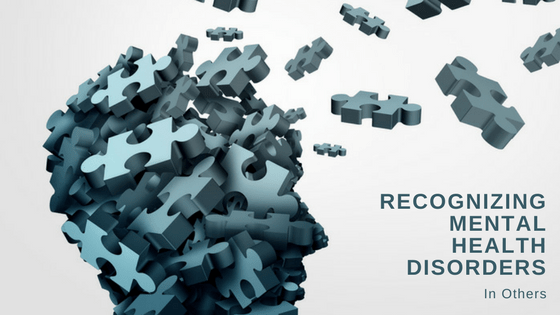
Recognizing-Mental-Health-Disorders-in-Others-1
What I’m talking about is the lack of education and training on mental illness that officers face. Sometimes having a Crisis Team individual to go out and talk to the individual can ensure less stress on both parties. Instead of immediately handcuffing an individual when simple talking to the person first could accomplish the same goal of getting someone much needed help. I completely understand that this is not feasible with all police departments especially smaller departments, in rural areas. Additionally, budget cuts in recent years makes this task virtually impossible.
Individuals aren’t necessarily prone to violent or criminal behavior. Does it happen? Sure, it does. But blanket statements are what causes stigmas that continue to build over time. Albuquerque had just started having a Crisis Team as we were moving out of the state.

There’s nothing like hearing someone hollering at you and looking down to see red dots on your shirt and not understanding why. Just like an episode of Cops, I was told to lay in the prone position on the cold concrete. I was then held at gunpoint with the red dots moving to my head. The male officer began screaming at me because he was supposed to get off work 30 minutes prior. The female officer was talking to me in a calm voice. Fortunately, I was wearing my medic alert dog tag that I wore because of another situation. She recognized the medic alert dog tag I was wearing and read the information. I was taken to one of the local hospitals for a mental health evaluation where I was subsequently let go.
This is just one of many situations that we encountered prior to leaving the state. Before I moved to Texas and Mel and our sons moved to Mississippi a crisis team came to our house wanting to know what the best way was to help with crisis situations. We gave them the information and for once I felt like I was being heard. There are many situations that happen like the above mentioned that could be helped with just trying to find out what the crisis is about versus being accusatory. And having the Crisis Team knowing what to do to help has changed how I feel about police officers and authority figures. We have a long way to go by challenging stigmas about mental illness. But I think it’s a start.
#thispuzzledlife