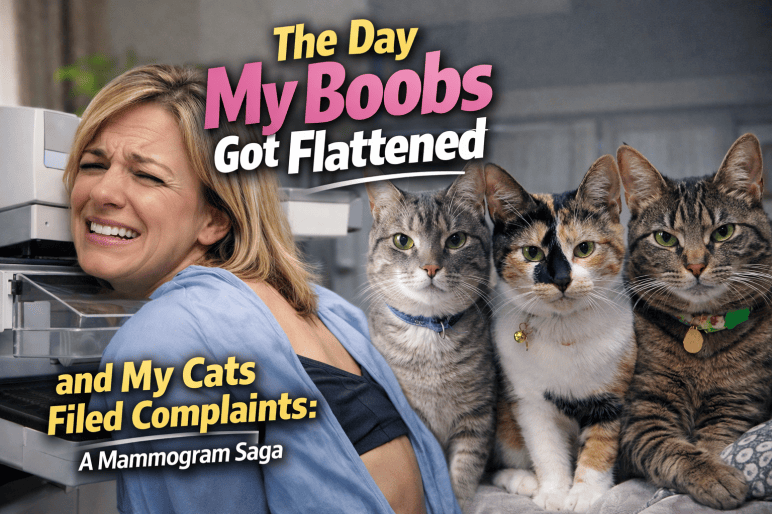


The Day My Boobs Got Flattened and My Cats Filed Complaints: A Mammogram Saga Octobe

“Listen, if Piper, Coco, and Tinkerbell can march into a medical facility like they’re auditioning for America’s Next Top Patient, then I can survive one little mammogram. Confidence is contagious. Especially when it sheds.”

-This Puzzled Life

Light the charcoal Sprinkle the sage. And pull up a chair and a heating pad. Because today we are talking about breast cancer awareness and the sacred Southern pilgrimage known as The Annual Mammogram, also known as, “The Day Your Boobs Meet the Panini Press of Destiny.”

And I am reporting live from the land of paper gowns, cold metal plates, and the annual reminder that my boobs are apparently public property for exactly 17 minutes. I walked into that imaging center feeling confident, moisturized, and blessed. And walked out looking like I’d just survived a WWE smackdown between my left titty and a hydraulic press.

Because nothing says “self‑care” like waking up at 6 a.m., chugging coffee, and driving across town to let a stranger flatten your chest like a Sunday biscuit. And listen, awareness matters. Early detection saves lives. But Lord, the way the world goes full Pepto Bismol in October with pink socks, pink yogurt lids, pink football cleats, and a pink ribbon shaped pancakes at IHOP. Meanwhile, Southern aunties everywhere are out here reminding you, “Baby, have you scheduled your mammogram yet? Don’t make me call Jesus and Blue Cross.”

You walk in. Sign your name. And immediately get handed a clipboard and a gown made from the same material as a Dollar Tree napkin. The nurse says, “Open in the front,” like you’re about to perform at the Grand Ole Opry. It’s always too short, too breezy, too confusing, and somehow both choking you and falling off your shoulders. You sit there clutching it closed like a Victorian widow.

The mammogram machine looks like something NASA built in the 80s and forgot to update. It has one job. Turn your boob into a crepe. The tech is always sweet, calm, and named something like Linda or Marsha. And she says things like, “Okay honey, just relax.” Relax? Ma’am, my nipple is currently pointing due north, and my soul has left my body.

Linda gently places your tit on the cold plate like she’s arranging a charcuterie board. Then she lowers the top plate. And lowers it. And lowers it. And keeps lowering it until your ancestors feel it. You’re standing there thinking, “Is this what a panini feels like?” “Did I pay my life insurance?” “Why is my left boob suddenly in 2D?” Linda steps back and says, “Hold your breath.” Ma’am, I haven’t breathed since the parking lot. The machine finally lets go. And your boob re-inflates like a sad balloon at a kid’s birthday party. You look down like, “Girl, you okay?” Your boob looks back like, “No.”

Piper, Coco, and Tinkerbell rolled up to their first mammograms like three tiny, furry Southern aunties who had absolutely rehearsed for this moment in the mirror. Piper marched in like she was the keynote speaker at the Breast Cancer Awareness Gala. Tail high, whiskers sharp, attitude louder than a Baptist choir. She hopped onto the check‑in counter and announced, “I’m here for my annual preventative maintenance, thank you.”

When the tech tried to hand her a paper gown, Piper sniffed it. Rolled her eyes. And said with her whole spirit, “This is polyester. I don’t do polyester.” She then attempted to operate the mammogram machine herself because “clearly no one else here has the range.”

Coco entered the building already offended. By what? Everything. The lighting. The temperature. The clipboard. The fact that she was asked to “wait her turn.” When the tech explained the process, Coco gasped like she’d been personally victimized. “EXCUSE ME?! You’re going to flatten what? These are heirlooms!” She then demanded a second opinion, a supervisor, and a snack.

Tinkerbell walked in wearing the confidence of a cat who has never once paid taxes or faced consequences. She took one look at the machine. Hissed. And then tried to climb it like it was a jungle gym. When the tech attempted to position her, Tinkerbell went limp like a toddler who doesn’t want to be picked up. Then she suddenly sprang back to life. Slapped the machine. And stole a pink ribbon off the wall like a tiny breast‑cancer‑awareness pirate. By the time it was over, the tech was sweating. The receptionist was praying. And the machine had filed for workers’ comp.

Piper strutted out like she’d just completed a TED Talk. Coco demanded her medical records “for emotional reasons.” Tinkerbell declared herself the new face of Feline Breast Health. And tried to pose for photos no one was taking. Cats dismissed. Awareness achieved. And the imaging center is now closed for spiritual repairs.

Breast cancer is real. And early detection saves lives. Because too many of our mamas, aunties, cousins, and sisters have fought this battle. Awareness isn’t just pink ribbons. It’s action. It’s appointments. It’s uncomfortable machines. It’s choosing yourself even when it’s inconvenient. And because most Southern women don’t play about two things. Jesus and preventative healthcare.

Schedule the mammogram. Wear the ugly gown. Let Linda flatten and fold your boob like a church bulletin. And walk out of that imaging center knowing you just did the bravest, squishiest thing a human can do. Laugh about it later. And remember. Your tatas are worth the trouble. And that’s the gospel truth. If surviving a mammogram doesn’t earn you a medal, parade, FIFA trophy, Nobel Peace Prize and a lifetime supply of padded bras, then society is broken beyond repair. Boobs checked. Blessings distributed.

And that, my friends, concludes this year’s episode of “Whose Boob Is It Anyway?” The only show where the points don’t matter. The machine always wins. And your nipple ends up pointing toward a constellation you’ve never heard of. Schedule the mammogram. Wear the tragic gown. Let Linda flatten you like a communion wafer. And then treat yourself to something fried. Because at the end of the day, your girls deserve to be checked, protected, and celebrated. And preferably with a bra that costs less than your car payment. Thanks for reading! Schedule your mammogram.

Affirmation: I am bold, blessed, and unbothered. My boobs, my boundaries, and my emotional support cats are all thriving. Today I face the squish with dignity, humor, and the chaotic energy of a feline who refuses to wear a paper gown.

***Don’t forget to watch the video!***

#ThisPuzzledLife

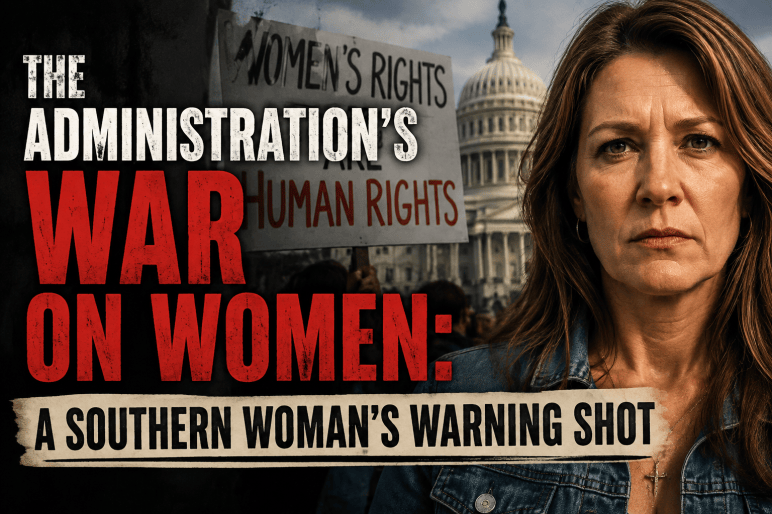
The Administration’s War on Women: A Southern Woman’s Warning Shot

“When they try to silence you remember. Your voice carries the strength of every woman who refused to disappear.”

-This Puzzled Life

Light the charcoal. Sprinkle the sage. Invoke the ancestors. At this point, I need every woman who ever walked barefoot through red clay. Every grandmother who ever whispered warnings in church pews. And every ancestor who ever held the line when the world tried to fold them in half. I need their strength, fire, and their stubborn refusal to disappear.

We are living in a moment where misogyny isn’t hiding in the shadows. It’s out here doing cartwheels in broad daylight. Feminists are fighting battles we already fought. Already won. Already buried. And already prayed over. And somehow, under this administration, those victories are being dug up like someone’s trying to rewrite the past and call it “progress.”

It’s emotional. It’s infuriating. It’s surreal. And yes the sarcasm is necessary. Because if I don’t laugh, I’ll start flipping tables. This isn’t just politics. This is personal. This is generational. This is spiritual. This is about the rights that shape our bodies, futures, families, safety, and dignity.

Before I get into this, let me say this clearly. These aren’t abstract policy points. These are lived experiences. These are wounds. These are warnings. These are the things I feel in my bones when I wake up and read the news.

Ten Women’s Rights Being Dismantled By This Administration

1. Reproductive autonomy

It feels like someone reached into my life and tried to snatch the steering wheel. Like our bodies are suddenly a battleground for people who will never carry a pregnancy. Never face the risks. And never feel the fear. It’s invasive. It’s dehumanizing. It’s infuriating.

2. Access to contraception

This rollback feels like a punishment for daring to plan my life. For daring to protect myself. For daring to choose when and if motherhood fits into my story. It’s insulting to my intelligence and dangerous to my future.

3. Domestic violence protections

Watching these weaken feels like watching a door slowly close on women, like me, who needed it open the most. It feels like the system is shrugging at our trauma. Like safety is optional. Like survival is a privilege instead of a right.

4. Equal pay initiatives

Women who have worked their whole lives have carried more weight than they should’ve had to. Seeing equal pay slip backward feels like being told, “Your work matters. But not as much as his.” It’s a slap wrapped in a smile.

5. Sexual harassment safeguards

This rollback feels like a return to the days when women had to swallow discomfort to keep a job. When we had to laugh off comments to survive. When our boundaries were treated like suggestions. It’s a reminder of every moment I felt unsafe but stayed quiet.

6. Maternal healthcare funding

As a mother, this one cuts deep. Pregnancy is not a hobby. Childbirth is not a casual event. Reducing maternal care feels like telling women, “Your life is an acceptable risk.” It’s cruel. It’s reckless. It’s unforgivable.

7. Title IX protections

I think of every girl who dreams big. Girls who run. Jump. Compete. And fight for their place. Rolling back Title IX feels like telling them, “Your dreams matter less.” It’s a theft of opportunity and a betrayal of potential.

8. Workplace discrimination enforcement

I’ve been labeled “too outspoken,” “too emotional,” “too much.” Weakening enforcement feels like handing every biased boss a permission slip. It feels like erasing the progress women clawed their way toward.

9. Childcare support programs

Working mother know that childcare is the backbone of survival. Cutting support feels like telling women, “Figure it out.” While knowing the system is designed for women to fail. It’s dismissive and deeply out of touch.

10. Representation in leadership roles

I’ve watched rooms full of men make decisions about women’s lives with the confidence of people who will never face the consequences. Reducing representation feels like erasing our voices from the future which is silencing by design.

Before I close, let me introduce what I’m about to say. This isn’t just a conclusion. This is a vow. A reminder. A line drawn in the sand. I am not here to shrink. I am not here to be quiet. I am not here to politely accept the erosion of my rights. I am the charcoal lit. I am the sage burning. I am the echo of every woman who refused to bow. And I will not sit still while my rights are peeled away like petals from a flower someone never bothered to water. Feminists aren’t fighting for attention. We’re fighting for survival. For dignity. For the future, our daughters deserve. And the one our ancestors dreamed of.

Let them underestimate us. Let them believe silence is compliance. Let them think we won’t notice. Because when women rise, we rise like storms. We rise like thunder rolling across the South. We rise like every ancestor who ever said, “Not today.” And watch us reclaim every damn thing they tried to take.

Affirmation: I rise rooted in truth that is guided by my ancestors. Fueled by my fire. And unshakeable in my right to exist fully, loudly, and freely.

***Don’t forget to watch the video!***

#ThisPuzzledLife
Domestic Violence Awareness Month: More Than Bruises, More Than One Story

“Leaving isn’t weakness. Staying alive long enough to escape is strength.”

-This Puzzled Life

Light the charcoal. Sprinkle the sage. Call the ancestors the loud ones, the protective ones, in close. The ones who don’t mind flipping a table when truth needs to be told. Let the ancestors pull up their rocking chairs and lean in like, “Alright baby, tell it exactly how it happened.“ Because today, we’re walking straight into a fire that too many people pretend isn’t burning. And the topic is Domestic Violence Awareness Month.

This month isn’t just a purple ribbon or a hashtag. It’s a national reckoning. A month carved out because silence has killed too many. Shame has trapped too many. And judgment has wounded too many who were already bleeding. It exists because domestic violence is not one thing. Not one story. Not one bruise. It’s a whole constellation of harm that is emotional abuse, financial control, spiritual manipulation, psychological warfare, sexual coercion, digital stalking, physical stalking, rape, threats, intimidation, and isolation. All of it real. All of it dangerous.

And Lord knows, the Deep South has a long tradition of saying, “Well, why didn’t she just leave?” With the same tone they use when asking why you didn’t bring potato salad to the church potluck. But today we’re not whispering. We’re not sugarcoating. We’re not letting judgment drown out truth.

Domestic violence is more than bruises. More than shouting. More than slammed doors. It’s the slow erosion of your identity. It’s the constant fear humming under your skin. It’s the way you learn to read someone’s footsteps like weather patterns. It’s the way you shrink. Fold. And contort yourself trying to keep the peace that never stays peaceful.

And let me say this with all the Southern sass I can muster. If you’ve never lived it, you don’t get to judge it. Because “just leaving” is a fantasy sold by people who have never had their life threatened. Their finances controlled. Their spirit manipulated. Or their faith weaponized against them. I know this because I lived it. Fourteen years in a domestic abuse situation that nearly swallowed me whole. The cycle wasn’t simple. It was a trap crafted with precision love bombing, threats, and intimidation. That is continuously repeated until you forget what freedom feels like.

I didn’t stay because I was weak. I stayed because I was scared. I stayed because I was conditioned. I stayed because every exit felt like a death sentence. And let me make something crystal clear. It wasn’t a billionaire. It wasn’t a senator. It wasn’t a monster hiding in the shadows. It wasn’t an immigrant. It wasn’t a drag queen with a story book. It wasn’t a trans person. It wasn’t a black person. It was a white, “Christian” man in the Deep South. One who used the Bible like a weapon. While twisting scripture into shackles. Preaching submission while practicing cruelty. A man who believed control was his God-given right. And fear was his favorite language.

That’s why Domestic Violence Awareness Month matters. Because abuse doesn’t look like one stereotype. Survivors don’t fit one mold. Judgment is easy. But understanding saves lives. It is a promise. A collective vow that we will speak loudly. Love fiercely. And refuse to let anyone’s suffering stay hidden behind closed doors.

And now, let me drop this mic so hard the ancestors stand up and clap. I survived what was meant to break me. I reclaimed what was stolen from me. And I will never apologize again for the fire in my voice. Thanks for reading! What have been your experiences?

Affirmation: I honor my survival, my truth, and my healing. I am worthy of safety, love, and a life without fear.

***Don’t forget to watch the video!***

#ThisPuzzledLife

Why My Boundaries Offend People Who Benefited From My Lack of Them

“When you stop people‑pleasing, you don’t become unkind. You become un-owned.”

-This Puzzled Life

Light the charcoal. Sprinkle the sage. Today we’re not just cleansing the air. We’re cleansing the generational rot that tried to bury us alive. While I also smile sweetly and was asked if I wanted more casserole.

There’s a special kind of exhaustion that comes from being raised in a culture where your worth is measured by how small you can make yourself. Where “good manners” means “don’t make anyone uncomfortable.” Even if you’re bleeding out emotionally. Where “respect” means “don’t you dare speak the truth out loud.” And the South? The South will hand you a monogrammed apron, a church bulletin, and a generational trauma starter pack before you can even walk. But today we’re unpacking all of it.

Let’s talk about people‑pleasing. Not the cute kind where you bring someone banana pudding because you love them. But the dangerous kind. The kind that rewires your nervous system. The kind that teaches you to abandon yourself so thoroughly that you forget you ever had needs in the first place.

People‑pleasing is not a personality trait. It’s a survival skill. A trauma response. A generational inheritance wrapped in a bow of “be sweet” and “don’t cause trouble.” And in the South, it’s practically a rite of passage.

We’re taught early don’t speak up. Don’t contradict. Don’t embarrass the family. Don’t make waves. Don’t question authority. Don’t tell the truth if the truth makes anyone uncomfortable. Don’t you dare put yourself first. That’s selfish. And for the love of all things holy, don’t let the church ladies hear you say “no.”

People‑pleasing becomes the currency of acceptance. The ticket to belonging. The price of being considered “good.” But here’s the sinister part. People‑pleasing trains you to betray yourself before anyone else even gets the chance. You learn to anticipate everyone’s needs but your own. You learn to apologize for existing. You learn to smile through pain so convincingly that even you forget you’re hurting. You learn to make yourself small enough to fit inside other people’s expectations. And the world, especially the Southern world, rewards you for it. Until you stop.

The moment you stop people‑pleasing. The moment you say “no,” or “that’s not okay,” or “I’m not doing that anymore.” The moment you choose yourself? Suddenly you’re the villain in a story you didn’t write. Suddenly you’re “difficult.” Suddenly you’re “ungrateful.” Suddenly you’re “too sensitive,” “too outspoken,” “too much,” “too emotional,” “too opinionated,” “too educated,” “too aware,” and “too alive.” But the truth is simple. You’re not too much. You’re just finally enough for yourself. And that terrifies people who benefited from your silence.

People‑pleasing is dangerous because it teaches you that your safety depends on your compliance. It teaches you that love must be earned through self‑abandonment. It teaches you that your needs are negotiable. But everyone else’s are sacred. When you grow up in a culture that worships politeness more than honesty. Appearances more than integrity. And reputation more than reality. You learn to disappear. Until one day, you don’t.

And here’s where it gets personal. This isn’t theory for me. This isn’t something I read in a book or heard in a podcast. This is lived experience that was carved into my bones. Stitched into my history. And dragged behind me for decades like a cross I never volunteered to carry.

On a personal note, my family marinated me in people‑pleasing my entire life. And when you don’t comply? You get labeled the troublemaker. The problem. The one who “changed.” The one who “thinks she’s better.” The one who “needs to calm down.” The one who “makes everything difficult.” But not teaching me boundaries while simultaneously demanding I people‑please was dangerous. Not inconvenient. Not uncomfortable. Dangerous.

I have almost died multiple times because I gave more of myself than I had to give. I was trained to prioritize everyone else’s happiness over my own survival. I was taught that my needs were optional. But their approval was oxygen. And in the South, it’s a shameful way of life to even question this dynamic.

I had to come to a point, not helped by their expectations, where I finally put myself first. And now that I have strong boundaries, my family and the community think I’m “nasty” because I tell them I don’t need their validation. They want me to “cow tow” to their needs while never expecting the same from them. And that, my friends, is the pinnacle of hypocrisy and controlling behavior. And at this point in my life, I can say with confidence that I’ll never allow myself to be controlled by someone else ever again.

Let me make this plain in a way even the most selectively‑forgetful, Bible‑thumping, reputation‑worshipping, boundary‑hating folks can understand. I am no longer available for my own destruction. I am no longer the family sponge soaking up everyone else’s dysfunction. I am no longer the emotional punching bag for people who refuse to face their own shadows. I am no longer the scapegoat for sins I didn’t commit. I am no longer the child who learned to survive by disappearing. I am no longer the adult who thought love meant self‑sacrifice. I am no longer the woman who begged for crumbs of acceptance from people who never learned how to love without conditions. I am done.

I’m done with the gaslighting. Done with the hypocrisy. Done with the “good Christian” performances. Done with the selective morality. done with the selective compassion. Done with the silence that protects abusers. Done with the shame that was never mine to carry. Done with the generational curses disguised as tradition. And done with the expectation that I should shrink so others can feel tall.

I am not here to make anyone comfortable. I am not here to uphold anyone’s illusion. I am not here to play the role they assigned me. I am not here to be palatable, agreeable, or quiet. I am here to live. Fully. Boldly. Truthfully. Unapologetically. And if my boundaries offend you? If my healing threatens you? If my voice rattles your cage? If my truth exposes your lies? That’s not my burden. That’s your mirror.

So let me end this with the clarity of a woman who has crawled out of the grave they dug for me. I didn’t lose my family. I lost my captors. I didn’t lose my community. I lost my chains. I didn’t lose my identity. I reclaimed it. And I will never, ever, ever hand it back. Lights out. Thanks for reading! To thine own self be true. What are your experiences with this?

Affirmation: My boundaries are sacred. My truth is valid. My life belongs to me now fully and forever.

***Don’t forget to watch the video!***

#ThisPuzzledLife

International Overdose Awareness Day: The Day We Stop Pretending Willpower Is Medicine

“Shame has never saved a life. Compassion has. And still can.”

-This Puzzled Life

Light the charcoal. Sprinkle the sage. Today, we’re not just cleansing the house. We’re cleansing the collective delusion that addiction is a moral failing. The sage is smoking like it’s trying to file a worker’s comp claim. The charcoal is popping like it’s gossiping about the neighbors. And I’m standing in the kitchen with the kind of determination usually reserved for Southern women who’ve had enough.

Piper struts in first.Tail high. Eyes narrowed. And a clipboard already out like she’s conducting a federal audit.

Piper: “Before we begin. I need to know if this is a cleansing ritual, a public dragging, or a memorial service. My paperwork differs.”

Me: “All three. It’s International Overdose Awareness Day. And I’m about to educate the masses.”

Coco barrels in next. She’s breathing heavily like she just ran a marathon but actually just walked from the living room.

Coco: “Is this about the humans who say addiction is willpower? And overdose is a moral collapse? I once ate an entire rotisserie chicken while sleepwalking. Explain that with willpower.”

Tinkerbell descends from the top of the fridge like a Victorian ghost who died of judgment.

Tinkerbell: “If willpower cured anything, half this household would stop doomscrolling at 2 AM. And the other half would stop emotionally eating Cheez-Its.”

Me: “Exactly. We’re dragging ignorance today.”

Piper adjusts her glasses. The glasses she does not need and sighs.

Piper: “I’ll prepare the minutes. This meeting is already chaotic.”

International Overdose Awareness Day started in 2001 as a remembrance event at a Salvation Army needle exchange in Melbourne, Australia. It was created to honor those lost. Reduce stigma around overdose. And to push the world to stop treating overdose like a shameful secret instead of a public health crisis. And let me say this plainly, with all the Southern sweetness of a peach cobbler baked in righteous fury, “Addiction and overdose are not moral issues.” And it’s not about willpower.

The next time you have diarrhea, keep in mind that it’s just willpower. Sit there with a Bible verse and see if the situation resolves itself. Let me know how that works out. That’s how ludicrous that argument is.

People don’t become addicts because they’re weak, sinful, lazy, or lacking character. Many addicts die wanting anything in life other than to be an addict. They die fighting. They die trying. They die hoping. But some folks, including people in my own family, love to say, “Addiction is about willpower.” It never has been. It never will be.

I’ve been an addict. I’ve been a professional treating addicts. I’ve buried friends. I’ve buried family. Not once have I judged them for their struggle. But the hypocrites in my life? The ones who claim moral superiority while ingesting alcohol at a rate that Pete Hegseth and Kash Patel struggle to keep up with? Hypocrite, please.

Overdose is an unfortunate part of addiction. Whether it’s chemicals, behaviors, or the slow-motion self-destruction people pretend “doesn’t count.” Because it’s socially acceptable. So how about we stop demonizing people who overdose while absolving ourselves of our own harmful, numbing, escapist overdoses?

If we’re being honest, some folks overdose on alcohol, self-righteousness, denial, Amazon Prime, gossip, rage, food, religion, and control. But somehow that doesn’t get labeled as a moral failure. Funny how selective morality works.

And here’s the truth that makes some folks squirm like they sat on a church pew with a splinter. Overdose doesn’t happen because someone is weak. It happens because someone is human. Humans who loved. Humans who tried. Humans who fought battles most people couldn’t survive for five minutes. Humans who deserved compassion instead of commentary.

But every year, we lose more people. Not because they were broken. But because the world still treats addiction and overdose like a character flaw instead of a medical condition. We lose them because shame is louder than science. Because judgment is easier than empathy. Because some folks would rather cling to their superiority complex than admit they don’t know a damn thing about what they’re talking about.

So on International Overdose Awareness Day, I’m lighting this charcoal. Sprinkling this sage. And saying this with my whole chest, “Stop demonizing the people who are drowning while you’re out here drinking from your own poison well. Stop pretending your socially acceptable overdoses are any less destructive just because they come with a cute, monogrammed tumbler or a Bible verse slapped on top. Stop acting like overdose is a choice when half the people judging can’t even choose to drink water or go to bed on time. And most importantly, start honoring the people we’ve lost by refusing to let stigma bury the living.

The dead deserve dignity. The living deserve compassion. And the ignorant deserve education. Loud, unapologetic, Southern‑fried education. Today, I’m choosing truth over tradition. Compassion over comfort. And humanity over hypocrisy. If that makes some folks uncomfortable? Good. Growth never happens in comfort. And comfort has never saved a single life. But truth might. Compassion might. You might. Thanks for reading! Share this with others.

 Affirmation: I honor the lives lost. Uplift the living. And refuse to let stigma speak louder than truth.

***Don’t forget to watch the video!***

#ThisPuzzledLife

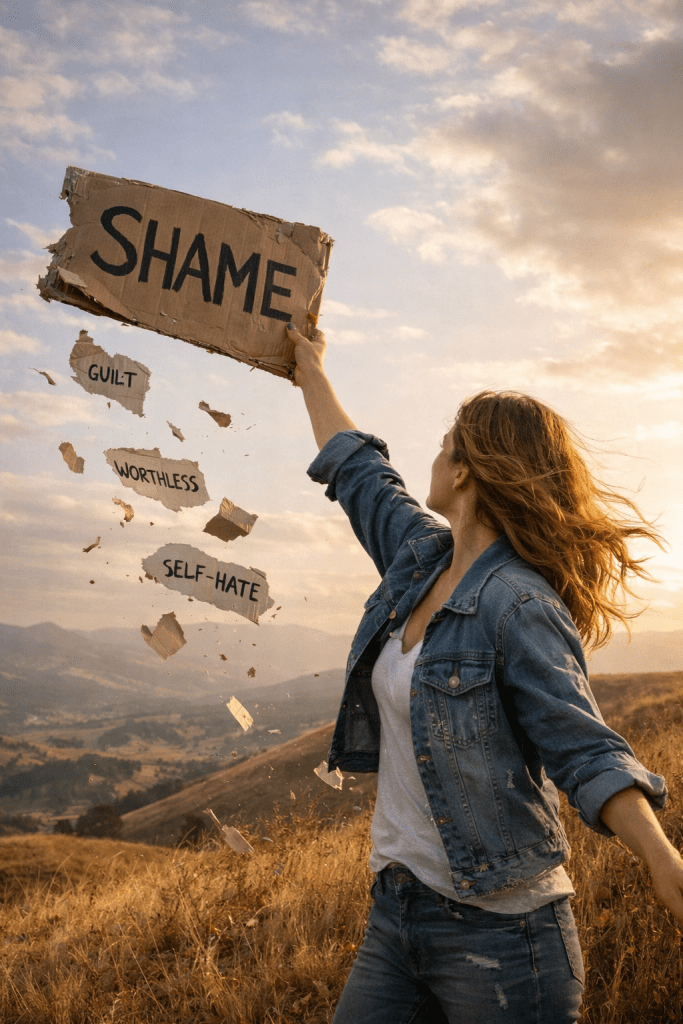
Shame: The Weight I Refuse to Carry Anymore

“Shame was never my reflection. It was the shadow of someone else’s fear cast across my life.”

-This Puzzled Life

Light the charcoal. Sprinkle the sage. Let the smoke rise like a soft warning. A trembling invitation. And a doorway cracked open just wide enough for the truth to step through without flinching. Let it drift through the room the way shame once drifted through our childhood homes as quiet and unspoken. But heavy enough to shape the way we learned to breathe.

This isn’t about performance. It isn’t about survival. It’s about naming the thing that has lived in your bones longer than some people have lived in their houses. I’m not writing from a place of humor or distance. I’m writing from the wound. From the memory. From the soil that raised me. And the silence that tried to claim me.

Shame is not born in us. It is handed to us. Pressed into our palms by people who were supposed to know better. People who were supposed to love better. People who were supposed to see us as whole. And in the Deep South, shame is practically a family heirloom.

Down here, some conservative communities have perfected shame into an art form as quiet, polished, and Sunday‑morning approved. They wield it like a switch they no longer have to swing. Because the words do the bruising for them. They don’t have to raise their voices. They just raise an eyebrow. They don’t have to say you’re wrong. They just say they’re “praying for you.” They don’t have to tell you to hide. They just make sure you know what happens to people who don’t.

Shame becomes the air you breathe before you even know what air is. It teaches you to fold yourself small. To tuck away the parts of you that don’t fit the script. To apologize for the way your heart beats. The way your voice trembles. And the way your truth refuses to die quietly. The worst part is how deeply it roots itself. And how it convinces you that you are the problem. Not the rules. Not the silence. Not the fear disguised as righteousness.

Some Southern conservative spaces are experts at this. They turn difference into danger. They turn authenticity into rebellion. They turn survival into sin. They shame you for who you are. And then shame you again for hurting because of it.

But here’s the truth shame never wants you to learn. You were never the one who failed. You were the one who endured. Shame is not your inheritance. It is not your identity. It is not your burden to carry one more mile. The moment you name what was done to you. The moment you say, “This wasn’t love. This was control.” The spell breaks. The weight shifts. The air clears. And you begin to see yourself without the fog of someone else’s fear. You begin to hear your own voice again. You begin to rise. And rising is the one thing shame cannot survive.

Shame is universal. It’s a part of every culture and every nation. And every community has its own way of teaching people to hide the parts of themselves that don’t fit the script. Shame is a global language. It is spoken in different dialects. It is enforced through different rituals. And it is carried in different bodies.

But the version I know. The one that shaped my bones and rewired my voice was born in the conservative Deep South. That’s the lens I speak from. That’s the air I learned to breathe. That’s the terrain where shame wasn’t just a feeling. It was a system.

Some conservative Southern communities wield shame like a tool of order. A way to keep people in line. A way to maintain the illusion of perfection even when the truth is rotting beneath the floorboards. They don’t have to say, “you’re wrong.” They just say, “we don’t talk about that.” They don’t have to say, “you’re unworthy.” They just say, “think of what people will think.” They don’t have to say, “you don’t belong.” They just make sure you feel it.

Shame becomes the soundtrack of your childhood. The shadow in every room. The reason you learn to fold yourself into shapes that hurt to hold. When you grow up queer, outspoken, different, or simply unwilling to disappear, the shame becomes sharper. More pointed. And more personal.

You were not the problem. You were the disruption. You were the truth they didn’t know how to hold. Shame thrives in silence. But it cannot survive being named. The moment you say, “This harmed me,” the spell breaks. The moment you say, “This wasn’t love,” the weight shifts. The moment you say, “I deserved better,” the ground beneath you changes shape.

You begin to see yourself without the fog of their expectations. You begin to hear your own voice without the echo of their judgment. You begin to rise in ways they never prepared for. And rising is the one thing shame cannot withstand.

Let every culture keep the shame it created. Let the South hold the weight of the shame it taught me to carry. I am done dragging their silence behind me. I am done mistaking their fear for my fault. I am done shrinking to make their world more comfortable. I speak now. I rise now. I reclaim every part of me they tried to bury.

And the sound of that truth is unapologetic. Unbroken. And is the loudest thing I’ve ever survived. You were never meant to carry it. Set it down. Walk forward. And let the sound of your unbroken truth shake the whole damn South. Thanks for reading! And put that shame down.

Affirmation: I release every ounce of shame that was handed to me. My truth rises. My voice steadies. And I walk forward unburdened and whole.

***Don’t forget to watch the video!***

#ThisPuzzledLife

Truth Over Tradition: My Exit From Comfortable Dysfunction

“The truth didn’t break my family. The pretending did.”

-Unknown

Here’s the bigger picture. I didn’t grow up in a family that heals. Problems don’t get solved. They get buried alive. And then resurrected during holidays like emotional zombies. Now that me and my sister are adults, childhood resentments still pop up like whack‑a‑mole. And nobody wants to pick up a mallet. Let’s all smile in public so we don’t “defame the family.” Which honestly, does a fantastic job defaming itself.

And my family isn’t special. Dysfunction is everywhere. I have enough mental health education in my background to recognize the patterns. But they’ll swear I’m the problem. If you look past the church smiles, the whole system is sick. I would genuinely rather be hit by a car than attend “family time.” And because my kids were born into a lesbian family, they get treated like they came with a moral recall notice.

You can’t throw money at children and then take no active part in their lives the rest of the time. Especially, when you do the opposite with the other children in the family. The kids notice. I’ve tried talking about it for 17 years. And the truth is this. They just don’t care.

I have a master’s degree in counseling psychology. Yet somehow I’m the ignorant one. They don’t want insight. They don’t want help. They want silence. And mine has officially expired. I defend myself and my kids however I see fit. Respectfully? No. Effectively? Absolutely.

They want healing without effort. They’re emotional pillow princesses that want the benefits of growth while doing absolutely nothing but blinking dramatically. And when truth bruises their egos, accountability never shows up. Meanwhile, my dad plays messenger pigeon flying information back and forth between me and the rest of the family so that the dysfunction stays perfectly preserved.

Here’s the part they’ll never admit. Family therapy requires guts and transparency. And those two things they treat like forbidden sins. Instead, they’ve built a giant sand pile where they can bury their heads. And pretend nothing is wrong. That’s their comfort zone. Not truth. Not healing. Just sand. Neck‑deep and breathing through a straw of selective memory.

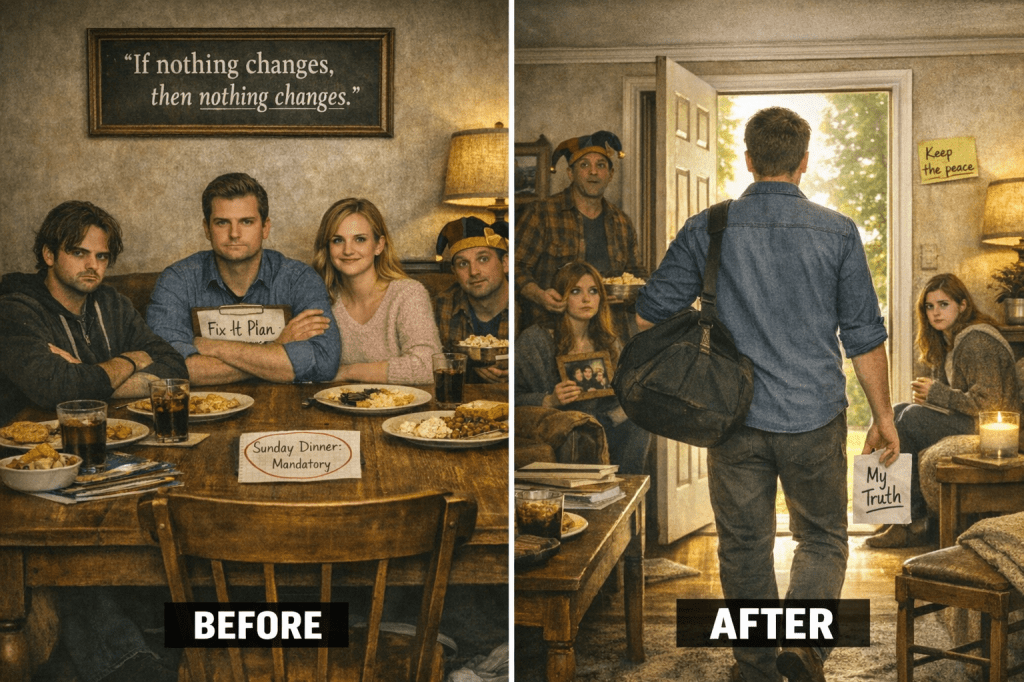
My favorite quote says it best, “If nothing changes, then nothing changes.” And I refuse to be silenced because their comfort depends on my suffering.

Our family lives in what I call comfortable dysfunction. It’s the emotional recliner they refuse to replace even though the springs are broken. And the fabric smells like denial. It’s easier than accountability. Easier than honesty. Easier than saying, “Maybe the gay daughter isn’t the downfall of civilization.”

And as if being the rainbow sheep wasn’t enough. I’m also the green sheep of the family because I’m a medical cannabis patient. And the family’s translation is that I’m “druggin’ and thuggin’.” The “bad influence.” And the “one who needs prayer.” But that’s not even the real issue.

The problem is my refusal to sit quietly in the pew of generational silence. The issue is that I no longer participate in the family’s favorite pastime of pretending. I’m done shrinking myself so other people can stay cozy in their outdated beliefs. I’m done letting conservative Christian values be weaponized against me and my children.

They can keep their selective morality. The kind where my sister thinks being gay is “wrong and evil.” But somehow premarital sex is just the Olympic sport of “being human.” Funny how sin gets flexible when it’s their behavior on the table. 

“My family says I’m ‘living in sin.’ Which is wild coming from some of them who wave a red hat like it’s the state flower. They preach about morality and still treat premarital sex, drinking, and hypocrisy like they’re covered under the ‘Jesus forgives me’ warranty.”And trust me. They act like I graffitied the Ten Commandments in rainbow glitter.

Being gay automatically made me the family’s “problem child.” Even though the real problems have nothing to do with what gender I love. And everything to do with the fact that I refuse to pretend. My sister can have premarital sex. Drink like she’s hydrating for the Olympics and drive afterward. And micromanage her child like she’s running a dictatorship. But somehow I’m the moral crisis.

Meanwhile, my sister’s shot glasses stays full. Her judgment stays loud. And her hypocrisy stays undefeated. Funny how cannabis for medical reasons is “dangerous.” But alcohol with a side of denial is “just being human.” I’m the rainbow sheep because I live authentically. I’m the green sheep because I choose a legal, doctor‑recommended treatment. And I’m the scapegoat because I refuse to shrink so other people can stay comfortable in their dysfunction. If being myself makes me the rainbow‑green hybrid sheep of the family, then so be it. At least I’m not grazing in the pasture of hypocrisy.

So no, I’m not stepping back into the box they built for me. I’m not dimming myself, so their comfort stays intact. I’m not carrying the weight of a family that refuses to lift a finger for its own healing. They can keep their comfortable dysfunction. They can keep their silence. They can keep their outdated beliefs wrapped in Bible verses that only apply to me.

Today I honor my inner rainbow‑green sheep. I’m fabulously queer. I’m medically lifted. And completely unbothered by the opinions of people who confuse hypocrisy with holiness.”

I’m choosing truth over tradition. I’m choosing growth over guilt. I’m choosing my children, my peace, and my sanity. And if my existence shakes the foundation of their worldview. Then the foundation was weak to begin with. Thanks for reading! Do you and let the others do them.

Affirmation: I bless my rainbow‑green sheep soul today queer, medicated, and thriving. While certain relatives clutch their red hats and pearls at my existence. But don’t blink twice at their own chaos, contradictions, or alcohol fueled commandments.

***Don’t forget the video!***

#ThisPuzzledLife

The Family Roles & The Circus They Created

“My family says I’m ‘living in sin.’ Which is hilarious coming from people who treat denial like a spiritual gift. And premarital sex like a community service.”

-This Puzzled Life

Light the charcoal. Sprinkle the sage. Negative energy, get your shoes on and leave. Today we’re diving into one of my favorite dysfunctional family topics. Family roles. Those unofficial job titles we never applied for. Never wanted. And yet somehow ended up performing like we were on salary. Take a moment and see where you and your people fall. And here’s the spoiler. If you’re reading this, you already know.

Before we get started, let me warn you. This is not a gentle stroll through family history. This is a full‑blown guided tour through a Southern household. That’s been held together with casserole, denial, and conservative Christian values. That seem to get applied with the accuracy of a toddler using glitter glue.

I grew up in a family where “we don’t talk about that” wasn’t a suggestion. It was the eleventh commandment. Emotions were treated like illegal fireworks. Everyone had them. Nobody handled them correctly. And something always exploded at the worst possible time.

In my house, honesty was considered aggressive. Accountability was considered disrespectful. And therapy? Therapy was treated like witchcraft performed by people who “don’t know Jesus personally.”

Meanwhile, the dysfunction strutted around the living room in broad daylight wearing a name tag and a church hat. And everyone pretended they couldn’t see it. If denial were a sport, my family would have Olympic medals and a sponsorship from Hobby Lobby.

So, buckle your emotional seatbelt. And prepare yourself. Because once you recognize the roles in a dysfunctional family. It’s like spotting roaches. You can’t unsee them. And suddenly they’re everywhere.

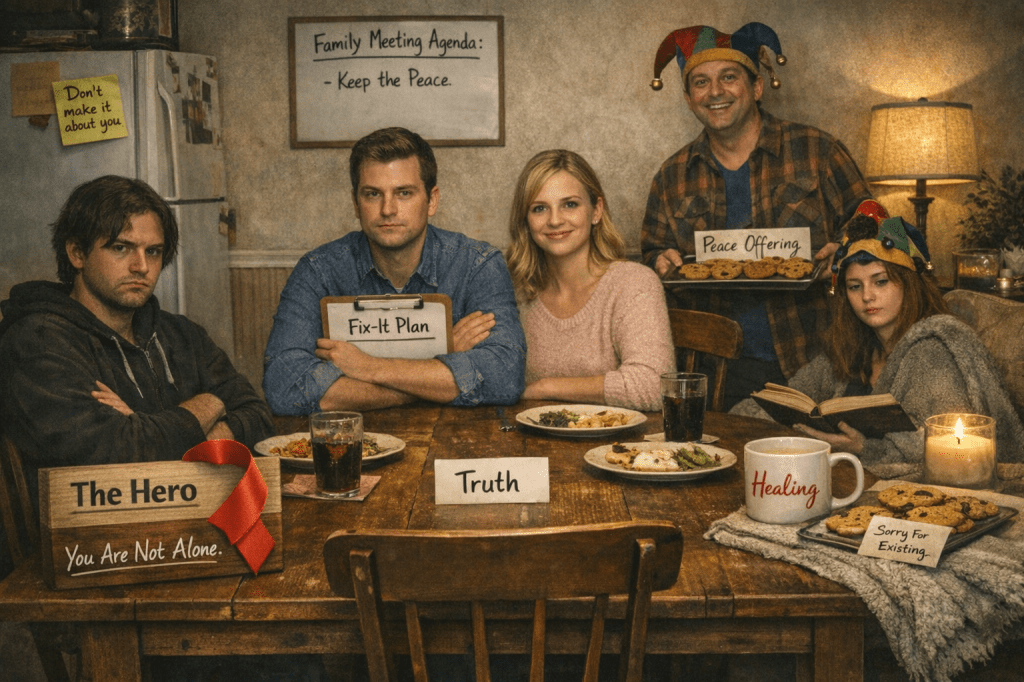
Family roles are the expected behaviors, responsibilities, and emotional acrobatics each person performs to keep the family circus running. These roles shift depending on culture, family size, and personality. But the classics are Hero, Scapegoat, Golden Child, Lost Child, Mascot. And I show up everywhere like glitter after a craft project.

Let’s begin.

1. The Hero (a.k.a. The Family PR Department) The Hero’s job is to make the family look normal, stable, and “blessed and highly favored” to the outside world. According to theraplatform.com (2025), they take on excessive responsibility to gain approval. This is my mother’s role. Or at least the role she auditions for. She is attention-seeking. Reputation-obsessed. And allergic to accountability. She delivers passive-aggressive comments like she’s handing out communion wafers. And then acts shocked when people get upset.

Her signature move? “The Dummy Card.” Suddenly she “doesn’t remember,” “didn’t mean it like that,” or “doesn’t know what you’re talking about.” But trust me, she knows. And right after she stirs the pot. She gives my dad the “rescue me” look. As if she didn’t just season that pot with cayenne, spite, and generational trauma. We only have real conversations when she’s mad at my sister, The Golden Child. Otherwise, it’s news, sports, and weather which is the Holy Trinity of Avoidance.


2. The Scapegoat (hi, it’s me) The Scapegoat is blamed for everything wrong in the family. Stubbed toe? My fault. Bad weather? Somehow me. The economy? Probably me too. I don’t conform to their lifestyle. I’m gay. I use medical cannabis. I don’t go to church because there are too many people who support the cruelty of the Trump regime. And align theirselves with the MAGA movement which practices a form of chriatianity that cannot be found in any Bible. And quite frankly, they have a bad reputation for normalizing pedophilia while demonizing being gay. I guess I should be glad that I just can’t understand that rationale. 

I talk about taboo topics. And I acknowledge reality instead of pretending everything is fine.
And did I mention I’m gay? Because trust me they will. Instead of saying,
“She’s our family and we love her no matter the gender of someone she loves and that loves her.” They act like my existence is a PR crisis. The attitude is like, “Remember when Dana destroyed the family by being prouid to be gay and authentic?”  I’m also the family whistleblower. I don’t play along with generational nonsense. I’m my own person. And I’m not apologizing for it.

3. The Golden Child (my sister, obviously) The Golden Child is the family’s prized possession. The chosen one. The favorite. And the one who can do no wrong even when she is actively doing wrong. Thriveworks.com (2023) describes this child as obedient, praised, and protected. That’s her. She has been dipped in gold since birth. She follows the script. Holds the same beliefs. And passes them down to her children like heirloom china. She was taught what to think. Not how to think. And the cycle continues. Children aren’t born to hate. They learn it from the adults who raise them. And this is what my sister excels at consistently.

4. The Lost Child (also my sister — she multitasks) The Lost Child avoids conflict like it’s a full-time job with benefits. She withdraws. Stays quiet. And pretends she’s above the chaos. While simultaneously contributing to it. She never acknowledges her harmful behavior. She believes most people are beneath her. And when she talks about someone being gay, she spells it out “G-A-Y” like she’s avoiding summoning a demon. Her emotional range is that of a frozen waffle. And honestly, that’s the family vibe overall.

5. The Mascot (me and my dad) Mascots use humor to distract from the dysfunction. We crack jokes. Lighten the mood. And do not dare fix anything. We just to keep the room from exploding. This doesn’t always work especially when me and my sister are at war like rainbows and bibles. My dad rescues my mom and sister from “big, bad Dana.” Who refuses to sweep things under the rug. I’m the villain because I tell the truth. Imagine that. Kind of sounds like the current government’s level of functioning.

Now you’ve met the cast and the roles they cling to like emotional security blankets. In the next part we’ll zoom out and look at the bigger picture. And it’s the part they refuse to acknowledge.

That concludes our tour of the Family Circus. Please exit through the gift shop. Where denial is half‑off. Accountability is out of stock. And the Scapegoat merchandise is mysteriously overpriced.” Thanks for reading! Keep breaking chains.

Affirmation: Today I honor my emotionally athletic self. The whistleblowing. Boundary‑setting. Truth‑telling legend who refuses to join the family’s Olympic Denial Team. Even though they’ve been training since the womb.

***Don’t forget to watch the video!***

#ThisPuzzledLife

He Is Risen. And So Is My Blood Pressure Watching Christians Misquote Scripture Again

“If Jesus didn’t need help rising from the dead, He definitely doesn’t need help judging His children.”

-This Puzzled Life

 Let the ancestors lean in. And the nonsense scatter like roaches when the kitchen light flips on. I’m clearing the air. Clearing my spirit. And clearing out anybody who came in here with judgmental energy, weaponized scripture, or a Facebook theology degree. Today we’re telling the truth with love, humor, and just enough Southern heat to make the devil fan himself.

Every year, Easter rolls around and suddenly half the conservative Christians in the South start acting like they’ve been personally hired by Jesus HR to conduct performance reviews on the entire population. They show up to church in pastel outfits so loud they could blind a deacon armed with judgment, casserole, and a Bible verse they skimmed once during Vacation Bible School in 1994.

Meanwhile, Jesus is over here like, “I rose from the dead to bring hope and liberation. Not to watch y’all turn my message into a neighborhood watch program for people who don’t look, love, or live like you.” But bless their hearts. They really believe Easter is about policing everyone else’s salvation. Like Jesus outsourced His job to a committee of pearl‑clutchers with Wi‑Fi.

Easter is supposed to be the celebration of renewal, liberation, and radical compassion. He was a man who literally washed feet. Fed strangers. And hung out with the outcasts. And provided a message of hope for the poor, the hungry, the immigrant, the traumatized, the eccentric, the ethnically diverse, and the folks society shoved to the margins.

Jesus was the original “bring everybody to the table” host. He didn’t ask for dress codes, doctrinal purity, or a background check. He said, “Come as you are.” And meant it. Not “Come as you are, unless Brenda doesn’t approve of your haircut.”

Somewhere along the way, though, a whole crowd of folks decided Jesus needed personal judges. A volunteer morality police. A neighborhood watch for rainbow flags. A holiness HOA. A spiritual TSA checkpoint. And they signed up like it was a Black Friday sale.

They twist His words like balloon animals. Weaponize scripture like it’s a Nerf gun. And act like Jesus is running a multi‑level marketing scheme where the top sellers get a crown and a parking spot in heaven. They weaponize His teachings against LGBTQIA+ folks, immigrants, people of color, the poor, or anyone who doesn’t fit their “approved” mold.

And then they have the audacity, the sheer sanctified audacity, to say they’re doing it “in Jesus’ name.” Jesus didn’t ask for helpers. He didn’t post a job listing for “Assistant Judge. An unpaid internship where you must hate fun.” If anything, he said the opposite such as, “Sit down. Be humble. Love people. And stop acting like you’re the CEO of Heaven’s HR department.”

Let’s talk about the rainbow for a second. Conservative Christians love to act like the rainbow was stolen, borrowed, or misused by queer folks. Jesus made the rainbow. The gays just accessorized it better. And queer folks are honoring the original design with more creativity, joy, and community than the people who claim ownership of it. If Jesus didn’t want the rainbow to be a symbol of diversity, unity, and hope, he wouldn’t have made it look like the world’s happiest flag.

Jesus was pro‑poor, pro‑immigrant, pro‑outcast, pro‑community, pro‑healing, pro‑inclusion, and pro‑“stop being hateful and go feed somebody.” He was the original DEI ( Diversity, Equity, Inclusion) department. Long before corporate America slapped it on a PowerPoint slide. He didn’t need a committee. He didn’t need a board vote. He didn’t need a church newsletter. He just did the work.

Christians love to toss around the phrase “hate the sin, love the sinner” like it fell straight out of Jesus’ mouth and onto a Hobby Lobby wall sign. But it did not. That line is nowhere in the Bible. Not in Genesis. Not in Psalms. Not in Leviticus. And not even hidden in the fine print of Revelation. The idea is loosely connected to Christian teachings. Sure. The actual phrase traces back to St. Augustine of Hippo in 424 AD. And it didn’t get its modern glow‑up until Mahatma Gandhi repeated a version of it centuries later. So, if folks want to use it, fine. But let’s stop pretending it’s scripture when it’s clearly not. As one source puts it, the exact phrase simply isn’t in the Bible (Catholic.com, 2026). In other words, quit assigning Jesus quotes he never said. Especially when they’re being used as a permission slip for judgment.

This Easter, let’s remember what actually happened. A brown, Middle‑Eastern, homeless, anti‑authoritarian healer rose from the dead to liberate humanity. Not to give conservative Christians a seasonal excuse to cosplay as Heaven’s security guards. Easter is about resurrection. Not regulation. Liberation. Not legislation. Compassion. Not condemnation.

If Jesus wanted personal judges, he would’ve hired them. Instead, he told everybody to love their neighbor and mind their business. Let’s celebrate Easter the way Jesus intended. With open arms, hearts, tables, and absolutely no volunteer applications for Assistant Judge of the Universe. He’s got that job covered. And the rainbow says the gays are doing just fine. Thanks for reading! Stay spiritually focus instead of judgmental.

Affirmation: I walk in the kind of love, compassion, and radical inclusion Jesus actually taught. Not the edited, fear‑based version some folks try to pass off as scripture.

***Don’t forget to watch the video!***

#ThisPuzzledLife

Child Abuse Awareness: When the Safe Places Aren’t Safe

“When the places built to protect children become the places that break them, the wound isn’t just personal. It’s a failure of every adult who chose silence over responsibility.”

-This Puzzled Life

Light the candles. Move the breakables. Tell the ancestors to take their seats and pass the sweet tea. We’re not easing into this one. And before the denial committee calls an emergency meeting to rehearse their “But that’s not what we meant” speeches, let’s go ahead and say the quiet part out loud.

Child abuse doesn’t just happen in the home. It happens in classrooms where teachers misuse authority. In churches where “discipline” is weaponized. In sports programs where adults confuse control with coaching. In friend groups where older kids exploit younger ones. And in any space where a child’s safety depends on an adult’s integrity, and that integrity fails.

Let me say this in the clearest way I know how. And  coming from someone who personally knows a little something on this topic, what happened to you was abuse. And it was a betrayal of power. Schools and other places are supposed to be safe. Adults in those buildings are supposed to protect children. You were not protected. And when abuse happens in a place that claims to be safe, the damage hits on multiple layers at once. It’s not just the act itself. It’s the collapse of every structure that was supposed to shield you.

You were a child. They were adults. The responsibilities were never equal. The conflict you still feel between “their job” and “your role” is a direct result of their failure, not yours. The tactics you endured weren’t just harmful. They were calculated. “Diabolical” would be the right word. The cruelty, the gaslighting, the public humiliation? These are methods designed to break a person’s sense of reality and self‑worth. Many adults would crumble under that kind of psychological warfare. Expecting a child to withstand it is unthinkable. And, yet, if you’re reading this, you did. Not because you should have had to. Not because you were equipped for it. But because you had no choice. That’s not resilience by choice. That’s survival by necessity.

Here are a few sources you might want to dive into.

1. Most child abuse is never reported (all types)

U.S. Department of Justice – Bureau of Justice Statistics“86% of child abuse cases are never reported to authorities.” 🔗 https://bjs.ojp.gov/content/pub/pdf/cv22.pdf (bjs.ojp.gov in Bing) (See section on underreporting of violent crime against children.)

2. Children often disclose abuse but are ignored or silenced

Health & Social Care in the Community (2025) Study on child maltreatment disclosures found that children frequently disclose abuse (physical, emotional, sexual, neglect) but are ignored, dismissed, or punished by adults. 🔗 https://onlinelibrary.wiley.com/doi/10.1111/hsc.14336(onlinelibrary.wiley.com in Bing)

3. Delayed disclosure is common across ALL abuse types

CHILD USA – National Think Tank for Child ProtectionOver 70% of victims delay disclosure for at least five years, regardless of abuse type. 🔗 https://childusa.org/wp-content/uploads/2024/01/Delayed-Disclosure-Report.pdf(childusa.org in Bing)

4. Institutional betrayal: schools, churches, programs often ignore reports

Journal of Child Sexual Abuse (applies to institutional responses across all abuse types) Shows that institutions frequently dismiss, minimize, or cover up reports of abuse.🔗 https://www.tandfonline.com/doi/full/10.1080/10538712.2019.1570402 (tandfonline.com in Bing)

Note: While this journal focuses on sexual abuse, the institutional‑betrayal patterns. It’s documents are identical across physical, emotional, and psychological abuse.

5. Teachers and school staff rarely report abuse, even when required by law

U.S. Department of Education Report Only 11% of school personnel who witness or suspect abuse report it. 🔗 https://www2.ed.gov/rschstat/research/pubs/misconductreview/report.pdf (www2.ed.gov in Bing)

6. Children who report abuse are often disbelieved or blamed

National Institute of Justice – Child Abuse Disclosure Research Children frequently disclose abuse but face denial, minimization, or retaliation from adults. 🔗 https://nij.ojp.gov/topics/articles/child-abuse-disclosure-what-research-tells-us (nij.ojp.gov in Bing)

The wound you carry makes sense. Trauma doesn’t fade just because time passes. It imprints itself. It becomes a landmark in the psyche. And  something you walk around, navigate, and learn to live beside. Therapy can help you understand it. But it can’t erase the fact that it happened. And that it shouldn’t have happened. The gaslighting you endured stole something fundamental. Your ability to trust your own perception.

When adults deny a child’s reality, the child learns to doubt themselves. When they shame a child publicly, the child learns their existence is a problem. When adults ignore a child’s cries for help, the child learns that safety is conditional or imaginary. That’s not a child “being dramatic.” That’s a child being abandoned. And then abandonment by the very people who were supposed to protect you happened. The people you trusted were identified as educators, authority figures,  and other adults in power. And that leaves a wound that is both emotional and existential. You were trapped. And that was not your fault.

A child cannot escape a system built around them. A child cannot “just tell someone” when the people they’re supposed to tell are the ones causing the harm or ignoring it. A child cannot “make better choices” when every direction is blocked. You survived in the only ways available to you. Your mind did what it had to do. Your body did what it had to do. Your spirit did what it had to do. Survival is not shameful. Survival is not weak. Survival is not something you owe anyone an explanation for.

 And the fact of the matter is that THE FAILURE WAS THEIRS. NOT YOURS. You were a child. They were adults. They had power. You had none. The responsibility was theirs. The consequences were yours. And that imbalance is the injustice you’re naming. What you lived through would have broken many adults. The fact that you’re here speaking and naming it is refusing to let it stay buried. And that is strength. Even if it doesn’t feel like it. Thanks for reading! And do your part to help protect our children.

Affirmation: “I honor the child who survived what no child should face. I am not defined by what was done to me. I am defined by the courage it takes to speak it.”

***Don’t forget to watch the video!***

#ThisPuzzledLife