This Puzzled Life is a mental health and recovery blog exploring addiction, trauma healing, LGBTQ experiences, humor, and the strange moments that shape us.
“Awareness isn’t comfortable, but neither is grief. Choose the discomfort that saves lives.”
-This Puzzled Life
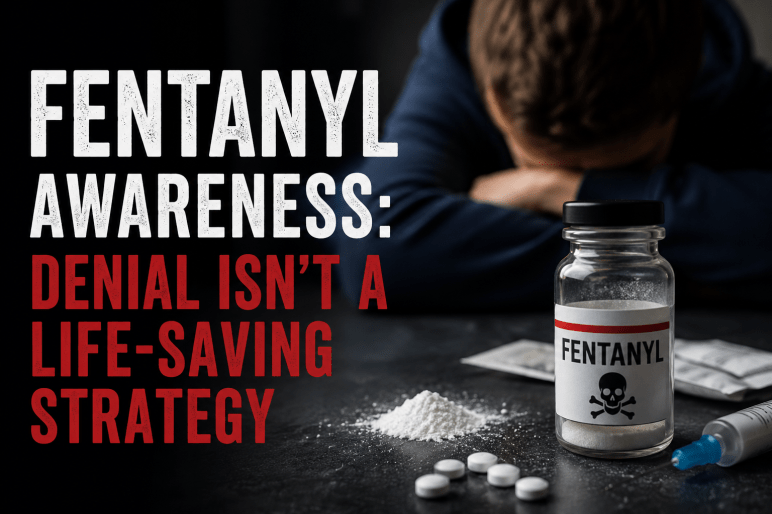
Light the charcoal. Sprinkle the sage. Today, we’re talking about Fentanyl Awareness. And Lord knows some folks need more than sage. They need a whole spiritual intervention. A PowerPoint and maybe a smack from an ancestor with a wooden spoon.
We’re still living in a world where people think fentanyl is something that happens to “other families,” “other communities,” or “those people over there.” Fentanyl doesn’t care about your zip code. Your Bible study attendance record. Or how many casseroles you’ve delivered to the church potluck. It is an equal-opportunity destroyer. And yet, some folks still clutch their pearls and say, “Well, if people didn’t do drugs.” Sweetheart, if ignorance burned calories, half this country would be runway-ready.
Fentanyl isn’t a moral issue. It’s a public health crisis. A grief generator. And a silent killer that slips into communities like humidity in Mississippi. It comes uninvited. Suffocating. And everywhere. But sure, let’s keep pretending it’s just a “bad choice” problem. And just for shits and giggles, I’ll say that bombing people in fishing boats that are clearly are not transporting this substance is not an answer to the problem.
Fentanyl doesn’t knock. It doesn’t ask permission. It doesn’t wait until you’re ready to have your life rearranged. It shows up like a tornado in the middle of a sunny day. It’s fast. Violent. And leaves you standing in the wreckage while wondering how the hell everything changed in seconds.
People aren’t overdosing because they’re weak. They’re overdosing because fentanyl is 50 times stronger than heroin. And 100 times stronger than morphine. They’re overdosing because it’s being mixed into substances without their knowledge. They’re overdosing because the world is heavy. Trauma is real. And coping mechanisms don’t magically appear with a bow on top.
But try telling that to the folks who think addiction is a “willpower issue.” These are the same people who can’t resist a clearance sale at Hobby Lobby. But somehow believe others should resist a chemically engineered substance designed to hijack the brain.
Addiction is not a character flaw. It’s not a spiritual failure. It’s not a lack of discipline. It’s a medical condition. A trauma response. And sometimes a desperate attempt to feel anything other than pain.
And fentanyl? It’s the predator waiting in the shadows. Families are burying children. Parents are burying parents. Communities are burying potential futures and dreams. And still some folks would rather cling to judgment than compassion. Because compassion requires effort. Judgment is free and easy like drive-thru theology.
So, here’s the truth that’s wrapped in Southern sass and tied with a bow of reality. Fentanyl doesn’t care about your opinions. It doesn’t care about your politics. It doesn’t care about your moral superiority complex. But we should care. We should care enough to talk about it. We should care enough to educate ourselves. We should care enough to stop pretending this crisis is happening in some faraway land to people we’ll never meet.
Fentanyl is already here. It’s in our towns, our schools, families, and our communities. And pretending otherwise won’t save a single life. And for the love of all things holy, open your eyes. Denial has never saved anyone. Awareness does. Compassion does. Action does. Try not to trip over it on your way back to reality. Thanks for reading! What are your thoughts?
Affirmation: I choose compassion over judgment. Truth over denial. And awareness over silence. My voice matters. And so does every life touched by this crisis.
“Some houses echo with laughter. The House of Addiction echoes with lessons. Loud, painful, and unforgettable lessons. And still, somehow, we walk out wiser than we ever meant to be.”
-This Puzzled Life
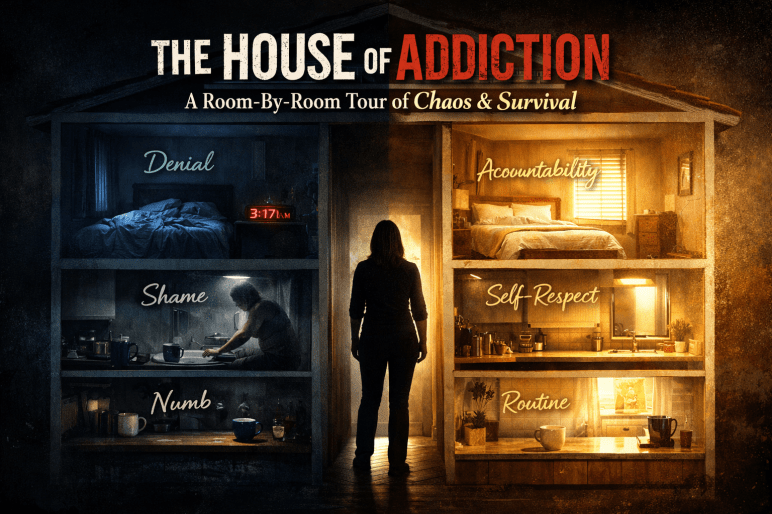
Light the charcoal. Sprinkle the sage. Let the smoke rise like it’s clocking in for a double shift. What we’re about to talk about requires spiritual PPE. It’s Addiction Awareness Month. And the House of Addiction doesn’t just haunt. It redecorates. It rearranges your memories. Steals your peace. And has the nerve to act offended when you notice.
From the outside, it looks like any other home on the block. But step inside, and you’ll find a floor plan designed by chaos itself. Complete with emotional booby traps and a staircase that creaks like it’s snitching on everybody.
The House of Addiction doesn’t creak when you walk in. It narrates. It knows your footsteps, fears, and soft spots. It knows you’re here for the truth. And it is already rearranging the furniture to make you doubt your own memory.
This house has the audacity of a Southern aunt who swears she “don’t gossip.” But somehow knows everybody’s business. Including the things you haven’t even done yet. Step inside. Keep your shoes on. This floor has seen some things. It will walk room to room with you, pretending it’s just “checking on things.” While it’s really dragging its mess across every surface like a toddler with a Sharpie.
The House of Addiction always looks normal from the outside. Fresh paint. Curtains that match. A porch light that pretends it’s welcoming you in. But the moment you cross that threshold, you realize this house has plans for you. None of them good. All of them messy. And every one of them delivered with the confidence of a demon wearing your grandmother’s pearls.
The Foyer: Where Denial Greets You Like a Nosy Aunt
You step inside and denial is already there. It’s leaning against the doorframe like it pays the mortgage. It’s smiling too big. Talking too fast. And insisting everything is fine. While the smoke alarm screams in the background. “No problem here,” Denial says. All while waving a broom at a fire like it’s a mosquito. The floorboards creak under the weight of secrets nobody wants to say out loud. The air smells like Febreze sprayed over a dumpster fire. This is the room where kids learn to tiptoe. Where silence becomes a second language. Where you learn to read moods like weather reports.
The Kitchen: Where Chaos Cooks Its Famous Disaster Casserole
Addiction loves the kitchen. It treats it like a stage. Pots banging. Cabinets slamming. Someone crying into a sink full of dishes that have been “soaking” since the Bush administration. This is where promises get burned to a crisp. Apologies get reheated for the 47th time. And kids learn to eat fast. Stay quiet. And watch the adults like they’re studying wildlife. The fridge is full of expired groceries and emotional leftovers nobody wants to deal with. And the table is where love tries to sit down. But keeps getting shoved aside by chaos wearing muddy boots.
The Living Room: Where Hope Sleeps on the Couch
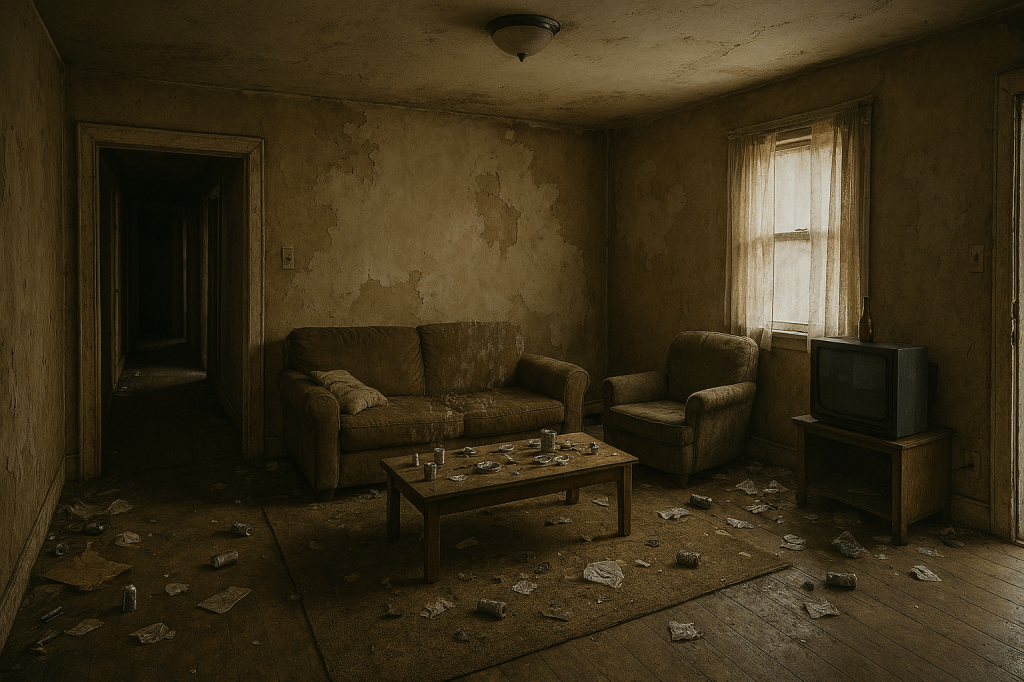
The living room used to be cozy. Now it’s a battlefield with throw pillows. Addiction drags its drama in here and spreads out like it pays rent. The TV is always too loud. The arguments are always too sharp. And the kids are always pretending they don’t hear what they hear. Hope still lives here. But it’s exhausted. It curls up on the couch under a blanket that smells like worry. It keeps whispering, “Maybe tomorrow.” Even though tomorrow keeps showing up drunk and late.
The Bedroom: Where Secrets Tuck Themselves In
This room is quiet. But not peaceful. It’s the kind of quiet that hums with tension. Addiction sits on the edge of the bed like a shadow with opinions. It whispers lies into the dark. It says, “You’re the problem,” “You can’t leave,” and “Nobody will believe you.” Kids learn to sleep lightly. To listen for footsteps. To brace for the door opening at 2 a.m. with the kind of energy that never means anything good.
The Laundry Room: Where Shame Hangs Itself Up to Dry
This room is where the truth piles up. Dirty clothes. Dirty secrets. Dirty looks from neighbors who pretend they don’t see what they see. Addiction loves this room because it knows shame thrives in small, cramped spaces. The washing machine is always running. But nothing ever feels clean. The dryer door squeaks like it’s tattling. And the air is thick with “Don’t tell anyone.”
The Bathroom: Where Tears Pretend They’re Just Steam
This is the only room with a lock. Which means it becomes a sanctuary for everyone including kids, partners, even the person struggling. People hide here to cry. Breathe. Or just exist without being needed. Addiction hates this room because it can’t control what happens behind a locked door. But it still bangs on it sometimes while demanding attention.
The Kids’ Room: Where Innocence Packs a Go-Bag
This room is the saddest part of the house. Toys on the floor. School papers on the wall. A bed that’s too small for the weight the child carries. Kids learn how to be invisible. How to be responsible for things they never caused. And how to grow up faster than their bones know how to handle. Addiction tiptoes in here sometimes. While pretending it’s not doing damage. But the cracks in the walls tell the truth.
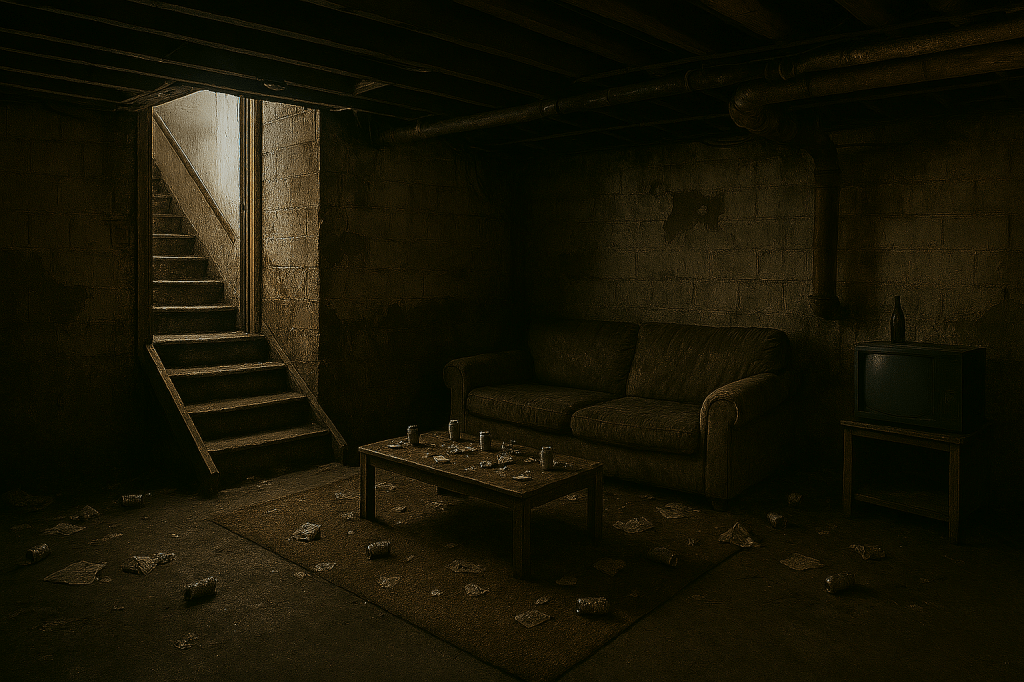
The Basement: Where the Truth Lives
Nobody wants to go down here. Not even Addiction. But this is where the real story sits quiet, heavy, and waiting. This is where trauma stacks itself like old boxes. Memories hide under tarps. And kids grow up and realize the house wasn’t normal. The basement is the part of the house that never lies. It knows exactly what happened. And it remembers everything.
The Attic: Where the “Old Stories” Live
The attic is dusty, cramped, and full of boxes labeled “We Don’t Talk About That.” This is where Addiction stores the memories you tried to outgrow. The versions of yourself you’re ashamed of. And the lies you were told about who you are.
Every box rattles when you walk by, like it wants to be opened. But also wants to stay sealed forever. Addiction loves this room because it knows you’ll avoid it. It knows the dust will settle on your truth until you forget what it looked like. But the attic is also where the light sneaks in through the cracks. It’s where you eventually realize that some stories aren’t yours to carry anymore.
The Garage: Where “I’ll Fix It Later” Goes to Die
The garage is full of unfinished projects, abandoned hobbies, and promises you meant to keep. Addiction parks itself here like a broken-down car that still thinks it can make the trip. This is the room where dreams get postponed. Goals get dusty. And potential sits on cinder blocks. You keep telling yourself you’ll clean it out “when things calm down.” But Addiction keeps tossing more junk in, insisting you don’t have time, energy, or worthiness to finish anything. But one day, you find the light switch. And you realize the garage isn’t full of failures. It’s full of things waiting for you to come back to yourself.
The Office: Where Control Pretends to Live
This room is where Addiction tries to look responsible. Bills stacked. Calendars marked. To‑do lists half done. Everything looks organized until you touch it. And the whole pile collapses like a Jenga tower built by denial. This is the room where you try to manage the unmanageable. You convince yourself you’re “still functioning.” And you hide behind productivity to avoid the truth.
Addiction sits in the office chair spinning slowly, whispering, “You’re fine. Look how much you’re getting done.” Meanwhile, nothing is actually getting done. But this is also the room where you learn the difference between control and survival. And where you finally fire Addiction from its fake job.
The Guest Room: Where You Pretend Everything Is Fine
This room is spotless. Too spotless. It’s the room you keep ready for visitors. So that they never see the chaos in the rest of the house. Addiction loves this room because it’s the perfect illusion of clean sheets. Fluffed pillows. And fake peace. This is where you host people who say, “You’re so strong.” Without knowing you cried in the hallway before they arrived. But the guest room is also where you learn that pretending is exhausting. And that real connection only happens when you stop hiding the mess.
The Crawl Space: Where the Fear Lives
Low ceilings. No light. Hard to breathe. This is the room Addiction never talks about but always uses. It’s where the fear crawls. It’s the fear of leaving, staying, being alone, and of being seen. Addiction keeps this space damp and cold, so you’ll avoid it. But this is the room where the truth hums the loudest. And when you finally crawl in with a flashlight, you realize the monsters were smaller than the shadows made them look.
The Backyard: Where Healing Starts Growing
The backyard is wild. Overgrown. And neglected but alive. Addiction never cared about this space. It didn’t think you’d ever step outside long enough to notice it. But this is where you breathe again. You plant new habits. You feel sunlight without flinching. And you imagine a life beyond the front door. The backyard is the first place that belongs to you again. It’s where you realize the house doesn’t own you. And where healing doesn’t have to be pretty to be real.
The Front Door: Where Freedom Waits
Every child of addiction eventually finds themselves standing at this door. Their hand on the knob. Heart pounding. And wondering if they’re allowed to leave. The truth is you can. You’re allowed to walk out. You’re allowed to build a new house. One with open windows, soft floors, and rooms that don’t whisper threats in the dark. You’re allowed to create a home where laughter doesn’t flinch. Where love doesn’t hide. And where the only thing haunting the halls is the sound of peace finally settling in.
And that’s the truth about the House of Addiction. It thought it owned you. It thought you’d stay lost in its attic of old stories. Stuck in its garage of unfinished dreams. And trapped in its crawl space of fear. It thought you’d keep tiptoeing past the guest room. While pretending everything was fine. And where it rearranged your soul like mismatched furniture.
But you just didn’t survive that house. You walked through every room with the lights on. The sage burning. And the ancestors humming behind you like a choir that refuses to let you forget who you are. You learned the floorplan. You named the ghosts. You opened the windows. And then you did the one thing that house never expected. You walked out the front door. And didn’t look back.
Let the walls rot. Let the roof cave in. Let the lies echo in empty rooms. You’re busy building a new home now. One with sunlight, softness, boundaries, and peace that doesn’t apologize for taking up space. Door slammed. Keys dropped. Cycle broken. Story reclaimed. Thanks for reading! Now walk away like a boss.
Affirmation: I honor the child who survived that house. And I empower the adult who refuses to live in it ever again. My peace is mine. My story is mine. And my future is built with steady hands.”
“It is dangerous, misleading, and illegal” and a “massive fraud on consumers that puts their safety directly at risk.”
–American Kratom Association
Light the charcoal. Sprinkle the sage. Negative energy go away. Today, I want to talk to you about the deadly synthetic opioid products known as 7-OH (gas station heroin). You might think that these products are safe. But there is only one descriptive term for them…..DANGEROUS.
Let me break down the problems associated with these products. The product is so dangerous that the FDA is specifically targeting the 7-OH products a concentrated byproduct of the kratom plant. They are not focused on the natural kratom leaf products. These products have a high potential for abuse because they bind to opioid receptors. They are not FDA-approved 7-OH opioid products. FDA Commissioner Marty Makary, M.D., M.P.H. is quoted saying, “7-OH is an opioid that can be more potent than morphine” (https://www.fda.gov, 2025).
What is 7-OH? –hydroymitragynine is a powerful opioid-like compound found in the leaves of the kratom plant. While this compound is naturally in trace amounts because manufacturers have begun to concentrate or synthesize it into highly potent and addictive products. They are sold at gas stations, vape shops and smoke shops. At this time, anyone of any age can purchase these products. And they are appealing to kids and teens because they are also made into edibles.
“It’s a recipe for a public health disaster.”
-Jim O’Neill, U.S. Department of
Health and Human Services
· Significantly stronger than morphine:Some synthetic products are reportedly 13 to 40 times more potent than morphine.
· Intense opioid effects: these include pain relief, euphoria, and sedation.
· High risk of dependence and addiction:Regular use can quickly lead to physical and psychological dependence with severe withdrawal symptoms when use is stopped.
· Serious adverse effects: There have been a notable rise in emergency room visits with symptoms that include nausea, agitation, rapid heart rate, high blood pressure, seizures and respiratory depression that can be fatal.
Difference between natural and concentrated 7-OH
· Natural kratom: in the natural form as a plant leaf, kratom contains only a small amount of 7-OH (less than 2%). It is often used for its mild stimulant or opioid-like effects, but the risk profile is significantly different from highly concentrated products.
· Concentrated/Synthetic 7-OH: lab created product where the 7-OH has been concentrated to a higher potency reaching 98%. These unregulated products are sold in forms like gummies, drinks, and tablets ((https://www.dshs.texas.gov, 2025).
I cannot express enough the dangerousness of these products. I, for one, fell in love with heroin and pills many years ago. And what a difficult process it has been to break free from those substances. Because “One is too many. And a thousand is never enough.” That’s how addiction works. Parents if you think that this is all a bunch of hoopla for nothing, you are dead wrong. This product scares me like most can’t. We have enough of an “opiate crisis” without introducing more into the family line. Educate yourself and your children. It just might save lives. Thanks for reading!
Affirmation: I have the ability to make a different choice.
“It’s not the use of drugs that causes the problem. It’s the abuse.”
-Patrick Betsch
Light the charcoal. Sprinkle the sage. Negative energy go away. Okie Dokie! I thought today that I would start by putting some information out there about some of the street drugs and other destructive things going on regarding addiction. Most have at one point in their lives done something incredibly stupid or dangerous in our teens. And I am no exception. I never learned my lesson and have continued to do so into my adult years.
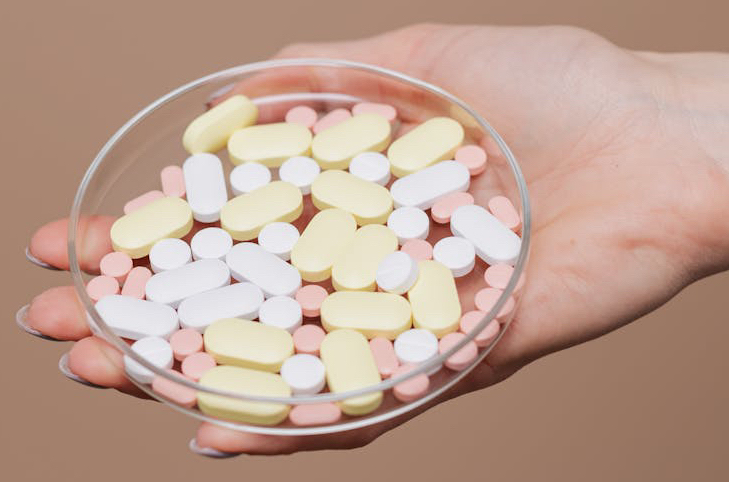
One of the more dangerous things I’ve heard of doing are parties known as “Pharm Parties” or “Skittles parties.” This refers to pharmaceuticals. These are baggies of pharmaceuticals that are gathered from parents’ medicine cabinets and dumped into a large bowl and taken at random. This activity has been going on since the 60’s which was known as “fruit salad parties,” which warned against the dangers in an Ann Landers column. At that time, the behavior was said to be out of rebellion directed towards parents. This was rumored by saying that the pills were being hidden inside fruit which were mixed into actual fruit salads. Individuals ended up in hospitals and comas as a result. However, now it’s commonly done due to addictive behaviors. (Slate, 2008). “Pharm parties” are silent killers that are also known to combine alcohol with the random concoction. While mixing medication is still dangerous, it’s still not any safer than taking a handful of any other type of medication. I have never personally attended one of these types of parties. Because I was always getting high by my own stash of medications. Nevertheless, it’s all dangerous.
These “parties” also involve Robo-tripping, which refers to using the cough suppressant medications like Robotussin or the like with other alcohol or drinking large amounts of the product. There is not a lot of evidence that these parties are widespread. However the abuse of prescription drugs among adolescents and college-age students is widespread. In relation to street drugs like heroin, cocaine and ecstasy, prescription drugs such as Ritalin, Adderall, Oxycontin and Vicodin tend to be cheaper and seem to provide the user with a false sense of safety. The Centers for Disease Control and Prevention indicate that 55 percent of prescription drug abusers obtain prescription painkillers free from a friend or a relative, making it cheaper than purchasing a keg (Health.usnews.com, 2016.).
College parties have evolved from “keggers. And have now progressed to prescription drugs. Society now seems to normalize “popping pills” as a risky part of adolescent behavior. But what happens when this becomes an addiction? The goal of this post is to educate parents by teaching us to keep an eye on medicine cabinets.
I will be writing more blogs related to topics about current trends regarding drugs and their misuse and abuse. Take what information you can use and leave the rest. But as I have said previously, the information is out there and ignorance can no longer be used as an excuse for behaviors that are taking the lives of ourselves and the ones we love.
“The abuse of prescription pills is a real thing. I understand that there are people that really need them and I understand that there are people that abuse them, and it’s just a gray line that unfortunately has to exist.”