This Puzzled Life is a mental health and recovery blog exploring addiction, trauma healing, LGBTQ experiences, humor, and the strange moments that shape us.
“Sometimes the spiral isn’t a breakdown. It’s a plot twist.”
-This Puzzled Life
Light the charcoal. Because the ancestors have pulled up lawn chairs. Piper is judging you from the counter. And your last functioning brain cell is wearing Crocs and screaming, “We’re fine.” Today, we’re about to roast our own mental health spiral like it’s Sunday dinner. And the ancestors are already circling the table whispering, “Lord, she’s doing that again.” Today’s sermon: The Stages of a Mental Health Spiral. This is not a gentle descent. This is a Six Flags drop tower operated by a raccoon with a GED and a dream.
You know that moment when you feel something is off? Not enough to call your therapist. But enough to stare at the wall like it owes you money. That’s when the spiral begins. Quietly. Softly. Like a Southern woman saying, “Bless your heart.” Right before she ruins your life.
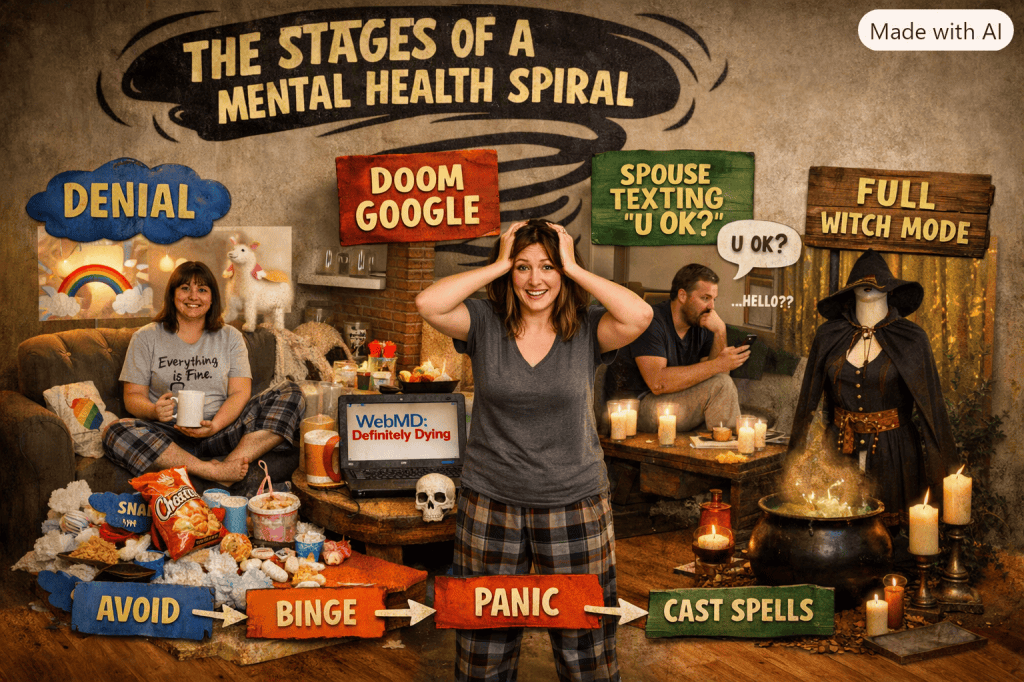
Behold, the official stages of a mental health spiral. The annotated. Dramatized. And spiritually supervised by your ancestors who are shaking their heads in unison.
1. Denial (a.k.a. “I’m fine.”)
You say “I’m fine” with the confidence of a toddler holding a permanent marker near a white couch. Your eye twitches. Your soul leaves your body. But you? You’re “fine.”
2. Snack-Based Coping
You open the fridge like it’s going to reveal the meaning of life. It does not. It reveals cheese. You eat the cheese. You feel nothing. You eat more cheese. You still feel nothing. You consider becoming cheese.
3. Googling Symptoms
You Google one minor sensation. “Why does my left eyebrow feel spicy?”
Google: You have 14 minutes to live.
You: “Reasonable.”
4. Texting Your Spouse
You send a message that is 40% panic. 40% apology. And 20% emojis that do not match the situation. Your spouse replies, “Did you eat today?” You did not. You lie anyway.
5. Bargaining With the Universe
You promise to drink water. You promise to stretch. You promise to stop doomscrolling. You do none of these things.
6. Existential Laundry
You stare at a laundry basket like it’s a metaphor for your entire life. You consider folding it. You do not fold it. You put a blanket over it like a Victorian ghost.
7. Deciding to Become a Forest Witch
You Google “how to disappear into the woods legally.” You imagine yourself living among moss, mushrooms, and emotionally stable squirrels. You start pricing cauldrons. You tell your spouse, “I’m going feral.” They say, “Okay, but text me when you get there.”
I told my therapist about the levels of decent into madness. She looked at me over her glasses like she’s trying to decide whether to laugh. Cry. Or call your ancestors for backup. She said, “Dana, you cannot diagnose yourself with 14 conditions. Eat a block of cheddar. And then attempt to join the woodland spirits. That’s not a treatment plan. That’s a Thursday.” Then she adds, “Next time, call me before you Google anything. Or before you buy a cauldron.”
And that, my friend, is the spiral. A journey. A pilgrimage. A spiritual hike through chaos, cheese, and questionable decisions. But you survived. You always do. Because even when my brain is doing NASCAR donuts in a Walmart parking lot, I still show up, I still laugh. And still threaten to become a forest witch at least twice a month. My ancestors are proud. My therapist is tired. My cats are unimpressed. And I’m doing amazing. Thanks for reading! What are things you do when you’re spiraling that isn’t funny at the time? But is now.
Affirmation: I can survive my own brain, one snack, one breath, and one dramatic monologue at a time.
“The truth didn’t break my family. The pretending did.”
-Unknown
Here’s the bigger picture. I didn’t grow up in a family that heals. Problems don’t get solved. They get buried alive. And then resurrected during holidays like emotional zombies. Now that me and my sister are adults, childhood resentments still pop up like whack‑a‑mole. And nobody wants to pick up a mallet. Let’s all smile in public so we don’t “defame the family.” Which honestly, does a fantastic job defaming itself.
And my family isn’t special. Dysfunction is everywhere. I have enough mental health education in my background to recognize the patterns. But they’ll swear I’m the problem. If you look past the church smiles, the whole system is sick. I would genuinely rather be hit by a car than attend “family time.” And because my kids were born into a lesbian family, they get treated like they came with a moral recall notice.
You can’t throw money at children and then take no active part in their lives the rest of the time. Especially, when you do the opposite with the other children in the family. The kids notice. I’ve tried talking about it for 17 years. And the truth is this. They just don’t care.
I have a master’s degree in counseling psychology. Yet somehow I’m the ignorant one. They don’t want insight. They don’t want help. They want silence. And mine has officially expired. I defend myself and my kids however I see fit. Respectfully? No. Effectively? Absolutely.
They want healing without effort. They’re emotional pillow princesses that want the benefits of growth while doing absolutely nothing but blinking dramatically. And when truth bruises their egos, accountability never shows up. Meanwhile, my dad plays messenger pigeon flying information back and forth between me and the rest of the family so that the dysfunction stays perfectly preserved.
Here’s the part they’ll never admit. Family therapy requires guts and transparency. And those two things they treat like forbidden sins. Instead, they’ve built a giant sand pile where they can bury their heads. And pretend nothing is wrong. That’s their comfort zone. Not truth. Not healing. Just sand. Neck‑deep and breathing through a straw of selective memory.
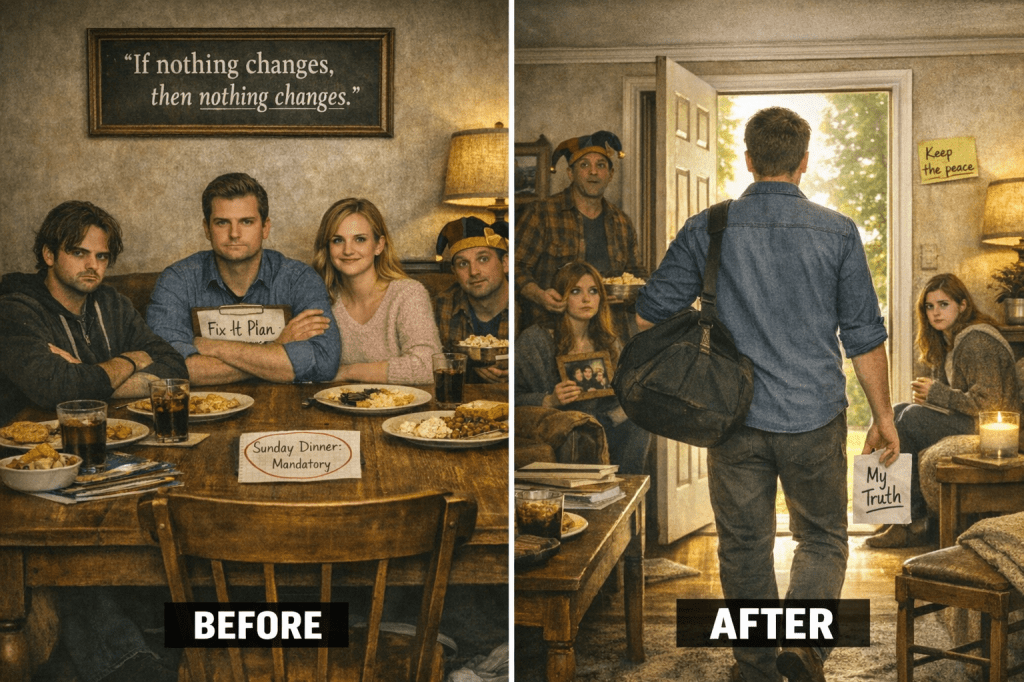
My favorite quote says it best, “If nothing changes, then nothing changes.” And I refuse to be silenced because their comfort depends on my suffering.
Our family lives in what I call comfortable dysfunction. It’s the emotional recliner they refuse to replace even though the springs are broken. And the fabric smells like denial. It’s easier than accountability. Easier than honesty. Easier than saying, “Maybe the gay daughter isn’t the downfall of civilization.”
And as if being the rainbow sheep wasn’t enough. I’m also the green sheep of the family because I’m a medical cannabis patient. And the family’s translation is that I’m “druggin’ and thuggin’.” The “bad influence.” And the “one who needs prayer.” But that’s not even the real issue.
The problem is my refusal to sit quietly in the pew of generational silence. The issue is that I no longer participate in the family’s favorite pastime of pretending. I’m done shrinking myself so other people can stay cozy in their outdated beliefs. I’m done letting conservative Christian values be weaponized against me and my children.
They can keep their selective morality. The kind where my sister thinks being gay is “wrong and evil.” But somehow premarital sex is just the Olympic sport of “being human.” Funny how sin gets flexible when it’s their behavior on the table.
“My family says I’m ‘living in sin.’ Which is wild coming from some of them who wave a red hat like it’s the state flower. They preach about morality and still treat premarital sex, drinking, and hypocrisy like they’re covered under the ‘Jesus forgives me’ warranty.”And trust me. They act like I graffitied the Ten Commandments in rainbow glitter.
Being gay automatically made me the family’s “problem child.” Even though the real problems have nothing to do with what gender I love. And everything to do with the fact that I refuse to pretend. My sister can have premarital sex. Drink like she’s hydrating for the Olympics and drive afterward. And micromanage her child like she’s running a dictatorship. But somehow I’m the moral crisis.
Meanwhile, my sister’s shot glasses stays full. Her judgment stays loud. And her hypocrisy stays undefeated. Funny how cannabis for medical reasons is “dangerous.” But alcohol with a side of denial is “just being human.” I’m the rainbow sheep because I live authentically. I’m the green sheep because I choose a legal, doctor‑recommended treatment. And I’m the scapegoat because I refuse to shrink so other people can stay comfortable in their dysfunction. If being myself makes me the rainbow‑green hybrid sheep of the family, then so be it. At least I’m not grazing in the pasture of hypocrisy.
So no, I’m not stepping back into the box they built for me. I’m not dimming myself, so their comfort stays intact. I’m not carrying the weight of a family that refuses to lift a finger for its own healing. They can keep their comfortable dysfunction. They can keep their silence. They can keep their outdated beliefs wrapped in Bible verses that only apply to me.
Today I honor my inner rainbow‑green sheep. I’m fabulously queer. I’m medically lifted. And completely unbothered by the opinions of people who confuse hypocrisy with holiness.”
I’m choosing truth over tradition. I’m choosing growth over guilt. I’m choosing my children, my peace, and my sanity. And if my existence shakes the foundation of their worldview. Then the foundation was weak to begin with. Thanks for reading! Do you and let the others do them.
Affirmation: I bless my rainbow‑green sheep soul today queer, medicated, and thriving. While certain relatives clutch their red hats and pearls at my existence. But don’t blink twice at their own chaos, contradictions, or alcohol fueled commandments.
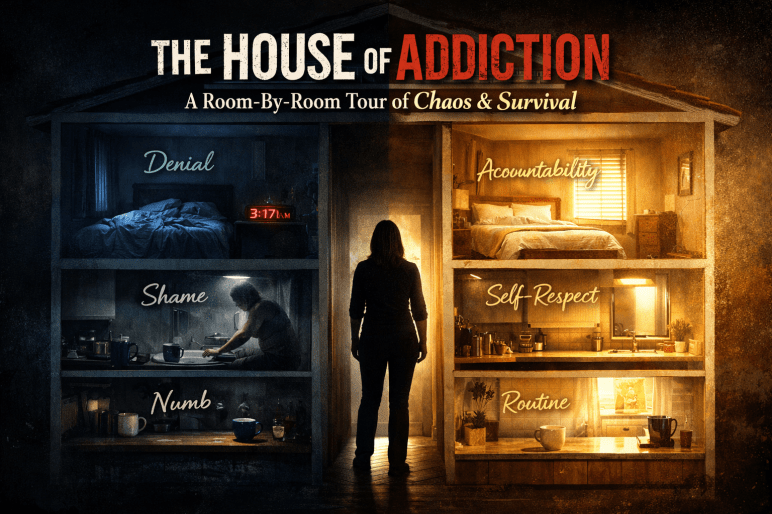
“Some houses echo with laughter. The House of Addiction echoes with lessons. Loud, painful, and unforgettable lessons. And still, somehow, we walk out wiser than we ever meant to be.”
-This Puzzled Life
Light the charcoal. Sprinkle the sage. Let the smoke rise like it’s clocking in for a double shift. What we’re about to talk about requires spiritual PPE. It’s Addiction Awareness Month. And the House of Addiction doesn’t just haunt. It redecorates. It rearranges your memories. Steals your peace. And has the nerve to act offended when you notice.
From the outside, it looks like any other home on the block. But step inside, and you’ll find a floor plan designed by chaos itself. Complete with emotional booby traps and a staircase that creaks like it’s snitching on everybody.
The House of Addiction doesn’t creak when you walk in. It narrates. It knows your footsteps, fears, and soft spots. It knows you’re here for the truth. And it is already rearranging the furniture to make you doubt your own memory.
This house has the audacity of a Southern aunt who swears she “don’t gossip.” But somehow knows everybody’s business. Including the things you haven’t even done yet. Step inside. Keep your shoes on. This floor has seen some things. It will walk room to room with you, pretending it’s just “checking on things.” While it’s really dragging its mess across every surface like a toddler with a Sharpie.
The House of Addiction always looks normal from the outside. Fresh paint. Curtains that match. A porch light that pretends it’s welcoming you in. But the moment you cross that threshold, you realize this house has plans for you. None of them good. All of them messy. And every one of them delivered with the confidence of a demon wearing your grandmother’s pearls.
The Foyer: Where Denial Greets You Like a Nosy Aunt
You step inside and denial is already there. It’s leaning against the doorframe like it pays the mortgage. It’s smiling too big. Talking too fast. And insisting everything is fine. While the smoke alarm screams in the background. “No problem here,” Denial says. All while waving a broom at a fire like it’s a mosquito. The floorboards creak under the weight of secrets nobody wants to say out loud. The air smells like Febreze sprayed over a dumpster fire. This is the room where kids learn to tiptoe. Where silence becomes a second language. Where you learn to read moods like weather reports.
The Kitchen: Where Chaos Cooks Its Famous Disaster Casserole
Addiction loves the kitchen. It treats it like a stage. Pots banging. Cabinets slamming. Someone crying into a sink full of dishes that have been “soaking” since the Bush administration. This is where promises get burned to a crisp. Apologies get reheated for the 47th time. And kids learn to eat fast. Stay quiet. And watch the adults like they’re studying wildlife. The fridge is full of expired groceries and emotional leftovers nobody wants to deal with. And the table is where love tries to sit down. But keeps getting shoved aside by chaos wearing muddy boots.
The Living Room: Where Hope Sleeps on the Couch
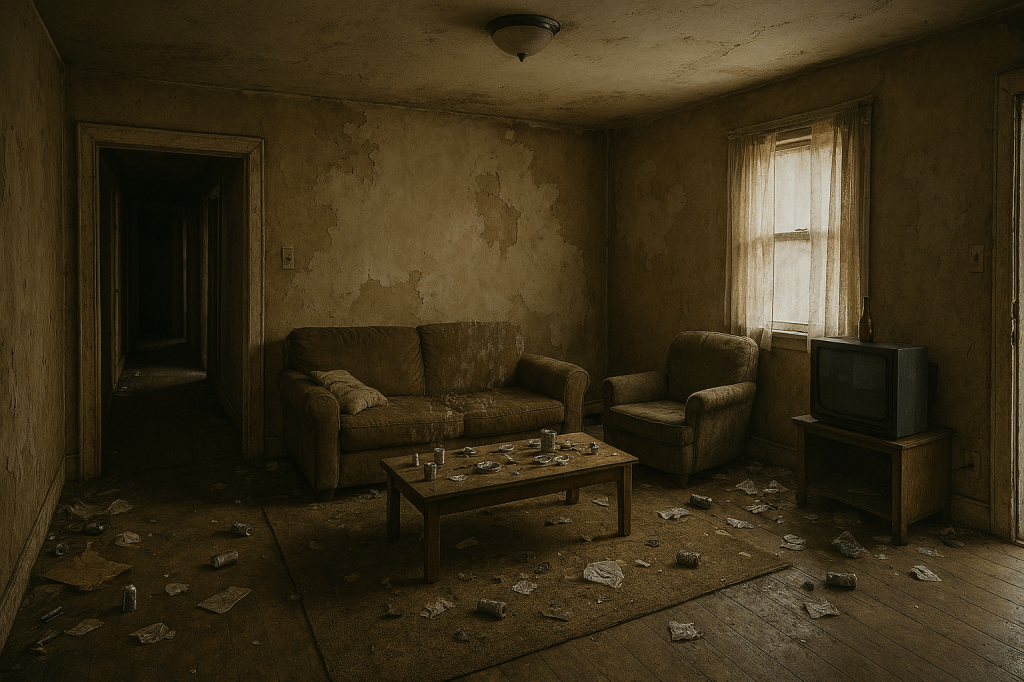
The living room used to be cozy. Now it’s a battlefield with throw pillows. Addiction drags its drama in here and spreads out like it pays rent. The TV is always too loud. The arguments are always too sharp. And the kids are always pretending they don’t hear what they hear. Hope still lives here. But it’s exhausted. It curls up on the couch under a blanket that smells like worry. It keeps whispering, “Maybe tomorrow.” Even though tomorrow keeps showing up drunk and late.
The Bedroom: Where Secrets Tuck Themselves In
This room is quiet. But not peaceful. It’s the kind of quiet that hums with tension. Addiction sits on the edge of the bed like a shadow with opinions. It whispers lies into the dark. It says, “You’re the problem,” “You can’t leave,” and “Nobody will believe you.” Kids learn to sleep lightly. To listen for footsteps. To brace for the door opening at 2 a.m. with the kind of energy that never means anything good.
The Laundry Room: Where Shame Hangs Itself Up to Dry
This room is where the truth piles up. Dirty clothes. Dirty secrets. Dirty looks from neighbors who pretend they don’t see what they see. Addiction loves this room because it knows shame thrives in small, cramped spaces. The washing machine is always running. But nothing ever feels clean. The dryer door squeaks like it’s tattling. And the air is thick with “Don’t tell anyone.”
The Bathroom: Where Tears Pretend They’re Just Steam
This is the only room with a lock. Which means it becomes a sanctuary for everyone including kids, partners, even the person struggling. People hide here to cry. Breathe. Or just exist without being needed. Addiction hates this room because it can’t control what happens behind a locked door. But it still bangs on it sometimes while demanding attention.
The Kids’ Room: Where Innocence Packs a Go-Bag
This room is the saddest part of the house. Toys on the floor. School papers on the wall. A bed that’s too small for the weight the child carries. Kids learn how to be invisible. How to be responsible for things they never caused. And how to grow up faster than their bones know how to handle. Addiction tiptoes in here sometimes. While pretending it’s not doing damage. But the cracks in the walls tell the truth.
The Basement: Where the Truth Lives
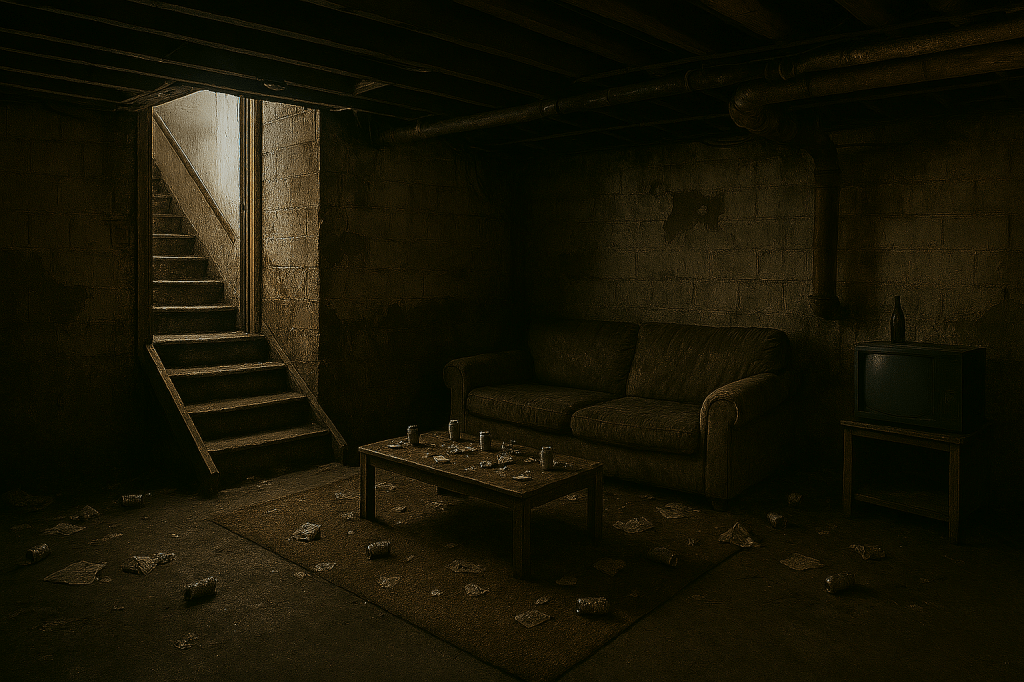
Nobody wants to go down here. Not even Addiction. But this is where the real story sits quiet, heavy, and waiting. This is where trauma stacks itself like old boxes. Memories hide under tarps. And kids grow up and realize the house wasn’t normal. The basement is the part of the house that never lies. It knows exactly what happened. And it remembers everything.
The Attic: Where the “Old Stories” Live
The attic is dusty, cramped, and full of boxes labeled “We Don’t Talk About That.” This is where Addiction stores the memories you tried to outgrow. The versions of yourself you’re ashamed of. And the lies you were told about who you are.
Every box rattles when you walk by, like it wants to be opened. But also wants to stay sealed forever. Addiction loves this room because it knows you’ll avoid it. It knows the dust will settle on your truth until you forget what it looked like. But the attic is also where the light sneaks in through the cracks. It’s where you eventually realize that some stories aren’t yours to carry anymore.
The Garage: Where “I’ll Fix It Later” Goes to Die
The garage is full of unfinished projects, abandoned hobbies, and promises you meant to keep. Addiction parks itself here like a broken-down car that still thinks it can make the trip. This is the room where dreams get postponed. Goals get dusty. And potential sits on cinder blocks. You keep telling yourself you’ll clean it out “when things calm down.” But Addiction keeps tossing more junk in, insisting you don’t have time, energy, or worthiness to finish anything. But one day, you find the light switch. And you realize the garage isn’t full of failures. It’s full of things waiting for you to come back to yourself.
The Office: Where Control Pretends to Live
This room is where Addiction tries to look responsible. Bills stacked. Calendars marked. To‑do lists half done. Everything looks organized until you touch it. And the whole pile collapses like a Jenga tower built by denial. This is the room where you try to manage the unmanageable. You convince yourself you’re “still functioning.” And you hide behind productivity to avoid the truth.
Addiction sits in the office chair spinning slowly, whispering, “You’re fine. Look how much you’re getting done.” Meanwhile, nothing is actually getting done. But this is also the room where you learn the difference between control and survival. And where you finally fire Addiction from its fake job.
The Guest Room: Where You Pretend Everything Is Fine
This room is spotless. Too spotless. It’s the room you keep ready for visitors. So that they never see the chaos in the rest of the house. Addiction loves this room because it’s the perfect illusion of clean sheets. Fluffed pillows. And fake peace. This is where you host people who say, “You’re so strong.” Without knowing you cried in the hallway before they arrived. But the guest room is also where you learn that pretending is exhausting. And that real connection only happens when you stop hiding the mess.
The Crawl Space: Where the Fear Lives
Low ceilings. No light. Hard to breathe. This is the room Addiction never talks about but always uses. It’s where the fear crawls. It’s the fear of leaving, staying, being alone, and of being seen. Addiction keeps this space damp and cold, so you’ll avoid it. But this is the room where the truth hums the loudest. And when you finally crawl in with a flashlight, you realize the monsters were smaller than the shadows made them look.
The Backyard: Where Healing Starts Growing
The backyard is wild. Overgrown. And neglected but alive. Addiction never cared about this space. It didn’t think you’d ever step outside long enough to notice it. But this is where you breathe again. You plant new habits. You feel sunlight without flinching. And you imagine a life beyond the front door. The backyard is the first place that belongs to you again. It’s where you realize the house doesn’t own you. And where healing doesn’t have to be pretty to be real.
The Front Door: Where Freedom Waits
Every child of addiction eventually finds themselves standing at this door. Their hand on the knob. Heart pounding. And wondering if they’re allowed to leave. The truth is you can. You’re allowed to walk out. You’re allowed to build a new house. One with open windows, soft floors, and rooms that don’t whisper threats in the dark. You’re allowed to create a home where laughter doesn’t flinch. Where love doesn’t hide. And where the only thing haunting the halls is the sound of peace finally settling in.
And that’s the truth about the House of Addiction. It thought it owned you. It thought you’d stay lost in its attic of old stories. Stuck in its garage of unfinished dreams. And trapped in its crawl space of fear. It thought you’d keep tiptoeing past the guest room. While pretending everything was fine. And where it rearranged your soul like mismatched furniture.
But you just didn’t survive that house. You walked through every room with the lights on. The sage burning. And the ancestors humming behind you like a choir that refuses to let you forget who you are. You learned the floorplan. You named the ghosts. You opened the windows. And then you did the one thing that house never expected. You walked out the front door. And didn’t look back.
Let the walls rot. Let the roof cave in. Let the lies echo in empty rooms. You’re busy building a new home now. One with sunlight, softness, boundaries, and peace that doesn’t apologize for taking up space. Door slammed. Keys dropped. Cycle broken. Story reclaimed. Thanks for reading! Now walk away like a boss.
Affirmation: I honor the child who survived that house. And I empower the adult who refuses to live in it ever again. My peace is mine. My story is mine. And my future is built with steady hands.”
“Being deeply loved by someone gives you strength,
while loving someone deeply gives you courage.”
—-Lao Tzu
Lately, there has been a request to identify strength and courage from within myself. And, honestly, the answer is not very easy for me to identify nor to convey. I haven’t written since early April and couldn’t have written if I had wanted to. Sometimes I seem to get lost in my own world not knowing how to get back to the present date and time. The words “strength” and “courage” seem to be ones of perception rather than having a concrete definition that fits most people and situations. Hang in there with me. I promise there is a point.
One of the more difficult things in my life has been to accept compliments. The ones I did get from perpetrators always seemed to have some form of abuse attached to them. Growing up and developing as an athlete I regularly received compliments from my coaches. I not only developed confidence but the discipline and hard work were always worth the effort. I received compliments from my parents, the parents of friends and teammates. When the compliments began to take on a more sinister tone and action from some people, I began to fear the very thing that only years before seemed to propel me into a healthy confidence and feeling of safety. Kind words, in their own way, can now cause instant fear and embarrassment unseen to the naked eye.
You can point out that survival of all the abuse is an example of both strength and courage. However, my stance is simply that I did what I had to do to live. Is this a great example of minimization? Well of course it is. But emotionally this is truly how I feel about my story of survival. So…..to identify examples of each I am forced to look at these things from another angle. I identify these by looking into the heart and eyes of my alters. This has truly been a process that has now led me to a position and attitude of gratitude. Trust me, it has not always been like this. For years I’ve been stuck continuing to try and deny the depth of my mental problems and diagnoses. And what this has led to for my system are feelings of denial and minimization of their strength, courage, bravery and existence of them both individually and as a group. This has led to anger, resentment and a whole lot of unneeded and hurtful chaos from them at times. They have had a general feeling of being unneeded and unwanted after years of wading through a life of blood, sweat, tears and the evilness of others. They have never wanted a war medal but rather just acknowledgement of the abuse and their efforts.
“Confront the dark parts of yourself, and work to banish them with illumination and forgiveness. Your willingness to wrestle with your demons will cause your angels to sing.”
—August Wilson
Me and “my team” or “my guys” as they are commonly referred to are not expendable. These children, teens and adults stepped into some very frightening situations when my mental and physical limits as an individual had been reached. Their actions often times with accurate precision led to self-preservation with the ultimate goal to preserve life. Their strength and courage doesn’t seem to have limits for which I’ll am eternally grateful. Their existence was created out of fear, pain and necessity. Mel will tell you that there have been times when physically and emotionally I shouldn’t have been able to function on any level. But you could also look up and standing before you would be someone who seemed to be functioning almost completely normal. The quest for my education while undergoing abuse, sometimes daily, is a stunning example of this very thing. Now several years later the answers as to how this was even a remote possibility are very clear. My guys stepped in and helped to make sure that my goals were achieved despite always being told that my dreams were nothing more than under achievable pipe dreams. To me, they are a living testimony of strength, courage and bravery that cannot be matched. And maybe my story is changing from one of survival to one about redemption.
“I never said I wanted a ‘happy’ life but an interesting one. From separation and loss, I have learned a lot. I have become strong and resilient, as is the case of almost every human being exposed to life and to the world. We don’t ever know how strong we are until we are forced to bring that hidden strength forward.”
“They are all innocent until proven guilty. But not me. I am a liar until I am proven honest.”
― Louise O’Neill, Asking For It
I have written and spoken several times about my life and domestic violence. Under the umbrella of domestic violence are several forms such as: physical abuse; emotional abuse; controlling or domineering; intimidation; stalking; passive/covert abuse; economic deprivation; endangerment; criminal coercion; kidnapping; unlawful imprisonment; trespassing; harassment and sexual abuse. I knew that several years after leaving him that something about our sex life continued to haunt me. I didn’t know what it was called but I always knew what it felt like….SOUL MURDER.
In the conservative deep south, I was brought up like many children to “save yourself for your husband.” This was not a tall order for me as sports was my number one priority. I would meet him at the age of 17 which was 19 years his junior. Naivety led me right into the cold awaiting arms of a predator disguised as “Prince Charming.” He used the one promise that he knew I couldn’t refuse to set the hook and reel me in “I will help you find your birth family.” Rolling off his silver tongue of manipulation would be the promises of a future with a man who would “treat me like his queen.” But like most things that seem too good to be true his promises would turn out to be lies.
I guess what made this so confusing was that I NEVER saw my dad treat my mom with disrespect. I was questioning the whole time, “This is what I saved myself for?” He was my first and the guy that finally trusted in such an intimate fashion only to have that trust betrayed in a way that is still too difficult to handle emotionally. I secretly wondered why I was never told about this side of marriage. The truth despite his “brainwashing” justifications for his actions was that no this was not normal and healthy marriages do NOT consist of this type of dominating behavior.
Many years later while looking for answers regarding the strange, threatening and coercive nature especially with the passages of the Bible about how a “woman is to submit to her husband,” I came across the term Marital Rape and I knew instantly that this was what had happened. The term marital rape describes “any unwanted sexual acts by a spouse or ex-spouse that is committed without the other person’s consent. Such illegal sexual activity are done using force, threat of force, intimidation, or when a person is unable to consent. The sexual acts include intercourse, anal or oral sex, forced sexual behavior with other individuals, and other sexual activities that are considered by the victim as degrading, humiliating, painful, and unwanted. It is also known as spousal rape” (https://definitions.uslegal.com/m/marital-rape/, 2018).
I personally have not been able to make sense of such an intimate form of betrayal. This type of violence destroys you from the inside out. Remembering how scared I was as a young child when the first time I was introduced to sexual abuse the rules of these types of scenarios were still very clear. The easiest and least painful way to get through the moment was to give in to their demands. If you try to fight them the abuse gets worse. If you don’t “perform” for them the abuse gets worse. And as I was told many times, “What are YOU going to tell them Dana? You’re the “head case” with the mental history, not me.” The puppet master continued to pull the strings to make sure that his needs and only his needs were met.
Even as I write this the nausea bubbling like a pot on a stove builds its way to the back of my throat as I think about and remember the vile ways that I was treated as property rather than as a human being. I was not a wife but rather a legal whore. Being told what I was going to do for him and then berated with humiliating and very damaging body image comments afterwards just seems to further rake into your soul with the devil’s claw. Consensual loving sex is not…
Forced sex. This should be obvious. But some men have the mistaken idea that marriage changes the rules. It doesn’t. If a husband holds his wife down, pushes her, or imposes sex by hurting her, it’s rape. Making love doesn’t include making someone cry.
Sex when the wife feels threatened. If a husband forces sex through verbal threats of harm to the woman or to people or things she cares about or if he comes to her in a barely contained rage, she can’t consent. She can only comply rather than risk being harmed either physically or emotionally.
Sex by manipulation. If a husband calls his wife names, accuses her of not being a good wife, or blackmails her emotionally by suggesting she’s so bad in bed that he will go elsewhere, he’s manipulating her. Some men even threaten to leave and take the kids with him if their wives don’t comply with demands for sex. When a wife falls for these tactics, it isn’t consent. It’s rape.
Sex when the wife can’t give consent. Loving sex is genuinely consensual. If a woman is drugged, asleep, intoxicated or unconscious, she obviously can’t give consent. Even if she says “yes” in such circumstances, the “consent” isn’t valid or truthful. She’s in no shape to consider the consequences or to participate as a willing partner.
Sex by taking a woman hostage. Some men keep themselves in a position of superiority by controlling all the money, by making contact with friends and family difficult to impossible, or by making sure there is no way for her to get transportation out of the house. The woman becomes a hostage in her own home. Like many hostages, she gives up and gives in to whatever he wants — including sex.
Sex when the woman feels she has no choice. Giving in isn’t the same as giving consent. When a woman feels that it’s just easier to give in to sex than to respect her own needs, she is being raped (https://psychcentral.com/lib/marital-rape/, 2016).
THE PSYCHOLOGICAL EFFECTS OF SUCH BEHAVIORS INCLUDE:
Short-term psychological effects include PTSD, anxiety, shock, intense fear, depression and suicidal ideation.
COMMON WAYS THAT ABUSERS AVOID RESPONSIBILITY FOR SEXUAL ASSAULT
Denial: Acting as if nothing out of the ordinary happened, boldly stating that it didn’t happen, calling you crazy for saying that it did, saying he doesn’t remember.
Rationalization: “You must have wanted it” “You could have stopped me,” “A husband is entitled to it”; Rationalization is also blaming you: ” If you gave me more sex I wouldn’t have to force you”
Minimization: I didn’t really hurt you” “You’re making a fuss about nothing” “I just wanted to make love to you.”
To say that I’ve lacked a fulfilling intimate sex life would be the understatement of my life. The level of fear that I experience even with the most supportive relationship cannot accurately be described with words. Whether it be child alters, teen alters or adult alters who step in to try and make this very part of my life possible, it always becomes a disaster. Oh and the mood gets squashed when you think, “Finally, I can do this!” But, yet, you find yourself running from the bedroom straight to the bathroom to vomit.
What I can say about this type of abuse over many years is this….
He not only raped my body, he also raped my mind and murdered my soul. I was very fortunate to meet someone like Mel who is one of the most caring, understanding and compassionate people I know. Our relationship has always been based on love and not sex. I married someone who loves me for the shattered and leftover parts of someone who use to be a fully functioning human being. It took me loving and bowing down to a monster to be able to recognize an angel. She and I walk hand-in-hand often with tears in both of our eyes trying to find a way through all the destruction. She didn’t ask to be married to a spouse with so many complex problems both physically and mentally. She does it because she loves me. Would I go through it all again just to have her? I go through it every day. The abuse has never stopped.
“Here, from her ashes you lay. A broken girl so lost in despondency that you know that even if she does find her way out of this labyrinth in hell, that she will never see, feel, taste, or touch life the same again.”
― Amanda Steele, The Cliff
“I want everyone that has been abused by someone in their childhood to know that you can get past it. Having DID is not the end of the world; it’s the beginning of your new life. DID allows the victim of exceptional abuse the ability to “forget” the abuse and continue living. Without it, I may have gone crazy as a teen and spent my life in a psychiatric hospital.” ― Dauna Cole, A Shattered Mind: One Woman’s Story of Survival and Healing
One of the major issues with this disorder are what most people refer to as ‘alters’ or other personalities. What I’m going to try to do is to paint the picture for you in a way that I’ve been learning how to understand this. So, imagine you have an apartment complex and each person has their own room. Except in these rooms, there are horrible memories that are behind doors and no one can get in without a key. The only people that have these keys are my therapists and my alters which help keep anything else from hurting me. This is what has protected me throughout the years. However, some of the coping strategies that worked then DO NOT work now.
Alters can also range in age depending on at what age the abuse occurred. As dysfunctional as things can get at times the alters as a whole are referred to as a ‘system.’ Until consciousness together can be shared, there might always be memory loss. The amnesic episodes are, at the very least, scary as hell. The memories that I often have include only flashes of pictures of the day or days. The information date, time and situation is usually not available.
Alters and systems are as individual as a finger print. There is no ‘cookie cutter’ way of treating DID. The most important thing to me hands down is the relationship with my therapists. Without that relationship, recovery is futile for any issue or disorder. I trust my therapists enough to take me into the depths of the most terrifying events that have ever happened to me. This relationship that has been allowed to happen, as close to trusting, as possible has taken 2 years now with one therapist. However, both the ups and downs of these relationships has lead to the progress now being made by leaps and bounds. Painful as this process is, I can only hope that things actually get better.
The tenets in these rooms represent parts of the person you know as Dana. I will not get into discussing how many or their names. I can tell you that while growing up with some of those reading this blog alters were already formed or forming. Not only do these alters hold memories, but they also function in different ways. However, sometimes the problem with the alters is that they function completely independent from the individual known as the ‘host.’ This is usually the mood swings that you might see. Alters develop out of traumatic events and sometimes more than one during a single traumatic event. Just to put to rest for those that don’t know my parents, no they were not any part of the abuse.
Alters actually develop when the brain compartmentalizes the traumatic event, memories, etc. The trauma is so overwhelming and the mind and body both have to survive, that the only way the individual knows instinctively to survive is by developing a new alter even though they may be unaware at the time. Often times, it is many years down the road that survivors even realize that they have alters. Therefore, many survivors are trapped in the cycle of the mental health system being misdiagnosed for years and much money spent on treatment for the wrong diagnoses.
Often times, many people say, “I’ve been through worse things and I don’t have alters.” The only answer I have found is that what’s traumatic for one person may not necessarily be traumatic for another person. There is also a genetic predisposition to being able to dissociate. And dissociation is key to the formation of alters. What is known is that trauma of any kind effects the brain permanently. Severity depends on how long and what type of trauma was occurred.
You can most definitely have PTSD without meeting criteria for DID. DID cannot exist without a diagnosis of PTSD since that is a large part of how the disorder forms. DID also usually always entails some form of early childhood sexual abuse although ‘splitting’ in adulthood is uncommon.
“Another of the difficulties of having DID is the denial. DID is a disorder of denial. It has to be because if the original person knew about the alters and felt their pain, they would either go crazy and be hospitalized permanently, or would die.” ― Eve N. Adams, A Shattered Soul