This Puzzled Life is a mental health and recovery blog exploring addiction, trauma healing, LGBTQ experiences, humor, and the strange moments that shape us.
“Leaving isn’t weakness. Staying alive long enough to escape is strength.”
-This Puzzled Life
Light the charcoal. Sprinkle the sage. Call the ancestors the loud ones, the protective ones, in close. The ones who don’t mind flipping a table when truth needs to be told. Let the ancestors pull up their rocking chairs and lean in like, “Alright baby, tell it exactly how it happened.“ Because today, we’re walking straight into a fire that too many people pretend isn’t burning. And the topic is Domestic Violence Awareness Month.
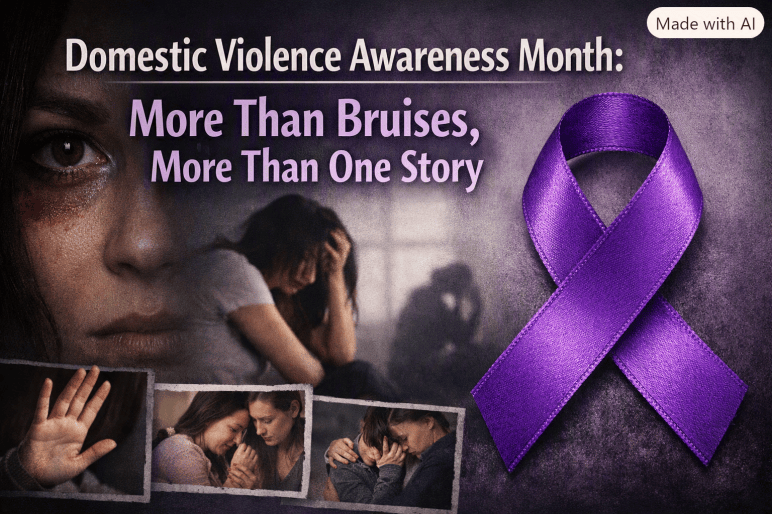
This month isn’t just a purple ribbon or a hashtag. It’s a national reckoning. A month carved out because silence has killed too many. Shame has trapped too many. And judgment has wounded too many who were already bleeding. It exists because domestic violence is not one thing. Not one story. Not one bruise. It’s a whole constellation of harm that is emotional abuse, financial control, spiritual manipulation, psychological warfare, sexual coercion, digital stalking, physical stalking, rape, threats, intimidation, and isolation. All of it real. All of it dangerous.
And Lord knows, the Deep South has a long tradition of saying, “Well, why didn’t she just leave?” With the same tone they use when asking why you didn’t bring potato salad to the church potluck. But today we’re not whispering. We’re not sugarcoating. We’re not letting judgment drown out truth.
Domestic violence is more than bruises. More than shouting. More than slammed doors. It’s the slow erosion of your identity. It’s the constant fear humming under your skin. It’s the way you learn to read someone’s footsteps like weather patterns. It’s the way you shrink. Fold. And contort yourself trying to keep the peace that never stays peaceful.
And let me say this with all the Southern sass I can muster. If you’ve never lived it, you don’t get to judge it. Because “just leaving” is a fantasy sold by people who have never had their life threatened. Their finances controlled. Their spirit manipulated. Or their faith weaponized against them. I know this because I lived it. Fourteen years in a domestic abuse situation that nearly swallowed me whole. The cycle wasn’t simple. It was a trap crafted with precision love bombing, threats, and intimidation. That is continuously repeated until you forget what freedom feels like.
I didn’t stay because I was weak. I stayed because I was scared. I stayed because I was conditioned. I stayed because every exit felt like a death sentence. And let me make something crystal clear. It wasn’t a billionaire. It wasn’t a senator. It wasn’t a monster hiding in the shadows. It wasn’t an immigrant. It wasn’t a drag queen with a story book. It wasn’t a trans person. It wasn’t a black person. It was a white, “Christian” man in the Deep South. One who used the Bible like a weapon. While twisting scripture into shackles. Preaching submission while practicing cruelty. A man who believed control was his God-given right. And fear was his favorite language.
That’s why Domestic Violence Awareness Month matters. Because abuse doesn’t look like one stereotype. Survivors don’t fit one mold. Judgment is easy. But understanding saves lives. It is a promise. A collective vow that we will speak loudly. Love fiercely. And refuse to let anyone’s suffering stay hidden behind closed doors.
And now, let me drop this mic so hard the ancestors stand up and clap. I survived what was meant to break me. I reclaimed what was stolen from me. And I will never apologize again for the fire in my voice. Thanks for reading! What have been your experiences?
Affirmation: I honor my survival, my truth, and my healing. I am worthy of safety, love, and a life without fear.
“Awareness is the first step toward healing. And healing is a community effort.”
-This Puzzled Life
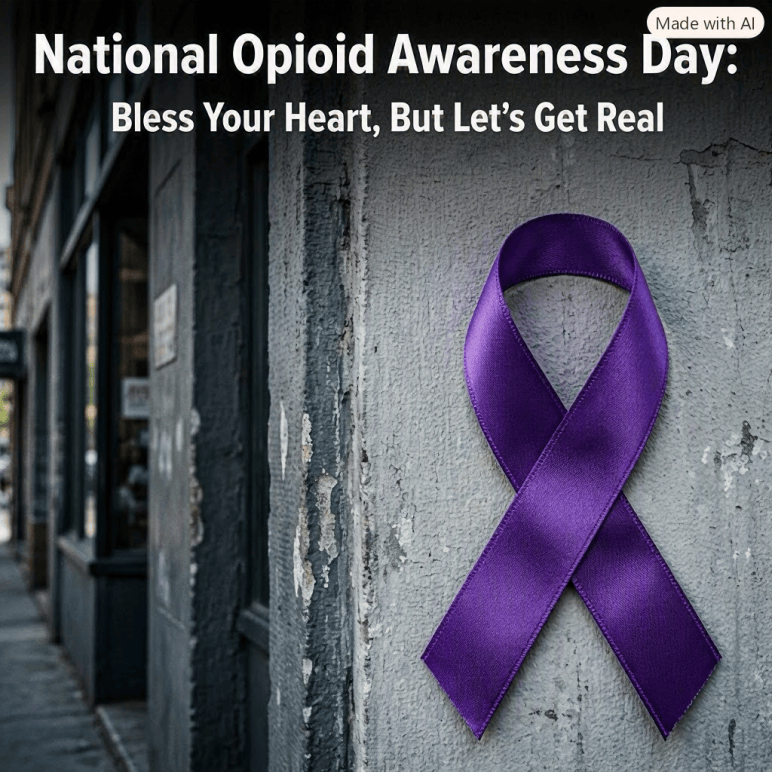
Light the charcoal. Sprinkle the sage. Call the ancestors. Today, we’re talking about National Opioid Awareness Day. And we’re doing it in full Southern-sass, porch‑swing truth‑telling mode. Grab your sweet tea, your emotional support cat, and maybe a biscuit for stability. Because this one’s gonna be equal parts hilarious, heartfelt, and holy‑ghost serious.
The truth is this. National Opioid Awareness Day exists because too many families have empty chairs at the dinner table. Too many mamas have cried into dish towels. Too many communities have buried dreams that should’ve lived.
This day is recognized to honor the lives lost. Uplift the ones still fighting. And remind the rest of us that addiction is not a moral failure. It’s a public health crisis that deserves compassion, resources, and loud, unapologetic awareness. But you know me. I can’t stay solemn for long. My ancestors didn’t raise me to be quiet or boring. Now let’s get sassy about it.
Let me tell you something. If the opioid epidemic were a person, it’d be that messy cousin who shows up uninvited. Eats all the potato salad. Steals your good Tupperware. And then has the nerve to ask for gas money. It’s rude. It’s destructive. And it’s been wreaking havoc across the nation like a raccoon with a grudge and access to your trash cans. This is the day we collectively say, “Not today, Satan. Not in my house. Not in my holler. And not in my county.”
It’s the day communities come together with churches, schools, aunties, cousins, and the neighbor who always knows everybody’s business. To learn. Support. And fight back with education, prevention, and love. Because love is louder than stigma. And community is stronger than crisis. And Southern women? We don’t play when it comes to protecting our people.
Addiction doesn’t care about zip codes. Because recovery is possible. Because shame kills. But awareness saves. Every life deserves a chance to come home. Sit at the table. And say, “I made it.” And if we don’t talk about it, we lose more than we can bear.
And so here we stand. Charcoal still glowing. Sage still swirling. Ancestors still humming that low in a knowing tune they save for moments when truth hits bone-deep. National Opioid Awareness Day isn’t just a date on a calendar. It’s a call to rise up like your grandma’s biscuits in a hot oven. It’s a reminder that we don’t get through hard things alone. And we sure don’t heal in silence.
Silence is a thief. Stigma is a liar. And shame? Shame is that dusty old cousin who shows up to the family reunion wearing flip-flops and bad decisions. While trying to tell everybody how to live. We don’t listen to shame in this house. We listen to compassion, community, and the ancestors who whisper, “Baby, keep going.”
We honor the ones we’ve lost. We uplift the ones still fighting. We stand guard over the ones who haven’t yet found their way home. And we do it with humor, heart, with Southern stubbornness. And with the kind of love that refuses to back down. It’s the kind of love that will fight a bear, a politician, and a malfunctioning church crockpot all before breakfast.
So today, light your charcoal. Sprinkle your sage. Call your ancestors. And then take one bold step toward awareness, healing, and being the kind of person who refuses to let crisis win. Because this story isn’t over. This fight isn’t finished. And this our community is louder, stronger, and more determined than any epidemic that ever tried to break us. Now excuse me while I drop this mic like it’s hotter than a Mississippi August sidewalk. We see you. We love you. We’re fighting with you. And we’re not done yet.
Affirmation: I honor the lives affected, uplift the ones still fighting, and choose compassion over judgment every single time.
“Silence is the oldest accomplice of violence. And Mississippi has been silent for far too long.”
-This Puzzled Life
Light the charcoal, y’all. Because my ancestors are pacing the porch tonight. I can feel them in the humidity, the cicada buzz, and in the way the air gets thick right before a storm. They’re whispering. Tapping their feet. And shaking their heads the way old Southern aunties do when they’ve had enough of the foolishness. And Lord knows Mississippi has given us more than enough foolishness wrapped in Bible verses. Dipped in denial. And served with a side of “the South will rise again” delusion.
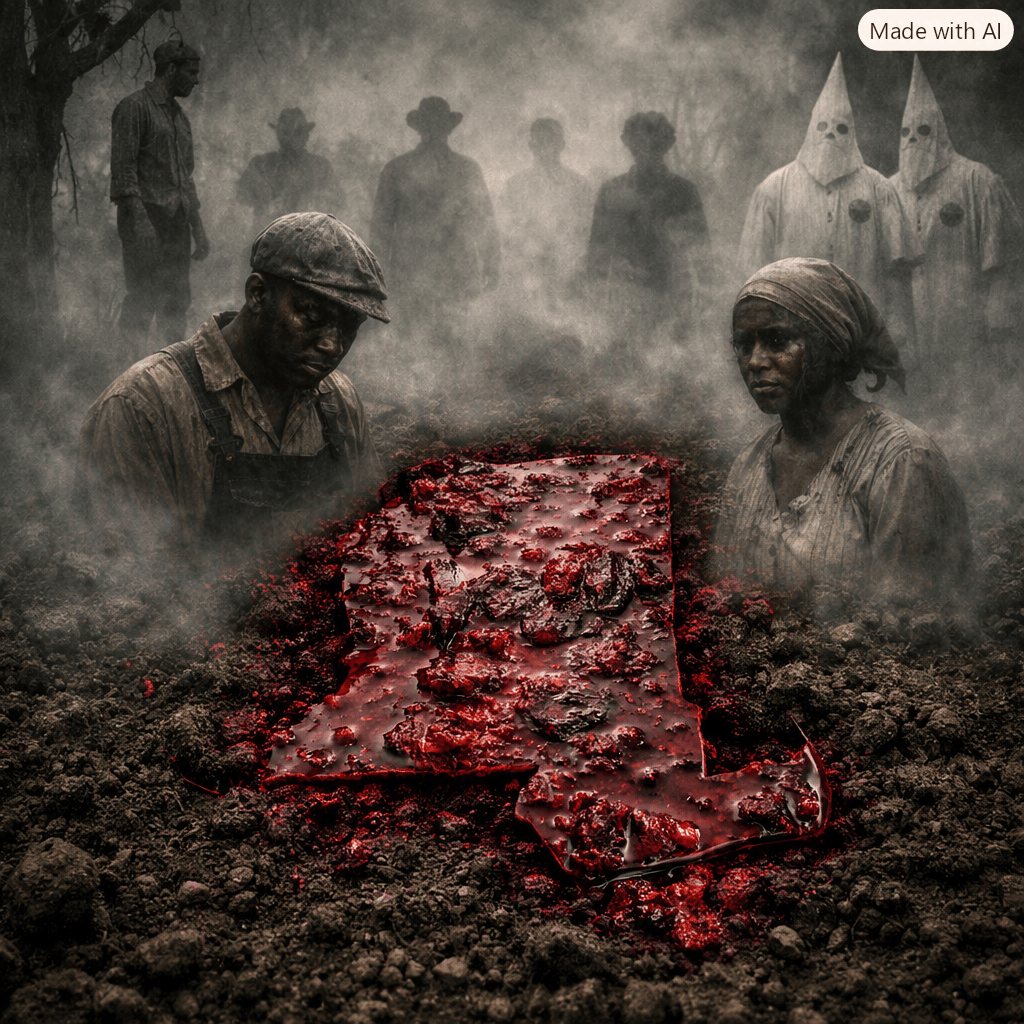
Because let’s tell the truth. The “Christian” community down here loves to shout about sin until it’s time to call out violence against Black bodies. Then suddenly everybody’s quiet. Clutching pearls. And humming hymns like silence is salvation. They’ll condemn a teenager’s skirt length before they condemn a system that keeps killing Black people. They’ll preach forgiveness while refusing accountability. They’ll talk about “God’s love” while ignoring the blood on their own soil. And I’m done pretending that’s holy.
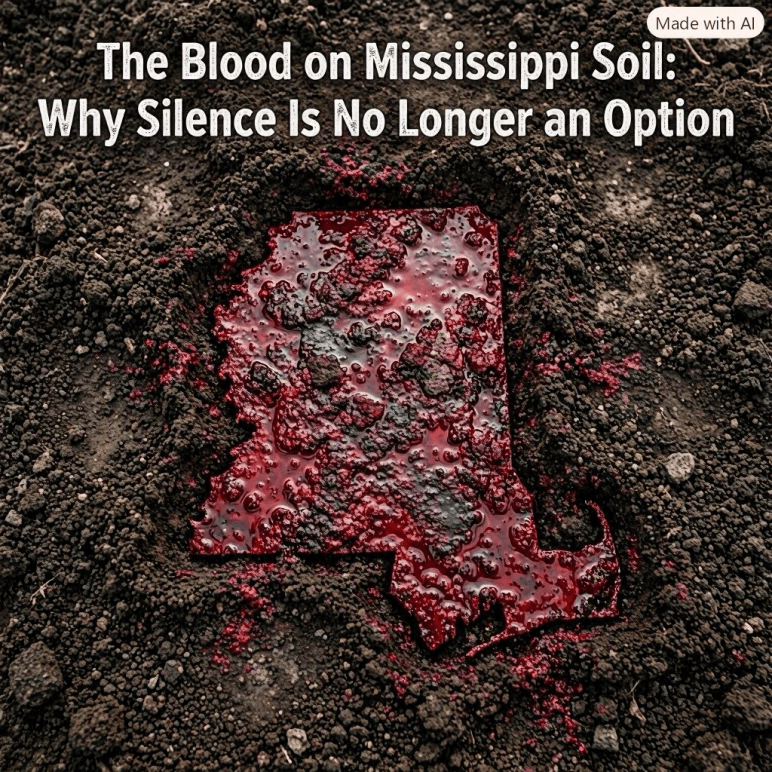
Mississippi has always been a place where racism isn’t just a belief. It’s infrastructure. It’s policy. It’s tradition. It’s the foundation poured into the dirt generations ago. And too many folks still treat it like sacred ground.
And now, again, violence has come knocking at the doors of Black families. Again, the state government refuses to investigate. Again, accountability disappears when the killer is white. Again, we are told to “wait for the facts.” While the facts are buried under good ol’ boy politics and backroom handshakes.
A one-year-old Black baby was shot and killed by a white officer over diapers. Let me say that again. A baby died because a grown man with a badge felt threatened by diapers.
A Black teenage boy was found dead under mysterious circumstances. And instead of answers, we get a cover-up thicker than Delta mud. Evidence missing. Stories changing. Officials shrugging like a child’s life is just a paperwork inconvenience.
And now, a Black woman found hanging from a tree in 2026. And the state wants us to believe it’s anything other than what it looks like. Mississippi has a long, violent history with Black bodies and trees. We know what this is. We’ve seen it before. Our ancestors saw it before. And the silence from leadership is louder than any confession.
This isn’t coincidence. This isn’t isolated. This is a pattern, a legacy, and a sickness that Mississippi refuses to treat because too many people benefit from the infection. And let me tell you something. I’m old enough now to stand up and say it plainly. I’m old enough to fight for marginalized groups which include Black folks, brown folks, Indigenous folks, immigrants, and anyone who doesn’t fit the whitewashed mold Mississippi keeps trying to force us into. I’m old enough to say that I’m proud that I didn’t buy into the racist ideology that some of my own family members still cling to like it’s heirloom china.
I broke the cycle. I chose humanity over heritage. I chose truth over tradition. I chose justice over comfort. And if that makes me the black sheep at the family reunion, hand me the potato salad because I’ll graze in the pasture with pride. I’m proud to say I’m not like them. Not molded by their fear. Not shaped by their hate. Not carved into the same brittle statue of “tradition” they keep worshiping like it’s holy. I’m proud to say I crawled out of the same Mississippi clay. And still managed to grow in a different direction. And it was one that didn’t twist my roots around racism and call it heritage.
If rejecting their ideology means I lose my seat at the family table, then pull the chair out from under me. If refusing to swallow their silence means I’m no longer welcome in their church pews, then let the hymns echo without me. If choosing humanity over hypocrisy means I have to walk away from religion entirely, then I’ll walk away barefoot. Head high and unbothered.
Because I refuse to be loyal to a system that kills Black children and calls it “procedure.” I refuse to be loyal to a state that covers up Black death and calls it “ongoing investigation.” I refuse to be loyal to a community that sees a Black woman hanging from a tree and calls it “unfortunate.” I refuse to be loyal to people who hide behind scripture while ignoring suffering. I refuse to be loyal to any ideology that demands my silence while it destroys lives.
Mississippi may be built on racism. But I am not. Mississippi may cling to its racist past. But I do not. Mississippi may worship its own mythology. But I refuse to kneel. I am not like them. I will never be like them. And if breaking away from their beliefs is the cost of protecting my soul, integrity, and humanity, then that’s a price I’ll pay in full with no regrets.
Let them keep their “South will rise again” fantasies. I’m rising in a different direction. One they can’t touch. Can’t claim. And sure as hell can’t control. That’s my mic drop. And I won’t be picking it back up. Thanks for reading! What are your thoughts?
Affirmation: I honor my ancestors by refusing to repeat their pain. I stand in truth. I stand in courage. And I stand in love even when I stand alone.
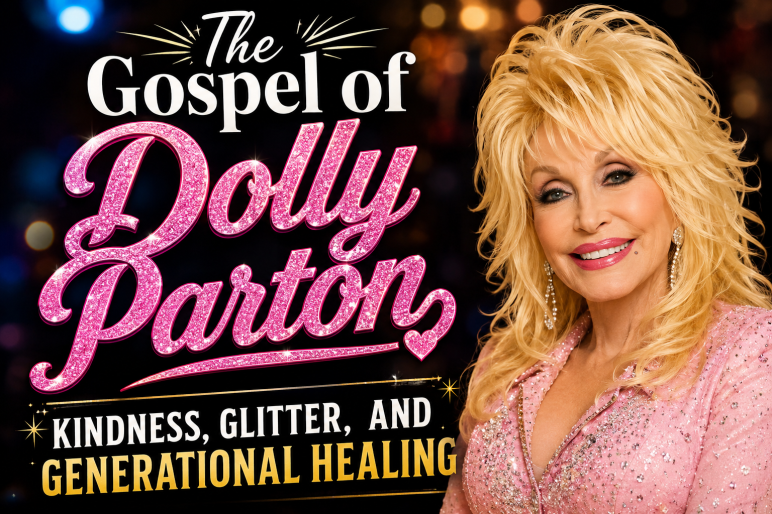
Light the charcoal. Pull up a chair. And let’s call the ancestors. Today, we’re about to talk about a woman whose legacy smells like warm biscuits, rhinestones, and generational healing. Dolly Parton wasn’t just a country singer. She was a walking love letter to humanity. A Southern phoenix who rose from the Smoky Mountains with a voice full of honey and a heart full of fire. And Lord, did she use that fire to light the way for all of us.
When we speak Dolly Parton’s name, we’re not just telling a story. We’re summoning a legacy stitched into the bones of the South, the nation, and every child who ever held a book and felt their world crack open with possibility.
Dolly wasn’t just a singer. She was a healer. A mountain-born miracle. A Southern woman who took her own childhood that was poor, barefoot, brilliant, and turned it into a mission to make sure no child, anywhere, ever felt small because of their circumstances.
She carried the Smoky Mountains in her voice. It was the sass of every Southern auntie who ever said, “Bless your heart. But fix your life.” And the tenderness of a mama who knows what it means to struggle and still show up with love. And when it came to children, Dolly didn’t play. She built an empire of hope one book, one song, one act of kindness at a time.
10 Things Dolly Did for All Communities (Especially the Ones Society Overlooked)
She created the Imagination Library, sendingover 200 million free books to children in rural, urban, poor, wealthy, Black, white, immigrant, Indigenous, disabled, LGBTQ+ families, and everyone. Dolly said literacy wasn’t a privilege. It was a birthright.
She made sure those books were culturally inclusive. They featured stories with diverse characters, languages, and experiences so every child could see themselves reflected in the pages.
She funded vaccine research by helping save lives during a global crisis without needing applause or credit.
She uplifted LGBTQ+ communities by loving loudly. Defending boldly. And showing up long before it was “safe” or trendy.
She championed women’s empowerment by proving you can be glamorous, soft, and still run an empire with steel in your spine.
She protected Appalachian culture by honoring the stories, music, and people who shaped her. And making sure the world respected them too.
She donated millions to disaster relief, especially in overlooked Southern and rural communities that often get left behind.
She built Dollywood, creating thousands of jobs and economic stability for families who needed hope and opportunity.
She supported literacy and education beyond books, funding scholarships, schools, and programs for children who grew up like she did full of potential but lacking resources.
She modeled radical kindness, showing the world that compassion is not weakness. It’s world-changing power.
Dolly didn’t just give books. She gave children a future. She gave parents hope. She gave communities pride. She gave generations a chance to dream bigger than their circumstances.
Dolly Parton walked through this world like a rhinestone-wrapped blessing. She didn’t ask permission to shine. She just did. And she made sure everyone around her felt the warmth of that glow. She was the kind of woman who could take her own childhood poverty and turn it into a global literacy movement. Who could take her pain and turn it into poetry. Who could take her sass and turn it into strength.
She taught us that kindness is a revolution. She taught us that generosity is a legacy. She taught us that beauty is not about perfection. It’s about authenticity. She taught us that you can be underestimated your whole life and still outwork, out love, and outshine every last person who doubted you. She didn’t just leave behind songs. She left behind libraries. She left behind hope. She left behind a blueprint for how to live with grace, humor, and unapologetic sparkle.
So, light the charcoal. Let the ancestors hum. Let the mountains echo her name. Because Dolly Parton didn’t just change country music. She didn’t just change philanthropy. She didn’t just change the South. She changed humanity one child, one book, one act of love at a time. Mic dropped. Sequins scattered. Legacy eternal.
Affirmation: I shine boldly. Give generously. And build a legacy of love just like Dolly taught me.
“Awareness isn’t comfortable, but neither is grief. Choose the discomfort that saves lives.”
-This Puzzled Life
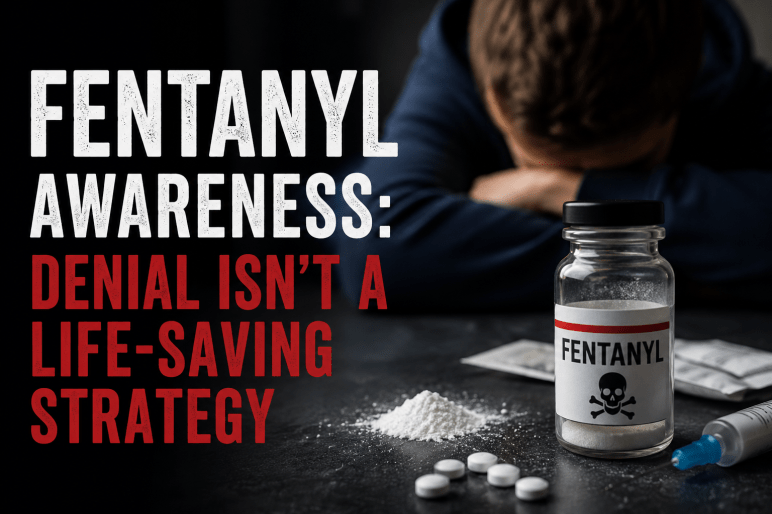
Light the charcoal. Sprinkle the sage. Today, we’re talking about Fentanyl Awareness. And Lord knows some folks need more than sage. They need a whole spiritual intervention. A PowerPoint and maybe a smack from an ancestor with a wooden spoon.
We’re still living in a world where people think fentanyl is something that happens to “other families,” “other communities,” or “those people over there.” Fentanyl doesn’t care about your zip code. Your Bible study attendance record. Or how many casseroles you’ve delivered to the church potluck. It is an equal-opportunity destroyer. And yet, some folks still clutch their pearls and say, “Well, if people didn’t do drugs.” Sweetheart, if ignorance burned calories, half this country would be runway-ready.
Fentanyl isn’t a moral issue. It’s a public health crisis. A grief generator. And a silent killer that slips into communities like humidity in Mississippi. It comes uninvited. Suffocating. And everywhere. But sure, let’s keep pretending it’s just a “bad choice” problem. And just for shits and giggles, I’ll say that bombing people in fishing boats that are clearly are not transporting this substance is not an answer to the problem.
Fentanyl doesn’t knock. It doesn’t ask permission. It doesn’t wait until you’re ready to have your life rearranged. It shows up like a tornado in the middle of a sunny day. It’s fast. Violent. And leaves you standing in the wreckage while wondering how the hell everything changed in seconds.
People aren’t overdosing because they’re weak. They’re overdosing because fentanyl is 50 times stronger than heroin. And 100 times stronger than morphine. They’re overdosing because it’s being mixed into substances without their knowledge. They’re overdosing because the world is heavy. Trauma is real. And coping mechanisms don’t magically appear with a bow on top.
But try telling that to the folks who think addiction is a “willpower issue.” These are the same people who can’t resist a clearance sale at Hobby Lobby. But somehow believe others should resist a chemically engineered substance designed to hijack the brain.
Addiction is not a character flaw. It’s not a spiritual failure. It’s not a lack of discipline. It’s a medical condition. A trauma response. And sometimes a desperate attempt to feel anything other than pain.
And fentanyl? It’s the predator waiting in the shadows. Families are burying children. Parents are burying parents. Communities are burying potential futures and dreams. And still some folks would rather cling to judgment than compassion. Because compassion requires effort. Judgment is free and easy like drive-thru theology.
So, here’s the truth that’s wrapped in Southern sass and tied with a bow of reality. Fentanyl doesn’t care about your opinions. It doesn’t care about your politics. It doesn’t care about your moral superiority complex. But we should care. We should care enough to talk about it. We should care enough to educate ourselves. We should care enough to stop pretending this crisis is happening in some faraway land to people we’ll never meet.
Fentanyl is already here. It’s in our towns, our schools, families, and our communities. And pretending otherwise won’t save a single life. And for the love of all things holy, open your eyes. Denial has never saved anyone. Awareness does. Compassion does. Action does. Try not to trip over it on your way back to reality. Thanks for reading! What are your thoughts?
Affirmation: I choose compassion over judgment. Truth over denial. And awareness over silence. My voice matters. And so does every life touched by this crisis.
“Addiction is a quiet predator. It’s patient. Calculated. Always hungry. And waiting for the moment you’re weakest to take the biggest bite out of your life.”
-This Puzzled Life
Light the charcoal. Sprinkle the sage. Because when we talk about addiction awareness, the air needs to be thick with truth, protection, and the kind of courage that makes your voice shake but keeps going anyway. This isn’t a pretty conversation. It’s not a gentle unveiling. It’s not polite. It’s not something you whisper behind closed doors like a family secret wrapped in shame. It’s the kind of truth that shakes the floorboards and rattles the bones of anyone who’s ever lived it. Loved someone through it. Or buried someone because of it. This is a front porch, bare soul, trembling‑hands kind of truth. And today, we’re telling it out loud.
Addiction doesn’t walk into a home quietly. It barges in like a storm. It tracks mud across every memory. It rearranges the furniture of your life. And convinces you that chaos is normal. It teaches you to apologize for things you didn’t break. To shrink yourself so its shadow can stretch across the room. And to pretend you’re fine when your insides feel like shattered glass. And the cruelest part? Addiction doesn’t just take from the person struggling. It takes from everyone who loves them.
Families learn to tiptoe. Children learn to decode moods like weather patterns. Partners learn to carry burdens that were never meant for one set of shoulders. And the person battling addiction, learns to hide their pain behind a smile that fools everyone except the people who know them best. Addiction awareness isn’t about statistics or slogans. It’s about the people who wake up every day fighting a war no one else can see.
There are the battles fought in bathrooms, parked cars, and bedrooms with the door locked. The battles fought in silence because shame is louder than the truth. The battles fought by people who are terrified to ask for help because they don’t want to be judged. Dismissed. Or treated like a problem instead of a person.
Addiction awareness means saying, “You are not alone. You are not broken beyond repair. You are not the worst thing you’ve ever done.” It means recognizing that recovery isn’t linear. It’s messy. It’s painful. It’s full of relapses, restarts, and revelations. But it is possible. I tasted that freedom many years ago, during a moment in life that now seems like it never existed.
Let’s talk about the people that love them too. The ones who hold the line when the person they love can’t. The ones who pray. Cry. Scream. Hope. And repeat. Addiction awareness means honoring their resilience. Their heartbreak. Their bravery. Loving someone through addiction is its own kind of battle that deserves to be seen.
Addiction is not a moral failure. It is not a character flaw. It is not a sign of weakness. It’s a neurological hijacking. And once it gets inside, it takes the controls and refuses to give them back. It’s a thief. A liar. And a weight that no one should carry alone.
Awareness is the first step toward compassion. Compassion is the first step toward healing. Healing is the first step toward freedom. And freedom? Freedom is the birthright of every single person touched by addiction. It doesn’t matter whether they’re fighting it. Surviving it. Or loving someone through it.
I have been an addict in one form or another since I was a very young teen. That’s the part people don’t see. The way it starts before you even understand what “coping” means. Before your brain is fully formed. Before you know that one decision can echo for decades. Some things I let go of and never touched again. But others? Others I’m still married to. Still controlled by. And still waking up beside like a partner I never meant to vow my life to. I’ve stood on every side of this issue. I’ve been a patient, professional, survivor, and witness. I’ve buried friends and family. And I’ve found the bodies of patients. I’ve even sat in classrooms learning the science. And I’ve sat on bathroom floors learning the consequences.
One of the biggest debates is whether addiction is a disease. And honestly? I see both sides. But I can attest to this. What I know in my bones is that addiction will pick up exactly where it left off. It doesn’t forget you. It doesn’t forgive you. And it doesn’t loosen its grip just because you got tired.
It progresses like a slow-moving fire. Consuming everything until it shuts down every functioning cell in your body. It’s the lover that kisses your forehead while holding a knife behind your back. And it’s like trying to pet a rattlesnake and hoping it suddenly cares about your well-being.
There are no social crack users. No social heroin users. No social meth, fentanyl, or “just once in a while” users of the things that hollow you out from the inside. I’ve known too many who didn’t make it. Too many funerals. Too many empty chairs. Too many stories cut short. And the truth is brutal. Addicts are not the type who typically live to be 80. The statistics confirm what our hearts already know. That many have died. And many more will die.
And process addictions? Eating disorders, self-harm, gambling, sex addiction, etc. are not softer versions. They are simply different roads to the same grave. Addiction doesn’t care about the method. It cares about the destruction. And it will be done in totality emotionally, socially, spiritually, and physically.
It strips you down until you’re a shell of what once resembled a human being. It destroys your life and the lives orbiting yours. That’s the goal. It wants no interference. And no one slowing its roll. It wants you wrapped around its finger in a relationship so co-dependent it feels cellular. It doesn’t care how many relationships are ruined as a result. Addiction is about the next fix. Whatever that fix is. And you will chase it until the line between living and dying blurs.
The saddest part is that you don’t know you’re susceptible until you’re already in it. Addiction does not discriminate. It shows no mercy to clergy, billionaires, politicians, Hollywood actors, musicians, doctors, lawyers, nurses, or the people just trying to keep the lights on and food on the table.
And the idea that you can outthink addiction? Outsmart the chemical, emotional, and neurological machinery it hijacks? That’s the thinking of fools. And I say that with compassion. Not judgment. There is nothing more heartbreaking than watching someone, yourself included, need their “drug” so badly that they would burn down every good thing in their life for another taste of something that is killing them.
Let the truth rise with the smoke. Addiction is not romance. It is not rebellion. It is not escape. It is suicide on an installment plan. And for every person who struggles, it has a bullet with their name on it. Even mine. Speaking the truth out loud is how we start breaking the cycle that wants us silent. Awareness is the first crack of light. Awareness is the first act of rebellion. Awareness is the first step toward choosing life. Even when the addiction whispers otherwise. It’s a story of survival in a world that doesn’t teach us how to hold our pain.
Your days of hiding in silence are over. We’re speaking your name. Shine light in your corners. And refusing to let shame be your shield. This is awareness. This is courage. This is the moment we stop whispering and start healing. And it’s for every soul who deserves a life bigger than their battle. Thanks for reading! And ask for what you need.
Affirmation: I honor the battles I’ve survived, and I refuse to let the shadows that once claimed me write the rest of my story. I rise with clarity, courage, and a spine made of truth.
“If your faith requires someone else to suffer, it’s not holy. It’s just dressed‑up cruelty.”
-This Puzzled Life
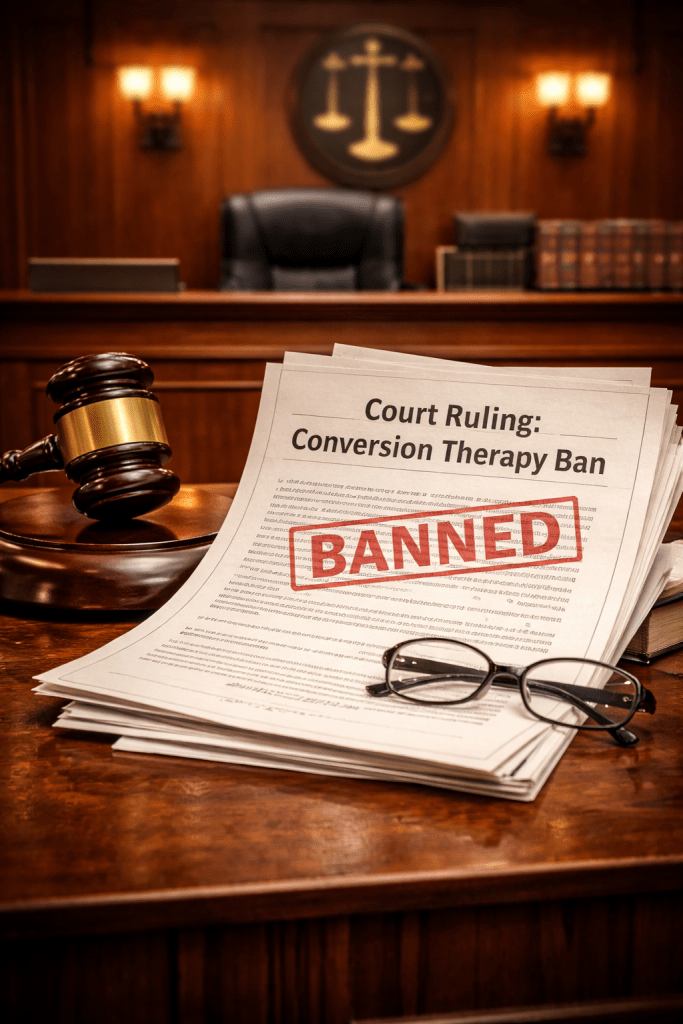
Light the charcoal. Apparently the courts woke up. Stretched. Sipped their Folgers and said, “Hmm. What if we brought back psychological torture today?” And the conservative Christians said, “YAY! Revival!” Meanwhile, every queer person in the South is standing on their porch like, “Lord, give me strength, patience, and a Xanax the size of a biscuit.”
Down here in Mississippi, we know hypocrisy like we know humidity. It clings. It suffocates. It ruins your hair and your spirit at the same time. And nothing brings out the hypocrisy quite like a ruling that says, “Sure, go ahead and traumatize queer people in the name of Jesus. He won’t mind.” These folks will tell you with a straight face that they’re doing this out of “love.” If that’s love, then I’m a straight man named Bubba who drives a lifted truck and says “bro” every six seconds.
Let’s be honest. This ruling isn’t about saving souls. It’s about controlling bodies. It’s about punishing difference. It’s about making queer people small enough to fit inside their narrow theology and even narrower worldview. And the wildest part? These are the same people who can’t keep their own households together. The same people who preach “traditional marriage” while living like a deleted storyline from a messy reality show. The same people who scream “protect the children!” While ignoring the actual dangers children face like abuse, exploitation, and the youth pastor who keeps volunteering for overnight trips.
But sure. Let’s focus on the gays. Because we’re clearly the problem. Not the pastors who keep getting “relocated.” Not the lawmakers who can’t keep their pants zipped. Not the “family values” influencers who spend more time in hotel rooms than in prayer.
Let me break it down in terms even a conservative uncle can understand. You cannot convert someone out of being gay. You cannot shame someone out of being gay. You cannot therapy someone out of being gay. You cannot “deliverance session” someone out of being gay. Unless the only thing you’re delivering is trauma.
If sexuality were a choice, don’t you think I would’ve chosen something easier? Something with less paperwork? Something that didn’t require me to explain myself at every family gathering like I’m giving a TED Talk in a Cracker Barrel? But no. God made me like this. Curved, colorful, and incapable of pretending otherwise.
You could dangle 45 sets of dangly bits in front of me like a clearance sale at Spencer’s Gifts and I still wouldn’t be straight. But put me in front of some boobs and a cooter cat and suddenly I’m glowing like a porch light in July. That’s not a choice. That’s not a phase. That’s not a “lifestyle.” That’s divine architecture.
If you want to stay in the closet because it feels safer, I get it. But don’t pretend it’s holiness. Don’t pretend it’s righteousness. Don’t pretend it’s “God’s plan.” It’s fear. And fear is the currency of conservative Christianity. I sprinted out of the closet like it was on fire. And I’ve been free ever since. Even with my own family members who weaponize scripture like it’s a Nerf gun filled with shame. I send that mess right back to sender with a smile and a boundary. Chosen family is where the love lives. Chosen family is where the truth lives. Chosen family is where the rainbow was always meant to shine.
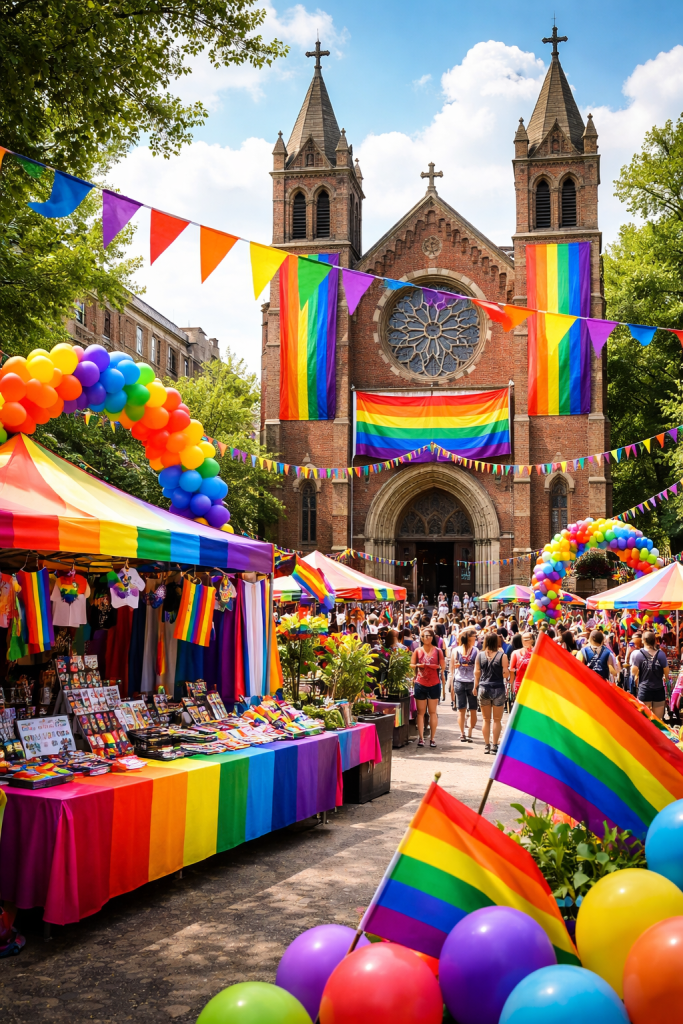
Theo rainbow is divine reassurance. It’s God saying, “Relax. I made y’all fabulous on purpose.” No court ruling can change that. No pastor can change that. No conversion therapist with a clipboard and a superiority complex can change that. We are here. We are queer. We are not going anywhere. And we are not apologizing for existing.
So let the smoke rise like a prayer the evangelicals forgot to proofread. Stand tall in your queerness like a magnolia tree that refuses to bow to the storm. Because here’s the truth they don’t want to face. Every time they try to erase us. We multiply. Every time they try to shame us. We shine harder. Every time they try to legislate us out of existence. We become louder, brighter, and more unbothered than ever.
Their hypocrisy is loud. But our joy is louder. Their cruelty is sharp. But our resilience is sharper. Their fear is deep. But our love is deeper. And at the end of the day, when the court rulings fade. When the sermons lose their sting. When the shame campaigns collapse under their own weight. We will still be here laughing. Loving. Living. Thriving. Dancing in the rainbow God hung in the sky as a reminder that storms don’t last forever.
So let them clutch their pearls. Let them scream about “family values.” Let them pretend their closets don’t have motion‑activated lights. We know the truth. You damn sure cannot stop the rainbow from rising. Mic dropped. Floor cracked. Hypocrisy exposed. Amen and pass the sweet tea. Thanks for reading! And Happy Pride year-round. What are your thoughts on this type of ruling?
Affirmation: “My identity is divine. My joy is sacred. And no court, church, or closet can dim the rainbow God put in my soul.”
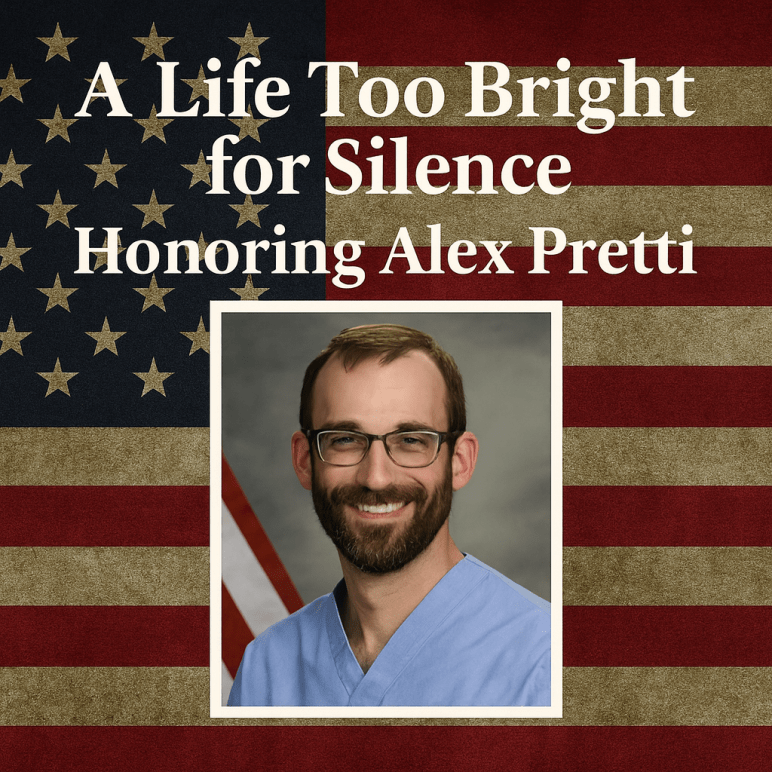
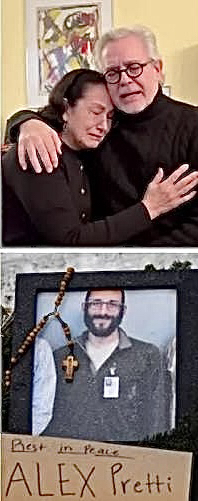
“Some people leave footprints. Alex left constellations.”
—This Puzzled Life
Light the charcoal. Sprinkle the sage. Grab your protest sign and a cup of coffee. Because if you live in the Deep South like I do, grief doesn’t just arrive. It sweats through your clothes and fogs up your glasses before breakfast.
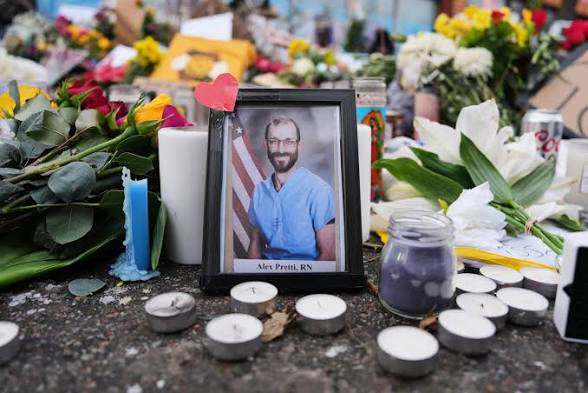
Before I knew his name. Before I knew the details that would punch me right in the chest, Alex Pretti reached me. All the way down here where I’m surrounded by red as far as the eye can see. And when a story travels that far and hits that hard, you know it’s not just news. It’s a wake‑up call. It’s a “Lord, give me strength” moment.
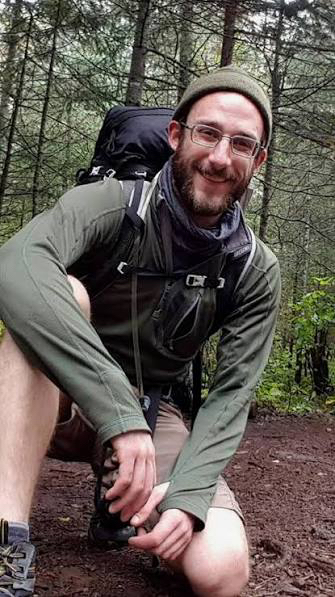
I didn’t know Alex personally. But the kind of man he was? You could feel it. He was one of those people whose light didn’t ask permission. It just showed up, loud and warm and human. The kind of man who loved deeply, laughed easily, and carried a softness this world doesn’t always know what to do with. A man who deserved to grow old, to be safe, to be held by a country he believed in.
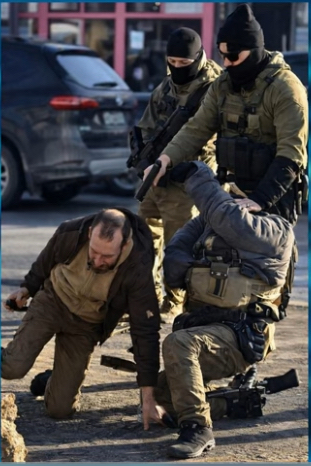
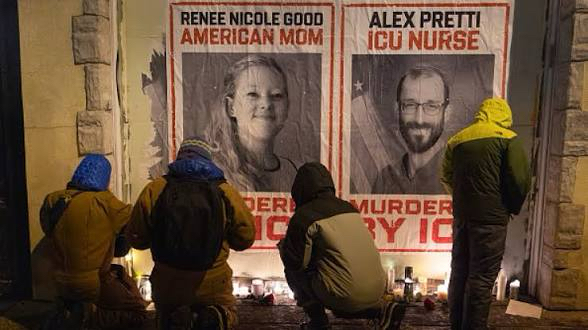
However, an ICE agent took his life. Another name added to a list no one should ever be on. And here I am, a radical left lesbian mom in Mississippi, suddenly out in the streets protesting because a man I never met had his life taken by a system that keeps insisting it’s “protecting” us while leaving families shattered in its reality.
Alex was the kind of man who felt everything at full volume. He cared deeply. He believed people deserved second chances. Even when he rarely gave himself one. He was the friend who showed up with snacks, unsolicited advice, and a chaotic plan that somehow always worked out. He was the man who apologized to furniture when he bumped into it. The man who hugged like he meant it. Said everything with his full chest. And had a softness, that humanity, is exactly what makes his loss so difficult. When I learned that Alex had been shot by an ICE agent, something inside me cracked. Not because it was surprising. Even though it was. But because it was familiar. Too familiar.
Another life taken. Another family grieving. Another official statement full of phrases like “self-defense” and “ongoing investigation.” Another community left holding the weight of a story that should never have happened.
Alex wasn’t a threat. He wasn’t a danger. He wasn’t a headline. He was a man. A son. A friend. A human being who deserved dignity, safety, and a future. And here’s the part that keeps making tears well up in my eyes. We never met. Our lives never crossed. But somehow his light still reached me. Where people like me are used to feeling outnumbered, unheard, and underestimated. Your story landed right in the middle of my heart like a truth I didn’t know I needed. Your life touched a stranger hundreds of miles away. Your death shook a community you never met. Your name pulled me into the streets to protest because what happened to you was wrong, and silence would’ve been its own kind of violence.
We had the only thing we ever needed in common. We were both Americans who still loved this country. All the colors of the rainbow. Who believed in equality for all. And who loves and respects our constitution. Not blindly, but bravely. Not the sanitized version. Not the version politicians slip out when they want applause.
We loved the real country. The one made of people, not power. The one made of communities, not cruelty. The one that’s worth fighting for because it’s ours, even when it breaks our hearts. You loved this place enough to believe in its promise. And I love it enough to protest the systems that stole you from it.
When I speak Alex’s name, I think of the way he lived. I think of his light and his laugh. The kind that made strangers smile. I think of his hope for our neighbors and country. The kind that refused to dim. I think of his softness. The kind that made people feel safe.
Alex taught me that love doesn’t have to be perfect to be real. He taught me that vulnerability is an act of courage. He taught me that showing up messy, flawed, and human is enough. You and me strangers on paper. Yet connected in purpose. Your life touched mine, and now your name lives in my throat every time I show up with a sign, a voice, and a righteous amount of Southern gay attitude.
I wish your story ended differently. I wish this country loved you back the way you loved it. Your light didn’t go out. It spread. It reached a queer mom in Mississippi who refuses to be quiet. It reached a community that refuses to forget. It reached people who are tired of watching the same system break the same bodies and call it “order.”
And if ICE, the state, or anyone else wants to know why I’m out here protesting, yelling, writing, and refusing to sit down, the answer is simple. Because Alex Pretti and Renee Good deserved to grow old.Because loving this country means fighting the parts of it that keep killing people.Because silence is not patriotism. Accountability is. And because The United States of America’s Constitution specifically states, “We hold these truths to be self-evident, that ALL men are created equal, that they are endowed by their Creator with certain unalienable Rights, that among these are Life, Liberty and the pursuit of Happiness.” BECAUSE IN THIS COUNTRY, THERE ARE NO KINGS!
And yes, I’ll still make jokes, because grief and humor are cousins in my family. But don’t get it twisted. The fire is real.
Your story changed me. Your name will not fade. And if this country ever gets better, it’ll be because of people like you. And the people who refuse to stop saying your name. Thanks for reading! And never stay quiet.
Affirmation: I honor the fallen by fighting like hell for the living. And by keeping my sense of humor, because the revolution needs snacks and sarcasm.
“Real happiness is cheap enough, yet how dearly we pay for its counterfeit.”
-Hosea Ballou
Light the charcoal. Sprinkle the sage. Negative energy go away. Today, I want to talk to you about the dangers of fake cannabis vape carts. Most people do not know how to spot the differences. Many parents give their kids money or go personally and buy these vapes. This can be a very costly and even deadly mistake. Even though it is widely accepted for vaping, not all vapes are regulated for safety.
What are fake vapes? They are unregulated, counterfeit products that pose very serious health risks due to unknown and harmful ingredients. They lack safety testing and can contain dangerous chemicals, heavy metals, or inaccurately labeled substances. There is very little, if any, quality control, and safety taken when creating these products (https://southbeachsmoke.com, 2025).
Here are just some of the chemicals and other cutting agents that are used to produce versus legitimate and controlled vapes.
· Vitamin E acetate: A thickening agent found in illicit THC cartridges strongly linked to 2019 EVALI outbreak which caused lung injuries associated with vaping. Thousands were hospitalized and dozens died.
· Pesticides: Lab tests on black market vapes have revealed pesticide levels of a thousand times higher than legal limits.
· Synthetic cannabinoids: Fake THC vapes contain unpredictable synthetic cannabinoids (like K2 or Spice) which have been linked to anxiety, paranoia, seizures, and psychosis.
· Fentanyl and other drugs: Vapes purchased from illicit sources have sometimes been found laced with lethal opioids like fentanyl which can lead to overdose and death.
· Formaldehyde: Some fake vapes have be found to contain levels of carcinogenic chemicals like formaldehyde and acetaldehyde which are found in cigarette smoke.
· Industrial solvents: Other harmful cutting agents like medium-chain triglycerides (MCT) oil and propylene glycol, can become toxic when inhaled.
· Toxic leaching: heating elements and coils of these devices can leach heavy metal like lead, nickel, and antimony into the vape liquid.
· Severe health effects: Inhaling heavy metals can cause neurological damage, respiratory issues, organ failure, and increase cancer risk (https://springboardcenter.org, 2025).
· Poor packaging: Examine the box for blurry printing, misspelled words, inconsistent logos, or a lack of safety seals.
· Missing authentication: Check for a QR code, batch number, or serial number on the package. Reputable brands offer a way to verify product’s authenticity.
· “Too good to be true” price: If a vape is priced significantly cheaper than retailers, it’s likely a counterfeit.
· Unlicensed seller: Only buy from trusted, licensed dispensaries or reputable retailers. Avoid street vendors “plugs” or unverified online sources.
· Odd performance or smell: If the vapor tastes burnt, metallic, or chemically unusual, stop using immediately.
· Suspicious liquid: High-quality vape is typically thick and golden or amber. If the liquid is thin, runny, or unnaturally colored, it could be fake (https://vaping360.com, 2024).
These are products that have been widely accepted among teens and adults. Whenever possible, please by your products from a reputable dispensary versus a smoke or vape shop which are only in the business for money rather than safety. Too many people have been seriously injured or died from fake vapes. Thanks for reading and please make educated decisions about these products.
Affirmation: I prioritize my health and safety by choosing products from reputable sources.
“Ibogaine got me through the door. The rest was up to me.”
-Unknown
Light the charcoal. Sprinkle the sage. Negative energy go away. Today, I want to talk to you about a plant that is said to help treat addiction. The name of the substance is called Ibogaine. I’ll be the first to admit that I don’t know much about this plant. But what I intend to do is to lay out the information and let you make the determination about what you think.
First, we’ll look at its origins. Ibogaine is a West African shrub that grows in the Congo and Angola which is then separated from the root bark. The active ingredient in the plant is Tabernanthe iboga. Traditionally it has been used as a hallucinogen to suppress hunger and fatigue while also being used as an aphrodisiac. Hold up! So, I’m going to be able to smell colors, sleep and get in the mood? And there’s a high likelihood that I might vomit? Count me in!
Purified ibogaine hydrochloride was first introduced to European consumers in 1939 under the name Lambarene. And it was sold in France until 1970 as an antidepressant that could improve mood, physical strength and used by athletes and others recovering from illness. In 1962 Howard Lotsof, a heroin addict, the experience with ibogaine was so transformative that he spent the rest of his life advocating for it as a cure for substance abuse. A Chilean psychiatrist Claudio Naranjo also advocated for ibogaine as a treatment which was described in his book in 1973 called The Healing Journey (Ibogaine Therapy Information- UC Berkeley BCSP, 2025).
Ibogaine is an alkaloid. The treatment with Ibogaine lasts around 12 to 24 hours. Keep in mind that the patient is in a hallucinogenic state. And though some consider it a “surgical” tool for addiction therapy it does have its medical risks (https://.randrmd.com, 2025). These include severe cardiotoxicity and neurological effects which have been associated with sudden death. Specifically, there are cardiac arrhythmias, hallucinations, seizures, nervous system depressant, bradycardia, hypotension, neurotoxicity, and negative psychological effects (https://www.sciencedirect.com/science/article/abs/pii/S0736467919305700#:~:text=Background,of%20ibogaine’s%20effects%20and%20safety). This treatment should always be done under medical supervision.
Not only is ibogaine used for opiate addiction, but also in the treatment of traumatic brain injury (TBI), PTSD, depression, and anxiety. Formal testing showed improvements in concentration, memory, information processing, and impulsivity(https://news.stanford.edu, 2024). Here are some statistics to keep in mind about this particular treatment. Studies in regard to Opiate Use Disorder from clinics primarily in Mexico and New Zealand indicate:
§ 80% of participants report the elimination or reduction of opiate withdrawal symptoms.
§ 50% of participants report no opioid use at 60 days post-treatment.
§ New Zealand study found that 50% of participants achieved one year of abstinence.
§ An overall analysis reports that 81% were classified as “responders” which means that they never used opioids again or significantly decreased their use after treatment.
Currently in the United States, Ibogaine is a Scheduled 1 controlled substance. Which means that it has no acceptable medical uses and a high potential for abuse. It is against federal law to possess, sell, or use ibogaine for any purpose outside of a federally approved research setting. However, Texas has allocated $50 million to fund clinical trials for addiction and TBI. Kentucky and Washington have also explored funding. And, yes, there are several biotech companies that are developing non-hallucinogenic analogs that could potentially gain FDA approval in the future.
While this treatment is not currently approved in the United States, a lot of desperate addicts will pay between $5,000 and $15,000 in countries like Mexico, Costa Rica, Portugal, Netherlands, South Africa, Canada, New Zealand, Australia, Brazil, and Gabon. Costs also depend on length of treatment and particular amenities of the individual programs. I’m not completely sold on this form of treatment for addiction or anything else. That’s not to say that people don’t find their own relief through this type of treatment. However, at this point, I would personally like to see more safety considerations and advanced research regarding this method. As an addict myself, I understand that level of desperation to want the cycle of addiction to end. My personal opinion is that I want to keep an eye on future research once it moves out of its infancy in our country. Thanks for reading! And stay informed.