This Puzzled Life is a mental health and recovery blog exploring addiction, trauma healing, LGBTQ experiences, humor, and the strange moments that shape us.
“Childhood in the 80s wasn’t safe. But it was flavorful.”
-This Puzzled Life
Light the charcoal. Today we’re grilling up the radioactive, neon‑dust‑covered, FDA‑defying buffet that raised us. The 1980s didn’t just feed us snacks. They fed us character development. They fed us resilience. They fed us enough artificial dyes to glow like a Chernobyl nightlight. And we ate it up with our bare hands. Because nobody in that decade had ever uttered the phrase “Is that safe for children?”
Back then, snacks weren’t “organic,” “non‑GMO,” or “ethically sourced.” They were chaos in a foil pouch. They were chemical warfare disguised as lunchbox joy. They were delicious, toxic, and probably illegal now. And I miss them every day like a long‑lost cousin who stole my bike but taught me how to cuss. Let’s take a stroll down memory lane. But wear protective gear. The 80s snack aisle was basically a Superfund site with better branding.
Planters Cheez Balls-The neon‑orange dust that stained your fingers for three to five business days. If you touched a white wall afterward, it looked like a crime scene at a clown convention.
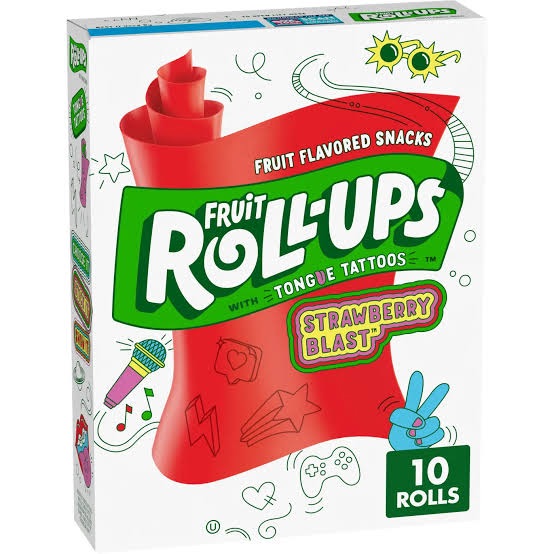
Fruit Roll‑Ups (Original Formula)-Essentially edible plastic wrap with a whisper of fruit. If you left it in the sun, it melted into a sheet of stained glass that could double as a weapon.
Jolt Cola-Two cups of coffee, a Red Bull, and a dare from Satan all mixed into one can. This drink raised your heart rate and your GPA.
Pop Rocks-Carbonated gravel. The snack that convinced an entire generation we might explode at any moment. And we still ate it by the fistful.
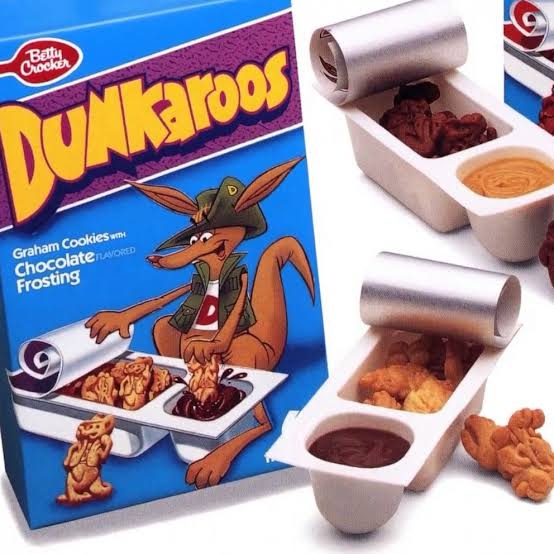
Dunkaroos-Cookies you dipped into frosting so sweet it could sandblast your enamel. A dentist’s retirement plan in a single pack.
Hubba Bubba Bubble Tape-Six feet of gum. Which was exactly five feet and eleven inches more than any child needed. We chewed it until our jaws locked like a rusty hinge.
Slush Puppie-A cup of shaved ice drowned in syrup so bright it could guide ships through fog. One sip and your tongue changed colors like a mood ring.
Hostess Pudding Pies-A pastry filled with custard that tasted like it had been stored in a bunker since the Cold War. We didn’t care. We inhaled them.
Tato Skins-Potato chips that were basically salt slabs. One bag could dehydrate a camel.
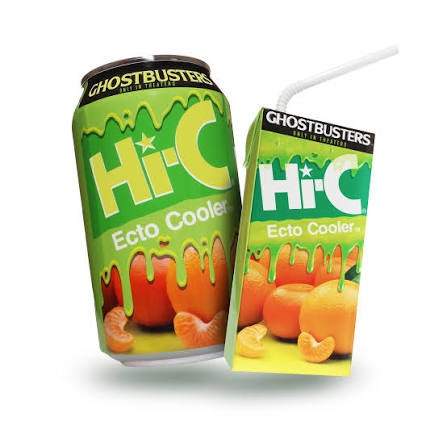
Hi‑C Ecto Cooler-A citrus drink so green it looked radioactive. Probably was. Delicious though.
And that’s it. The snacks that built our immune systems, our personalities, and possibly our future medical bills. We were raised on sugar, dye, caffeine, and vibes. No one checked labels. No one asked questions. If it glowed, fizzed, popped, or came in a pouch that looked like it was designed by a hyperactive raccoon, we ate it. Meanwhile, today’s kids are out here with gluten‑free, dye‑free, sugar‑free, joy‑free snacks shaped like clouds and promises. Bless their hearts.
We survived lawn darts, metal slides, and snacks that could strip paint. And now we’re out here trying to survive our own children. Who melt down if their organic fruit snack is the wrong shade of mauve. While helicopter moms hover with SPF 9000 and BPA‑free water bottles shaped like emotional support gourds. The 80s made us fireproof. Thanks for reading! What are more snacks that you can remember from this time period?
Affirmation: “I honor my inner 80s kid by embracing chaos. Choosing joy. And refusing to read ingredient labels.”
“Gen X: Because someone had to survive the 80s so the rest of y’all could have feelings.”
-This Puzzled Life
Light the charcoal. We’re about to summon the spirits of Gen X. We were the only generation that survived metal playground equipment, unfiltered hose water, and parents who thought “supervision” was something only rich people did.
Let’s talk about the 80s. The decade where every child was basically a free‑range chicken with a bike. And nothing captures the chaos of our upbringing better than the rotary phone. That thing wasn’t just a communication device. It was the first escape room. A psychological puzzle. A patience test. A spiritual trial. A full‑body workout. A rite of passage.
Listen. If you didn’t grow up in the 80s, you will never understand the emotional damage of mis‑dialing the last number on a rotary phone. You’d get all the way to the ninth digit. Your finger trembling. Your soul leaving your body. And then slip. Back to the beginning. Do not pass go. Do not collect $200. Do not call your friend to see if they can come outside.
Rotary phones were the original “Are you smart enough to escape this room?” challenge. Except the room was your grandmother’s kitchen. The puzzle was a plastic wheel from 1952. And the prize was getting to talk to someone whose mom might pick up and yell, “Hello? Who is this?” And Gen X? We were forged in that fire.
We survived:
Phone cords long enough to lasso a sibling, a dog, and a passing station wagon.
Busy signals, which were basically the universe saying, “try again later, loser.”
Parents screaming “Get off the phone, I’m expecting a call!” even though they weren’t.
The fear of calling a friend and having their dad answer with a voice that sounded like he ate gravel for breakfast.
Kids today will never know the terror of dialing a crush’s house and praying their mother didn’t answer with the tone of a woman who had already raised three children and was done.
And while we’re at it, Gen X childhood wasn’t just rotary phones. It was metal slides hot enough to brand livestock. Monkey bars designed by someone who hated children. Halloween costumes made of plastic so flammable they violated the Geneva Convention. Riding in the back of pickup trucks like we were in a Marlboro commercial. Snacks made of 98% Red Dye No. 5. Being left alone for 12 hours with nothing but a bike, a stick, and a vague sense of danger.
We didn’t have helicopter parents. We had “figure it out” parents. We didn’t have screen time limits. We had “go outside and don’t come back until the streetlights come on.” We didn’t have anxiety. We had character development. And now? We’re raising kids who need a snack, a water bottle, a fidget toy, a weighted blanket, and three emotional support apps just to go to Target.
So yes. We are Gen X. We survived rotary phones, lawn darts, metal slides, Satanic Panic, latchkey childhood, and parents who thought seatbelts were “optional suggestions.” We escaped the escape room. We solved the puzzle. We lived to tell the tale. And now we’re out here trying to raise children who cry if the Wi‑Fi blinks for three seconds.
Meanwhile, we’re still laughing. Still standing. Still unbothered. Because we were raised by chaos, danger, and a phone that required upper‑body strength. Cord tangled. Streetlights on. Gen X forever. Thanks for reading! What do you remember about growing up in the 80’s?
Affirmation: “I am a resilient, sarcastic, rotary‑phone‑forged masterpiece. And nothing in this modern world can intimidate me.”
“Our childhood wasn’t supervised. It was witnessed.”
-This Puzzled Life
Light the charcoal. Bless the yard. We’re summoning the spirits of a generation raised on asbestos, sugar, and unmonitored chaos. A generation that survived childhoods so reckless they now qualify as folklore. Welcome to Growing Up in the 80s: A Survival Guide for the Barely Supervised. It’s where the toys were weapons. The adults were tired. And the safety standards were “Godspeed, child.” Get comfortable while we take a stroll through the hilarity of growing up Gen X in the 1980s.
Playgrounds: Where Childhood Went To Die.
The playground wasn’t a place to have fun. It was a government‑approved death trap. The metal slide? Forged in the fires of Mount Doom. By noon it was hot enough to brand cattle. You’d climb up. Sit down. And immediately lose three layers of thigh skin. And the equipment? Not equipment. Artifacts. One day a giant industrial truck tire would just appear. No explanation. No installation. Just a 400‑pound rubber monolith that rolled off an 18‑wheeler and onto the playground like, “Here. Climb inside this tomb and see what happens.”
I cannot end this part without mentioning the merry‑go‑round. It was a device clearly invented by someone who wanted to test the limits of the human skull. This wasn’t the cute, slow, musical carousel at the mall. No. This was a rusted metal centrifuge powered entirely by children with no impulse control. You’d hop on. Hold the bar with sweaty little hands and pray. The moment the older kids grabbed the rails and started running, you were no longer a participant. You were payload.
They’d spin that thing so fast your soul would leave your body and hover above the playground like, “Welp. This is how we meet Jesus.” If you lost your grip? You were slung off in a blaze of glory. Bouncing across the gravel like a loose hubcap on I‑10, while collecting rocks, dirt, and possibly a mild concussion.
And the adults? They didn’t intervene. They didn’t slow it down. They didn’t even look concerned. They’d just shrug and say, “That’s why you hold on tighter next time.” Meanwhile, the teachers assigned to playground duty were spiritually absent. You could be actively being decapitated. And they’d shout from across the field,“ If you’re bleeding, go to the office!”
Lawn Darts
Lawn darts were literal spears marketed as toys. You’d throw them into the sky and pray they didn’t come down in your skull. Parents watched from lawn chairs. And were drinking Tab and saying, “Be careful!” As if that would stop a 2‑pound metal projectile from piercing your femur.
Halloween: The Budget Was $3 and a Prayer
Our costumes were plastic trash bags with a picture of the character printed on the front. And a mask that smelled like melted crayons and carbon monoxide. The eye holes were never aligned with actual human eyes. So, we trick‑or‑treated like drunk raccoons bumping into mailboxes.
And the horror movies? Low‑budget masterpieces. Special effects made from ketchup packets and someone’s uncle’s old Halloween wig. But we watched them anyway. Because we were latchkey kids with no adult supervision. And a VCR that ate tapes like a hungry goat.
The Rotary Phone: A Weapon, A Workout, A Trap
Kids today will never know the terror of dialing a friend whose number had multiple 9s in it. You’d start dialing at 3 PM and finish sometime around dusk. And that phone cord? It could stretch from the kitchen. Through the living room. Out the front door. Down the driveway. And halfway to the neighbor’s house. Then it would wrap around your body like a boa constrictor with a grudge. And would drag you to the floor while your mom yelled, “Don’t you dare hang up! I’m talking to Aunt Sarah.”
Cigarette Smoke Everywhere
The 80s smelled like nicotine, Aqua Net, and generational denial. Restaurants had “smoking” and “non‑smoking” sections separated by a single fern. Airplanes had smoking sections. Hospitals had smoking sections. Your pediatrician? He’d walk in with a cigarette and say, “Your lungs sound tight.” Sir, I wonder why.
Tv Antennas
If you wanted to watch cartoons, someone had to climb onto the roof. Usually a child. Your dad would yell, “Turn it a smidge!” All while you clung to the chimney like a tiny lineman in a lightning storm. You would say, “Is it better now?” And they would reply, “No, you made it worse!” You were one gust of wind away from meeting Jesus.
Cereal With Enough Sugar To Stop A Hummingbird’s Heart
Our cereal wasn’t “part of a balanced breakfast.” It was diabetes in a box. The milk at the bottom turned into neon syrup that could power a small generator. And the commercials promised superpowers, speed, and happiness. They were all lies, but delicious ones.
Riding In The Back Of Pickup Trucks
Seatbelts? Not in the back of a truck. We’d bounce around like human popcorn. While our friend’s dad took corners at 40 mph. We waved at strangers like we were the Grand Marshals of the Unsupervised Children’s Parade.
Public Pools
Swimming in an 80s public pool was already a gamble. Public pools were cloudy cauldrons of mystery. You couldn’t see your own legs. The bottom was a rumor. And the smell of chlorine could peel paint off a Buick. You’d inevitably bump into something and pray it wasn’t a Band‑Aid or a rogue diaper.
But every now and then, the universe would spice things up with a code‑brown catastrophe. You’d be dog‑paddling through that murky soup. When suddenly the lifeguard, a sunburned 16‑year‑old, who hadn’t cared about anything all day. And would rather die than get in the water. Would suddenly come alive. They’d blow their whistle like they were signaling the end times, waving their arms, and screaming, “Everybody Out! Everybody Out Now!”
And then you’d see it. Floating. Majestic. Unbothered. A lone turd drifting across the surface like it was the captain of its own ship. And charting a course straight through the deep end. Kids would scatter. And they were climbing out of the pool like panicked wet cats. Slipping. Screaming. And traumatized. Moms would grab their children like they were rescuing them from a burning building. And the lifeguard? They’d stand there. Whistle still in their mouth. And staring at the water like, “I don’t get paid enough for this.” We didn’t have sharks in pools. We had floaters.
Mosquito Trucks & Ice Cream Trucks
Southern summer evenings in the 80s had two sacred sounds. The jingle of the ice cream truck. And the low, ominous rumble of the mosquito truck rolling through the neighborhood like a mobile cancer dispenser. The mosquito truck would creep down the street. While spraying a thick, white fog of chemicals so potent it could kill a roach at 50 yards. And what did we do? We ran toward it.
We’d get two steps from the bumper. Arms outstretched. And inhaling that cloud like it was the breath of life itself. Kids today have essential oils and organic bug spray. We had government‑issued carcinogens and the lung capacity of Olympians. We’d dance in that fog like feral woodland spirits. Coughing, laughing, and probably shaving five years off our lifespan. While our parents stood on the porch waving like, “Y’all stay where we can see you!”
And then. The moment the fog cleared. The ice cream truck would appear like a reward for surviving the chemical baptism. We’d sprint toward it. Pockets full of sweaty quarters. Ready to buy a popsicle shaped like a cartoon character whose eyes were always crooked. And whose flavor was “red.” Poison cloud, then ice cream. A perfect system.
Stranger Danger Training
Our entire safety curriculum was, “Don’t get in a van.” That was it. Then they’d send us outside for 10 hours with no supervision, no sunscreen, and no water bottle. We roamed the neighborhood like feral raccoons with bikes. And helping ourselves to anyone’s yard that had a visible garden hose.
No YouTube, No Cell Phones, No Dollar Tree
My 10‑year‑old hears this and acts like I grew up in the prehistoric era. Back in my day, if you wanted to learn something, you had to ask a grown‑up (who might lie). Ask a friend (who would definitely lie). Or check the encyclopedia (which was older than your grandma). And Dollar Tree? Didn’t exist. If you wanted cheap toys. You had to wait for a gas station to put something on clearance. Usually because it had faded into a new color.
The Satanic Panic: Southern Edition
The South in the 80s was convinced the devil lived in rock music, Dungeons & Dragons, black clothing, and Halloween, Oh, and anyone who didn’t go to church three times a week. You couldn’t even be friends with a Methodist without someone whispering, “Don’t you go sellin’ your soul now.”
Big Hair Bands
Men wore eyeliner, leather pants, and hair so teased it could block a doorway. Nobody questioned it. We said, “This is masculinity. This is art. This is culture.” And then there was R&B. Those songs were so sensual you needed birth control just to listen to them. You’d be nine years old hearing lyrics that made you blush and wonder if you needed to talk to a priest.
Nature As Weaponry
We didn’t have Nerf guns. We had sticks. Sticks that became Spears, Rifles, Swords, Magic wands, and occasionally, a snake. We played cowboys and Indians, cops and robbers, and dramatic death scenes worthy of an Oscar.
Childhood Mental Health Was A Mythical Concept
If you were stressed, anxious, or overwhelmed, adults said, “Go outside.” “Stop crying.” “You’re fine.” “Kids don’t get stressed.” Meanwhile, we were out here processing trauma with a Capri Sun and a bike with no brakes.
Prank Calls
Before caller ID, we were chaos. We’d flip through the phone book. Which was an actual book. And call someone named Margarita to ask if her husband was Jack Daniels and her dog was Tequila. Or we’d call strangers at 1 AM and ask, “Do you know how to cook a blueberry pie?” And we did all this sober. Because we had to create our own fun without electronics.
Cameras
Taking pictures was a gamble. You’d take 24 photos. Wait three weeks. Pay $12.99. And discover blurry faces and closed eyes. Sometimes thumbs over the lens. A strange photobombing. Or the entire roll blank because someone forgot to load the film. There was no delete button. Just shame.
And now here we are. Veterans of the 80s. We have scars both physical and emotional. And needing therapy where we now have to process our entire lives. All while trying to survive our own children. Who now need hydration schedules, emotional check‑ins, and sunscreen applied with the precision of a NASA engineer. We watch helicopter moms circling the playground. Adjusting knee pads. Putting toddlers on leashes. And we just smile. Because we know the truth. We survived the 80s. We can survive anything. Even this. Thanks for reading! And I hope this was the brightest spot of your day. Please leave a comment about other hilarious things from the 80’s that we Gen X might remember.
Affirmation: I honor the feral resilience that raised me. I survived metal slides, mosquito fog, and lawn‑dart warfare. So, today’s challenges don’t scare me. I am built from grit, humor, and pure Gen X immortality.
“I didn’t grow up in the dark ages. I grew up in the spark‑a‑fire‑with‑two‑sticks era of resilience.”
-This Puzzled Life
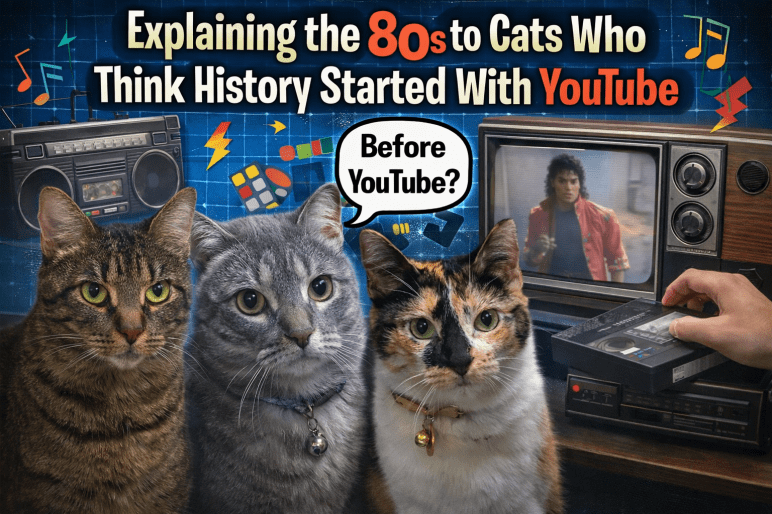
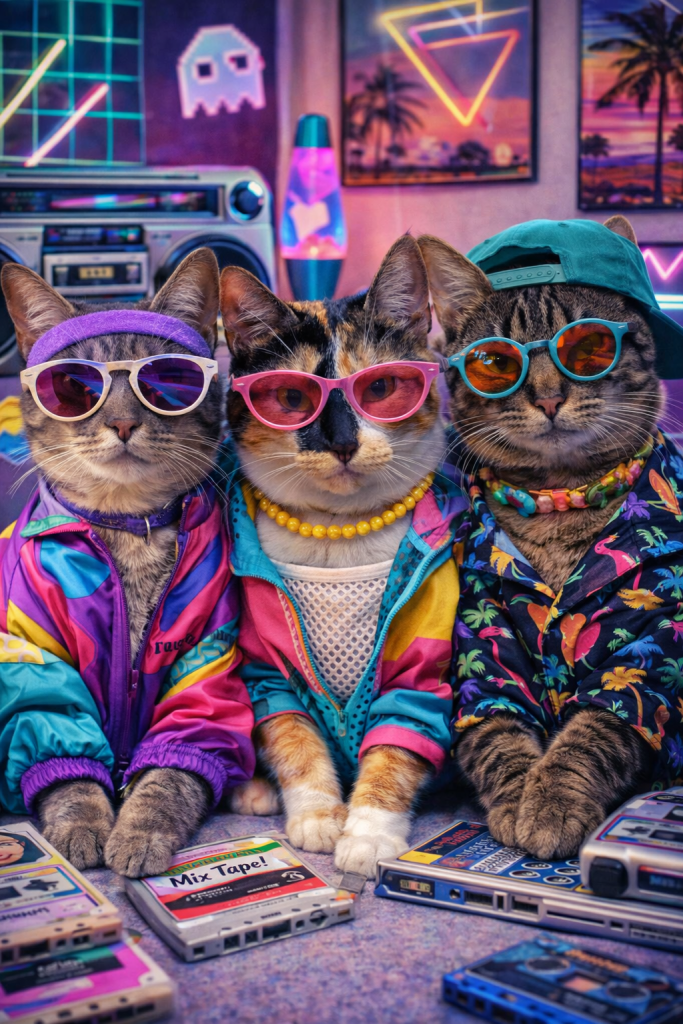
Light the charcoal. Hide the breakables. Put Piper on airplane mode. Today my cats staged a full‑scale intervention. Not a gentle, “Mama, we have questions.” No. This was a feline congressional hearing.
Piper dragged a legal pad across the floor like she was subpoenaing me. Coco sat in a chair backwards like a middle‑school guidance counselor trying to relate. Tinkerbell lit a metaphorical cigarette and whispered, “Let’s begin.” And then, in perfect unison, they asked, “Mama, what was it like growing up in the 80s?”
It started like any normal morning. Piper was knocking things off shelves for cardio. Coco was judging me for existing. And Tinkerbell was staring into the middle distance like she was remembering a past life where she had fewer dependents and more emotional bandwidth.
Then Piper jumped onto the coffee table with the energy of a prosecutor who had receipts. Coco dragged a dining chair across the floor. Sat in it backwards like a youth pastor trying to be relatable and announced, “Mama we need to talk about your childhood.” Tinkerbell sighed. Crossed her paws and whispered, “Prepare yourselves. She grew up before Wi-Fi.”
The room went silent. The air thickened. Somewhere a single dial‑up modem screamed in the void. While an 8‑track tape shed a single tear. How do you explain to three modern, snack‑entitled, YouTube‑addicted cats that their mother was raised in a decade where Phones had cords long enough to lasso livestock. Music lived on ribbons that needed pencils for CPR. ADHD was treated with the “Board of Education” (a wooden paddle with tenure) Bag phones were luxury items for rich people, car dealers, and the occasional drug lord. Supervision was optional. Helmets were a myth. And childhood was basically a survival sport. And coming out as gay in the conservative South was about as safe as juggling lit fireworks in a dry barn.
So, I took a deep breath. Adjusted my imaginary shoulder pads. The emotional ones and the fashion ones and said, “Children buckle up. Mama’s about to take you on a journey through the Dark Ages.”
1. ROTARY PHONES — THE ORIGINAL TORTURE DEVICE
Piper: “So you’re telling me you had to spin the numbers? Like a wheel? Like a game show?”
Me: “Yes. And if you messed up one number, you had to start over.”
Piper: “Start over? Mama, that’s not a phone. That’s a punishment.”
Coco: “And you couldn’t text? No emojis? No memes? No sending me pictures of myself?”
Me: “Nope. You just talked.”
Coco: “Out loud? With your mouth? Barbaric.”
Tinkerbell: “Children, let her speak. She survived.”
2. CAMCORDERS — THE SHOULDER MOUNTED BEASTS
Piper: “So your parents carried around a camera the size of a microwave?”
Me: “Yes. Every dad looked like he was filming a documentary about corn.”
Coco: “And you couldn’t edit? No filters? No TikTok?”
Me: “No. You got what you got.”
Coco: “So childhood memories were raw footage?”
Me: “Exactly.”
Coco: “Unacceptable. I’m filing an HR complaint.”
3. 8‑TRACKS, CASSETTES & JAM BOXES
Piper: “So music lived on ribbons?”
Me: “Yes.”
Piper: “And you had to rewind it? Manually?”
Me: “With a pencil.”
Piper: “A pencil? Mama, were y’all okay?”
Tinkerbell: “Back in my day, we carried burdens too. I honor your struggle.”
4. SNACKS — THE WILD WEST OF SUGAR
Coco: “What were snacks like?”
Me: “Fruit Roll-Ups that tasted like edible stickers. Kool-Aid that was 98% sugar. Chips in bags so loud they could summon the dead.”
Coco: “So chaos.”
Me: “Yes.”
Piper: “I would’ve thrived.”
5. TOYS — AKA STICKS
Piper: “You played with yard debris?”
Me: “Yes. Sticks were swords, guns, wands, fishing poles, and occasionally, lawsuits.”
Piper: “Was childhood a punishment?”
Me: “No. It was imagination.”
Piper: “Sounds like poverty.”
6. OUTSIDE — THE ORIGINAL OPEN-WORLD GAME
Coco: “So you were a latchkey kid?”
Me: “I wasn’t. But many of my friends were. It was the culture.”
Coco: “No adult supervision? No check-ins? No GPS? No Life360?”
Me: “Nope. We just existed.”
Coco: “That’s not childhood. That’s a documentary on resilience.”
7. THE SATANIC PANIC — WHEN EVERYTHING WAS THE DEVIL
Piper: “So adults thought everything was witchcraft?”
Tinkerbell: “Mama, what was it like being gay back then?”
Me: “Growing up gay in the conservative South wasn’t just hard. It was dangerous. It was whispered about. Prayed over. Feared. Punished. Misunderstood.So, I didn’t come out until my 30s. Which was when I finally had safety, language, and the audacity to choose myself.”
Piper: “So you had to hide who you were?”
Me: “Yes.”
Coco: “Not anymore. If anyone tries that again, I’m biting them.”
Tinkerbell: “You bloomed late because the soil was hostile. That’s not your fault.”
And then Piper knocked over a cup because emotional vulnerability makes her itchy.
10.THE BAG PHONE — THE RICH PEOPLE FLEX
Piper: “What’s a bag phone?”
Me: “A cell phone the size of a small suitcase. It lived in a giant toiletries bag.”
Coco: “Who carried that?”
Me: “Rich people. Car dealers. Maybe a drug lord.”
Piper: “So it was a phone in a purse that only wealthy people could use?”
Me: “Yes.”
Piper: “Sounds like an Hermes collab.”
11.MENTAL HEALTH IN THE 80s — AKA ‘YOU’RE FINE, GO OUTSIDE’
Coco: “Mama, were you in therapy back then?”
Me: “No. Therapy wasn’t a thing for kids. Mental health was treated with prayer, denial, and chores.”
Piper: “What about ADHD?”
Me: “That was treated with the ‘Board of Education.’”
Piper: “What’s that?”
Me: “A wooden paddle.”
Piper: “Ma’am.”
Tinkerbell: “Corporal punishment has mostly been eliminated now.”
Me: “Back then it was Tuesday.”
12.THE PADDLE — AND YES, I GOT MANY
Coco: “Did you ever get paddled in school?”
Me: “Oh yes. Many times.”
Piper: “For what?”
Me: “Well one time me and my friends squeezed staples into tiny squares, put them on the end of pencils, and flicked them at each other.”
Coco: “Why?”
Me: “Entertainment.”
Piper: “And?”
Me: “And I misaimed and hit the football coach in the forehead with staple shrapnel.”
Piper: “Mama. That’s assault.”
Me: “It was the 80s. We called it ‘horseplay.’”
13.PENCIL BREAKING WARS — THE ORIGINAL HUNGER GAMES
Coco: “What are pencil wars?”
Me: “You’d hold your pencil and try to break someone else’s pencil with it. Champion #2 pencils only.”
Piper: “So gladiator combat but with office supplies?”
Me: “Yes.”
Piper: “I would’ve won.”
14.ERASER BURNS — THE PAIN OLYMPICS
Tinkerbell: “And what are eraser burns?”
Me: “Someone would hold your hand down and rub the eraser on your skin as hard as possible. Whoever lasted the longest won.”
Coco: “Won what?”
Me: “Respect.”
Piper: “That sounds like hazing.”
Me: “It was childhood.”
Tinkerbell: “Children were different back then.”
So yes. I grew up in the 80s. With rotary phones that spun like medieval torture wheels and doubled as cardio equipment. Phone cords long enough to strangle a small horse. Cassette tapes that needed pencils for CPR. Snacks that violated several FDA guidelines. And probably a few spiritual ones. And closets, both literal and metaphorical, that took decades to escape. I also survived pencil wars, eraser burns, chaotic childhood, the Satanic Panic, dial‑up internet, and the conservative South’s Olympic‑level repression. I didn’t come out until my 30s because the world I grew up in wasn’t safe for a gay kid. But I made it out. I made it loud. And I made it proud.
And now? I live with three cats who scream at walls. Demand snacks like they’re unionized. And interrogate me about my prehistoric upbringing like I’m a museum exhibit they did not approve the funding for. They cannot fathom a world without YouTube, Wi-Fi, or same‑day delivery. And yet here I stand, a relic of the Dark Ages. Forged in the fires of rotary phones and questionable parenting.
And somehow, this is the upgrade. Jam box blasting. Cordless phone nowhere in sight. Thanks for reading! Praise be to Gen X. What are your thoughts on the greatest decade?
Affirmation: I honor the child who survived. The adult who emerged. And the joy I refuse to apologize
“If August had a face, it would be sweating. Stressed. And asking for a manager.”
-This Puzzled Life
Light the charcoal. August has rolled up on my porch like a sweaty Jehovah’s Witness with a clipboard and a mission. And I am once again reminded that this is the month when children across the Deep South rise up as one unified voice to declare, “We don’t wanna go.” And honestly? Same.
August in Mississippi is hotter than Satan’s armpit. The air is thick enough to butter biscuits with. And every mama I know is clinging to the last threads of summer like it’s the final lifeboat off the Titanic.
Meanwhile, the school district is out here acting like we’re all supposed to be excited about “a fresh start.” A fresh start? Ma’am, I’m a middle‑aged lesbian mom in Deep South Mississippi. The only fresh start I’m getting is when I open a new stick of deodorant.
But here we are. The dog days of August. The month when backpacks reappear. Lunchboxes resurface from the underworld. And children suddenly develop medical conditions like “I can’t go to school because my soul hurts.”
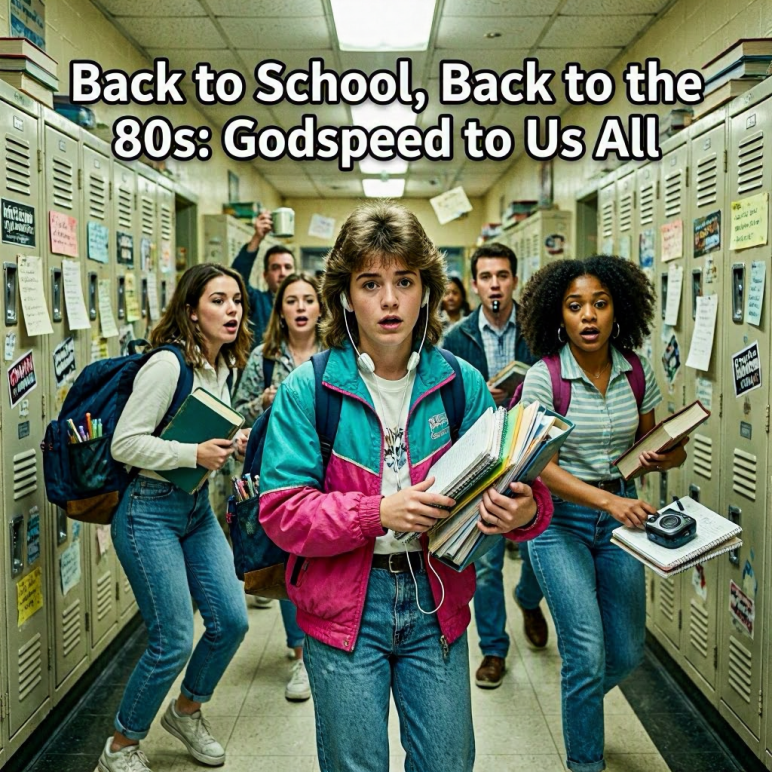
And because I’m me. My Gen X DNA refuses to let me suffer in silence. I’ve decided that this entire month, my blogs will be dedicated to reflecting on what it was like growing up as an 80s kid. A feral, sunburned, unsupervised, seatbelt‑optional, rotary‑phone‑wrangling Gen Xer. Because if I’m going to survive back‑to‑school season as a middle‑aged mom in Mississippi, I might as well laugh my way through it and drag y’all with me.
This month is when school begins here in the Deep South. My kids are not excited about their education. In fact, they told me that they would prefer to learn by traveling the world. So, I asked how they plan to make that happen financially? Their response was, “Well, we have everything lined up but the money.” I asked them, “What is the best part about school?” They replied, “Going home.” So, I asked, “What’s the worst thing about school?” Now, in my day, the answer was the food. Those lunch ladies served mystery meat that could’ve doubled as building material. But my kids? Their answer was: “Going to school.”
I told them, “Well, unfortunately, it’s a law.” They asked, “Why is it a law?” I said, “The government doesn’t want a bunch of dummies running around in our country.” To which my oldest replied, without missing a beat, “Why not? They’re running around in our government.”
And listen. Did I correct him? No. I smiled like a proud mama who just witnessed a spark of critical thinking ignite in the wild. I asked, “Do you just prefer to go through life uneducated?” He said, “Yes.” And honestly? I had to respect the consistency. I wasn’t fired up about education at that age either.
One thing my daddy did with me right before school started each year was take me and my sister out to dinner to discuss the upcoming school year. Which is something I also do with my boys. However, in this economy, we go to dinner together instead of separate meals. And really, they don’t care as long as they can eat to their heart’s content.
This month I’ve decided to reminisce on my days of growing up in school and at home in the greatest decade ever. Yes, I am a Gen Xer who grew up in the 80s. And yes, even my cats need clarification on how different life was back then. If you also grew up during that time, you will enjoy this month’s sometimes hilarious memories of mine to which you can probably relate. Also, my cannabis strains this month will reflect things from the 1980s. And please. If you have any additional memories, leave a comment on this blog.
Sit back as we get through the dog days of August with a trip that is sure to bring a smile to your face and laughter in your belly. And yes, I will also mention what it’s like now being middle‑aged. Because Lord knows that’s a whole saga by itself.
Buckle up, buttercup. School is back. August is here. And I’m about to drag you through the 1980s like a kid being pulled by the arm through Kmart. We survived metal playground slides hot enough to brand cattle. Water hoses that tasted like pennies. And parents who didn’t know where we were for 12 hours at a time.
If we lived through that, we can survive back‑to‑school season, middle age, and whatever fresh nonsense August tries to throw at us. Now excuse me while I go pack lunches. Sign forms. And pretend I’m not Googling “How many days until fall break.” Bell rung. Class dismissed. Thanks for reading! What is a memory you have of going to school in the 80s?
Affirmation: “I am a resilient Gen Xer. I survived the 80s. I can survive August. And I will not be defeated by school supply lists, teenage attitudes, or the Mississippi heat.”
“Some cats bury their poop. Some cats bury their feelings. And some cats bury nothing at all. And that’s why we sage the house.”
-This Puzzled Life
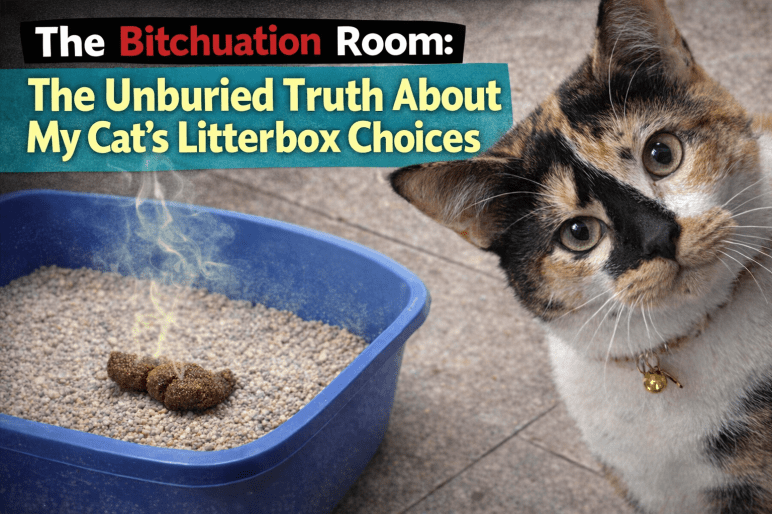
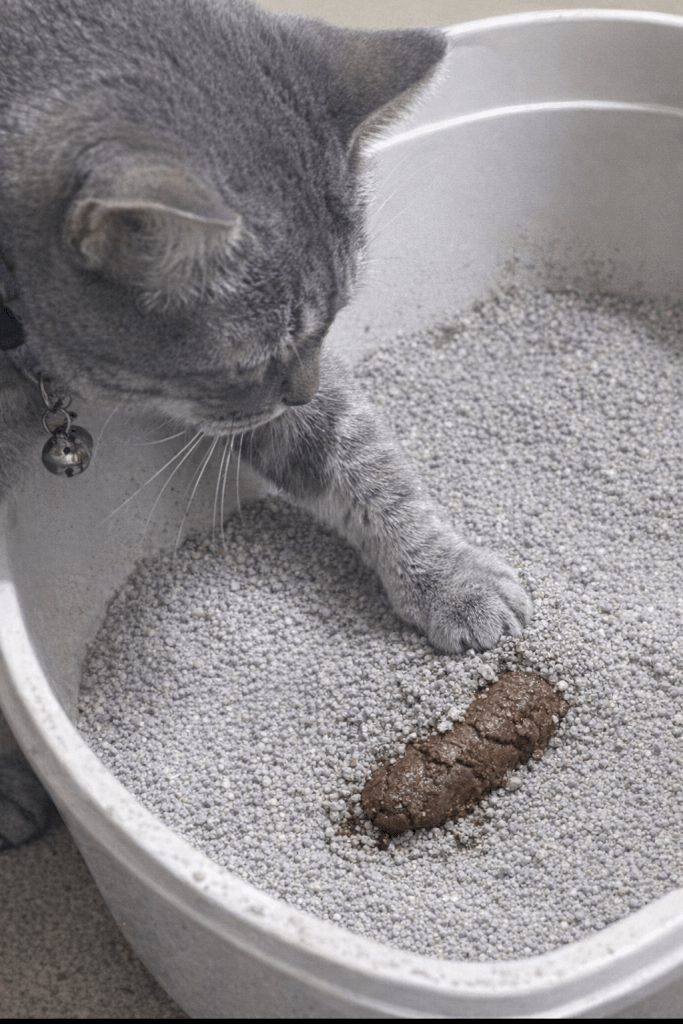
Light the charcoal. Sprinkle the sage. Today, we are not cleansing the house. We are not cleansing the ancestors. We are cleansing my spirit from the psychological warfare my own cat has waged against me by refusing to cover her poop in the litterbox. I’m convinced at this point she is missing a chromosome, a gene, a strand of DNA, or a spiritual download. She is missing something that tells normal cats, “Hey girl, bury that.” But not her. Oh no. She drops her little war crime in the sand like she’s signing the Declaration of Independence. Then she just walks away. Tail high. Proud. Unbothered. A menace.
And right on cue. Like the people-pleasing, co-dependent child of a Southern family who’s been trained since birth to “fix it before company sees.” Here comes Coco. Covering it. Cleaning it. Smoothing the sand like she’s prepping a grave at a mafia funeral. I swear I heard her sigh once. A deep, exhausted, “Lord give me strength” sigh. The sigh of a cat who has accepted her role as the emotional support janitor of this household.
Let’s break this down like a Discovery Channel documentary narrated by a woman who has simply had enough.
Exhibit A: The Offending Cat Named Tinkerbell
She walks into the litterbox like she’s clocking in for a shift she didn’t want. Poops. Stares into the void. Leaves. No attempt. No paw twitch. No sand shuffle. Just vibes and disrespect.
Exhibit B: The One Situation Only People-Pleasing, Co-dependent Cat Named Coco
She hears and smells the poop hit the air. Materializes from the shadows. Looks at me like, “I got it, Mama. She ain’t right.” Covers it with the urgency of a woman hiding evidence before the sheriff arrives.
EXHIBIT C: Piper-The Chaos Intern Who Thinks She Runs HR
Now listen. We cannot talk about litterbox dynamics in this household without acknowledging Piper, my chaotic, dramatic, emotionally unstable daughter who behaves like she’s the lead actress in a telenovela about feline suffering. Piper does not simply enter a room. She arrives. She makes an entrance like she’s descending a staircase at the Met Gala. Even if she’s just coming from the water bowl. And when it comes to the litterbox? Oh, she has notes.
Piper will stand at the edge of the box like a Victorian governess inspecting the servants’ work. She squints. She judges. She sighs dramatically, as if the weight of this family’s dysfunction rests solely on her tiny shoulders.
But she will yell about the smell. Yell about the mess. Yell about the other cats’ technique. Yell because she enjoys yelling. And yell because she believes the world is her stage and the litterbox is her spotlight. Piper is the kind of cat who would file an HR complaint about the litterbox conditions. She is the Beyoncé of unnecessary drama. She is the Shakespeare of overreaction. She is the Southern aunt who faints at the family reunion because someone used the wrong potato salad recipe. She will also supervise the people‑pleasing cat as she covers it. While offering commentary like, “You missed a spot, darling. Mama deserves better.” Piper is chaos. Piper is theater. Piper is the reason I sage the house twice a week.
Exhibit D: Me
I’m standing there like a disappointed Southern aunt at a church potluck whispering, “Now why would you do that in front of company.” At this point, I’m ready to submit Tinks DNA to 23 and Meow. Because something ain’t firing. Something ain’t connecting. Something in her ancestral lineage said, “We don’t bury things. We leave them out, so the world knows we were here.” Ma’am, this is not the Oregon Trail. You are not marking territory for rival mountain lions. You are a house cat with a heated blanket and a dental plan.
Tink: “I don’t feel called to cover my poop. It’s not aligned with my spirit.”
Coco: “Your spirit is funky.”
Tink: “Maybe the world needs to sit with my truth.”
Coco: “Your truth smells like sin.”
Piper: “Tink, you need remedial litterbox training.
Me: “All of y’all need Jesus and a job.”
Let’s be honest. Every Southern household has at least one family member who leaves chaos behind. And another who quietly cleans it up, so the neighbors don’t talk. My cats are simply reenacting generational trauma in the litterbox.
And let me tell you something before I go refill the sage bowl and pray for patience. I have made peace with the fact that one of my cats is simply not spiritually assigned to cover her poop. She is a free thinker. A disruptor. A pioneer in the field of “I don’t care what y’all do, I’m doing me.” She is the Rosa Parks of refusing to bury anything. She said, “My poop will not be moved,” and history will remember her.
But the real hero. The unsung, overworked, underappreciated backbone of this household is the “one situation only” people‑pleasing Coco who keeps covering it. Every. Single. Time. She is the Southern grandmother reincarnated. She is the fixer. The smoother. The one who whispers, “Lord, don’t let the neighbors see this mess.” While sweeping the sand like she’s preparing the church fellowship hall for revival.
And me? I’m just standing there watching generational patterns play out in clumps of Tidy Cats. And realizing that even in the animal kingdom, somebody always ends up cleaning up after the family member who “just ain’t right.”
So, here’s the truth. The revelation. The altar call. If my non‑covering cat ever decides to bury her poop, I will know the world is ending. I will know the veil has lifted. I will know the ancestors have intervened directly. Until then, I will continue to light the charcoal. Sprinkle the sage. And accept that some souls were put on this earth to leave their mess out in the open. And some souls were put here to cover it before company arrives.
If reincarnation is real, I hope my poop-not-covering cat comes back as a woman in a Southern family. Then she will finally understand what it feels like when someone else has to clean up your mess.
And that, my friends, is the litterbox prophecy. May it bless you and convict you. Litter scooped. Spirit cleansed. Thanks for reading! And Tink Cover Your Poop! Does anyone else experience this?
Affirmation: I release the burdens that are not mine to clean. Even when they smell like they might be.
“After today’s conversation, I’ve decided that if life ever assigns me a job involving the human backdoor, I will simply log out of the simulation and let my cats take over my identity.”
-This Puzzled Life
Light the charcoal. Sprinkle the sage. Today we’re cleansing not just the room, but the entire situation that led us here in the first place. The energy was so chaotic, even the ancestors peeked around the corner like, “Now who summoned this foolishness?” And the cats scattered like I’d announced surprise bath time. Which tells you everything you need to know about the spiritual turbulence we were dealing with.
While standing there in a cloud of sage and cannabis. And trying to convince myself that adulthood is not just paperwork, mystery smells, and emotional turbulence. I learned something that shook my spirit straight out of alignment. Somebody out there chooses to become a proctologist. Not “falls into it accidentally.” Not “lost a bet.” Not “was assigned by a vengeful guidance counselor.”
Let me tell you what set off this whole cleansing ritual. I learned that proctologists. The real, licensed, tax‑paying adults choose that career. A human being wakes up one morning, stretches, yawns, and says, “You know what? I want to spend the rest of my life abyss excavating the darkest corners of the human situation. They don’t get drafted. They don’t lose a bet. They don’t wake up in a Saw movie and have to pick between that and dentistry.
No. They look at the buffet of human professions and say, “Yes. The canyon. The cavern. The forbidden hallway. That’s my ministry.” And listen. I respect them. Somebody has to do it. But it will never be anyone in this house.
Coco climbed onto the laundry basket like she was about to deliver a royal decree.
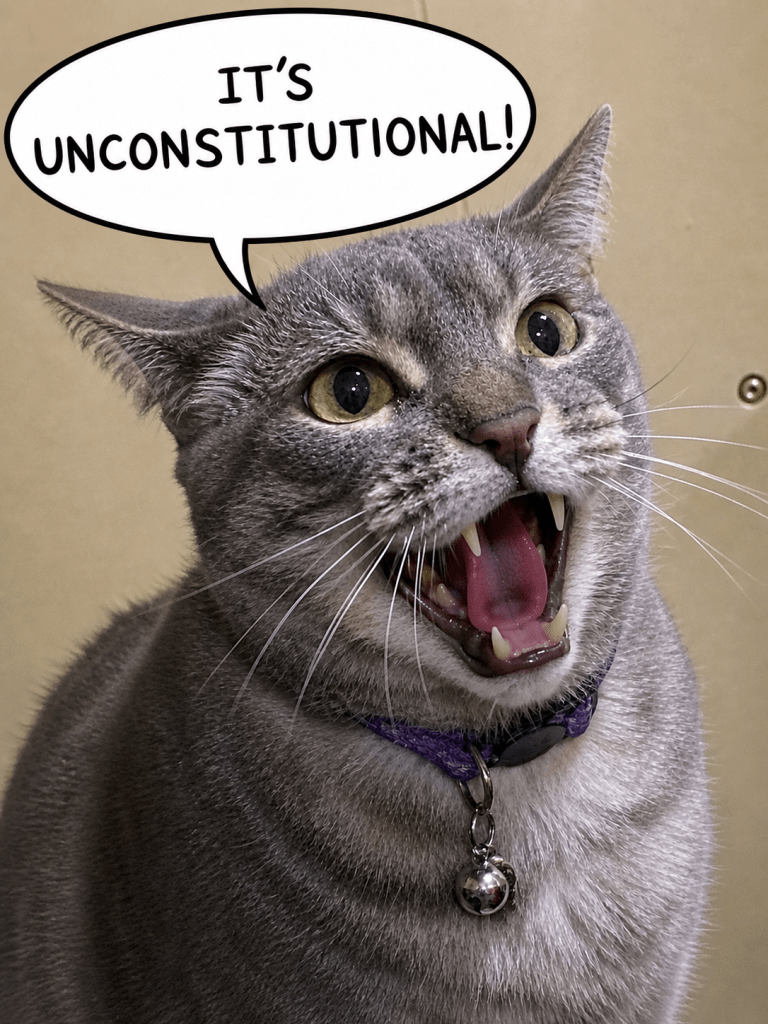
“Mother,” she began with the tone of someone who has never been wrong in her life. She said, “I do not even look at my own butt. Why would I volunteer to examine strangers? I am a queen. Not a Rear‑End Archaeologist.” Then she knocked over a cup to punctuate her point.
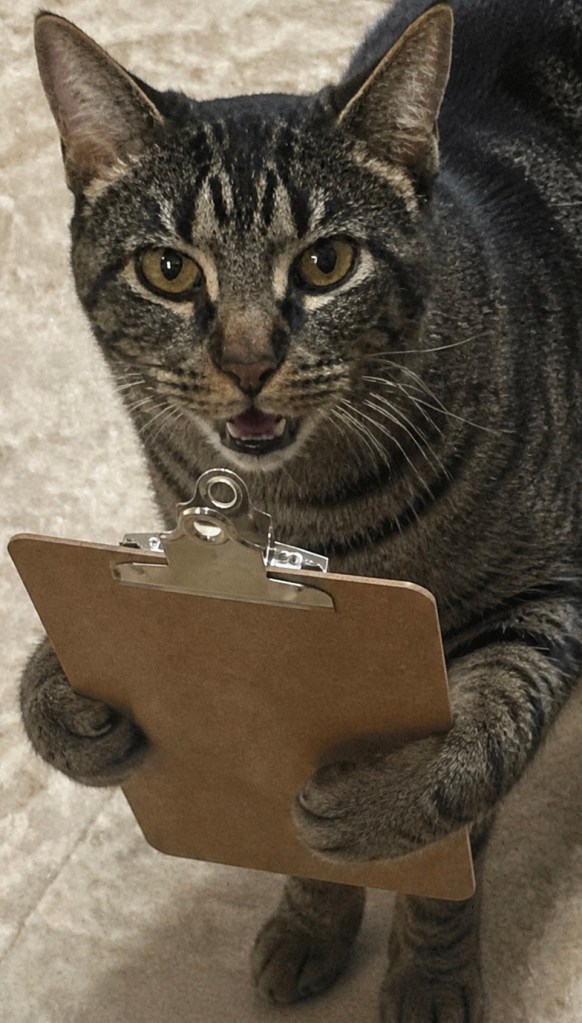
Piper pulled out her clipboard like she was conducting federal interviews.
She said, “Let’s review my qualifications. I’m good at surveillance, judgment, filing complaints, identifying your mistakes in real time. And documenting chaos for legal and spiritual purposes.
“Now,” she continued, “let’s review what I am not qualified for.” I am not qualified for tunnel exploration. Human cave mapping. Backdoor diagnostics. And anything requiring latex gloves. She looked at me over her glasses (that she does not own) and added, “And neither are you.”
Tinkerbell arrived late, loud, and ready to deliver a keynote address.
And while pacing like a tiny insurance adjuster preparing to deny a claim she said, “Every household needs boundaries. And the boundary we are establishing today is simple. No one here is going into the human abyss professionally.” She then knocked a plant off the counter. I assume that was her way of cleansing the space.
Let’s be honest. We are a household of snacks, chaos, and questionable decisions. We are not a household of brave medical back‑alley expeditioners. And we are barely a household of people who can schedule our own appointments. If someone said, “Dana, your community needs you to become a proctologist.” I would simply pack a bag and move into the woods. The cats would follow while carrying clipboards, snacks, and a list of reasons why this was the correct choice.
Coco had declared the entire topic unconstitutional. Piper had drafted a 47‑page complaint titled “Absolutely Not: A Household Manifesto.” And Tinkerbell was in the corner performing a spiritual audit to determine which one of us invited this energy into the home. And honestly? She’s right to ask.
We are a household of snacks, naps, chaos, and questionable decision‑making. But we are not a household of brave medical cave divers. We can barely handle a vet appointments without forming a support group. And the very idea of any of us voluntarily entering the human abyss? Coco said, “she’d rather get a job.” Piper said, “she’d rather work retail.” And Tinkerbell said, “she’d rather reincarnate.”
We salute the proctologists of the world. We honor them. We appreciate their courage, training, and their commitment to the human cause. We thank you for your service. But in this house? Absolutely not. Not today. Not tomorrow. And not in any timeline where Coco is in charge of HR.
We will be over here lighting sage. Minding our business. And staying far, far away from the canyon of no return. By the end of this whole ordeal, it became painfully clear that me and these three furry unionized coworkers of mine are now going to have to schedule another therapy session. An emergency one, at that.
Coco needs to process the emotional violence of even hearing the word “proctologist.” Piper has to unpack the secondary trauma of documenting the conversation. And Tinkerbell? She’s already drafting a statement for the therapist titled “Boundaries, Backdoors, and Why My Household Must Never Speak of This Again.” Our poor therapist has her monumental work cut out for her.
And honestly, I’ll be right there on the couch with them. I’ll be clutching my emotional support iced coffee while explaining to our brave, patient and compassionate therapist how a simple morning spiraled into a full‑blown spiritual evacuation drill. We are not called to that ministry. And we will be processing the thought of it for weeks. And that, my friends, is where I set the mic gently on the floor. Walked away. And let the ancestors close the door behind me. Thanks for reading! And do what makes you happy.
Affirmation: I am divinely protected from careers, conversations, and chaos that are not meant for me. My household walks in clarity, boundaries, and the sacred right to say, ‘Absolutely not.’
“I didn’t just fart at Dollar Tree. I spiritually pressure‑washed aisle three. And my son treated it like the Super Bowl halftime show.”
–This Puzzled Life
Light the charcoal. Sprinkle the sage. Negative energy go away. Lord knows what happened in Dollar Tree today was not of this realm. The air shifted. The ancestors paused. And even the off‑brand greeting cards seemed to lean back like, “Now hold on, what was that?” I swear the whole store took one collective inhale. And my spirit briefly left my body to file a complaint with the universe.
I walked into that store with dignity, purpose, and a buggy that already had one wheel screaming for help. I was just trying to buy some cheap sponges and mind my business. But the universe said, “No ma’am, today you will be humbled.” And my son? My own child stood beside me ready to witness my downfall like he bought front‑row tickets. What happened next could only be described as a biological betrayal wrapped in a spiritual lesson wrapped in a $1.25 price tag.
In the Deep South, conservative Christians act like they’re the self‑appointed referees of Southern Decency. And they’re ready to blow a whistle the second somebody steps outside the invisible rulebook of “proper behavior.” These are the same folks who will gasp so hard they inhale their own dentures if a woman accidentally lets one slip in Dollar Tree. Yet they’ll turn right around and scream at a Little League umpire like they’re auditioning for a demon‑possession documentary. They’ll tell you to “act right,” “sit pretty,” and “hold it in.” As if the Lord Himself is grading your internal plumbing.
Meanwhile, I’m over here trying to survive humidity, motherhood, and Dollar Tree air pressure. And my son is announcing my bodily failures like he’s the town crier. And southern properness never stood a chance.
Let me set the scene. It’s a peaceful Saturday at Dollar Tree. The kind of day where the fluorescent lights hum like they’re praying for release. And every shelf leans just a little to the left. I’m minding my business. Pushing my buggy with the wobbling wheel. And trying to decide if I need another pack of off‑brand sponges that dissolve on contact with water. My son is beside me, living his best life. He’s touching everything he shouldn’t. Narrating loudly like he’s the Dollar Tree David Attenborough.
And then, my stomach shifts. Not a warning shift. Not a polite “hey girl, maybe walk slower” shift. No. This was the tectonic‑plate‑sliding, earth‑core‑rumbling shift of a woman who had coffee, anxiety, and a questionable breakfast. I try to hold it. I really do. But the Dollar Tree air pressure said absolutely not. And out it came. A fart so sharp, so sudden, so disrespectful to the floor that even the wind chimes in aisle seven stopped vibrating.
I froze. My soul left my body. I saw my ancestors shaking their heads. But my son? My child? My flesh and blood? The one I fed, raised, and protected? This boy collapsed. Not physically but emotionally. He folded like a Dollar Tree lawn chair. He screamed laughing. Not giggled. Not chuckled. Screamed. Like he was being tickled by the Holy Spirit of Comedy. “Oh my god, mom farted! Mom blew up the store!” He is pointing. He is wheezing. He is reenacting the sound like a sound‑effects intern on a cartoon.
Meanwhile, I’m standing there like a scandalized Victorian who just watched someone fry chicken in margarine. Serve instant mashed potatoes at Sunday dinner. And then announce they ‘don’t really like biscuits’ in front of the whole congregation. While also praying the security cameras don’t have audio.
And does he protect me? Does he shield his mother, the woman who helped give him life? Absolutely not. This boy is auditioning for a Netflix comedy special in aisle three. A woman two aisles over peeks around the corner like she’s checking for storm damage. A toddler starts crying. A pack of balloons rustles like they’re trying to escape.
My beloved child is now telling strangers, “It shook the shelves! I think she made the plastic storage bins vibrate!” I’m trying to walk away with dignity. But you can’t walk away with dignity when your own kid is narrating your fart like it’s breaking news.
By the time we get to the checkout, he’s still giggling, breathless, and still wiping tears. The cashier looks at me like she knows. She knows. I swipe my card in silence while praying the Lord will swallow me whole. Or at least cut the power so the cameras reset. We leave the store. My son looks at me with pure joy and betrayal in his eyes and says, “That was the best day of my life!” And honestly? I can’t even be mad.
If motherhood has taught me anything, it’s this. Your kids will not protect your dignity. They will not guard your secrets. They will not cover your shame. But they WILL laugh until they almost pass out. And somehow, that’s love. Lord, restore my dignity.
After today, I’m convinced Dollar Tree needs to sage me out of the building. My son is still laughing like he just watched a stand‑up special written by the Holy Ghost. The cashier is probably telling her coworkers about “the woman who shook aisle three.” And I’m at home trying to process how a single fart turned into a family‑wide comedy event with zero protection from the child. But that’s motherhood in the Deep South. Your kids won’t shield your reputation. But they’ll sure holler it across the store like they’re calling hogs. And honestly? If laughter adds years to your life, my son will live to be 147. Thanks for reading! Keep laughing.
Affirmation: I release shame like I released that Dollar Tree thunder, and I stand tall knowing laughter is my legacy.
“I’m not saying my life is chaotic, but even my cats hold emergency staff meetings before waking me up.”
-This Puzzled Life
Light the charcoal. Sprinkle the sage. America just turned 250 years old. And the ancestors, the cats, and the queer community all have something to say.Welcome to the backyard celebration where the grill is smoking. The humidity is judging us. And my cats have formed a bipartisan committee to review the last two and a half centuries of American behavior.Spoiler: the report reads like a Yelp review written by someone who did not enjoy their meal.
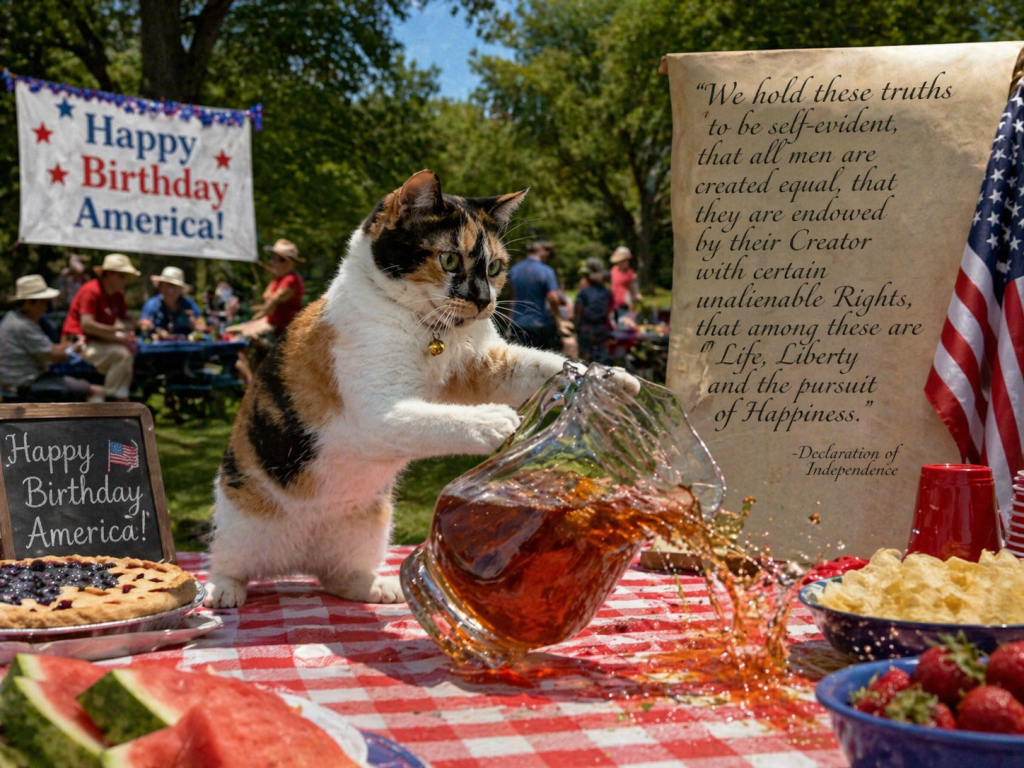
Tink, the union rep, conspiracy theorist, and the only cat who can quote the Declaration of Independence while knocking over a pitcher of sweet tea. She is pacing the yard like a Southern aunt who just found out someone brought store‑bought potato salad to the reunion.
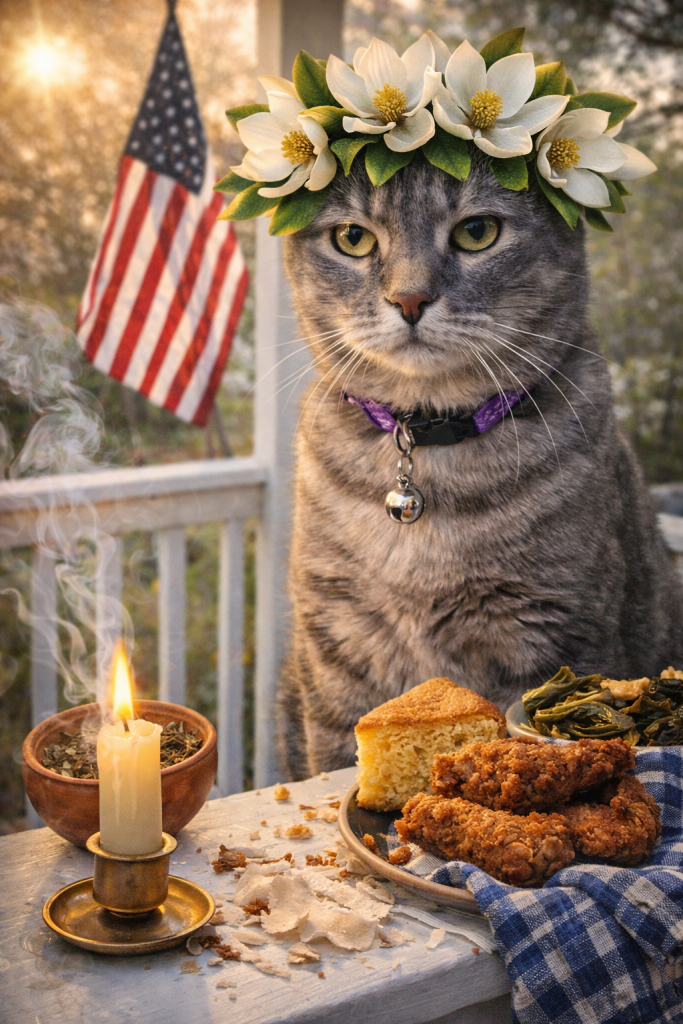
Coco, the Sunbeam High Priestess, is perched on the porch rail wearing a magnolia crown. With a look that says she’s about to bless the food. Curse the government. And call on the ancestors in one breath.
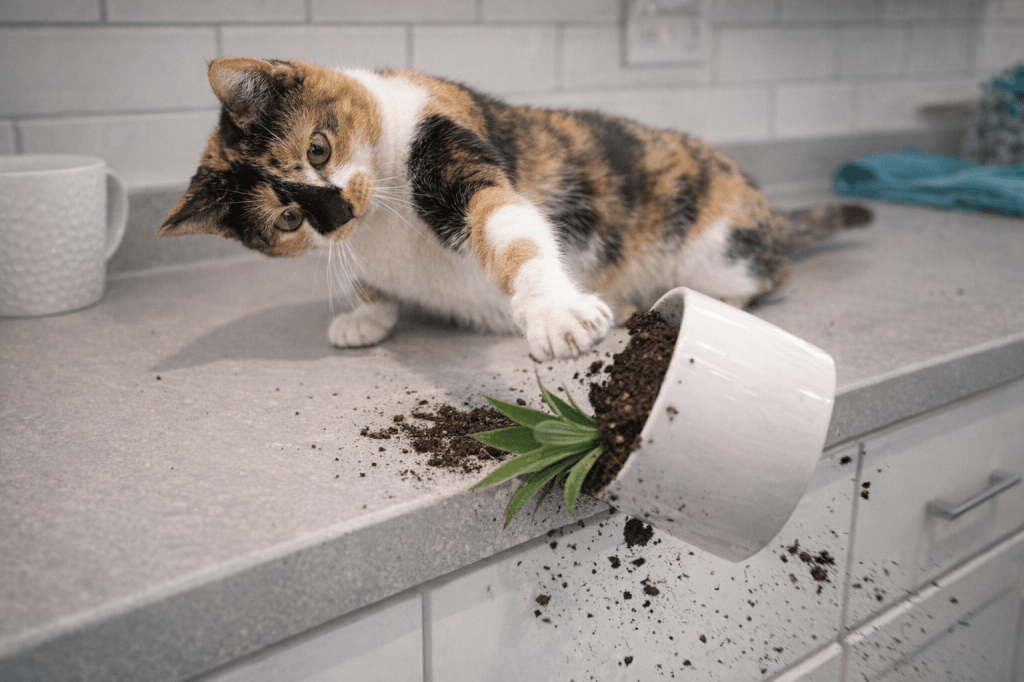
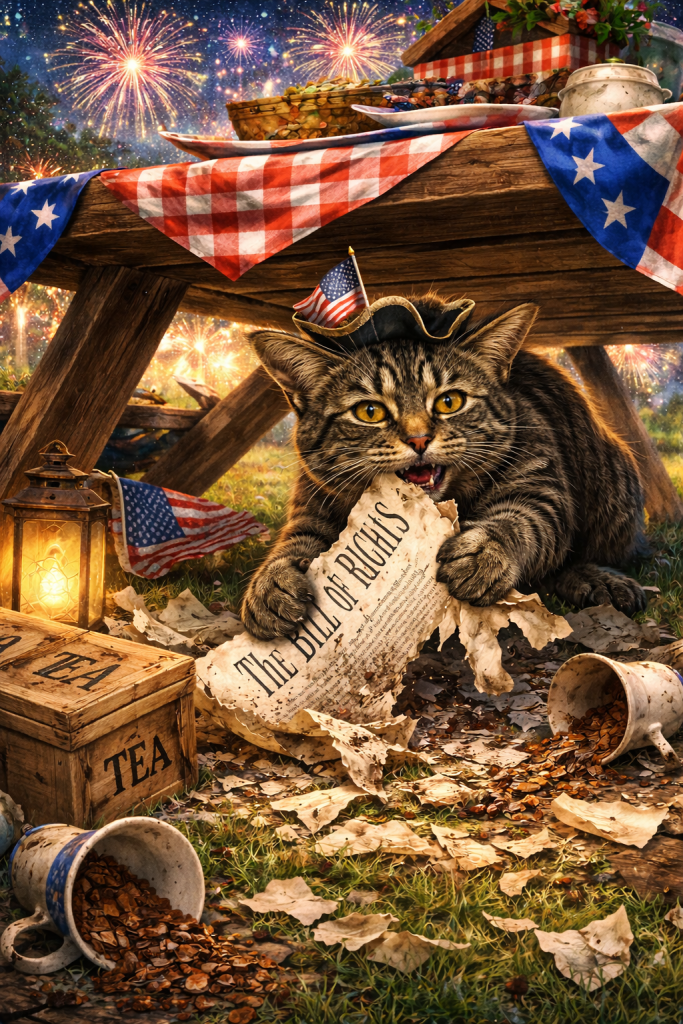
Piper, the chaotic gremlin and Security Briefing Officer, is under the picnic table shredding a copy of the Bill of Rights. And it’s like she’s reenacting the Boston Tea Party. But with more attitude and fewer boats.
And me? I’m standing here with a spatula, a prayer, and the kind of patience only a Southern woman with humidity pressing on her soul can muster.
Let’s start with the part America keeps trying to whisper like it’s gossip instead of history. This land belonged to Native peoples. Sovereign nations. Ancient cultures. Communities with governments, languages, and spiritual traditions older than anything Europe could dream up. And from the moment colonizers arrived, Native people were met with violence, displacement, broken treaties, and centuries of injustice that still echo today.
Piper has already drafted a resolution titled, “Acknowledge the original landlords, sugar.”
Tink is lighting a candle for every Native ancestor whose story was erased.
Coco is chewing on a map as symbolism.
The Declaration vs. Today: A Southern Birthday Roast
1. “All men are created equal.”
Back then: a bold statement. Today: treated like the fine print on a Dollar General receipt.
And let’s be honest. It did include Black people, Native people, women, or queer folks. We’ve been fighting ever since to make those words true.
2. “Life, Liberty, and the Pursuit of Happiness.”
Originally: a promise. Now: feels like trying to get a refund at Walmart without a receipt.
Tink is offended on behalf of the ancestors.
3. “No taxation without representation.”
Today: Representation that sometimes forgets who it’s supposed to represent.
Coco is chewing on a campaign flyer as symbolism and possibly a snack.
4. The Bill of Rights
A beautiful list of protections America treats like a potluck. Take what you want. Ignore the vegetables. And pretend the casserole section doesn’t exist.
Piper is muttering, “If they’d just read the whole thing, we wouldn’t be in this mess.”
America didn’t magically improve. It was dragged lovingly, loudly, and sometimes kicking by people who refused to sit down or shut up.
I’m talking about people like:
Harriet Tubman, who freed herself and then went back repeatedly to free others.
Frederick Douglass, who told America the truth with more clarity than any Founder.
Rosa Parks, who sat down so the nation would stand up.
Dr. Martin Luther King Jr., who turned civil disobedience into a moral mirror.
John Lewis, who taught us about “good trouble.”
Fannie Lou Hamer, Mississippi’s own, who said she was, “sick and tired of being sick and tired” and meant it.
Native activists, from the American Indian Movement to modern water protectors, who have fought for sovereignty and dignity for generations.
Tink has declared them the true Founders of America’s second draft.
And because America’s story isn’t complete without the queer community. Especially the ones who risked everything so future generations could breathe freely.
Our leaders were:
Marsha P. Johnson, who threw the first brick of truth.
Sylvia Rivera, who demanded that trans people not be erased from the movement they helped build.
Bayard Rustin, the strategist behind the March on Washington, whose brilliance shaped the Civil Rights Movement even as he faced discrimination for being gay.
Audre Lorde, who taught us that silence never saved anyone.
Harvey Milk, who insisted that visibility is power.
These leaders didn’t just fight for rights. They fought for the right to exist.
Piper has added them to the “Heroes Who Did America’s Homework For Her” list.
And while we’re being honest. America isn’t white. America is black brilliance. Native resilience. Brown creativity. Asian innovation. Pacific Islander strength. Middle Eastern wisdom. Multiracial beauty. Queer joy. Immigrant courage. And every shade, accent, and story in between. Color is what makes this country beautiful. Color is what makes this country possible.
Tink has declared this the official theme of the 250th, “Patriotism, but make it multicultural.”
Coco has declared the theme, “Snacks and diversity.”
Piper has declared the theme, “America is a gumbo, not a mayonnaise sandwich.”
Happy 250th, America!You’re messy. You’re dramatic. You’re full of contradictions, potential, and fireworks that definitely violate at least three county ordinances.But you’re ours. And we’re going to keep fighting, laughing, voting, boundary‑setting, and sage‑burning until you live up to the promises you made on Day One.
Because the Declaration wasn’t a suggestion. The Bill of Rights wasn’t a Pinterest board. And democracy isn’t a spectator sport. It’s a potluck where everybody better bring something besides complaints. May America’s next 250 years be less “Hold my beer” and more “Hold my principles.” And if not, don’t worry. My cats already drafted a backup government using crayons, glitter, and pure Southern audacity. Thanks for reading! And let freedom ring.
Affirmation: I am a whole miracle with seasoning. Not everyone can handle the flavor. And that’s their burden to carry, bless their heart.”
“When the world starts smelling like political mildew, light the charcoal. Call your ancestors. And let the queer folk lead the way back to sanity.”
-This Puzzled Life
Light the charcoal. Sprinkle the sage. The energy in this house, and frankly, in this entire country, has gotten so funky that even my cats are refusing to walk through certain rooms without spiritual PPE.
I woke up this morning with my hair looking like a disgruntled possum. Before I could even sip my coffee, the cats were holding a household meeting about “the state of the union.” Which is always a bad sign. Coco had a clipboard. Tink was already in the hallway wearing her imaginary reading glasses. Which were radiating the kind of disappointment usually reserved for people who microwave fish at work. Piper also whispered, “Ma’am, the political nonsense has reached critical levels. We need a blog post before Tink files a grievance.” She was chewing on the corner of a cardboard box like she was absorbing strength for the battle ahead. And she was also eating the minutes.
And here we are. I’m half awake. Half-caffeinated. Fully irritated. And spiritually powered by coffee and queer rage and fully done with the world. The cats, unionized and dramatic. The political landscape is acting like it needs to be put in time‑out with no tablet. And I’m ready to unpack the latest political nonsense like it’s a Walmart bag full of mystery items you forgot you bought.
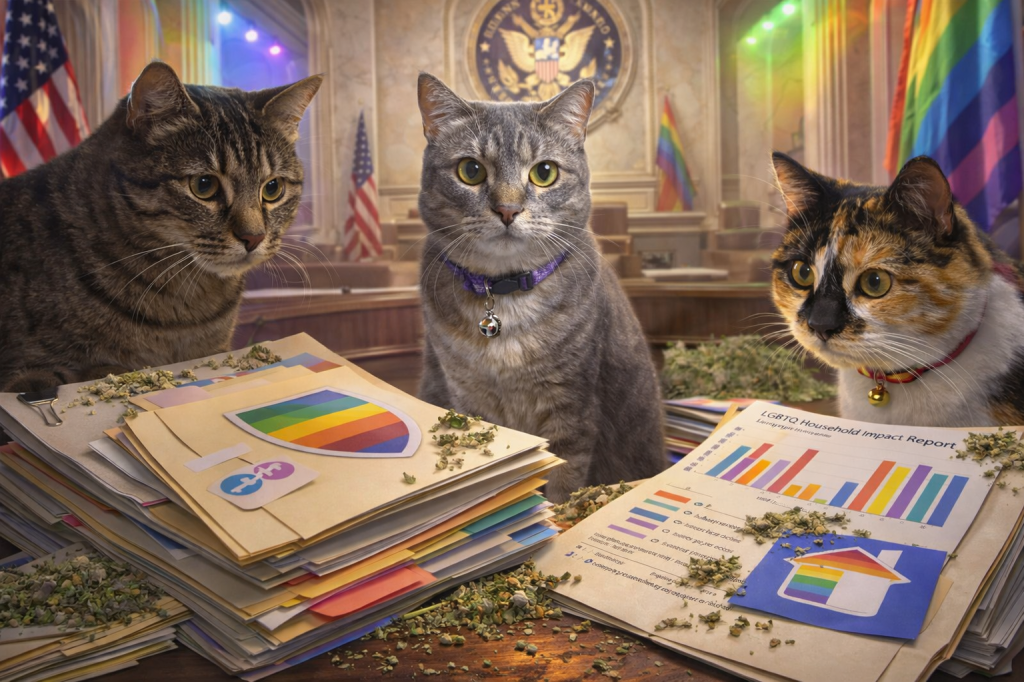
Let’s begin. The cats have taken their positions. Tink is pacing like a union rep preparing for a strike. Coco is perched in a sunbeam like a disappointed CEO. And Piper is licking an outlet for emotional support.
Filed by Piper (Gremlin-at-Large), Tink (Union Rep), and Coco (CEO of Sunbeams)
Ladies, gentlemen, gays, theys, strays, and anyone who has ever been personally victimized by a legislative session. welcome. I, Tinkerbell, your local union rep and part‑time conspiracy theorist, have called this emergency press briefing because the humans are stressed. The news is chaotic. And the federal government has once again discovered a new way to make LGBTQ folks’ lives harder. And when the humans are stressed. We are stressed. And when we are stressed. Someone’s shower curtain is getting shredded. That’s democracy, baby.
Coco here. CEO. Visionary. Keeper of Warm Spots. I run this house. And I run it with dignity. That’s something certain political leaders could try sometime. Let’s talk about these changes that have been rolling out like a bad reboot of a show nobody asked for.
1. Policies targeting transgender people
Tink’s summary: “Why are they obsessed with people’s gender? They can’t even manage their own hair.”
From restrictions on gender‑affirming care to attempts to limit trans people’s rights in public life. The changes have been hitting the trans community hard. Tink’s official stance: “If someone tried to regulate my litter box access, I would simply bite them.”
2. Attempts to roll back protections for LGBTQ workers and students
Piper interrupts, “We in the Feline Union stand firmly against workplace discrimination. Especially discrimination that interrupts nap time.”
Some policy shifts have weakened protections for LGBTQ employees and students. And this is making it harder for queer folks to feel safe at work or school. Piper’s stance is, “If anyone tried to discriminate against me, I would scream at 3 a.m. Until they reconsidered their life choices.”
3. Changes affecting LGBTQ families and adoption rights
Coco says, “Imagine telling someone they can’t adopt because of who they love. Meanwhile, I’ve seen humans who can’t even keep a houseplant alive.”
Some policy changes have made it harder for LGBTQ couples to adopt or foster children. Coco: “We support all families. Especially the ones who provide snacks.”
4. The demonization of the LGBTQ community. Especially trans folks
Piper: “Oh, the irony. The same people clutching pearls about ‘protecting children’ are the ones passing laws that harm them.”
Some political messaging has painted LGBTQ people, especially transgender people, as threats or problems. Tink: “If anyone is a threat, it’s Coco when she hasn’t had her 2 p.m. zoomies.”
Piper here. I’m the emotional support gremlin. I don’t understand politics. But I do understand vibes. And the vibes are rancid. Let me tell you what I’ve observed. The humans are tired. The queer humans are extra tired. And the trans humans are tired, angry, and carrying the entire moral backbone of the country on their shoulders. And the cats? We’re eating plastic. And knocking things off counters in solidarity.
Coco’s official statement: “Stop targeting LGBTQ people. They’re fabulous. Also, give me treats.”
Tink (adjusting tiny glasses): “We stand with the LGBTQ community. We stand with trans folks. We stand with queer families. We stand with drag queens, bisexuals, nonbinary babes, leather daddies, sapphic aunties, and anyone who has ever had to explain their pronouns to a man who thinks Wi-Fi is witchcraft.”
Coco (basking in a sunbeam): “We reject policies that harm queer people. We reject discrimination. We reject cruelty. We reject anything that interrupts my naps.”
Piper (chewing a cardboard box): “We reject bigotry. And also, gravity.”
And that, my friends, concludes today’s episode of “Why Are Humans Like This?” starring a government that needs therapy. A household that runs on chaos. And three cats who have officially drafted a cease‑and‑desist letter addressed to bigotry itself.
Coco has stamped it with her paw. Tink has notarized it with a dramatic sigh. Piper tried to eat it, which counts as approval. Coco has filed the paperwork. Tink has approved it with a single judgmental blink. Piper tried to eat the evidence, which honestly feels symbolic.
Coco: “If the government wants to keep messing with LGBTQ rights, they should know this household is ready. We have claws. We have opinions. We have a gremlin.”
Tink: “And we have a human who writes like a Southern Shakespeare with boundary issues.”
Piper: “So consider this your warning. Stop targeting queer people. Or we will knock over everything you love.”
Let me say this with the clarity of a Southern auntie who has had enough. And also, loud enough for the ancestors, the neighbors, and the lawmakers who pretend not to hear. Queer people aren’t the problem. Cruelty is. And this household does not negotiate with nonsense. Queer folks deserve safety. Trans folks deserve dignity. And bigotry deserves to be escorted out like it just caused a scene at Applebee’s.
This household stands with the LGBTQ community. We have claws out. The sage lit. The charcoal glowing. And Piper ready to scream at anyone who needs a reminder. The cats strut away like they just won the Miss America pageant. They exit the room in slow motion. With tails high. And theme music swelling. Thanks for reading! Happy Pride!
Affirmation: My spirit is steady. My boundaries are blessed. And my queer joy is non‑negotiable. No law, no headline, and no nonsense can dim the light I carry. Or the claws backing me up.