

What Are Your Family Dynamics? 

“In every conceivable manner, the family is a link to our past, bridge to our future.”

-Alex Haley

 Light the charcoal. Sprinkle the sage. Negative energy go away. Today, I want to talk about something personal, our families. I know. It makes my skin crawl as well. Part of the “icky” feeling we get when we discuss our families is because we know, in some unique way, we have a dysfunctional family. And we are also taught, especially in the south, to keep family business within the family. This includes race, gender and sexuality. And if it’s not what the family allows, sometimes for generations, it’s all to be kept secret. But what does that accomplish?

Let us first look at what family dynamics are. They are composed of behavioral and relational patterns that determine how members interact with each other and in society. And these patterns are passed down through generations. Family dynamics can be healthy or unhealthy. And they also largely influence someone’s self-perception, relationships and well-being (mywellbreing.com, 2025).
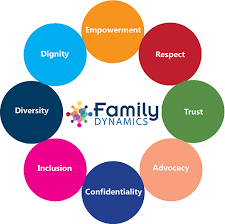
Three examples of family dynamics are Healthy, Dysfunctional and Toxic.

Healthy Family Dynamics: This is where there is open communication, mutual respect, clear boundaries, honesty about feelings healthy and supportive environment for growth . And I would venture to say that most families don’t fit into this category.

Dysfunctional Family Dynamics: This involves poor communication, lack of boundaries, unhealthy behaviors, and emotional neglect (psychologytoday.com, 2025). This is where my family seems to fit like a glove.

Toxic Family Dynamics: This includes controlling behaviors, abuse, neglect or addiction and can significantly harm the well-being of family members (therapygroupdc.com, 2024). And sadly, my family fits in nicely with some of this category also.

 I will go much more in-depth in this blog series about family dynamics. My own family doesn’t even come close to fitting into “healthy” family dynamics. Also, over generations the behaviors passed down will change in some way. Families think that “their” way is the only way. And overtime that has been the accepted way of thinking. But does that foster growth? Growth will never be fostered in family relationships if those types of criteria are not met. And having “perceived” healthy relationships among three out of four members of a family is NOT “Healthy Family Dynamics.”

I don’t know what is so difficult for people to understand about this. But when “dysfunction” is accepted as the new “healthy” it is only a matter of time before the breakdown in the family unit begins to happen. And this being allowed to go on for years, can create bitterness, resentment, fear, loss and chaos. Even at this point, families like my own, refuse to acknowledge the hurtful tactics used as a way of functioning and breed only toxicity. This will eventually breakdown the family until there is nothing that can be repaired.

Stay tuned as I dive even deeper into family dynamics and how we function. As always, take what you can use and leave the rest. Stay safe. Keep Smiling. And Keep Moving Forward!

Affirmation: I am worthy of love and respect, even when faced with difficult family dynamics.

***Don’t forget to watch the video!***

#Thispuzzledlife

What Is Narcissism? Part 2

“The Narcissist wants the authority of a king while having the accountability of a toddler.”

-Haryo Aswicahyono

My ex-husband and his brother are both very narcissistic in the way that they manage everything. They are not men. They are boys with very fragile egos that were destroyed by their father. Nothing they ever did was good enough for him. And his explosive anger was the way that he maintained control.

Their was also raised by narcissistic uncles that taught him the only way to raise kids is to beat them into submission. That is also how his grown children operate. If they don’t get what they want, they abuse their victim until submission is achieved. And my ex-husband was that way in every area of his life. Because physically they’re both just broken-down old men who use threats and intimidation. Because they would get beaten physically in a fight. 

Where was their mother? Well, she was an uneducated homemaker for many years. And where was she to go or to do? Her circumstances didn’t allow her to take three children and leave. The services were just not available then. But what it caused was continuous trauma to others. If someone doesn’t put a stop to it then the abuse continues to multiply like cancer until it becomes the norm. Then, they become accustomed to what is now their normal life and anyone who challenges that must pay in whatever way they see fit. 

I finally got enough and left. But his brother’s wife continues to take emotional abuse. I went into my next relationship and the mark of his abuse also crept in. I decided that I was where the effects of his abuse would cease to continue. And it’s been an arduous process the last twenty or so years in therapy. The way I got though life was so distorted once I was able to step back and realize all the damage that he caused. The most difficult part of living through it is that the PTSD that I sustained from his emotional, financial, sexual and religious abuse continues to affect me today. And sometimes the simplest of things are monumental. 

I’m one person who has been through this. And there are millions more people, both men, women and children who are subjected to a malignant narcissist like I was. Will everyone get help that can be so beneficial? Absolutely not. And then the cycle will continue for another generation that are busy building more narcissists. 

Oh, the kids can grow up to be successful in spite of the narcissism. Just look at our president. He oozes with narcissism, and he has a cult of followers who don’t see it either. It is all about his personal gain that is disguised as “Making America Great Again.” Those of us who have been abused by a narcissist can identify the “gas lighting” and “manipulation” a hundred miles away. Because some of the same statements and attitudes came out of my ex-husband’s mouth. 

Narcissists rarely get help because they never see fault in themselves. They are great at dishing it out. But they absolutely cannot handle it being done to them. He very much wanted to be seen as some kind of a “big boy.” However, he had the emotional maturity of a toaster. My sons are already better men at 10 and 13 years old than he is at 68 years old.

So, I ask you, “How do I support someone like that? I’ve already been through its multiple times in my life. And if you really want to find out the total damage that has been caused to me by way of the narcissists in my life, I’ll let you talk to my therapist who continues to see me struggle years later.”  Thanks for reading! Stay educated. Stay safe. And keep smiling!

Affirmation: I resolve to walk away from situations where someone lies, refusing to engage with truth benders or gas lighters.

***Don’t forget to watch the video!***

#Thispuzzledlife

What Is Narcissism?

“Narcissism is a cover for a very weak self-image.”

-Dian Grier, LCSW

 Light the charcoal. Sprinkle the sage. Negative energy go away. Today, I want to talk about narcissism. This doesn’t just occur in world leaders. This occurs within our family members and those we meet along the way. And narcissist abuse will leave a mark on all of its unsuspecting victims.

Before I go any further, I want to tell you about the specifics of Narcissistic Personality Disorder as a diagnosis. Let me see if I can describe these types of individuals, so that you will have a better understanding about what to look for. One thing to note about a narcissist is that they enjoy criticizing others for any little thing. However, if you begin to criticize anything about them, they will quickly lash out with discontent.

First, we must understand the difference between “personality” and “personality disorder.” Someone’s personality is influenced by experiences, environmental and hereditary. A healthy personality allows someone to cope with the normal stresses of life while developing and maintaining satisfying relationships. However, when long term patterns of thinking and behavioral responses are rigid, inflexible, and cause stress and impairment in functioning, the personality is considered “disordered.” To be classified as a disorder the person’s way of thinking, feeling and behaving deviates from the expectations of the culture while also causes distress or problems functioning and lasts over time. The behavior typically begins in late adolescence into early adulthood (psychiatry.org, 2024).

 The criteria for a diagnosis of Narcissistic Personality Disorder in the Diagnostic and Statistical Manual of Mental Disorders (DSM-5-TR) defines the disorder as “a pervasive pattern of grandiosity, need for admiration, and lack of empathy.” Beginning by early adulthood and present in a variety of contexts. To meet criteria for a diagnosis there must be at least five of the nine criteria. Having a grandiose sense of self-importance, such as exaggerating achievements and talents, expecting to be recognized as superior even without commensurate achievements.

They believe that they are “entitled” to special privileges and have unrealistic expectations for  special treatment.

 Demanding excessive admiration

·         They crave excessive attention from others. And they seek validation and applause for their perceived achievements and abilities.

Sense of entitlement

Exploitation behaviors

  They take advantage of others to achieve their own goals. And they lack concern for the harm they cause doing it.

Lack of empathy

They struggle to understand the feelings and needs of others while also dismissing or minimizing their experiences.

Envy towards others or belief that others are envious of them.

They want to see others envious of them.

Inability to handle criticism.

Preoccupation with fantasies of success, power, beauty, and idealization.

Belief in being “special” and that they can only be understood by or associated with other  high-status people (or institutions).

 They struggle to accept criticism or feedback and become defensive and angry when confronted.

Fragile Self-Esteem

Despite their appearance of how they exude  confidence, they really have a very fragile sense of self-worth and are overly sensitive to criticisms.

Arrogant behaviors and attitudes(StatPearls Publishing, 2025 January).

Childhood trauma is one of the most common types of traumas that can contribute to the development of narcissism. And it can include things such as physical, emotional and sexual abuse, neglect and abandonment. When a child is subjected to things like this, the mind has to find a “work around” for dealing with the emotions. Some children deal with these seemingly “threatening” feelings and emotions by developing a sense of entitlement, a need for control, and a lack of empathy towards others.

This is exactly who my ex-husband is. Trying to form a close emotional bond with him was like trying to hug an iceberg. There was just nothing ever there. He got mad and pretended to empathize with others. The fact of the matter is that he considered him “the best” at everything. And he made a point to criticize everyone he had contact with once they left. He and his brother were at the mercy of his father’s physical and emotional abuse that was a direct result of his own narcissism. I’ve known and been around them all and I can tell you that it’s like being around the “Narcissism Entourage.”  

I will post part 2 in the next few days. Keep reading. Keep Smiling. And always remember, “Tomorrow is another day to begin again.”

Affirmation: I am embracing my journey towards healing and growth.

***Don’t forget to watch the video!***

#Thispuzzledlife