This Puzzled Life is a mental health and recovery blog exploring addiction, trauma healing, LGBTQ experiences, humor, and the strange moments that shape us.
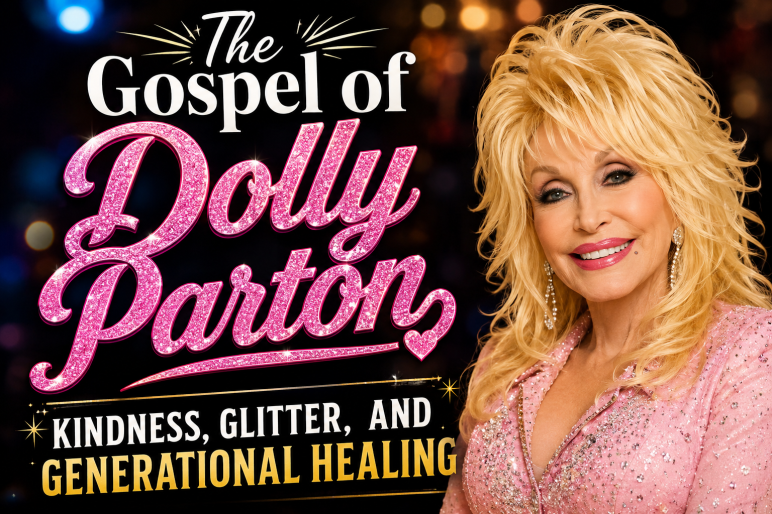
Light the charcoal. Pull up a chair. And let’s call the ancestors. Today, we’re about to talk about a woman whose legacy smells like warm biscuits, rhinestones, and generational healing. Dolly Parton wasn’t just a country singer. She was a walking love letter to humanity. A Southern phoenix who rose from the Smoky Mountains with a voice full of honey and a heart full of fire. And Lord, did she use that fire to light the way for all of us.
When we speak Dolly Parton’s name, we’re not just telling a story. We’re summoning a legacy stitched into the bones of the South, the nation, and every child who ever held a book and felt their world crack open with possibility.
Dolly wasn’t just a singer. She was a healer. A mountain-born miracle. A Southern woman who took her own childhood that was poor, barefoot, brilliant, and turned it into a mission to make sure no child, anywhere, ever felt small because of their circumstances.
She carried the Smoky Mountains in her voice. It was the sass of every Southern auntie who ever said, “Bless your heart. But fix your life.” And the tenderness of a mama who knows what it means to struggle and still show up with love. And when it came to children, Dolly didn’t play. She built an empire of hope one book, one song, one act of kindness at a time.
10 Things Dolly Did for All Communities (Especially the Ones Society Overlooked)
She created the Imagination Library, sendingover 200 million free books to children in rural, urban, poor, wealthy, Black, white, immigrant, Indigenous, disabled, LGBTQ+ families, and everyone. Dolly said literacy wasn’t a privilege. It was a birthright.
She made sure those books were culturally inclusive. They featured stories with diverse characters, languages, and experiences so every child could see themselves reflected in the pages.
She funded vaccine research by helping save lives during a global crisis without needing applause or credit.
She uplifted LGBTQ+ communities by loving loudly. Defending boldly. And showing up long before it was “safe” or trendy.
She championed women’s empowerment by proving you can be glamorous, soft, and still run an empire with steel in your spine.
She protected Appalachian culture by honoring the stories, music, and people who shaped her. And making sure the world respected them too.
She donated millions to disaster relief, especially in overlooked Southern and rural communities that often get left behind.
She built Dollywood, creating thousands of jobs and economic stability for families who needed hope and opportunity.
She supported literacy and education beyond books, funding scholarships, schools, and programs for children who grew up like she did full of potential but lacking resources.
She modeled radical kindness, showing the world that compassion is not weakness. It’s world-changing power.
Dolly didn’t just give books. She gave children a future. She gave parents hope. She gave communities pride. She gave generations a chance to dream bigger than their circumstances.
Dolly Parton walked through this world like a rhinestone-wrapped blessing. She didn’t ask permission to shine. She just did. And she made sure everyone around her felt the warmth of that glow. She was the kind of woman who could take her own childhood poverty and turn it into a global literacy movement. Who could take her pain and turn it into poetry. Who could take her sass and turn it into strength.
She taught us that kindness is a revolution. She taught us that generosity is a legacy. She taught us that beauty is not about perfection. It’s about authenticity. She taught us that you can be underestimated your whole life and still outwork, out love, and outshine every last person who doubted you. She didn’t just leave behind songs. She left behind libraries. She left behind hope. She left behind a blueprint for how to live with grace, humor, and unapologetic sparkle.
So, light the charcoal. Let the ancestors hum. Let the mountains echo her name. Because Dolly Parton didn’t just change country music. She didn’t just change philanthropy. She didn’t just change the South. She changed humanity one child, one book, one act of love at a time. Mic dropped. Sequins scattered. Legacy eternal.
Affirmation: I shine boldly. Give generously. And build a legacy of love just like Dolly taught me.
“If the 80s didn’t kill me. Your opinion definitely won’t.”
-This Puzzled life
Light the charcoal. If we’re gonna talk about the 80s, we need smoke, drama, and at least one angelic visitation from a Southern Baptist church lady clutching a casserole. And whisper‑praying for our souls.
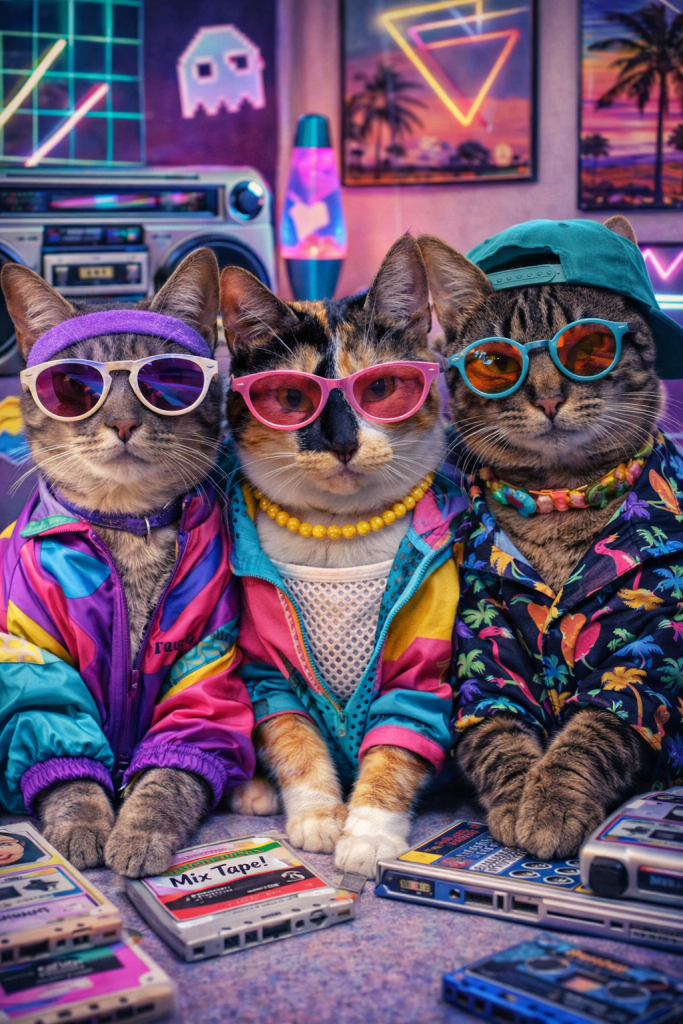
I had barely struck the match when Piper strutted in like she was auditioning for RuPaul’s Drag Race: Feline Edition. Coco followed. She was rolling her eyes so hard she saw her own brain. Tinkerbell arrived last. She was carrying the emotional weight of someone who lived through dial‑up internet. And refuses to talk about it.
Piper: “Mama, tell us again how y’all used to chase the mosquito‑spraying truck like it was the ice cream man.”
Me: “Baby, that was our version of aromatherapy.”
Coco: “So you willingly ran toward poison?”
Me: “Yes, and we called it summer.”
Tinkerbell: “Lord have mercy. Y’all were one bad decision away from a Lifetime movie called ‘Bless Her Heart: The Dana Story.’”
Piper: “Was this before or after you realized you were gay?”
Me: “Before. But the signs were there. I had a favorite Golden Girl.”
Coco: “Which one?”
Me: “Dorothy.”
Tinkerbell: “Yeah, that tracks.”
The charcoal popped. The cats stared. And I knew it was time to confess the truth. 80s childhood wasn’t a vibe. It was a survival sport.
Look, kids today have helmets, GPS trackers, and parents who Google things like “Is this safe?” We had none of that. We had vibes and the Lord’s protection. Which was honestly stretched thin. He was also busy dealing with televangelists, Reaganomics, and every Southern mama praying for her gay child without knowing why.
UNSUPERVISED BIKE RIDES
We rode bikes miles away from home with no water, no sunscreen, and no adult supervision. If you got lost, you didn’t call anyone. You just accepted your new life in the woods like a feral pioneer child.
THE MOSQUITO TRUCK
Modern kids run from danger. We ran toward it. That fog rolled down the street like a Stephen King villain and we said, “Oh goodie, free mist!”
THE SNACKS
We ate plastic‑wrapped cheese. Kool‑Aid with enough sugar to stop a grown man’s heart. Bologna that had a rainbow sheen. And popsicles that tasted like lead paint and joy.
THE PARENTING STYLE
Southern parents in the 80s didn’t “supervise.” They announced. “Be home by dark.” That was it. No follow‑up questions. No safety plan. Just vibes and Jesus.
THE GAY PART
Growing up gay in the conservative South was like being a unicorn in a deer stand. You knew you were magical. But you also knew you needed to stay quiet, or someone’s mee-maw would try to pray the glitter out of you.
Meanwhile, my cats listened to all this like they were taking notes for a documentary.
Piper: “So basically, y’all were raised by chaos and pesticides.”
Coco: “And shame. Don’t forget the shame.”
Tinkerbell: “Honestly, it explains everything.”
So yes. Every 80s kid was one bad decision away from a Lifetime movie plot. We survived poison fog. Unsupervised adventures. Snacks that violated FDA guidelines. And Southern Christianity’s “We love you but also don’t ask questions” energy.
Let me tell you something right now. Standing here in my Mississippi kitchen with three judgmental cats and the ghost of every Southern church lady who ever side‑eyed my existence hovering over my left shoulder like a passive‑aggressive guardian angel.
We, the 80s kids, should not be alive. Not metaphorically. Not spiritually. I mean biologically, medically, scientifically, and according to every modern parenting blog written by someone named Brittany who packs organic snacks in BPA‑free containers.
We were raised in an era where seatbelts were “optional suggestions.” Bike helmets were “for the weak.” And the mosquito truck was “community enrichment.” We were one bad decision away from starring in a Lifetime movie titled “Bless Her Heart: The Dana Chronicles” or “Raised By Pesticides” or “Southern Gay Survival Story.” Take your pick.
And while we were out there inhaling poison fog like it was Chanel No. 5, our Southern Christian parents were inside praying hedge‑of‑protection prayers so thick they could’ve been used as insulation. Not that they knew what we were doing. They thought we were “playing outside.” Ma’am, we were reenacting Lord of the Flies with bicycles and no adult supervision.
Meanwhile, I was also quietly navigating the spiritual obstacle course of being a gay kid in the conservative South. Which meant I was simultaneously dodging mosquito fog, emotional repression, and Sister Linda’s unsolicited prophecy that “the Lord has a special plan for you.” And he did. It involved glitter and sarcasm.
And now? Now we’re grown. We pay bills. We raise kids. We have opinions about grout. We have survived everything from Reagan to dial‑up to purity culture. To the fact that our childhood snacks were made of 40% petroleum byproduct.
My cats watched me deliver this sermon like I was testifying in the Church of Chaotic Upbringing.
Piper: “Mama, you’re not just a miracle. You’re a franchise.”
Coco: “Honestly, you should’ve come with a warning label.”
Tinkerbell: “Or a Lifetime contract.”
And here’s the mic‑drop truth. The gospel according to every 80s kid who lived through the fog, the freedom, the foolishness, and the fundamentalist fearmongering. We just didn’t survive the 80s. We outlived the 80s. We walked through the valley of mosquito spray and came out moisturized. We endured the shame, the chaos, the bologna with the rainbow sheen, and the Southern Christian guilt that could crush a lesser mortal. We are the chosen ones. The anointed. The pesticide‑kissed prophets of resilience.
So, if anyone tries to tell you you’re “too much,” just smile sweetly. Bless their heart and remember, “You survived an entire decade that tried to kill you with fog machines, sugar, and Jesus.” They can’t handle you. They’re not qualified to handle you. You are a walking Lifetime movie with better hair and boundaries. Charcoal still burning. Cats applauding silently in judgmental solidarity. Thanks for reading! How do you remember the 80s?
Affirmation: I am resilient. I am fabulous. And I survived the 80s. Nothing can stop me except maybe gluten.
“Awareness isn’t comfortable, but neither is grief. Choose the discomfort that saves lives.”
-This Puzzled Life
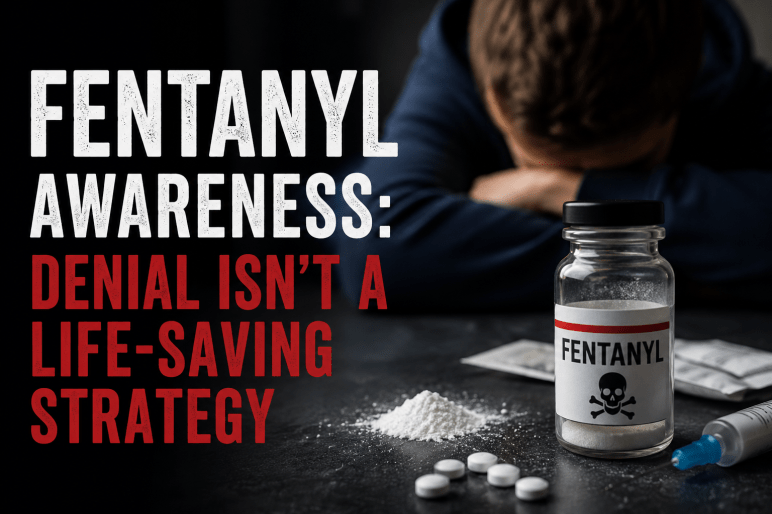
Light the charcoal. Sprinkle the sage. Today, we’re talking about Fentanyl Awareness. And Lord knows some folks need more than sage. They need a whole spiritual intervention. A PowerPoint and maybe a smack from an ancestor with a wooden spoon.
We’re still living in a world where people think fentanyl is something that happens to “other families,” “other communities,” or “those people over there.” Fentanyl doesn’t care about your zip code. Your Bible study attendance record. Or how many casseroles you’ve delivered to the church potluck. It is an equal-opportunity destroyer. And yet, some folks still clutch their pearls and say, “Well, if people didn’t do drugs.” Sweetheart, if ignorance burned calories, half this country would be runway-ready.
Fentanyl isn’t a moral issue. It’s a public health crisis. A grief generator. And a silent killer that slips into communities like humidity in Mississippi. It comes uninvited. Suffocating. And everywhere. But sure, let’s keep pretending it’s just a “bad choice” problem. And just for shits and giggles, I’ll say that bombing people in fishing boats that are clearly are not transporting this substance is not an answer to the problem.
Fentanyl doesn’t knock. It doesn’t ask permission. It doesn’t wait until you’re ready to have your life rearranged. It shows up like a tornado in the middle of a sunny day. It’s fast. Violent. And leaves you standing in the wreckage while wondering how the hell everything changed in seconds.
People aren’t overdosing because they’re weak. They’re overdosing because fentanyl is 50 times stronger than heroin. And 100 times stronger than morphine. They’re overdosing because it’s being mixed into substances without their knowledge. They’re overdosing because the world is heavy. Trauma is real. And coping mechanisms don’t magically appear with a bow on top.
But try telling that to the folks who think addiction is a “willpower issue.” These are the same people who can’t resist a clearance sale at Hobby Lobby. But somehow believe others should resist a chemically engineered substance designed to hijack the brain.
Addiction is not a character flaw. It’s not a spiritual failure. It’s not a lack of discipline. It’s a medical condition. A trauma response. And sometimes a desperate attempt to feel anything other than pain.
And fentanyl? It’s the predator waiting in the shadows. Families are burying children. Parents are burying parents. Communities are burying potential futures and dreams. And still some folks would rather cling to judgment than compassion. Because compassion requires effort. Judgment is free and easy like drive-thru theology.
So, here’s the truth that’s wrapped in Southern sass and tied with a bow of reality. Fentanyl doesn’t care about your opinions. It doesn’t care about your politics. It doesn’t care about your moral superiority complex. But we should care. We should care enough to talk about it. We should care enough to educate ourselves. We should care enough to stop pretending this crisis is happening in some faraway land to people we’ll never meet.
Fentanyl is already here. It’s in our towns, our schools, families, and our communities. And pretending otherwise won’t save a single life. And for the love of all things holy, open your eyes. Denial has never saved anyone. Awareness does. Compassion does. Action does. Try not to trip over it on your way back to reality. Thanks for reading! What are your thoughts?
Affirmation: I choose compassion over judgment. Truth over denial. And awareness over silence. My voice matters. And so does every life touched by this crisis.
“Childhood in the 80s wasn’t safe. But it was flavorful.”
-This Puzzled Life
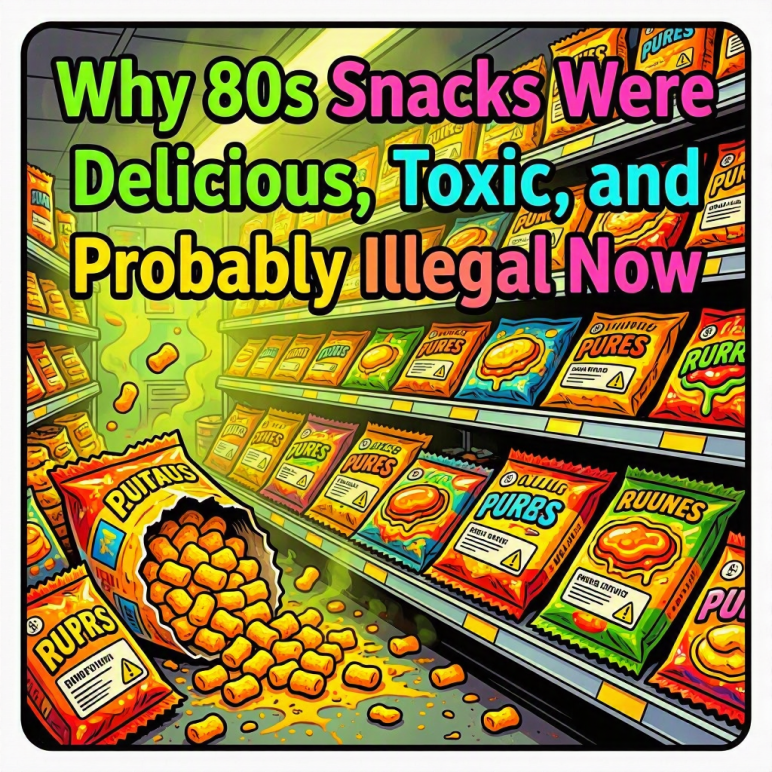
Light the charcoal. Today we’re grilling up the radioactive, neon‑dust‑covered, FDA‑defying buffet that raised us. The 1980s didn’t just feed us snacks. They fed us character development. They fed us resilience. They fed us enough artificial dyes to glow like a Chernobyl nightlight. And we ate it up with our bare hands. Because nobody in that decade had ever uttered the phrase “Is that safe for children?”
Back then, snacks weren’t “organic,” “non‑GMO,” or “ethically sourced.” They were chaos in a foil pouch. They were chemical warfare disguised as lunchbox joy. They were delicious, toxic, and probably illegal now. And I miss them every day like a long‑lost cousin who stole my bike but taught me how to cuss. Let’s take a stroll down memory lane. But wear protective gear. The 80s snack aisle was basically a Superfund site with better branding.
Planters Cheez Balls-The neon‑orange dust that stained your fingers for three to five business days. If you touched a white wall afterward, it looked like a crime scene at a clown convention.
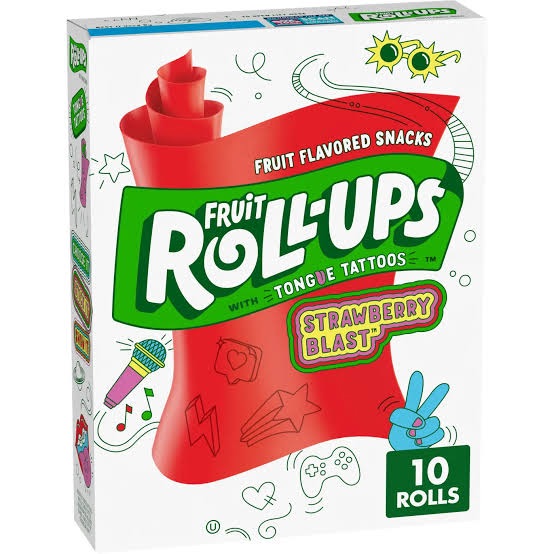
Fruit Roll‑Ups (Original Formula)-Essentially edible plastic wrap with a whisper of fruit. If you left it in the sun, it melted into a sheet of stained glass that could double as a weapon.
Jolt Cola-Two cups of coffee, a Red Bull, and a dare from Satan all mixed into one can. This drink raised your heart rate and your GPA.
Pop Rocks-Carbonated gravel. The snack that convinced an entire generation we might explode at any moment. And we still ate it by the fistful.
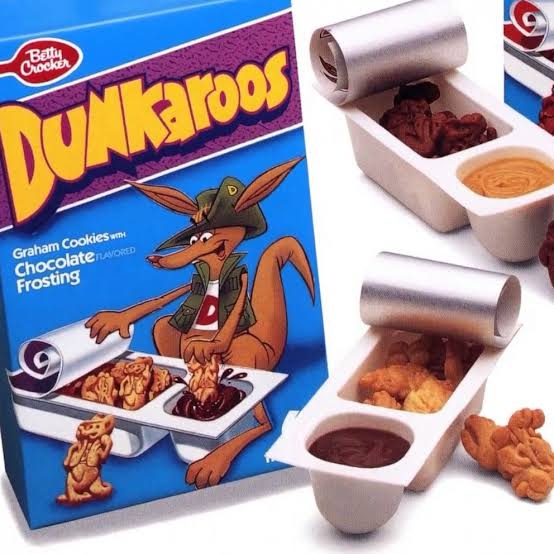
Dunkaroos-Cookies you dipped into frosting so sweet it could sandblast your enamel. A dentist’s retirement plan in a single pack.
Hubba Bubba Bubble Tape-Six feet of gum. Which was exactly five feet and eleven inches more than any child needed. We chewed it until our jaws locked like a rusty hinge.
Slush Puppie-A cup of shaved ice drowned in syrup so bright it could guide ships through fog. One sip and your tongue changed colors like a mood ring.
Hostess Pudding Pies-A pastry filled with custard that tasted like it had been stored in a bunker since the Cold War. We didn’t care. We inhaled them.
Tato Skins-Potato chips that were basically salt slabs. One bag could dehydrate a camel.
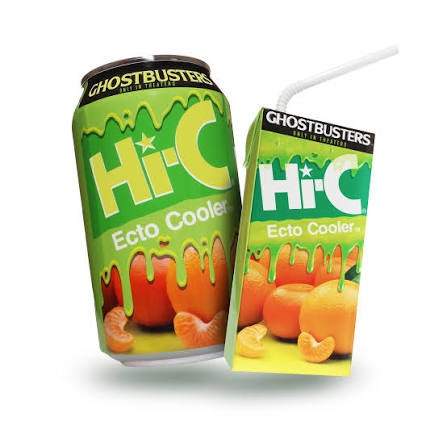
Hi‑C Ecto Cooler-A citrus drink so green it looked radioactive. Probably was. Delicious though.
And that’s it. The snacks that built our immune systems, our personalities, and possibly our future medical bills. We were raised on sugar, dye, caffeine, and vibes. No one checked labels. No one asked questions. If it glowed, fizzed, popped, or came in a pouch that looked like it was designed by a hyperactive raccoon, we ate it. Meanwhile, today’s kids are out here with gluten‑free, dye‑free, sugar‑free, joy‑free snacks shaped like clouds and promises. Bless their hearts.
We survived lawn darts, metal slides, and snacks that could strip paint. And now we’re out here trying to survive our own children. Who melt down if their organic fruit snack is the wrong shade of mauve. While helicopter moms hover with SPF 9000 and BPA‑free water bottles shaped like emotional support gourds. The 80s made us fireproof. Thanks for reading! What are more snacks that you can remember from this time period?
Affirmation: “I honor my inner 80s kid by embracing chaos. Choosing joy. And refusing to read ingredient labels.”
“Gen X: Because someone had to survive the 80s so the rest of y’all could have feelings.”
-This Puzzled Life
Light the charcoal. We’re about to summon the spirits of Gen X. We were the only generation that survived metal playground equipment, unfiltered hose water, and parents who thought “supervision” was something only rich people did.
Let’s talk about the 80s. The decade where every child was basically a free‑range chicken with a bike. And nothing captures the chaos of our upbringing better than the rotary phone. That thing wasn’t just a communication device. It was the first escape room. A psychological puzzle. A patience test. A spiritual trial. A full‑body workout. A rite of passage.
Listen. If you didn’t grow up in the 80s, you will never understand the emotional damage of mis‑dialing the last number on a rotary phone. You’d get all the way to the ninth digit. Your finger trembling. Your soul leaving your body. And then slip. Back to the beginning. Do not pass go. Do not collect $200. Do not call your friend to see if they can come outside.
Rotary phones were the original “Are you smart enough to escape this room?” challenge. Except the room was your grandmother’s kitchen. The puzzle was a plastic wheel from 1952. And the prize was getting to talk to someone whose mom might pick up and yell, “Hello? Who is this?” And Gen X? We were forged in that fire.
We survived:
Phone cords long enough to lasso a sibling, a dog, and a passing station wagon.
Busy signals, which were basically the universe saying, “try again later, loser.”
Parents screaming “Get off the phone, I’m expecting a call!” even though they weren’t.
The fear of calling a friend and having their dad answer with a voice that sounded like he ate gravel for breakfast.
Kids today will never know the terror of dialing a crush’s house and praying their mother didn’t answer with the tone of a woman who had already raised three children and was done.
And while we’re at it, Gen X childhood wasn’t just rotary phones. It was metal slides hot enough to brand livestock. Monkey bars designed by someone who hated children. Halloween costumes made of plastic so flammable they violated the Geneva Convention. Riding in the back of pickup trucks like we were in a Marlboro commercial. Snacks made of 98% Red Dye No. 5. Being left alone for 12 hours with nothing but a bike, a stick, and a vague sense of danger.
We didn’t have helicopter parents. We had “figure it out” parents. We didn’t have screen time limits. We had “go outside and don’t come back until the streetlights come on.” We didn’t have anxiety. We had character development. And now? We’re raising kids who need a snack, a water bottle, a fidget toy, a weighted blanket, and three emotional support apps just to go to Target.
So yes. We are Gen X. We survived rotary phones, lawn darts, metal slides, Satanic Panic, latchkey childhood, and parents who thought seatbelts were “optional suggestions.” We escaped the escape room. We solved the puzzle. We lived to tell the tale. And now we’re out here trying to raise children who cry if the Wi‑Fi blinks for three seconds.
Meanwhile, we’re still laughing. Still standing. Still unbothered. Because we were raised by chaos, danger, and a phone that required upper‑body strength. Cord tangled. Streetlights on. Gen X forever. Thanks for reading! What do you remember about growing up in the 80’s?
Affirmation: “I am a resilient, sarcastic, rotary‑phone‑forged masterpiece. And nothing in this modern world can intimidate me.”
“Our childhood wasn’t supervised. It was witnessed.”
-This Puzzled Life
Light the charcoal. Bless the yard. We’re summoning the spirits of a generation raised on asbestos, sugar, and unmonitored chaos. A generation that survived childhoods so reckless they now qualify as folklore. Welcome to Growing Up in the 80s: A Survival Guide for the Barely Supervised. It’s where the toys were weapons. The adults were tired. And the safety standards were “Godspeed, child.” Get comfortable while we take a stroll through the hilarity of growing up Gen X in the 1980s.
Playgrounds: Where Childhood Went To Die.
The playground wasn’t a place to have fun. It was a government‑approved death trap. The metal slide? Forged in the fires of Mount Doom. By noon it was hot enough to brand cattle. You’d climb up. Sit down. And immediately lose three layers of thigh skin. And the equipment? Not equipment. Artifacts. One day a giant industrial truck tire would just appear. No explanation. No installation. Just a 400‑pound rubber monolith that rolled off an 18‑wheeler and onto the playground like, “Here. Climb inside this tomb and see what happens.”
I cannot end this part without mentioning the merry‑go‑round. It was a device clearly invented by someone who wanted to test the limits of the human skull. This wasn’t the cute, slow, musical carousel at the mall. No. This was a rusted metal centrifuge powered entirely by children with no impulse control. You’d hop on. Hold the bar with sweaty little hands and pray. The moment the older kids grabbed the rails and started running, you were no longer a participant. You were payload.
They’d spin that thing so fast your soul would leave your body and hover above the playground like, “Welp. This is how we meet Jesus.” If you lost your grip? You were slung off in a blaze of glory. Bouncing across the gravel like a loose hubcap on I‑10, while collecting rocks, dirt, and possibly a mild concussion.
And the adults? They didn’t intervene. They didn’t slow it down. They didn’t even look concerned. They’d just shrug and say, “That’s why you hold on tighter next time.” Meanwhile, the teachers assigned to playground duty were spiritually absent. You could be actively being decapitated. And they’d shout from across the field,“ If you’re bleeding, go to the office!”
Lawn Darts
Lawn darts were literal spears marketed as toys. You’d throw them into the sky and pray they didn’t come down in your skull. Parents watched from lawn chairs. And were drinking Tab and saying, “Be careful!” As if that would stop a 2‑pound metal projectile from piercing your femur.
Halloween: The Budget Was $3 and a Prayer
Our costumes were plastic trash bags with a picture of the character printed on the front. And a mask that smelled like melted crayons and carbon monoxide. The eye holes were never aligned with actual human eyes. So, we trick‑or‑treated like drunk raccoons bumping into mailboxes.
And the horror movies? Low‑budget masterpieces. Special effects made from ketchup packets and someone’s uncle’s old Halloween wig. But we watched them anyway. Because we were latchkey kids with no adult supervision. And a VCR that ate tapes like a hungry goat.
The Rotary Phone: A Weapon, A Workout, A Trap
Kids today will never know the terror of dialing a friend whose number had multiple 9s in it. You’d start dialing at 3 PM and finish sometime around dusk. And that phone cord? It could stretch from the kitchen. Through the living room. Out the front door. Down the driveway. And halfway to the neighbor’s house. Then it would wrap around your body like a boa constrictor with a grudge. And would drag you to the floor while your mom yelled, “Don’t you dare hang up! I’m talking to Aunt Sarah.”
Cigarette Smoke Everywhere
The 80s smelled like nicotine, Aqua Net, and generational denial. Restaurants had “smoking” and “non‑smoking” sections separated by a single fern. Airplanes had smoking sections. Hospitals had smoking sections. Your pediatrician? He’d walk in with a cigarette and say, “Your lungs sound tight.” Sir, I wonder why.
Tv Antennas
If you wanted to watch cartoons, someone had to climb onto the roof. Usually a child. Your dad would yell, “Turn it a smidge!” All while you clung to the chimney like a tiny lineman in a lightning storm. You would say, “Is it better now?” And they would reply, “No, you made it worse!” You were one gust of wind away from meeting Jesus.
Cereal With Enough Sugar To Stop A Hummingbird’s Heart
Our cereal wasn’t “part of a balanced breakfast.” It was diabetes in a box. The milk at the bottom turned into neon syrup that could power a small generator. And the commercials promised superpowers, speed, and happiness. They were all lies, but delicious ones.
Riding In The Back Of Pickup Trucks
Seatbelts? Not in the back of a truck. We’d bounce around like human popcorn. While our friend’s dad took corners at 40 mph. We waved at strangers like we were the Grand Marshals of the Unsupervised Children’s Parade.
Public Pools
Swimming in an 80s public pool was already a gamble. Public pools were cloudy cauldrons of mystery. You couldn’t see your own legs. The bottom was a rumor. And the smell of chlorine could peel paint off a Buick. You’d inevitably bump into something and pray it wasn’t a Band‑Aid or a rogue diaper.
But every now and then, the universe would spice things up with a code‑brown catastrophe. You’d be dog‑paddling through that murky soup. When suddenly the lifeguard, a sunburned 16‑year‑old, who hadn’t cared about anything all day. And would rather die than get in the water. Would suddenly come alive. They’d blow their whistle like they were signaling the end times, waving their arms, and screaming, “Everybody Out! Everybody Out Now!”
And then you’d see it. Floating. Majestic. Unbothered. A lone turd drifting across the surface like it was the captain of its own ship. And charting a course straight through the deep end. Kids would scatter. And they were climbing out of the pool like panicked wet cats. Slipping. Screaming. And traumatized. Moms would grab their children like they were rescuing them from a burning building. And the lifeguard? They’d stand there. Whistle still in their mouth. And staring at the water like, “I don’t get paid enough for this.” We didn’t have sharks in pools. We had floaters.
Mosquito Trucks & Ice Cream Trucks
Southern summer evenings in the 80s had two sacred sounds. The jingle of the ice cream truck. And the low, ominous rumble of the mosquito truck rolling through the neighborhood like a mobile cancer dispenser. The mosquito truck would creep down the street. While spraying a thick, white fog of chemicals so potent it could kill a roach at 50 yards. And what did we do? We ran toward it.
We’d get two steps from the bumper. Arms outstretched. And inhaling that cloud like it was the breath of life itself. Kids today have essential oils and organic bug spray. We had government‑issued carcinogens and the lung capacity of Olympians. We’d dance in that fog like feral woodland spirits. Coughing, laughing, and probably shaving five years off our lifespan. While our parents stood on the porch waving like, “Y’all stay where we can see you!”
And then. The moment the fog cleared. The ice cream truck would appear like a reward for surviving the chemical baptism. We’d sprint toward it. Pockets full of sweaty quarters. Ready to buy a popsicle shaped like a cartoon character whose eyes were always crooked. And whose flavor was “red.” Poison cloud, then ice cream. A perfect system.
Stranger Danger Training
Our entire safety curriculum was, “Don’t get in a van.” That was it. Then they’d send us outside for 10 hours with no supervision, no sunscreen, and no water bottle. We roamed the neighborhood like feral raccoons with bikes. And helping ourselves to anyone’s yard that had a visible garden hose.
No YouTube, No Cell Phones, No Dollar Tree
My 10‑year‑old hears this and acts like I grew up in the prehistoric era. Back in my day, if you wanted to learn something, you had to ask a grown‑up (who might lie). Ask a friend (who would definitely lie). Or check the encyclopedia (which was older than your grandma). And Dollar Tree? Didn’t exist. If you wanted cheap toys. You had to wait for a gas station to put something on clearance. Usually because it had faded into a new color.
The Satanic Panic: Southern Edition
The South in the 80s was convinced the devil lived in rock music, Dungeons & Dragons, black clothing, and Halloween, Oh, and anyone who didn’t go to church three times a week. You couldn’t even be friends with a Methodist without someone whispering, “Don’t you go sellin’ your soul now.”
Big Hair Bands
Men wore eyeliner, leather pants, and hair so teased it could block a doorway. Nobody questioned it. We said, “This is masculinity. This is art. This is culture.” And then there was R&B. Those songs were so sensual you needed birth control just to listen to them. You’d be nine years old hearing lyrics that made you blush and wonder if you needed to talk to a priest.
Nature As Weaponry
We didn’t have Nerf guns. We had sticks. Sticks that became Spears, Rifles, Swords, Magic wands, and occasionally, a snake. We played cowboys and Indians, cops and robbers, and dramatic death scenes worthy of an Oscar.
Childhood Mental Health Was A Mythical Concept
If you were stressed, anxious, or overwhelmed, adults said, “Go outside.” “Stop crying.” “You’re fine.” “Kids don’t get stressed.” Meanwhile, we were out here processing trauma with a Capri Sun and a bike with no brakes.
Prank Calls
Before caller ID, we were chaos. We’d flip through the phone book. Which was an actual book. And call someone named Margarita to ask if her husband was Jack Daniels and her dog was Tequila. Or we’d call strangers at 1 AM and ask, “Do you know how to cook a blueberry pie?” And we did all this sober. Because we had to create our own fun without electronics.
Cameras
Taking pictures was a gamble. You’d take 24 photos. Wait three weeks. Pay $12.99. And discover blurry faces and closed eyes. Sometimes thumbs over the lens. A strange photobombing. Or the entire roll blank because someone forgot to load the film. There was no delete button. Just shame.
And now here we are. Veterans of the 80s. We have scars both physical and emotional. And needing therapy where we now have to process our entire lives. All while trying to survive our own children. Who now need hydration schedules, emotional check‑ins, and sunscreen applied with the precision of a NASA engineer. We watch helicopter moms circling the playground. Adjusting knee pads. Putting toddlers on leashes. And we just smile. Because we know the truth. We survived the 80s. We can survive anything. Even this. Thanks for reading! And I hope this was the brightest spot of your day. Please leave a comment about other hilarious things from the 80’s that we Gen X might remember.
Affirmation: I honor the feral resilience that raised me. I survived metal slides, mosquito fog, and lawn‑dart warfare. So, today’s challenges don’t scare me. I am built from grit, humor, and pure Gen X immortality.
“If the 80s taught me anything, it’s that danger builds character. And apparently more trust than modern governance.”
-This Puzzled Life
Light the charcoal. We’re about to smoke out some truth hotter than a Mississippi July with no AC and a broken ceiling fan. I’m talking about the 1980s. The era where children were basically raised by asbestos, sugar, and unregulated chaos. And somehow all ten of these hazards still feel more reliable than anything coming out of the current administration. According to what many people online joke about when comparing political frustrations to nostalgic dangers. So, buckle up. Preferably with a seatbelt that doesn’t lock. Fray. Or snap like the ones we had in ’84.
10 Dangerous Things From the 80s I Trust More Than the Current Administration
1. Metal Playgrounds That Reached the Temperature of Satan’s Forehead
Those slides would sear the skin clean off your thighs. But at least they were consistent. Predictable. Honest. They said, “Climb me and you will suffer.” And they delivered every time.
2. Lawn Darts
The 80s handed children spears and said, “Go outside.” And you know what? Those spears had more accountability than anything happening in Washington.
3. Station Wagons With No Seatbelts in the Back
We rolled around like loose produce in a grocery sack. But somehow we survived. Meanwhile, some people online say they feel like modern political decision-making is the real crash hazard.
4. The Original Easy-Bake Oven
Powered by a literal light bulb hot enough to melt a Barbie leg. And yet? Still felt safer than certain policy rollouts.
5. Tang
A powdered beverage that tasted like citrus-flavored drywall. But it never pretended to be anything else. A level of transparency many folks online wish they saw more often.
6. Those Giant Wooden Cable Spools We Used as Furniture
Splinters? Absolutely. Structural integrity? Questionable. But they held up better than some public promises.
7. Slip ’N Slides on Concrete
We didn’t have lush lawns. We had optimism and a hose. And even that felt like a more thought-out plan than some national strategies people complain about.
8. The McDonald’s Play Place Ball Pit
A microbial swamp of mystery fluids and lost socks. But at least the danger was visible. Tangible. Honest.
9. 80s Hair-Spray Clouds
We walked through enough aerosol to punch a hole in the ozone layer. But at least Aquanet never flip-flopped on its mission. It would hold that hair like your life depends on it.
10. The Sears Catalog Weight Set
Rusty. Questionable. Missing instructions. But it still felt more stable than the vibes coming out of D.C., according to many frustrated folks.
And that’s it. Ten relics of 80s chaos that could’ve taken us out at any moment. Metal slides that branded our thighs. Lawn darts that doubled as medieval weaponry. And Slip ’N Slides that were basically chiropractic roulette. And somehow, all that reckless nostalgia still feels sturdier than the national decision-making process folks online love to fuss about. If that ain’t Southern truth wrapped in neon spandex, I don’t know what is.
Let me tell you something. If surviving the 80s taught us anything, it’s that we were forged in a lawless era where children drank from garden hoses. Rode in the back of pickup trucks doing 70 on a gravel road. And ate popsicles that tasted like freezer burn and lead paint. We were raised by chaos, negligence, and whatever was on sale at K‑Mart. And somehow we still came out sturdier than the governmental circus folks keep hollering about these days.
Here’s the truth wrapped in a biscuit. The 80s didn’t pretend to protect us. They didn’t pat us on the head and say, “We’ve got this under control.” They didn’t hand us a flaming lawn dart and call it “innovative policy.” No, ma’am. The 80s looked us dead in the eye and said, “Listen, this might kill you. Good luck.” And honestly? That level of transparency feels downright refreshing compared to the current vibes.
So yes. Give me the metal slides, asbestos ceiling tiles, the unregulated fireworks, the neon‑soaked danger, the questionable snacks, the ozone‑destroying hair spray, and the Slip ’N Slide that doubled as a chiropractic emergency. At least those threats were honest. At least those hazards didn’t smile in my face while tripping me from behind.
And if that stings, light the charcoal. Because truth always cooks hotter than the grill. Now excuse me while I go pour myself a glass of sweet tea strong enough to dissolve a spoon. And pray for the strength of an 80s kid who survived Tang, lawn darts, and Reaganomics. Because apparently we’re gonna need it.Now pass me the charcoal. I’ve got more truth to smoke out.Mic dropped so hard it cracked the linoleum. Thanks for reading! What is your opinion?
Affirmation: I move through this world with the confidence of an 80s kid who survived. My resilience is vintage. My sass is eternal. And my trust is reserved for things that actually earn it.
Light the charcoal. Sprinkle the sage. Turn the thermostat down to “Don’t Play With Me.” Today’s story begins with Piper. She’s my overly chaotic, dramatic, emotionally unstable lead actress. She is waking up. Stretching her little diva paws. And declaring, “I live in a PRISON. A carceral state. A maximum‑security facility with no parole.” Why? Because I wouldn’t let her go outside at 8:03 AM to fight a butterfly. But then. I opened the door. And Mississippi humidity said, “Come here, sweetheart. Let me teach you something.”
Me: “Alright Piper, you wanna go outside? Go ahead.”
Piper(strutting like she’s leading a protest): “ I will taste freedom! I will breathe liberty! I will-”
The door opens. The humidity hits her like a wet spiritual slap.
Piper: “What is this? Why is the air touching me?”
Coco(from the hallway, eating an imaginary snack):“I told her. I told her. But she thinks she’s the main character.”
Tinkerbell (adjusting her invisible glasses): “Statistically speaking. She lasted longer than expected. I predicted immediate collapse.”
Piper takes one step outside. One. Single. Step. Her fur frizzes. Her soul leaves her body. Her whiskers droop like overcooked noodles.
Piper: “I am melting. I am being steamed like a dumpling. Call 911.”
Me: “Baby, that’s just humidity.”
Piper: “This is a hate crime!”
She turns around dramatically. Panting like she just crossed the Sahara.
Piper: “Let me back in. I have been assaulted by the sky.”
I open the door. She collapses onto the floor like a Victorian widow whose fainting couch was repossessed.
Piper: “I take back everything I said. This is not a prison. This is a climate‑controlled sanctuary of salvation.”
Coco: “Mm‑hmm. And next time you’ll listen to your elders.”
Tinkerbell: “Unlikely. She has the memory of a wet sock.”
Piper: “I have been traumatized. I need compensation. I need snacks. I need-”
Me: “You need to sit down and stop being dramatic.”
Piper: “I am a victim of the outdoors!”
And that is how Piper went from “I am an oppressed inmate” to “I would like to personally thank the HVAC industry for its service.” All in under 12 seconds. The South didn’t just humble her. It baptized her in sweat. Snatched her ego. And sent her home reborn.
I would like to personally nominate the air conditioner for the Nobel Peace Prize.” The South sautéed her. Seasoned her. And served her back to the living room like a damp little cautionary tale.
So, the next time Piper demands “freedom,” open the door. Let the humidity slap her with a warm, wet truth. And remember, “Sometimes the lesson isn’t deep. Sometimes the lesson is, “Get back inside before you melt.” Thermostat lowered. Ego evaporated. Thanks for reading! And praise be for air conditioning. Can you relate?
Affirmation: “I honor my boundaries, my AC unit, and my right to stay indoors. Where the air is cold. The humidity is low. And the cats are only moderately feral.”
“Southern summers will test your patience, your deodorant, and your faith. But nothing melts faster than other people’s manners.”
-This Puzzled Life
Light the charcoal. Sprinkle the sage. The public body odor situation in a Southern summer has reached a level that can only be handled with spiritual cleansing, municipal ordinances, and maybe a pressure washer. We have reached that special time of year when the humidity is so disrespectful it feels personal. And the general public is out here smelling like they’ve been slow‑cooked in their own decisions. If you’ve stepped outside lately and thought, “Why does the air taste like somebody’s day?” Congratulations, you’ve survived another Mississippi summer morning.
There’s hot. And then there’s Southern hot. And it’s where the humidity sits on your chest like an unpaid bill. The moment you step outside, the air grabs you by the throat like, “You sure you wanna do this?” And the public? The public smells like they lost the battle hours ago.
We’re talking about these smells:
“I’ve been running errands since 8 a.m.” funk.
“I thought body spray counted as a shower” funk.
“I sat on vinyl seats in shorts” funk.
“I mowed the lawn and then went to Walmart” funk.
“I’m glistening, not sweating” funk (ma’am… you are sweating).
The South is humid enough to baptize you against your will. And yet somehow folks are out here smelling like they’ve been sautéed in their own regrets.
There’s a special kind of scent that only appears between June and September. It’s not quite sweat. Not quite despair. But a collaboration between the two. A duet. A remix. A limited-edition fragrance called Eau de Why Did I Leave the House? You can smell it in grocery store aisles, gas station lines, post office lobbies, any outdoor festival where someone brought a lawn chair, and the DMV (year‑round but amplified in summer). It’s the kind of aroma that makes you rethink your errands, your life choices, and your proximity to other humans.
We’ve all encountered these summer scent celebrities which include:
The man who jogged “just a little bit” but smells like he ran from the law.
The woman who swears she “doesn’t sweat,” while actively melting.
The teenager who believes deodorant is optional.
The person who got out of a car with leather seats and left half their soul behind.
And the festival goer who smells like they’ve been marinating in the sun since Thursday.
If we’re being honest, the South needs deodorant checkpoints. Public misting tents filled with cold air and accountability, a statewide ban on polyester. A “Shower Before You Leave Home” PSA campaign. And emergency cooling stations that are just walk‑in freezers. Because at this point, the humidity is not the only thing that assaults people.
If your personal aroma can be described as “interactive,” “memorable,” or “lingering,” please stay home until further notice. Summer in the South is already a full‑contact sport. We don’t need the bonus level of surprise scents.
And that’s where we are, folks. A region full of good-hearted people who smell like they’ve been marinating in a Crock‑Pot set to “Low and Regret.” Until deodorant becomes a civic duty and showers are treated like the sacred rituals they are, the South will continue to function as one big, sweaty, aromatic potluck of questionable scents. If your personal aroma has texture, stay home. Thanks for reading! And for God’s sake, bathe and use D-O for the B-O!
Affirmation: I move through this humid, chaotic world with grace, humor, and a scent profile I can be proud of. Other folks’ funk is not my spiritual assignment.
“Cats understand Independence Day better than anyone. They’ve been declaring freedom from authority since the moment they opened their eyes.”
— Tinkerbell, Level‑Headed Elder Stateswoman of the Living Room
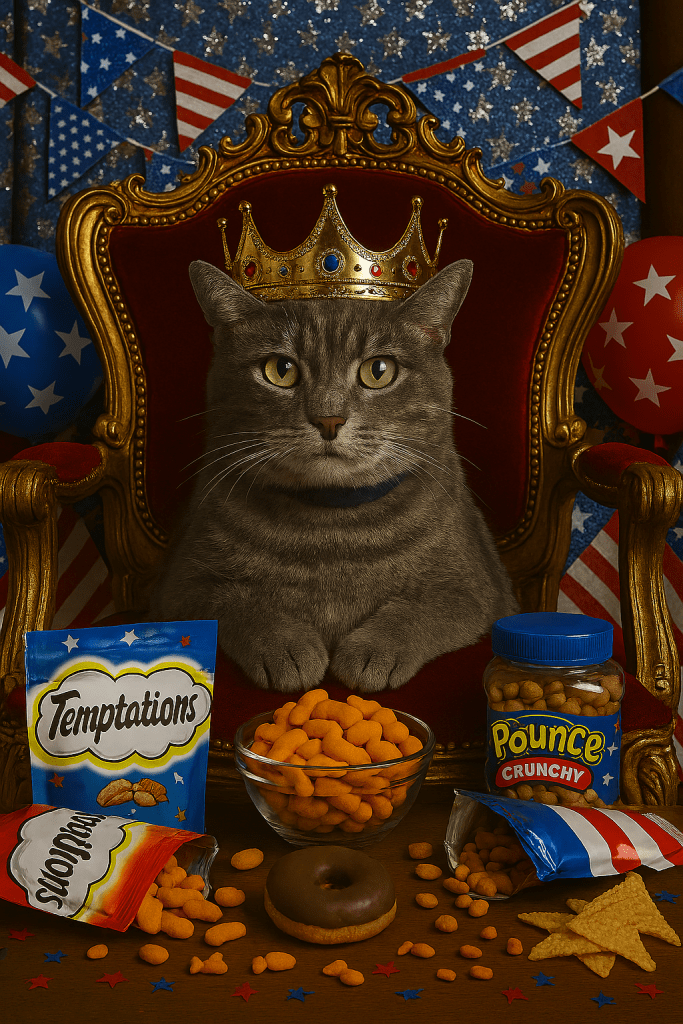
Down here in the Deep South, July 4th isn’t just a date on a calendar. It’s a full-bodied experience. A cultural thunderclap. A reminder that freedom has always been loud. Messy. And worth fighting for. The humidity is thick enough to baptize you. The mosquitoes are running a coordinated military campaign. And someone’s uncle is always one sparkler away from a cautionary tale. The air also gets thick enough to chew. The cicadas start hollerin’ like they’re running for office. And the whole world smells faintly of barbecue.
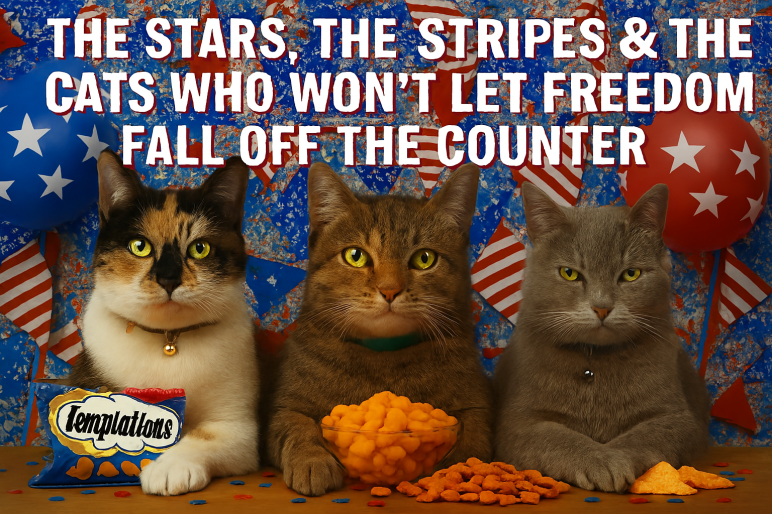
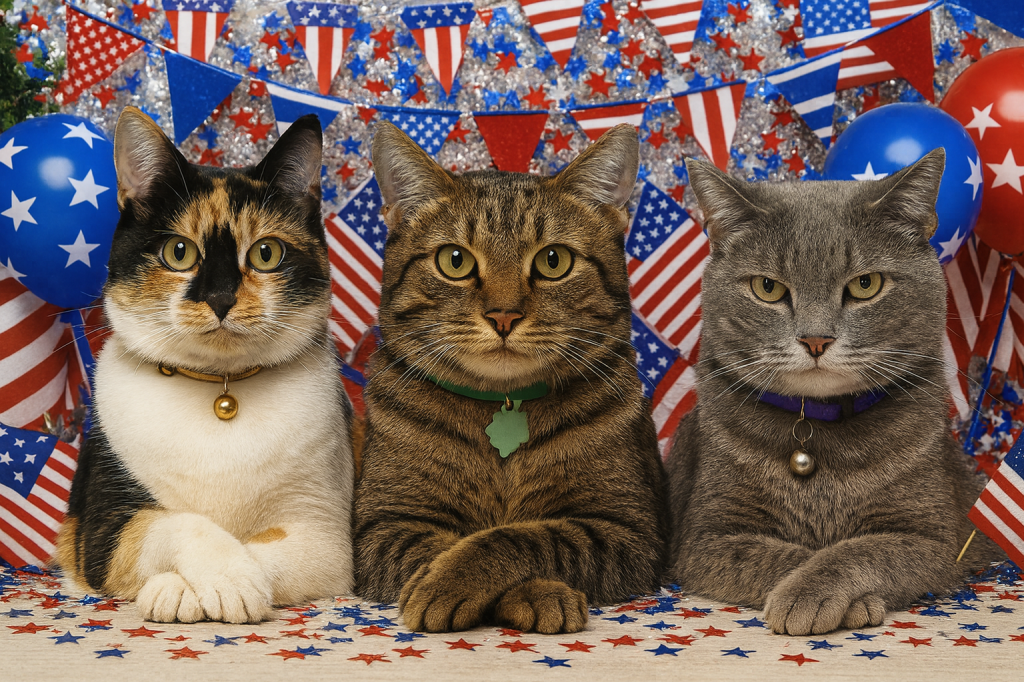
And right in the middle of this Southern symphony, my three cats. But inside my house, another sacred tradition unfolds. Piper, Coco, and Tinkerbell gather for their annual Independence Day Democracy Summit. This year’s theme: “Freedom, Fireworks, and the Big Orange Cat Who Keeps Testing the Constitution.”
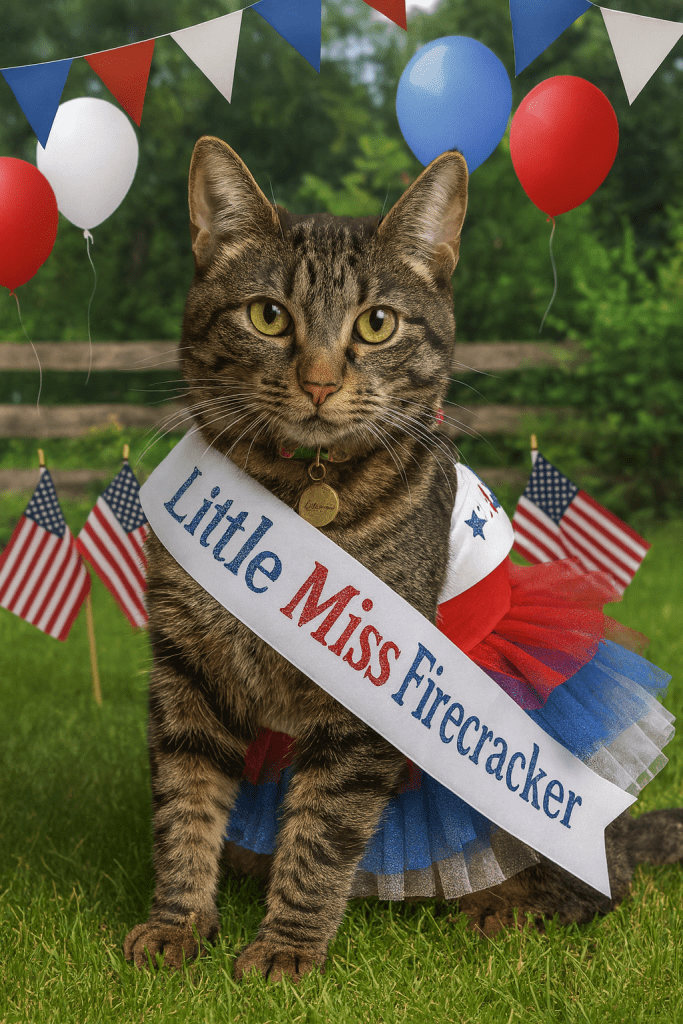
Piper, Coco, and Tinkerbell gather like a furry constitutional convention. Piper arrives dressed as Miss Firecracker. Coco shows up ready to filibuster for snacks. And Tinkerbell takes her seat like the level‑headed elder stateswoman she is. And prepared to keep the republic intact with nothing but patience and a well‑timed sigh. Because in this house, democracy isn’t an abstract idea. It’s alive. It’s chaotic. And it’s covered in cat hair.
Piper (Miss Firecracker, vibrating with patriotic energy): “Okay y’all, HISTORY TIME! A long, long time ago, before Temptations treats existed, America was just a bunch of humans living under a big boss called a king.”
Coco: “A king who didn’t even live here. Imagine someone in another house telling us when we can eat snacks. Couldn’t be me.”
Tinkerbell (level‑headed, adjusting her tiny bow):“The colonies were under British rule. They paid taxes but had no say in the laws. It was undemocratic and unsustainable.”
Piper: “Exactly! So, the humans said, “We’re tired of this nonsense!” And BOOM! They wrote the Declaration of Independence.”
Coco: “Basically a breakup letter with extra drama.”
Tinkerbell: “A foundational document asserting that people have rights consisting of life, liberty, and the pursuit of happiness.”
Piper: “And snacks! Don’t forget snacks!”
Tinkerbell: “Snacks were not mentioned.”
Coco: “They were implied.”
Piper: “Anyway, they sent that letter to the king, and he was mad. But the humans stood their ground. Fought a whole war. And eventually formed a new country based on democracy.”
Tinkerbell: “A system where power comes from the people. Not one big boss.”
Coco: “Unless the Big Orange Cat gets his way.”
Piper: “Not on my watch! Miss Firecracker protects the Constitution!”
Tinkerbell: “Lord help us all.”
Piper (the baby patriot, dressed as Miss Firecracker): “BOOM! I’m ready to defend democracy, y’all!”
She’s wearing a red‑white‑and‑blue tutu, a sparkly sash that says MISS FIRECRACKER, and enough enthusiasm to power a Waffle House at 3 a.m.
Coco (the chaos middle child): “I move that we begin with snacks. Preferably the crunchy ones.”
Tinkerbell (the level‑headed elder stateswoman):“Let’s maintain order. And dignity. And maybe not set anything on fire this year.”
Me: “Tinkerbell, sweetheart, that’s a big ask.”
Piper: “Anyway, they sent that letter to the king, he got mad, a whole war happened, and eventually the humans formed a new country based on democracy.”
1. “Freedom means sparkles, snacks, and yelling ‘YEEHAW!’ at sunrise.” — Piper, Miss Firecracker
Piper believes the Founding Fathers would’ve loved glitter. Fireworks should be legal year‑round. And democracy is best defended by yelling loudly and wearing sequins. She salutes the ceiling fan. “For America and snacks!”
2. “Democracy is like a potluck. Everyone brings something. Even if it’s a mess.” — Coco
Coco explains that everyone gets a voice. Nobody knows what’s happening. And someone always starts a fight over the deviled eggs. She knocks over a mason jar of sweet tea to demonstrate “institutional fragility.”
3. “Freedom requires responsibility. And someone has to keep these two from burning the house down.” — Tinkerbell
Tinkerbell believes that democracy is sacred. Rules matter. Piper should not be allowed near fireworks, matches, or anything labeled “flammable.”
She adjusts her tiny patriotic bow and sighs like a Southern grandmother who’s seen too much.
Piper: “The Big Orange Cat is trying to take over everything.”
Coco: “He keeps knocking over the Constitution like it’s a roll of toilet paper.”
Tinkerbell: “He’s dismantling democracy one paw swipe at a time. It’s undignified.”
They list his alleged offenses such as he’s sitting on the separation of powers. He’s swatting at voting rights. He’s acting like rules don’t apply to him. He yells constantly. And he’s treating the Constitution like a scratching post. Piper stomps her tiny Miss Firecracker foot. “He’s a menace to freedom!” Tinkerbell nods gravely. “Bless his heart, but that’s not how governance works.” And after a heated debate (and one brief intermission where Piper tried to ignite a sparkler indoors), the cats issued their proclamation:
“Independence Day matters because democracy is fragile. Freedom is sacred. And the Big Orange Cat cannot be allowed to treat the Constitution like a chew toy. We honor this day with snacks, naps, sparkles, and the courage to stand up for what’s right. Even if we’re tiny.”
Tinkerbell added a footnote: “Please supervise Piper at all times.”
July 4th reminds us that democracy takes all kinds. It accepts the firecrackers, the chaos agents, and the level‑headed guardians who keep everyone from blowing up the porch. And if Piper, Coco, and Tinkerbell can navigate constitutional crises with humor, heart, and Southern grit, the rest of us can surely manage one respectful conversation over barbecue.
At the end of the day, July 4th isn’t just about fireworks or cookouts or who brought the best potato salad. It’s about remembering that democracy is a living thing. It’s a fragile, precious, and always one paw swipe away from chaos if we’re not paying attention. Piper may be tiny. Coco may be unhinged. And Tinkerbell may be the only adult in the room. But together they understand something deep. Freedom takes all of us. The sparkly ones. The loud ones. The steady ones. And the ones who show up even when the world feels heavy.
So, as the smoke clears. And the porch lights flicker on, we honor this day the way Southerners always have. With grit, humor, stubborn hope, and a fierce belief that the story of this country is still being written. And in this house, that story is guarded by three cats who refuse to let the Big Orange Cat scratch holes in the Constitution.
Because freedom matters. Democracy matters. And in this little Mississippi home, we’ll defend both with sparkles, snacks, and the kind of Southern backbone that doesn’t break, even when the world shakes. Thanks for reading! God Bless America!
Affirmation: “I stand in my power with the steady courage of Tinkerbell. The bold fire of Piper. And the unshakable resilience to rise above any Big Orange Cat trying to knock over my peace.”