This Puzzled Life is a mental health and recovery blog exploring addiction, trauma healing, LGBTQ experiences, humor, and the strange moments that shape us.
Light the charcoal. Sprinkle the sage. Turn the thermostat down to “Don’t Play With Me.” Today’s story begins with Piper. She’s my overly chaotic, dramatic, emotionally unstable lead actress. She is waking up. Stretching her little diva paws. And declaring, “I live in a PRISON. A carceral state. A maximum‑security facility with no parole.” Why? Because I wouldn’t let her go outside at 8:03 AM to fight a butterfly. But then. I opened the door. And Mississippi humidity said, “Come here, sweetheart. Let me teach you something.”
Me: “Alright Piper, you wanna go outside? Go ahead.”
Piper(strutting like she’s leading a protest): “ I will taste freedom! I will breathe liberty! I will-”
The door opens. The humidity hits her like a wet spiritual slap.
Piper: “What is this? Why is the air touching me?”
Coco(from the hallway, eating an imaginary snack):“I told her. I told her. But she thinks she’s the main character.”
Tinkerbell (adjusting her invisible glasses): “Statistically speaking. She lasted longer than expected. I predicted immediate collapse.”
Piper takes one step outside. One. Single. Step. Her fur frizzes. Her soul leaves her body. Her whiskers droop like overcooked noodles.
Piper: “I am melting. I am being steamed like a dumpling. Call 911.”
Me: “Baby, that’s just humidity.”
Piper: “This is a hate crime!”
She turns around dramatically. Panting like she just crossed the Sahara.
Piper: “Let me back in. I have been assaulted by the sky.”
I open the door. She collapses onto the floor like a Victorian widow whose fainting couch was repossessed.
Piper: “I take back everything I said. This is not a prison. This is a climate‑controlled sanctuary of salvation.”
Coco: “Mm‑hmm. And next time you’ll listen to your elders.”
Tinkerbell: “Unlikely. She has the memory of a wet sock.”
Piper: “I have been traumatized. I need compensation. I need snacks. I need-”
Me: “You need to sit down and stop being dramatic.”
Piper: “I am a victim of the outdoors!”
And that is how Piper went from “I am an oppressed inmate” to “I would like to personally thank the HVAC industry for its service.” All in under 12 seconds. The South didn’t just humble her. It baptized her in sweat. Snatched her ego. And sent her home reborn.
I would like to personally nominate the air conditioner for the Nobel Peace Prize.” The South sautéed her. Seasoned her. And served her back to the living room like a damp little cautionary tale.
So, the next time Piper demands “freedom,” open the door. Let the humidity slap her with a warm, wet truth. And remember, “Sometimes the lesson isn’t deep. Sometimes the lesson is, “Get back inside before you melt.” Thermostat lowered. Ego evaporated. Thanks for reading! And praise be for air conditioning. Can you relate?
Affirmation: “I honor my boundaries, my AC unit, and my right to stay indoors. Where the air is cold. The humidity is low. And the cats are only moderately feral.”
“If drag queens were dangerous, the Pentagon would’ve hired them already.”
-This Puzzled Life
Light the Charcoal. Sprinkle the Sage. This is a queer survival sermon for a country that keeps missing the point. And also, a sermon for the people in the back. But first we need to spiritually fumigate the room. The hypocrisy is thick. The contradictions are bold. And the political theater is so dramatic it deserves its own theme song.
Let the smoke rise like a Southern mama’s eyebrow when she hears someone say, “I’m not homophobic, but…” The “but” is always where the foolishness lives. And if the government spent half as much time fixing real problems as they do trying to regulate drag queens, pronouns, and who gets to pee where, this country would have free healthcare, affordable housing, a postal system that doesn’t lose your packages, and potholes filled with ethically sourced glitter.
But no. Instead, they’re out here acting like LGBTQIA+ people are a glitter‑powered militia plotting to overthrow the Republic with brunch menus and Beyoncé remixes. If queer people had that kind of power, the Capitol would’ve been redecorated in jewel tones and mood lighting decades ago.
Reason #1: We’re too fabulous to regulate
Bureaucracy loves order. It loves forms. It loves rules like “sign here, here, here, and also initial your soul.”But queer people? We show up like,“gender is more interesting than your filing cabinet.”,“no, I will not shrink myself to make you comfortable.”And “yes, this outfit is a political statement.”Trans folks especially break every boring little box the government tries to stuff people into. And nothing terrifies a bureaucracy more than a human being who refuses to be reduced to a checkbox.
Reason #2: Trans people expose the government’s worst fear. That identity is personal, not regulated
Trans people walk around every day proving that identity is self‑determined. Autonomy is real. Bodily freedom is non‑negotiable. And gender is not a federal highway with only two exits. That level of self‑possession shakes the table harder than a Pentecostal praise break.
Reason #3: We’re the easiest group to blame when they don’t want to talk about real problems
When the government doesn’t want to talk about healthcare, poverty, infrastructure, climate, wages, or why the DMV line is still 4 hours long. They go, “Quick! Hand me a queer person to blame!” It’s classic misdirection. It’s kind of like a magician. But instead of pulling a rabbit out of a hat, they pull out a bill restricting drag brunches.
Reason #4: The demonization is loud and the contradictions are louder
Let’s talk about the demonization of queer and trans people. The irony is so thick you could spread it on a biscuit. Some folks in the conservative political world will stand at a podium. Clutch a Bible like it’s a backstage pass to heaven. And declare that queer people are destroying America. And then turn around and behave in ways that would make a drag queen whisper, “Now baby, that’s between you and your therapist.”
It’s giving public morality, private chaos. And do as I say, not as I do. If hypocrisy were a sport, some of y’all would have Olympic medals.
Reason #5: Demonizing queer people while trying to sanitize harmful behavior elsewhere
Here’s where the sage needs to burn a little hotter. There’s a bizarre cultural pattern where some people loudly demonize LGBTQIA+ folks while simultaneously trying to downplay, excuse, or normalize harmful behavior in other areas that actually put children at risk. It’s the strangest double standard. A drag queen reading a book? “Danger!” Actual conversations about protecting kids from real harm? “Let’s not be dramatic.” It’s like living in a world where the smoke alarm goes off every time someone lights a birthday candle. But stays silent when the kitchen is actually on fire.
This contradiction isn’t about morality. It’s about distraction. It’s about misdirection. It’s about making sure nobody notices the real issues tap‑dancing in the background wearing tap shoes from Hobby Lobby.
Reason #6: Drag queens are too powerful
Drag queens have stage presence, community influence, sequins, microphones, and the ability to read a senator to filth without breaking a nail. The government knows if drag queens ever unionize, it’s over. The Pentagon cannot compete with a well‑timed death drop.
Reason #7: Queer joy is resistance
Queer people, especially trans folks, have mastered the art of joy in a world that keeps trying to dim them. That joy is political. That joy is rebellious. That joy is contagious. And nothing scares a system built on conformity more than people who refuse to be ashamed.
Reason #8: We don’t die quietly. We organize.
Every time the government tries to scapegoat the LGBTQIA+ community, queer folks respond with mutual aid, court challenges, community networks, fundraisers, marches, and a drag show themed “You Tried It, But We’re Still Here.” We don’t disappear. We get louder, smarter, and more fabulous.
Reason #9: We hold up a mirror
Queer and trans people reveal truths about society. And these truths are, who gets protected? Who gets ignored? Who gets punished for existing? And who gets celebrated for conformity?
When you hold up a mirror to power, power tends to say, “Actually, could you put that mirror down? I don’t like the lighting.” And the moment power starts whining about the lighting, that’s when my cats kick the door open like, ‘Oh, you don’t like the reflection? Don’t worry. We brought a whole panel discussion and a ring light.’”
PIPER: I’ve called this emergency press conference because the humans are once again blaming queer folks for things they didn’t do. And frankly, I’m tired.
TINKERBELL: I have reviewed the allegations and found them to be stupid. Deeply stupid. Embarrassingly stupid.
COCO: I knocked a plant off the shelf this morning and nobody blamed the gays for that. So, clearly the government is slipping.
PIPER: They’re out here demonizing queer people while ignoring actual problems. Meanwhile, I’ve been asking for universal basic treats for YEARS.
TINKERBELL: And the hypocrisy? Whew. They’re clutching pearls about drag queens reading books while ignoring harmful behavior elsewhere. The math ain’t mathing.
COCO: If they cared about children, they’d ban vacuum cleaners. Those things are TERRIFYING.
PIPER: Focus, Coco.
COCO: I am focused. Focused on justice. And snacks.
TINKERBELL: Motion to declare queer people fabulous and not the problem.
COCO: Motion to add snacks.
PIPER: Motions passed. Democracy lives.
COCO: Why do some people scream “protect the children” every time a drag queen opens a book? But go silent when real issues show up like uninvited relatives at Thanksgiving?
TINKERBELL: It’s giving “I don’t read, so nobody else should either.”
PIPER: It’s like yelling at a houseplant for being too green. While ignoring the raccoon in the pantry.
TINKERBELL: The contradictions are louder than Coco knocking over a water glass at 3 a.m.
COCO: I knock things over for justice.
PIPER: And then there’s the “family values” crowd behaving like a soap opera plot twist.
TINKERBELL: If you’re going to preach morality, try living it for more than 12 minutes.
COCO: Twelve minutes is generous.
PIPER: In conclusion: Distraction. Deflection. Drama. And occasionally, pure comedy.
Let the last of the smoke curl around the truth they keep trying to hide. Queer people and especially trans folks aren’t the threat. We’re the reminder. We’re the proof that freedom is possible. We’re the living, breathing evidence that identity cannot be legislated into a filing cabinet. And that scares the hell out of systems built on control.
So the next time someone tries to blame the LGBTQIA+ community for society’s problems, smile sweetly and say, “Baby, if queer people had that much power, this country would be running smoother than a drag queen’s legs on pageant night.” Sequins still sparkling.
Affirmation: I shine so brightly that even when power flinches at its own reflection. I stay rooted, radiant, and unbothered. My truth is steady. My joy is sacred. And no amount of misdirection can dim what was never theirs to control.
“When the world starts smelling like political mildew, light the charcoal. Call your ancestors. And let the queer folk lead the way back to sanity.”
-This Puzzled Life
Light the charcoal. Sprinkle the sage. The energy in this house, and frankly, in this entire country, has gotten so funky that even my cats are refusing to walk through certain rooms without spiritual PPE.
I woke up this morning with my hair looking like a disgruntled possum. Before I could even sip my coffee, the cats were holding a household meeting about “the state of the union.” Which is always a bad sign. Coco had a clipboard. Tink was already in the hallway wearing her imaginary reading glasses. Which were radiating the kind of disappointment usually reserved for people who microwave fish at work. Piper also whispered, “Ma’am, the political nonsense has reached critical levels. We need a blog post before Tink files a grievance.” She was chewing on the corner of a cardboard box like she was absorbing strength for the battle ahead. And she was also eating the minutes.
And here we are. I’m half awake. Half-caffeinated. Fully irritated. And spiritually powered by coffee and queer rage and fully done with the world. The cats, unionized and dramatic. The political landscape is acting like it needs to be put in time‑out with no tablet. And I’m ready to unpack the latest political nonsense like it’s a Walmart bag full of mystery items you forgot you bought.
Let’s begin. The cats have taken their positions. Tink is pacing like a union rep preparing for a strike. Coco is perched in a sunbeam like a disappointed CEO. And Piper is licking an outlet for emotional support.
Filed by Piper (Gremlin-at-Large), Tink (Union Rep), and Coco (CEO of Sunbeams)
Ladies, gentlemen, gays, theys, strays, and anyone who has ever been personally victimized by a legislative session. welcome. I, Tinkerbell, your local union rep and part‑time conspiracy theorist, have called this emergency press briefing because the humans are stressed. The news is chaotic. And the federal government has once again discovered a new way to make LGBTQ folks’ lives harder. And when the humans are stressed. We are stressed. And when we are stressed. Someone’s shower curtain is getting shredded. That’s democracy, baby.
Coco here. CEO. Visionary. Keeper of Warm Spots. I run this house. And I run it with dignity. That’s something certain political leaders could try sometime. Let’s talk about these changes that have been rolling out like a bad reboot of a show nobody asked for.
1. Policies targeting transgender people
Tink’s summary: “Why are they obsessed with people’s gender? They can’t even manage their own hair.”
From restrictions on gender‑affirming care to attempts to limit trans people’s rights in public life. The changes have been hitting the trans community hard. Tink’s official stance: “If someone tried to regulate my litter box access, I would simply bite them.”
2. Attempts to roll back protections for LGBTQ workers and students
Piper interrupts, “We in the Feline Union stand firmly against workplace discrimination. Especially discrimination that interrupts nap time.”
Some policy shifts have weakened protections for LGBTQ employees and students. And this is making it harder for queer folks to feel safe at work or school. Piper’s stance is, “If anyone tried to discriminate against me, I would scream at 3 a.m. Until they reconsidered their life choices.”
3. Changes affecting LGBTQ families and adoption rights
Coco says, “Imagine telling someone they can’t adopt because of who they love. Meanwhile, I’ve seen humans who can’t even keep a houseplant alive.”
Some policy changes have made it harder for LGBTQ couples to adopt or foster children. Coco: “We support all families. Especially the ones who provide snacks.”
4. The demonization of the LGBTQ community. Especially trans folks
Piper: “Oh, the irony. The same people clutching pearls about ‘protecting children’ are the ones passing laws that harm them.”
Some political messaging has painted LGBTQ people, especially transgender people, as threats or problems. Tink: “If anyone is a threat, it’s Coco when she hasn’t had her 2 p.m. zoomies.”
Piper here. I’m the emotional support gremlin. I don’t understand politics. But I do understand vibes. And the vibes are rancid. Let me tell you what I’ve observed. The humans are tired. The queer humans are extra tired. And the trans humans are tired, angry, and carrying the entire moral backbone of the country on their shoulders. And the cats? We’re eating plastic. And knocking things off counters in solidarity.
Coco’s official statement: “Stop targeting LGBTQ people. They’re fabulous. Also, give me treats.”
Tink (adjusting tiny glasses): “We stand with the LGBTQ community. We stand with trans folks. We stand with queer families. We stand with drag queens, bisexuals, nonbinary babes, leather daddies, sapphic aunties, and anyone who has ever had to explain their pronouns to a man who thinks Wi-Fi is witchcraft.”
Coco (basking in a sunbeam): “We reject policies that harm queer people. We reject discrimination. We reject cruelty. We reject anything that interrupts my naps.”
Piper (chewing a cardboard box): “We reject bigotry. And also, gravity.”
And that, my friends, concludes today’s episode of “Why Are Humans Like This?” starring a government that needs therapy. A household that runs on chaos. And three cats who have officially drafted a cease‑and‑desist letter addressed to bigotry itself.
Coco has stamped it with her paw. Tink has notarized it with a dramatic sigh. Piper tried to eat it, which counts as approval. Coco has filed the paperwork. Tink has approved it with a single judgmental blink. Piper tried to eat the evidence, which honestly feels symbolic.
Coco: “If the government wants to keep messing with LGBTQ rights, they should know this household is ready. We have claws. We have opinions. We have a gremlin.”
Tink: “And we have a human who writes like a Southern Shakespeare with boundary issues.”
Piper: “So consider this your warning. Stop targeting queer people. Or we will knock over everything you love.”
Let me say this with the clarity of a Southern auntie who has had enough. And also, loud enough for the ancestors, the neighbors, and the lawmakers who pretend not to hear. Queer people aren’t the problem. Cruelty is. And this household does not negotiate with nonsense. Queer folks deserve safety. Trans folks deserve dignity. And bigotry deserves to be escorted out like it just caused a scene at Applebee’s.
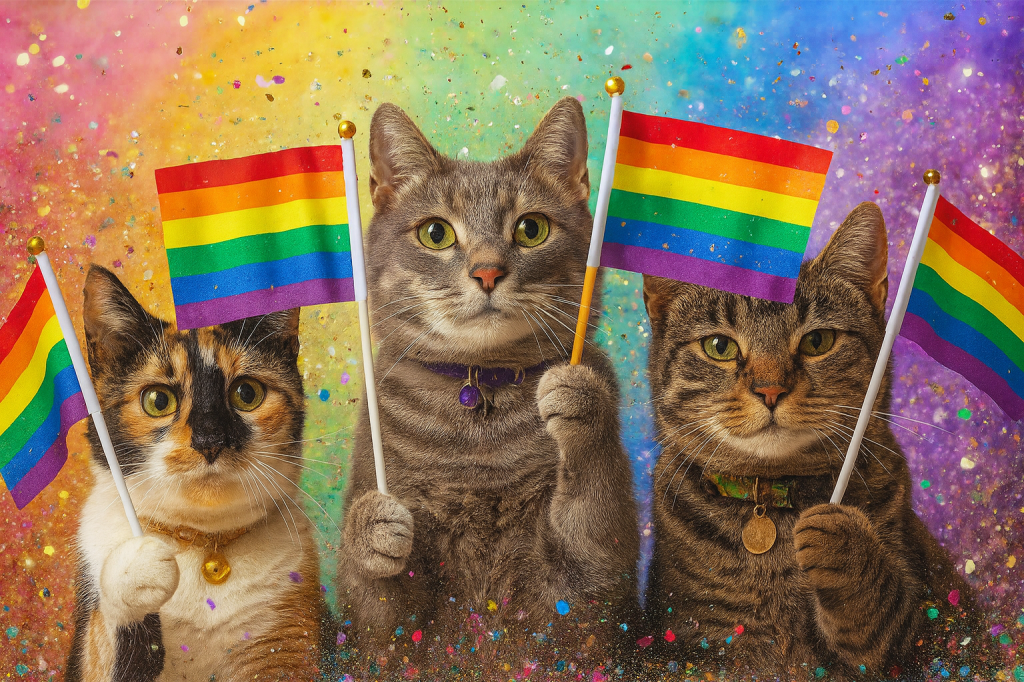
This household stands with the LGBTQ community. We have claws out. The sage lit. The charcoal glowing. And Piper ready to scream at anyone who needs a reminder. The cats strut away like they just won the Miss America pageant. They exit the room in slow motion. With tails high. And theme music swelling. Thanks for reading! Happy Pride!
Affirmation: My spirit is steady. My boundaries are blessed. And my queer joy is non‑negotiable. No law, no headline, and no nonsense can dim the light I carry. Or the claws backing me up.
“My peace stays protected because I refuse to wrestle with hypocrisy. Especially when my cats can spot it faster than I can.”
-This Puzzled Life
Light the charcoal. Sprinkle the sage. Negative energy go away. Today we’re talking about conservative Christians who shame the LGBTQIA+ community while swimming in hypocrisy so deep they need a snorkel, a flotation device, and a word with Jesus Himself. And doing the spiritual equivalent of showing up to church with a flask in their Bible cover.
Piper has already put on her “I’m judging you but politely” face. Coco is pacing like she’s waiting for someone to confess on camera. Tinkerbell has taken one look at the hypocrisy and gone back to bed because she said, “Mama, I don’t have the emotional bandwidth for this.” If hypocrisy were a sport, half these folks would have endorsement deals. It is not ankle‑deep. It is not knee‑deep. It is baptism‑level immersion. Gather your spirit, your boundaries, and your emotional support snacks, we’re going in.
You ever notice how the loudest voices yelling “SIN!” are the same ones who have a secret second family. Or are having premarital sex that they condemn others about. They have a prayer request list longer than the CVS receipt. And a browser history that would make a demon blush? They’ll shame queer folks for existing. Then turn around and gossip so hard the angels have to put in earplugs. They’ll say, “We’re just protecting traditional values.” While their own values are out back doing donuts in the church parking lot. They’ll say, “We’re worried about the children.” While their children are on TikTok learning more compassion in 30 seconds than the adults have learned in 30 years.
Piper watches conservative Christian culture shame queer folks and whispers, “If hypocrisy were a spiritual gift, half these people would be apostles.” She sits on the arm of the couch like a bishop. She remembers the potluck of 2014. She knows who brought the store‑bought potato salad and lied.
Coco sees the hypocrisy and immediately starts knocking things off the counter. She says it’s “symbolic.” She says she’s “cleansing the space.” She says if one more person uses Jesus as a weapon, she’s flipping the whole table like it’s the Last Supper Reunion Special. And she is one tail flick away from staging a full‑scale revival.
Tinkerbell curls up in my lap and whispers, “If they spent half as much time loving people as they do policing them, the world would be healed by now.” Then she falls asleep because the hypocrisy exhausted her spirit. It hurts. I really does.
To be told you’re wrong for loving. To be told you’re broken for existing. To be told your joy is sinful while someone else’s cruelty is “righteous.” But the ancestors keep whispering, “There is nothing wrong with you. There has never been anything wrong with you. The problem is the mirror they refuse to look into.” And that mirror is dusty.
Piper says, “Judge not, lest ye be caught doing worse behind the fellowship hall.” Coco says, “Shame is not a ministry. But I can make it one if needed.” And Tinkerbell says, “Take a nap. You deserve softness.” And I say, “We will not shrink. We will not apologize. We will not dim our joy to make someone else’s fear comfortable.”
That concludes today’s sermon on love, truth, and the Olympic‑level gymnastics required to shame queer folks while ignoring your own mess. Piper has officially closed her Bible and whispered, “This ain’t what Jesus meant.” Coco is knocking over a decorative cross because she said the energy is fraudulent. Tinkerbell has curled up on my chest and declared the hypocrisy “spiritually crusty.”
Bless your identity, your joy, your pronouns, your peace, and your whole queer spirit. Because if conservative Christian culture insists on swimming in hypocrisy, then we’ll be over here floating in truth, glitter, and emotional freedom. And supervised by three cats who refuse to let shame win.
Affirmation: I walk in truth, joy, and glitter‑coated freedom. No shame formed against me will prosper, because my spirit is protected, my boundaries are blessed, and my cats will hiss at anything that tries me.
“Let them call you too much. Some people only say that because they’ve never met someone who refuses to live on mute.”
-This Puzzled Life
Light the charcoal. Sprinkle the sage. Let the smoke rise like it’s clocking in for its shift. Like it’s ready to escort every dusty opinion, every unsolicited critique, and every generational expectation straight out the front door. The moment somebody decides to inform you that you are either “too much” or “not enough,” that’s when the ritual begins. That’s when you cleanse the room. Clear the energy. And prepare yourself for the comedy of errors that is other people trying to regulate a spirit they did not create. And once that sage hits the air? The truth comes out like it’s been waiting backstage with a mic and a spotlight.
You know that moment when your family, your friends, and the entire Southern social order gather around like a committee of porch‑sitting elders. And they proceed to inform you, very gently, very prayerfully, that you are either too much or not enough? That’s the moment you realize you were never the problem. The problem was the committee.
It always starts with someone holding a casserole like it’s a moral authority. They pull you aside and say, “We’re just worried.” Worried about what? Your volume? Your opinions? Your refusal to shrink yourself into a polite, beige, church‑approved silhouette?
They’ll say, “You’re too loud,” “You’re too emotional,” “You’re too confident,” And “You’re too honest.” And then, without even inhaling, they’ll pivot to, “You’re not grateful enough,” “You’re not humble enough,” “You’re not patient enough,” And “You’re not quiet enough.” Am I a Category 5 hurricane or a lukewarm drizzle? I cannot be both the storm and the drought.
There is nothing like being raised in a culture where people will literally say, “Bless your heart,” while handing you a personality correction like it’s a church bulletin. They want you to be authentic, as long as, your authenticity fits inside their emotional carry‑on bag. They’ll warn you “Tone it down,” “Don’t rock the boat,” “Don’t embarrass the family,” and “Don’t say that out loud.” Meanwhile, the family has been embarrassing you since 1986.
One day, you wake up and realize you are not auditioning for the role of “Acceptable Human #3” in someone else’s life. You stop editing your personality for people who don’t even proofread their own lives. You stop shrinking your joy to fit someone else’s comfort zone. You stop apologizing for existing at full wattage. And suddenly the same people who said you were “too much” start whispering, “She’s changed.” No, you haven’t. You just stopped offering the discounted version of yourself.
People call you “too much” when they’ve built their lives around being less. People call you “not enough” when they want you small enough to manage. People call you “intimidating” when they’re used to being unchallenged. People call you “dramatic” when they’re used to you swallowing your feelings like communion wafers. You are not too much. You are not, not enough. You are exactly the right amount for the life you’re meant to live.
Let’s start by rewriting the script. If they say you’re too loud. Maybe they’re too quiet. If they say you’re too emotional. Maybe they’re emotionally constipated. If they say you’re too confident. Maybe they’re allergic to self‑esteem. And if they say you’re too honest. Maybe they’re used to lies dressed as manners. You are not a problem to be solved. You are a whole person with a whole personality or many. And if that rattles the folding chairs at the family reunion, then let them rattle.
The next time somebody tries to hand you a personality correction like it’s a bulletin from the usher board, just smile. Adjust your crown. And keep walking. Because if being fully yourself shakes their table. Flips their pew. And rattles their casserole. Maybe the problem isn’t your volume. Maybe it’s their weak foundation. Opinions are like buttholes. We all have them. And they all stink. Thanks for reading! And keep letting your light shine no matter what they say.
Affirmation: I honor the fullness of who I am. I expand anyway, shine anyway and take up the space my spirit was built for.
“If catching gay were possible, I’d have turned half this town by now just by standing nearthe produce section.”
-Unknown
Light the charcoal. Sprinkle the glitter. Negative energy go away. It’s Pride 2026! And I just got a text from my red hat relative that said, “Praying for you during this difficult season of rainbow confusion.” Ma’am, the only confusion here is why you think Jesus would skip the parade. My neighbor just taped a sign to my mailbox that says, “We don’t hate you. We just hate your lifestyle.” Ma’am, the only lifestyle I’m living is hydrated, moisturized, and unbothered. Something your church potluck potato salad could never relate to.
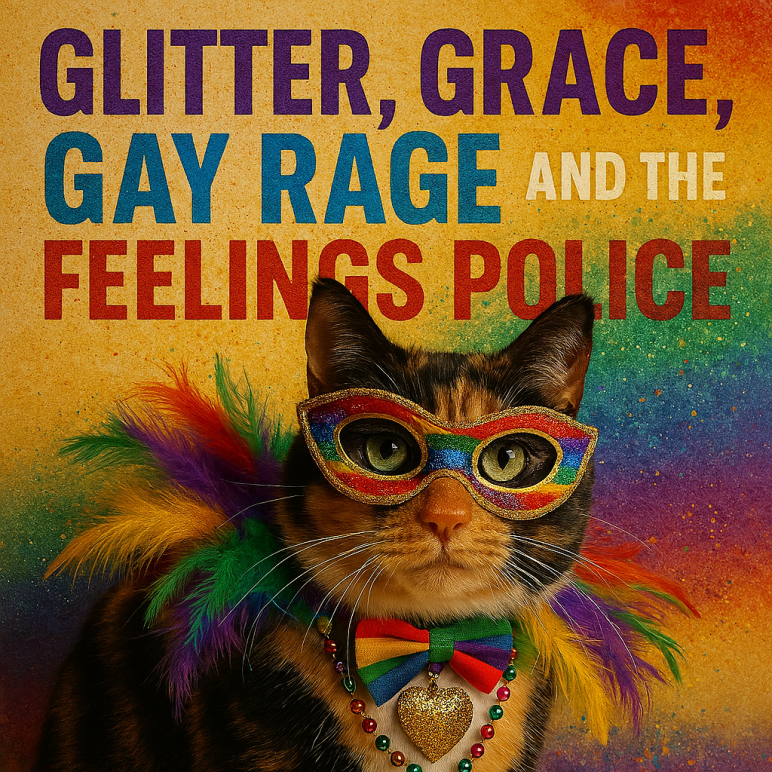
Welcome back to This Puzzled Life, where the cats are dramatic. The snacks are questionable. And the Pride decorations mysteriously disappeared after my neighbor’s Bible study group “accidentally” parked in my yard. This year’s Pride theme? “Glitter, Grace, and Gay Rage.” And yes, the cats have thoughts.
Meanwhile, my cats are already in the living room holding a strategy meeting about which Pride float they plan to hijack. The engines roared. The asphalt trembled. And the red‑hat brigade clutched their pearls like they were auditioning for a Victorian fainting couch.
Tinkerbell: “That sound is freedom, Brenda.”
Piper: “I tried to hop on a Harley. They said no. I said ‘cowards.’”
Coco: “They look like they could fix a carburetor and my self-esteem.”
The queens rolled by on a float shaped like a giant glitter‑encrusted Bible with a banner that read, “JESUS SAID LOVE EVERYBODY. Y’ALL JUST CAN’T READ.” My red hat wearing uncle gasped so hard he almost inhaled a sequin.
Coco: “Finally, someone with the confidence I deserve.”
Piper: “I asked one queen to adopt me. She said she already had three cats. I said ‘same.’”
And right as a queen in a rhinestone robe blew a kiss to a group of teenagers, one of the red‑hat ladies muttered, “This is how they turn kids gay.”
Me: “Sweetheart, if you could catch gay from a drag queen reading a book, half the South would’ve come out during library story hour.”
Piper: “Honestly, that would’ve solved a lot of problems.”
Coco: “Imagine thinking literacy is contagious but kindness isn’t. And calling other people “woke” while your leader is basically a tangerine influencer with two boyfriends.”
Tinkerbell: “Bless her heart. And by bless, I mean educate.”
Next, were the beautiful furries that lighten the mood. A neon wolf handed me a sticker that said, “You’re valid, babe.” A sparkly fox tried to pet Piper. Piper hissed. The fox hissed back. Mutual respect was achieved.
Tinkerbell: “They are kind, gentle creatures. Unlike the family values feelings police.”
Then came the leather community walking in polished boots, harnesses, vests, and enough confidence to power the entire parade without electricity. The conservative Christian red‑hat brigade froze like someone had unplugged their programming. One leather daddy walked past holding a sign that said, “CONSENT IS HOLY.”
Coco: “I like them. They mind their business and moisturize.”
Piper: “One of them winked at me. I don’t know what it meant. But I felt powerful.”
Tinkerbell: “They have better manners than half the people at your family reunion.”
Meanwhile, one red‑hat lady whispered, “This is inappropriate for children.” Ma’am, your child just watched a wolf hand out emotional support stickers. They’re fine. One of the red hats approached me and said, “We’re here to defend traditional families.”
Me: “Sweetheart, my family includes three cats, a vape pen, and a group chat called ‘Queer & Petty.’ We’re thriving.”
Coco: “She asked if I was saved. I said I was spayed.”
Piper: “I offered her a rainbow sticker. She recoiled like I was handing her a tax increase.”
Tinkerbell: “She tried to quote Leviticus. I countered with RuPaul. She had no defense.”
And then the girls decided about the importance of being happy in life. Here are their responses.
Piper: “I want lasers, snacks, and a fog machine that smells like lavender.”
Coco: “I want a float that plays Beyoncé and throws shade.”
Tinkerbell: “I want a float that offers hydration, affirmation, and a safe space for questioning squirrels.”
Just when the parade felt like it couldn’t get any more radiant, the Trans Joy Float rolled in. It was a shimmering, sky‑blue and cotton‑candy‑pink cloud of pure euphoria. The float glowed like someone had bottled sunrise and set it loose on wheels. Silk flags rippled in the air. Bubbles drifted like blessings. And a banner stretched across the top reading, “TRANS IS BEAUTIFUL. TRANS IS HOLY. TRANS IS HOME.”
The crowd erupted. They shouted cheers, tears, and hands over hearts. And our trans community seems to be the personal scapegoat of the red hat leader in our country this year. Even the furries paused their chaotic frolicking to clap.
Piper: “I want to live on that float. They have snacks and good lighting.”
Coco: “Those outfits are immaculate. I respect a community that commits to a color palette.”
Tinkerbell: “This is what liberation looks like. It’s soft, fierce, and unapologetically alive.”
A group of trans elders stood at the front, waving like royalty. Behind them, trans teens danced with the kind of joy that makes the air feel lighter. And in the very back, a trans man in a sparkly binder held a sign that said, “I survived. I’m thriving. Keep up.”
The red‑hat brigade tried to look away, but the float was too bright, beautiful, and full of life to ignore. One of them muttered, “This is confusing.”
Me: “Sweetheart, compassion isn’t confusing. You just haven’t tried it yet.”
Tinkerbell: “Bless her heart. And by bless, I mean educate.”
So, sprinkle the glitter. And tell your neighbor that Jesus fed people without asking for a lifestyle audit. Pride isn’t a phase, a parade, or a “difficult season of rainbow confusion.” It’s a declaration. A reclamation. It’s a glitter‑coated refusal to shrink that fills in the cracks of oppression. It’s Dykes on Bikes shaking the pavement. Drag queens blessing the crowd like queer clergy. Furries handing out emotional support stickers. The leather community teaching consent. And that’s better than half the churches in this zip code. And, finally, it’s the red‑hat feelings police losing theological debates to a cat in rainbow sunglasses. It’s my family that is chosen, furry, chaotic, and unbothered.
Piper: “If they don’t like it, they can look away. I’m queer, chaotic, and emotionally unavailable. Happy Pride.”
Coco: “Piper you are not gay. I’m not either. But I am petty. And that counts. But if they look away, I’ll make them look back.”
Tinkerbell: “Child, Pride is holy. Act like you know.”
And me? I’m hydrated. I’m moisturized. I’m queerly fortified. And I’m done explaining myself to people who think glitter is a threat. This is Pride 2026. This is my life. This is my family. And it’s me standing here in full queer glory. And watching people scream about “wokeness”, while their own orange‑tinted leader wears a full face of makeup. Which reportedly, he swoons over someone named Bubba. And keeps a communist‑flavored second daddy on speed dial. But somehow I’m the one who threatens traditional values. And if that offends you? Take it up with Jesus. He’s at the parade. Thanks for reading! Happy Pride!
Affirmation: I am unbothered. Uncloseted. And untouchable. I’m too hydrated for hate. And too holy for homophobia.
“You can’t heal in the same environment that taught you to hide your wounds. Sometimes the bravest thing you’ll ever do iswalk away from the place that expected you to stay broken.”
-This Puzzled Life
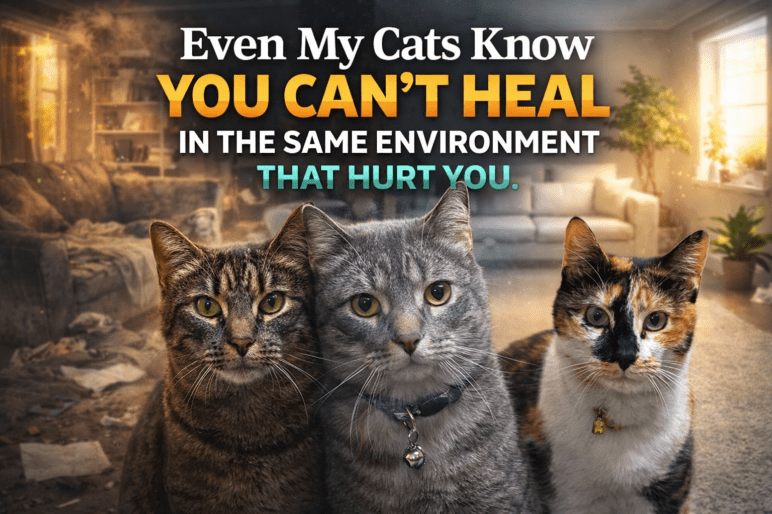
Light the charcoal. Sprinkle the sage. Apparently, healing requires both barbecue energy and spiritual pest control. Welcome back to my household. Where the cats run the HOA. The ancestors run the commentary. And I’m just trying to unlearn 30 years of “bless your heart and keep suffering quietly.” Today’s sermon is titled, “You Cannot Heal in the Same Environment That Hurt You.” And yes, the cats have notes.
You ever try to heal in the same place that taught you to pretend everything was fine? It’s like trying to detox from sugar while sitting inside a Krispy Kreme with the “Hot Now” sign glowing like the gates of temptation. Meanwhile, my Southern upbringing is in the corner whispering, “Well now, you can leave, but don’t you dare make a scene. And take this casserole so folks don’t think you’re ungrateful.”
Healing in the same environment that hurt you is basically a full‑contact sport. You’re dodging old triggers. Outdated expectations. And that one relative who still thinks therapy is “for people who don’t pray hard enough. And still thinks Obama personally raised your rent.” Nothing says emotional clarity like feline commentary.m
Coco (the judgmental one): “Girl, you keep trying to heal in the same room where your trauma sleeps. Move the furniture or move yourself.”
Piper (the chaotic one): “I say we knock everything off the shelves and start fresh. Healing begins with destruction.”
Tinkerbell (the Southern belle of the group): “Bless your heart. Even Jesus left Nazareth.”
And honestly, they’re right. Cats don’t stay in places that stress them out. They relocate with the confidence of a woman who knows she’s too good for this nonsense.
Southern Conservative Truth #1
“If it ain’t working, you don’t fix it. You replace it.” This applies to lawn chairs, husbands, and emotional environments.
Southern Conservative Truth #2
“You can’t grow tomatoes in poisoned soil.” But you can grow generational trauma if you keep watering it.
Southern Conservative Truth #3
“If the dog keeps biting you, stop blaming the dog and fix the fence.” Stop expecting people who hurt you to suddenly develop character.
Southern Conservative Truth #4
“You can’t sit on a broken chair and then get mad when you hit the floor.” If the environment is unstable, your healing will be too.
Southern Conservative Truth #5
“If the chicken’s burnt, the oven ain’t gonna apologize.” Some folks will never take accountability. Move on.
Southern Conservative Truth #6
“You can’t plant hope in a field full of denial and expect a harvest.” Healing requires fertile ground. Not family members who think boundaries are disrespectful.
Southern Conservative Truth #7
“If the swamp keeps producing gators, stop acting surprised when you get bit.” Patterns are patterns, not mysteries.
And of course, the cats had to weigh in again.
Coco: “Humans love staying in toxic places because they’re sentimental. Cats leave because we’re smart.”
Piper: “If the vibes are off, I’m gone. No explanation. No forwarding address.”
Tinkerbell: “A lady does not heal where she was harmed. She relocates with grace and a fresh can of Fancy Feast.”
Here’s the truth they don’t stitch on pillows. You cannot heal in the same environment that taught you to shrink, hush, or swallow your own voice like it was impolite to exist. You cannot bloom in soil that resents your roots. You cannot rise in a room built to keep you small. And you sure as hell cannot become your highest self in a place that only wanted the quiet, obedient version of you.
Healing requires space. Not the kind of space where you shove your feelings into a Tupperware container and label it “Later.” I mean real space. The kind where you can breathe without hearing echoes of who you used to be. Healing requires distance. Healing requires disruption. Healing requires the courage to walk away from the familiar and toward the version of you that refuses to die in the same cage she was born in.
Sometimes that means leaving the room. Sometimes that means leaving the house. Sometimes that means leaving the whole dang ZIP code. And sometimes it means telling your inner Southern critic, “No ma’am, we are not staying here out of politeness.” Healing requires new air, new light, new boundaries, and sometimes, a new porch to sit on while you process your life choices.
Leaving the environment that hurt you isn’t betrayal. It’s survival. It’s reclamation. It’s the moment you decide your healing deserves better than the bare minimum. And if anyone has a problem with it. Just tell them the cats said you’re unavailable for nonsense until further notice. And that’s on healing. Now excuse me while I sage the house like I’m trying to smoke out a demon.
So let them talk. Let them misunderstand you. Let them clutch their church bulletin and call it rebellion. Let them say you’ve changed. Because God knows you have. And thank goodness for that. You are not obligated to stay where your spirit was suffocated. You are not required to keep shrinking to fit the room. You are allowed to outgrow the places that could not love you whole.
And if anyone has a problem with your healing journey, tell them, “I didn’t leave because I was angry. I left because I was finally ready to breathe. And once you taste oxygen, you don’t go back to drowning.” Thanks for reading! And stop shrinking for their comfort.
Affirmation: I honor my healing by choosing spaces that honor me. I release the rooms that dimmed my light. And I rise in environments that celebrate my growth, my boundaries, and my becoming.
“A nation that forgets its fallen has already surrendered its soul.”
-This Puzzled Life
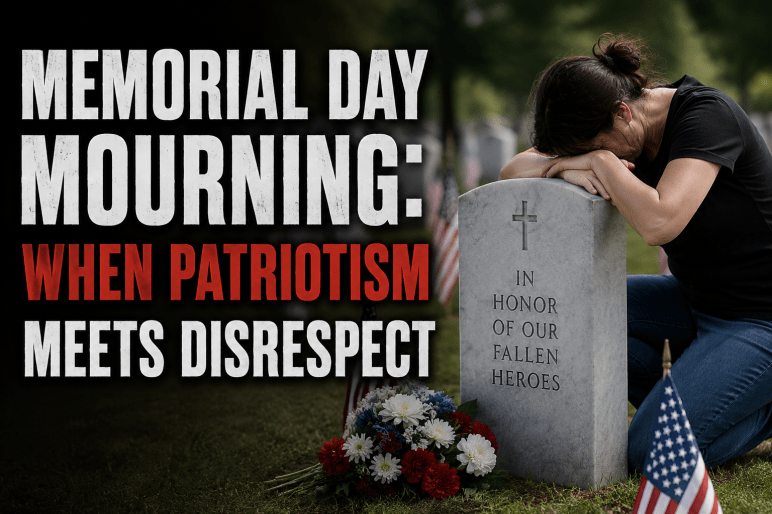
Light the charcoal. Today, ancestors, I need you close. I need every grandmother who prayed over folded flags. Every great‑uncle who never made it home. Every lineage‑bearer who stood against tyranny with nothing but grit, fear, and a trembling hope that their sacrifice would mean something. I need them all gathered around this fire with me. Because my heart is breaking in a way I can feel in my teeth.
Memorial Day is supposed to be sacred. A day of reverence. A day where the air itself feels heavy with memory. A day where we whisper “thank you” to the ones who went in our place. I don’t care how they voted. What bumper sticker they had. Or what political arguments they hollered at the TV. They went. They stood in the line of fire so I didn’t have to. They carried the weight of a nation on their backs. And some never came home to tell the story.
And now. We are living in an era where their sacrifices are being mocked. Minimized. And twisted into political theater. Where illegal war chew up American lives for reasons that don’t hold water. Where the Commander‑in‑Chief has openly called fallen soldiers “losers” and “suckers,” according to multiple reports from former officials. And I swear, ancestors, I can feel you shifting in your graves like, “We did NOT fight fascism for this.”
Let me be clear. This isn’t about politics. This is about decency, honor, and basic human respect. And they are the qualities that should never be partisan. And yet here we are. Watching behavior that would’ve gotten any of our mamas slapped with a sandal for raising someone so disrespectful. Here are examples that are widely reported. Documented. And discussed. They are of how Donald Trump has disrespected veterans and fallen soldiers.
Calling fallen soldiers “losers” and “suckers”– reported by multiple sources which including former senior officials. My ancestors just collectively rolled their eyes so hard the earth tilted.
Skipping a WWI cemetery visit in France because “it was raining.” Sir, they fought in trenches full of mud, blood, and rats the size of emotional support animals. You can handle a drizzle.
Attacking Gold Star families-families who lost loved ones in service. The audacity. The disrespect. The spiritual malpractice.
Mocking Senator John McCain’s capture-“I like people who weren’t captured.” My ancestors are now pacing the room with hands on hips.
Using the military as political props-something every veteran I know despises. Because service is not a campaign backdrop.
Delaying military aid for political leverage-which put actual soldiers at risk. The ancestors have now lit their own charcoal.
And the emotional stability? Lord. It’s giving “someone sprinting down the interstate with their bra and underwear on the outside of their clothes.” It’s giving me chaos. It’s giving “not a single ancestor signed off on this behavior.” And the compassion? About as present as a cactus at a cuddle party.
This is not how you honor the fallen. This is not how you respect the living. This is not how you lead a nation that has buried far too many of its children. My ancestors fought authoritarianism with their bare hands. Their last breaths. Their prayers whispered into the dirt. And now authoritarianism is parading through our streets wearing a red hat and a tantrum. While insisting it’s the second coming of patriotism. It’s not patriotism. It’s performance. And it’s breaking my heart.
And so, on this Memorial Day. I stand here with the charcoal lit. And the ancestors gathered like a celestial neighborhood watch, I have to say it plainly. America cannot honor its fallen while allowing a man who dodged the draft five times to strut around pretending to be the patron saint of patriotism. America cannot claim to respect sacrifice while elevating someone who avoided service with the infamous “bone spurs” excuse. A condition that miraculously healed the moment the danger passed and the privilege resumed. America cannot pretend to value courage while applauding someone whose greatest battle was apparently against accountability.
Because let’s be honest. The disrespect being hurled at our veterans and fallen soldiers isn’t coming from a place of strength. It’s coming from a place of entitlement so bloated it could have its own gravitational pull. It’s coming from a man who has never had to work for anything. Who has never known the terror of a battlefield. Who has never stood in the boots of the people he mocks.
And the behavior? Hold my sweet tea. We are watching a grown man. A man who holds the highest office in the land. Who is behaving with the emotional steadiness of someone who discovered social media for the first time and decided to treat it like a 3 a.m. confessional booth. Extended blinking sessions like he’s buffering. Late‑night ranting on whatever platform will still have him like Temu Twitter. And typing like a raccoon who found a phone in a staff member’s purse at a memory care facility. And is now live‑blogging its escape attempt.
And the consistency? The only thing consistent is the stench both literal and the metaphorical odor of disrespect, chaos, and ego that follows him like a cloud of Axe body spray applied by a teenager who doesn’t understand dosage.
Meanwhile, our fallen soldiers. The ones who actually knew sacrifice. Who actually faced danger. Who actually gave everything. Are being used as props in a performance that dishonors everything they stood for. My ancestors fought tyrants who believed they were above the people. Above the truth. And now, authoritarianism is parading through our streets loud. Petty. Self‑obsessed. And wrapped in a flag it does not deserve to touch.
So, hear me clearly. I honor our fallen. I honor our veterans. I honor every soul who went in my place so I could live free. But I will not and cannot stay silent while their memory is dragged through the mud by someone who never carried anything heavier than his own ego. This Memorial Day, I stand with the ancestors, the fallen, and the truth. And to the one disrespecting them? Your performance is over. Your act is tired. And the nation you claim to love deserves better. Thanks for reading! God bless those who lost their lives and took a stand against fascism and tyranny. What are your thoughts?
Affirmation: I honor the brave. I speak the truth. And I stand with the ancestors who fought for freedom before me.
“My boundaries are so tight now that if you overstep, my spirit will escort you back to your lane before I even open my mouth free of charge.”
-This Puzzled Life
Light the charcoal. Sprinkle the sage. The ancestors have gathered on my porch like it’s a family reunion, and they are whispering, “We did NOT endure Jim Crow, bad perms, and church fans with funeral ads on the back for you to let people treat your peace like a community potluck.”
Meanwhile, my cats have formed a boundary tribunal on the kitchen counter. Tails flicking. Eyes narrowed. And judging me with the same intensity they use when I buy the wrong flavor of treats.
One cat is channeling Harriet Tubman energy. Another is giving “your great‑granddaddy who didn’t play about his land.” The third is licking her paw like, “Let’s see if she finally learned how to say no without a 12‑slide PowerPoint.”
So welcome to Boundary School. Where the ancestors are the professors. The cats are the teaching assistants. And I am the student who keeps asking, “Is this going to be on the test?” People know the word boundaries the way they know the word ‘fiber.’ They’ve heard it’s important. But they have no earthly idea how to actually use it.”
People think boundaries are a vibe, a mood, a Pinterest board, or a cute quote on Instagram with a beige background. Boundaries are actually a set of rules that protect your time, energy, and sanity. A spiritual fence. A divine “Do Not Disturb” sign blessed by your ancestors. Boundaries are not rude. They are not mean. They are not optional. They are emotional sunscreen. And some of y’all are out here raw‑dogging the sun.
People misinterpret boundaries the way they misinterpret IKEA instructions. They think they understand. But the final product is wobbling. Missing screws. And leaning against the wall for emotional support. And people will swear you need their approval like it’s oxygen. When really it’s more like glitter which is unnecessary. Messy. And half the time it ends up places it shouldn’t.
Here’s the thing. You don’t need outside validation to live your life. Make your choices. Or protect your peace. You’re not a coupon that needs to be scanned. You’re not a parking ticket waiting for someone to stamp “approved.” You’re a whole human being with ancestors behind you. And a spirit that knows exactly what it’s doing.
People will misinterpret your confidence as arrogance. Because they’re used to you shrinking. They’ll say things like “You sure about that?” “I mean if that’s what you want to do.” Or “you’re making a mistake. But suit yourself.” When the only mistake would be letting people who can’t manage their own lives narrate yours.
My cats don’t seek validation. They don’t ask, “Was that a good jump?” They don’t wonder, “Do you like my vibe today?” They simply exist confidently, unapologetically, and occasionally on top of the fridge for no reason. Meanwhile, humans out here waiting for applause before they take a step.
Here’s the truth the ancestors keep whispering. “If you need permission, you’ll always be waiting. If you trust yourself, you’ll always be moving.” Your worth is not up for a vote. Your decisions are not a group project. Your life is not a suggestion box. You don’t need validation. You need alignment. And those are two very distinctly different things.
Some folks hear the word “boundaries” and immediately translate it into, “You’re being mean.” “You’re shutting me out.” “You think you’re better than me.” “You must be going through something.” Or my favorite “You’ve changed.” No, sweetheart. I’m not being mean. I’m being clear. And clarity feels like cruelty to people who benefited from your confusion.
Boundaries are not punishment. They are not revenge. They are not emotional eviction notices. But people will swear up and down that your boundary is a personal attack. Even though all you said was, “I’m not available for that.” Suddenly you’re the villain in their story. the antagonist in their memoir, the reason their tomato plants won’t grow this year.
Meanwhile, my cats set boundaries all day long and nobody questions it. A cat can walk away mid‑petting session, and everyone says, “Aww, look at her being independent.” But let a human say, “I need some space,” and suddenly it’s a federal investigation. Boundaries get misinterpreted because people confuse access with entitlement. They think your time is their time. Your energy is their energy. Your peace is their playground. And when you finally say, “Actually, no,” they act like you’ve personally unplugged their life support.
But here’s the truth and the ancestors are nodding in agreement. A boundary is not a wall. It’s a door with a lock. And you get to decide who has the key. Boundaries fall into categories and knowing them helps you enforce them without guilt.
1. Physical Boundaries
Your body, your space, your bubble. If someone stands too close, you have the right to step back like a cat avoiding a toddler.
2. Emotional Boundaries
You are not a sponge. You are not a therapist. You are not a free emotional storage unit.
3. Time Boundaries
Your time is not a community resource. You are not FEMA.
4. Material Boundaries
Your car, your money, your Tupperware. Especially the Tupperware. The ancestors get real loud about that one.
5. Conversational Boundaries
You don’t have to discuss things that drain you. You can simply say, “I’m not available for that topic,” and walk away like a cat who heard the treat bag but decided you weren’t worthy.
WHY HUMANS STRUGGLE (AND CATS DO NOT)
Humans: “I don’t want to hurt anyone’s feelings.”
Cats: “I will leave this room mid‑sentence and feel nothing.”
Humans: “I don’t want them to think I’m mean.”
Cats: “I will slap your hand away and then take a nap.”
Humans: “I don’t want to disappoint people.”
Cats: “I disappoint people recreationally.”
Cats are boundary prodigies. Humans are boundary interns.
The ancestors want you to know that “No” is a complete sentence. “I’m not available” is a spiritual practice. “That doesn’t work for me” is a generational blessing. “I’m leaving now” is self‑care. “I don’t receive that” is emotional pest control. They also want you to stop explaining yourself like you’re applying for a loan.
And as we close this ceremony of wisdom, comedy, and feline judgment, let us honor the truth. The ancestors did not survive oppression, heartbreak, and church potlucks with questionable potato salad for you to let someone’s grown child drain your spirit like a cracked Yeti cup. Your boundaries are sacred. Your peace is ancestral property. Your “no” is a generational blessing.
May your boundaries be as firm as a cat who has decided your pillow is now their homeland. May your spirit be as unbothered as a cat ignoring its name. May your peace be as protected as the good Tupperware. And may your boundaries rise up like your ancestors intended.
My boundaries are set. My peace is protected. And my spirit is no longer accepting walk‑ins. If you can’t handle that, take it up with the ancestors. They’re the ones who told me to stop letting folks treat my life like an open‑bar wedding. And with that, I’m stepping back into my joy, my clarity, and my God‑given right to say “no” without a dissertation. Thanks for reading! And protect your peace.
Affirmation: “I honor my peace like it’s heirloom china. I say no with confidence, yes with intention, and I protect my energy the way my ancestors protected the good cornbread recipe.”
“I’m not tired. I’m Southern‑tired. Which means my soul needs a nap. My spirit needs a snack. And my cats need me to stop acting like I’m immortal.”
-This Puzzled Life
Light the charcoal. Sprinkle the sage. Let the ancestors clock in for their shift. Today’s energy walked in here barefoot. Tracking mud across my spirit. And my Southern cats have already filed a complaint. Listen. If self‑care were a Southern woman, she’d be standing on your porch right now. Her hands on hips. Church finger raised saying, “Baby, you look tired. Not regular tired. The kind of tired where even your shadow needs to sit down.”
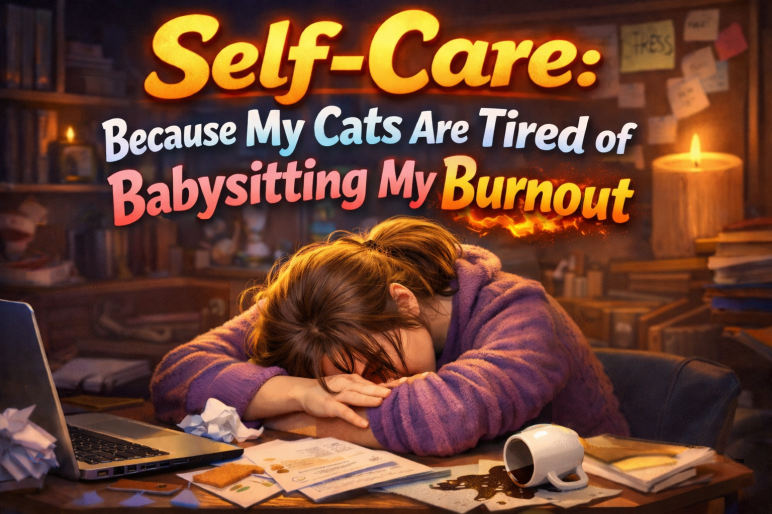
Let me tell you something right now. Self‑care is not optional. Self‑care is not a luxury. Self‑care is not “I’ll get to it after I finish these 47 tasks and emotionally babysit three grown adults.” Self‑care is a requirement like sweet tea at a funeral. Or humidity in July. And if you don’t believe me, that’s fine. The cats do. And they’ve unionized. The cats are inside holding a family meeting about your wellbeing like, “Bless her heart. She tried to drink coffee for hydration again.”
This is not a drill. This is a wellness emergency. This is FEMA‑level fatigue with a side of “I’ll rest when I’m dead.” And the cats have decided they will NOT be attending your funeral if you don’t get it together. Piper has already drafted a strongly worded letter to the universe. Coco is practicing her disappointed stare in the mirror. And Tinkerbell is pacing like she’s preparing to deliver a eulogy she absolutely does not have time for. They’re unified. They’re fed up. And they’ve declared you a Code Red Hot Mess until further notice.
Piper is perched on the counter like a tiny porch‑sitting auntie whispering, “Baby, cleanse this house before the chaos gets ideas.” Coco is circling my feet like she’s smudging the perimeter with her attitude alone. And Tinkerbell has taken her position by the window. And she’s staring into the horizon like she’s negotiating with forces I can’t see. We reclaim the room, the mood, and the moment. Negative energy gather your belongings and exit like you were raised right.
It started last Tuesday when I sat down on the couch. I was exhausted. And holding a cup of coffee that tasted like it had given up on life. Piper hopped up beside me, stared directly into my soul, and said (in fluent Southern telepathy),“Ma’am. When was the last time you drank water?”
Coco strutted in behind her like a wellness coach who charges $300 an hour and doesn’t take insurance. “And when,” she added, “was the last time you sat down without clenching your jaw like you’re trying to crack a pecan with your molars?” Tinkerbell didn’t say a word. She just placed one paw on my knee which is the universal sign for, “Baby, you’re running on fumes and spite.”
People hear “self‑care” and think it means a spa day, a $90 candle, or a bath bomb that promises enlightenment. But real self‑care is things like drinking water before your kidneys file a complaint. Saying “no” without writing a three‑paragraph apology. Resting because your body is not a rental car. Eating something green that didn’t come from a gummy bear. And getting enough rest so that your mind and body has time to digest what’s going on throughout our nation. It’s the quiet, unglamorous maintenance that keeps you from turning into a feral possum in a Dollar General parking lot.
Getting enough rest is not optional. It’s the bare‑minimum maintenance required to keep you from turning into a sleep‑deprived cryptid haunting your own kitchen. Your body is not a 24‑hour Waffle House. And yet you keep acting like folks can wander in at any hour demanding emotional hash browns “scattered, smothered, and covered.” Meanwhile, your Southern cats are watching you shuffle around the house like a ghost who missed their exit to the afterlife.
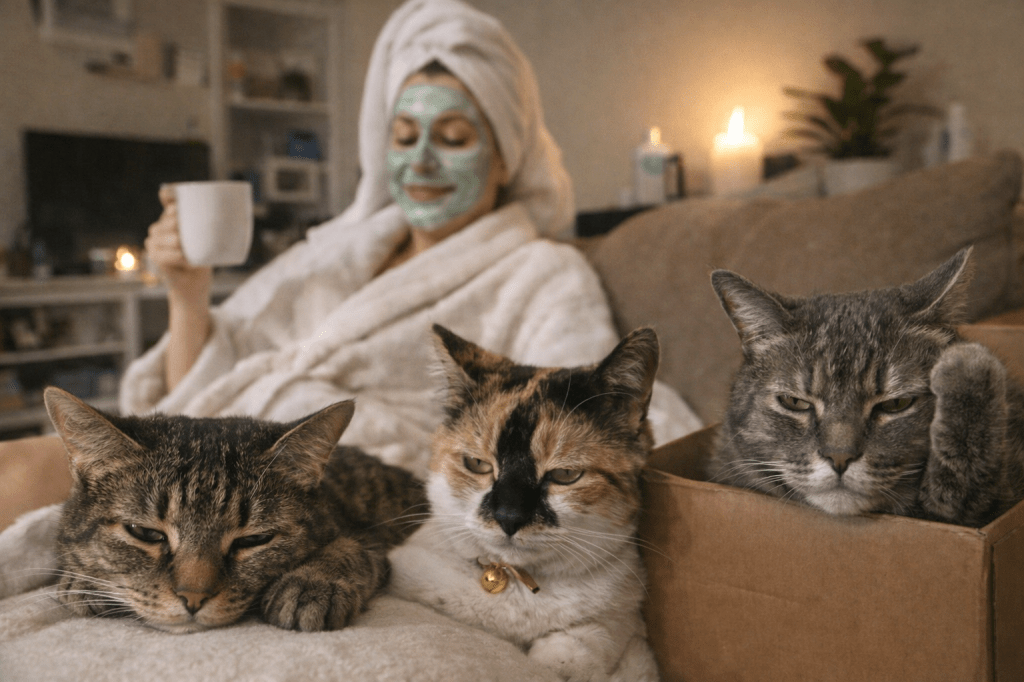
Piper keeps blinking slow like she’s trying to Morse‑code “go lay down.” Coco has already dragged a blanket onto the couch in protest. Tinkerbell is perched on the armrest while giving you that look that says, “If you don’t rest voluntarily, we will stage a wellness coup.” Rest is not laziness. Rest is strategy. Rest is how you keep your spirit from filing for divorce.
Piper naps 19 hours a day and feels no shame. Coco refuses to let anyone touch her unless she specifically requests it. Tinkerbell meditates by staring at the wall like she’s communing with the ancestors. These cats have boundaries so strong they could stop a hurricane. And here I am, letting people text me “hey u up?” at 6 AM like I’m a Waffle House.
Down South self‑care also means ignoring your phone like it’s a bill collector. Sitting on the porch and letting the breeze baptize you. Lighting a candle and telling the ancestors, “Handle it. I’m tired.” And eating a biscuit because joy is medicinal. And yes, sometimes it means telling your entire family, “I love y’all. But I’m off duty today. Please direct all emotional emergencies to Jesus or the group chat.”
Piper says, “Hydrate or diedrate.” Tinkerbell says, “Rest is resistance.” And Coco says, “If you don’t take care of yourself, I will sit on your chest until you do.” Honestly, that last one felt like both a threat and a blessing. You deserve rest. You deserve softness. You deserve to take care of yourself without guilt gnawing at your ankles. Self‑care is not selfish. Self‑care is how you stay alive. Stay sane. And stay Southern without cussing out the entire tri‑county area. This means that I also need to do better at self-care.
So, here’s the truth. And it’s delivered with the force of a cast‑iron skillet hitting a countertop. If you don’t start taking care of yourself, your cats will file a formal complaint with the ancestors. And they will win. Rest. Hydrate. Set boundaries. Do it like your sanity depends on it because it does. We’ve still got many months of with this horrible administration.
Now go practice some self‑care before Piper drafts a PowerPoint. Coco calls HR. And Tinkerbell summons the spirits to intervene. And that’s on sweet tea, porch swings, and minding your blessed business. Thanks for reading! And know that you’re worth it.
Affirmation: I honor my rest. Protect my peace. And let my body recharge without guilt. Because even my ancestors and my cats agree that a well‑rested me is a powerful me.