

The House of Addiction: A Room‑By‑Room Tour of Chaos and Survival

“Some houses echo with laughter. The House of Addiction echoes with lessons. Loud, painful, and unforgettable lessons. And still, somehow, we walk out wiser than we ever meant to be.”

-This Puzzled Life

Light the charcoal. Sprinkle the sage. Let the smoke rise like it’s clocking in for a double shift. What we’re about to talk about requires spiritual PPE. It’s Addiction Awareness Month. And the House of Addiction doesn’t just haunt. It redecorates. It rearranges your memories. Steals your peace. And has the nerve to act offended when you notice.

From the outside, it looks like any other home on the block. But step inside, and you’ll find a floor plan designed by chaos itself. Complete with emotional booby traps and a staircase that creaks like it’s snitching on everybody.

The House of Addiction doesn’t creak when you walk in. It narrates. It knows your footsteps, fears, and soft spots. It knows you’re here for the truth. And it is already rearranging the furniture to make you doubt your own memory.

This house has the audacity of a Southern aunt who swears she “don’t gossip.” But somehow knows everybody’s business. Including the things you haven’t even done yet. Step inside. Keep your shoes on. This floor has seen some things. It will walk room to room with you, pretending it’s just “checking on things.” While it’s really dragging its mess across every surface like a toddler with a Sharpie.

The House of Addiction always looks normal from the outside. Fresh paint. Curtains that match. A porch light that pretends it’s welcoming you in. But the moment you cross that threshold, you realize this house has plans for you. None of them good. All of them messy. And every one of them delivered with the confidence of a demon wearing your grandmother’s pearls.

The Foyer: Where Denial Greets You Like a Nosy Aunt

You step inside and denial is already there. It’s leaning against the doorframe like it pays the mortgage. It’s smiling too big. Talking too fast. And insisting everything is fine. While the smoke alarm screams in the background. “No problem here,” Denial says. All while waving a broom at a fire like it’s a mosquito. The floorboards creak under the weight of secrets nobody wants to say out loud. The air smells like Febreze sprayed over a dumpster fire. This is the room where kids learn to tiptoe. Where silence becomes a second language. Where you learn to read moods like weather reports.

The Kitchen: Where Chaos Cooks Its Famous Disaster Casserole

Addiction loves the kitchen. It treats it like a stage. Pots banging. Cabinets slamming. Someone crying into a sink full of dishes that have been “soaking” since the Bush administration. This is where promises get burned to a crisp. Apologies get reheated for the 47th time. And kids learn to eat fast. Stay quiet. And watch the adults like they’re studying wildlife. The fridge is full of expired groceries and emotional leftovers nobody wants to deal with. And the table is where love tries to sit down. But keeps getting shoved aside by chaos wearing muddy boots.

The Living Room: Where Hope Sleeps on the Couch

The living room used to be cozy. Now it’s a battlefield with throw pillows. Addiction drags its drama in here and spreads out like it pays rent. The TV is always too loud. The arguments are always too sharp. And the kids are always pretending they don’t hear what they hear. Hope still lives here. But it’s exhausted. It curls up on the couch under a blanket that smells like worry. It keeps whispering, “Maybe tomorrow.” Even though tomorrow keeps showing up drunk and late.

The Bedroom: Where Secrets Tuck Themselves In

This room is quiet. But not peaceful. It’s the kind of quiet that hums with tension. Addiction sits on the edge of the bed like a shadow with opinions. It whispers lies into the dark. It says, “You’re the problem,” “You can’t leave,” and “Nobody will believe you.” Kids learn to sleep lightly. To listen for footsteps. To brace for the door opening at 2 a.m. with the kind of energy that never means anything good.

The Laundry Room: Where Shame Hangs Itself Up to Dry

This room is where the truth piles up. Dirty clothes. Dirty secrets. Dirty looks from neighbors who pretend they don’t see what they see. Addiction loves this room because it knows shame thrives in small, cramped spaces. The washing machine is always running. But nothing ever feels clean. The dryer door squeaks like it’s tattling. And the air is thick with “Don’t tell anyone.”

The Bathroom: Where Tears Pretend They’re Just Steam

This is the only room with a lock. Which means it becomes a sanctuary for everyone including kids, partners, even the person struggling. People hide here to cry. Breathe. Or just exist without being needed. Addiction hates this room because it can’t control what happens behind a locked door. But it still bangs on it sometimes while demanding attention.

The Kids’ Room: Where Innocence Packs a Go-Bag

This room is the saddest part of the house. Toys on the floor. School papers on the wall. A bed that’s too small for the weight the child carries. Kids learn how to be invisible. How to be responsible for things they never caused. And how to grow up faster than their bones know how to handle. Addiction tiptoes in here sometimes. While pretending it’s not doing damage. But the cracks in the walls tell the truth.

The Basement: Where the Truth Lives

Nobody wants to go down here. Not even Addiction. But this is where the real story sits quiet, heavy, and waiting. This is where trauma stacks itself like old boxes. Memories hide under tarps. And kids grow up and realize the house wasn’t normal. The basement is the part of the house that never lies. It knows exactly what happened. And it remembers everything.

The Attic: Where the “Old Stories” Live

The attic is dusty, cramped, and full of boxes labeled “We Don’t Talk About That.” This is where Addiction stores the memories you tried to outgrow. The versions of yourself you’re ashamed of. And the lies you were told about who you are.

Every box rattles when you walk by, like it wants to be opened. But also wants to stay sealed forever. Addiction loves this room because it knows you’ll avoid it. It knows the dust will settle on your truth until you forget what it looked like. But the attic is also where the light sneaks in through the cracks. It’s where you eventually realize that some stories aren’t yours to carry anymore.

The Garage: Where “I’ll Fix It Later” Goes to Die

The garage is full of unfinished projects, abandoned hobbies, and promises you meant to keep. Addiction parks itself here like a broken-down car that still thinks it can make the trip. This is the room where dreams get postponed. Goals get dusty. And potential sits on cinder blocks. You keep telling yourself you’ll clean it out “when things calm down.” But Addiction keeps tossing more junk in, insisting you don’t have time, energy, or worthiness to finish anything. But one day, you find the light switch. And you realize the garage isn’t full of failures. It’s full of things waiting for you to come back to yourself.

The Office: Where Control Pretends to Live

This room is where Addiction tries to look responsible. Bills stacked. Calendars marked. To‑do lists half done. Everything looks organized until you touch it. And the whole pile collapses like a Jenga tower built by denial. This is the room where you try to manage the unmanageable. You convince yourself you’re “still functioning.” And you hide behind productivity to avoid the truth.

Addiction sits in the office chair spinning slowly, whispering, “You’re fine. Look how much you’re getting done.” Meanwhile, nothing is actually getting done. But this is also the room where you learn the difference between control and survival. And where you finally fire Addiction from its fake job.

The Guest Room: Where You Pretend Everything Is Fine

This room is spotless. Too spotless. It’s the room you keep ready for visitors. So that they never see the chaos in the rest of the house. Addiction loves this room because it’s the perfect illusion of clean sheets. Fluffed pillows. And fake peace. This is where you host people who say, “You’re so strong.” Without knowing you cried in the hallway before they arrived. But the guest room is also where you learn that pretending is exhausting. And that real connection only happens when you stop hiding the mess.

The Crawl Space: Where the Fear Lives

Low ceilings. No light. Hard to breathe. This is the room Addiction never talks about but always uses. It’s where the fear crawls. It’s the fear of leaving, staying, being alone, and of being seen. Addiction keeps this space damp and cold, so you’ll avoid it. But this is the room where the truth hums the loudest. And when you finally crawl in with a flashlight, you realize the monsters were smaller than the shadows made them look.

The Backyard: Where Healing Starts Growing

The backyard is wild. Overgrown. And neglected but alive. Addiction never cared about this space. It didn’t think you’d ever step outside long enough to notice it. But this is where you breathe again. You plant new habits. You feel sunlight without flinching. And you imagine a life beyond the front door. The backyard is the first place that belongs to you again. It’s where you realize the house doesn’t own you. And where healing doesn’t have to be pretty to be real.

The Front Door: Where Freedom Waits

Every child of addiction eventually finds themselves standing at this door. Their hand on the knob. Heart pounding. And wondering if they’re allowed to leave. The truth is you can. You’re allowed to walk out. You’re allowed to build a new house. One with open windows, soft floors, and rooms that don’t whisper threats in the dark. You’re allowed to create a home where laughter doesn’t flinch. Where love doesn’t hide. And where the only thing haunting the halls is the sound of peace finally settling in. 

And that’s the truth about the House of Addiction. It thought it owned you. It thought you’d stay lost in its attic of old stories. Stuck in its garage of unfinished dreams. And trapped in its crawl space of fear. It thought you’d keep tiptoeing past the guest room. While pretending everything was fine. And where it rearranged your soul like mismatched furniture.

But you just didn’t survive that house. You walked through every room with the lights on. The sage burning. And the ancestors humming behind you like a choir that refuses to let you forget who you are. You learned the floorplan. You named the ghosts. You opened the windows. And then you did the one thing that house never expected. You walked out the front door. And didn’t look back.

Let the walls rot. Let the roof cave in. Let the lies echo in empty rooms. You’re busy building a new home now. One with sunlight, softness, boundaries, and peace that doesn’t apologize for taking up space. Door slammed. Keys dropped. Cycle broken. Story reclaimed. Thanks for reading! Now walk away like a boss.

Affirmation: I honor the child who survived that house. And I empower the adult who refuses to live in it ever again. My peace is mine. My story is mine. And my future is built with steady hands.”

***Don’t forget to watch the video!***

#ThisPuzzledLife
Sexual Assault Awareness: I Survived. Now I Speak. 

“I am not the sum of what was done to me. I am the proof that even in the places where humanity failed, my spirit refused to.”

-This Puzzled Life

Light the charcoal. Sprinkle the sage. Today, I’m going to talk about sexual assault. Religious betrayal. And the kind of generational silence that tries to swallow whole communities. We might as well start with a cleansing. Lord knows the air gets thick when truth finally walks into the room.

There are some topics into which you don’t ease. You cannonball straight in. Bless your heart and everyone else’s. Sexual Assault Awareness is one of them. And if you grew up anywhere near the Deep South like I did, you know we were raised on two things casseroles and silence. One of those is delicious. The other is deadly. So today, we’re breaking the generational habit of whispering about the things that actually need megaphones. Let’s start with the part that makes people shift in their seats like they’re sitting on a church pew with a splinter.

These aren’t “somewhere out there” numbers. These are “in your neighborhood, in your school, in your family, in your church, and in your workplace” numbers. And if that makes you uncomfortable, good. Discomfort is the first sign your moral compass still works.

Survivors are people who still show up to work. Raise kids. Laugh at memes. And try to remember where they put their keys. They’re not broken. They’re exhausted from carrying what should’ve never been theirs to hold. And if you’re a survivor reading this, let me say this plainly. You are not the shame. You are the evidence that harm can be done and still not win. The shame belongs with the perpetrator.

Now, I’m not talking about making light of this kind of crime. That’s not humor. That’s cruelty with a punchline. I’m talking about the kind of humor survivors use to stay alive. The kind that says, “I’ve been through hell. But I still have jokes. So clearly hell didn’t win.” It’s the same humor Southern aunties use when they say things like, “We don’t air our dirty laundry.” While standing in front of a clothesline full of secrets flapping in the wind. Humor is a pressure valve. It lets us breathe while we talk about the things that steal breath.

If someone trusts you enough to tell you they were assaulted, here’s your script. “I’m so sorry that happened,” “I believe you” and “How can I support you right now?” Notice what’s missing? Questions that sound like cross examinations. Advice no one asked for. And any sentence beginning with “Why didn’t you…?” Survivors don’t need detectives. They need validation that the abuse happened and that it wasn’t their fault in any way.

Sexual abuse cases in the U.S. justice system have increased by 62.5% since 2020. Yet the vast majority of survivors never see justice at all. And before anyone says “Well, reporting is easy.” Let me remind you. If reporting were easy, we wouldn’t have a national hotline that stays busy 24/7.

People who’ve lived through abuse, especially abuse justified with moral or religious language, tend to recognize certain dynamics instantly. Power used without accountability. Authority figures protecting each other instead of the vulnerable. Moral language used as a shield for harmful behavior. Gaslighting and denial when confronted with wrongdoing. Silencing or discrediting those who speak up through threats and intimidation. And systems that reward loyalty over truth.

These patterns show up in many places like churches, marriages, schools, corporations, and yes, in government. Survivors often have the clearest radar for institutional betrayal. Because they’ve lived it in the most intimate way possible. When you look at the world and say, “This feels familiar.” That’s not paranoia. That’s pattern recognition born from experience.

I grew up in a world where people could quote scripture faster than they could show compassion. Where pastors’ children could harm a five‑year‑old and still be called “good families.” And where a husband could twist the Bible into a weapon and call it marriage. I know what it feels like to be violated in Jesus’ name. I know what it feels like to be told your body is a man’s property. I know what it feels like when resistance is met with punishment. When silence is demanded. And when trauma is treated like an inconvenience.

Trump said of rape victim E. Jean Carroll “she loved it!” But he also said he didn’t know her. About 29:10 is where he says this. Watch the whole thing and tell me why you think victims don’t come out sooner. This is the way that abusers keep their victims in fear for years. Mine did the same thing.

After a lifetime of being told to stay quiet when people in power start using God, morality, or “order” as a shield, it’s never about holiness. It’s about control. I’ve lived under that kind of control. I’ve survived it. I know exactly what it looks like when someone wraps abuse in scripture and calls it righteousness. So, when I see institutions using the same tactics, same silencing, same moral posturing to protect themselves instead of the people they harm, I don’t need a press release to tell me what’s going on. Survivors recognize the pattern long before the headlines catch up.

What do we do? We talk. We teach. We intervene. We stop pretending this is a “women’s issue” or a “men’s issue” or a “kids these days” issue. It’s a human issue. We raise kids who know consent isn’t a suggestion. We raise adults who know silence is complicity. We raise communities where survivors don’t have to choose between telling the truth and keeping the peace.

And at the end of the day, the pattern speaks louder than any press conference ever could. The world watched as Jeffrey Epstein’s name kept resurfacing in court documents, flight logs, and survivor testimony. The world also watched as questions piled up about who knew what, who looked away, and who benefited from the silence. People aren’t asking these questions because they’re bored. They’re asking because the public record is full of smoke. And every time someone tries to follow it, another door slams shut.

If the Trump administration thought history would politely avert its eyes, they miscalculated. Survivors don’t forget. Journalists don’t forget. The internet definitely doesn’t forget. And the truth has a funny habit of surviving every cover‑up attempt. Because eventually, the receipts outlast the people who hoped we’d stop reading them.

And to my fellow survivors, you are not alone. You are not to blame. You are not too much. You are a whole person with a whole story. And the world is better because you’re still here to tell it. And if anyone tries to silence you, just remember. You come from a long line of people who know how to make noise when it matters.

After the childhood abuse, the marital rape, the spiritual manipulation, the PTSD that still echoes through my bones. I’ve learned something important. Abuse doesn’t just happen in homes and churches. It happens anywhere power goes unchecked. So, if you hear a familiar pattern in the way certain institutions operate today, you’re not imagining it. 

Once you’ve lived through the kind of darkness that tries to disguise itself as divine, you stop being intimidated by titles, pulpits, or podiums. You stop mistaking authority for integrity. And you stop believing that silence is the price of peace. If your power depends on someone else’s silence, it’s not leadership. It’s abuse with better lighting. And survivors like me aren’t afraid of the dark anymore. Thanks for reading! And never let them silence you.

Affirmation: I honor the child I was, the survivor I became, and the woman I am now. My voice is not fragile. It is forged. My healing is not a question. It is a declaration. I rise today not because the past was gentle, but because I am.

***Don’t forget to watch the video!***

#ThisPuzzledLife

Child Abuse Awareness: When the Safe Places Aren’t Safe

“When the places built to protect children become the places that break them, the wound isn’t just personal. It’s a failure of every adult who chose silence over responsibility.”

-This Puzzled Life

Light the candles. Move the breakables. Tell the ancestors to take their seats and pass the sweet tea. We’re not easing into this one. And before the denial committee calls an emergency meeting to rehearse their “But that’s not what we meant” speeches, let’s go ahead and say the quiet part out loud.

Child abuse doesn’t just happen in the home. It happens in classrooms where teachers misuse authority. In churches where “discipline” is weaponized. In sports programs where adults confuse control with coaching. In friend groups where older kids exploit younger ones. And in any space where a child’s safety depends on an adult’s integrity, and that integrity fails.

Let me say this in the clearest way I know how. And  coming from someone who personally knows a little something on this topic, what happened to you was abuse. And it was a betrayal of power. Schools and other places are supposed to be safe. Adults in those buildings are supposed to protect children. You were not protected. And when abuse happens in a place that claims to be safe, the damage hits on multiple layers at once. It’s not just the act itself. It’s the collapse of every structure that was supposed to shield you.

You were a child. They were adults. The responsibilities were never equal. The conflict you still feel between “their job” and “your role” is a direct result of their failure, not yours. The tactics you endured weren’t just harmful. They were calculated. “Diabolical” would be the right word. The cruelty, the gaslighting, the public humiliation? These are methods designed to break a person’s sense of reality and self‑worth. Many adults would crumble under that kind of psychological warfare. Expecting a child to withstand it is unthinkable. And, yet, if you’re reading this, you did. Not because you should have had to. Not because you were equipped for it. But because you had no choice. That’s not resilience by choice. That’s survival by necessity.

Here are a few sources you might want to dive into.

1. Most child abuse is never reported (all types)

U.S. Department of Justice – Bureau of Justice Statistics“86% of child abuse cases are never reported to authorities.” 🔗 https://bjs.ojp.gov/content/pub/pdf/cv22.pdf (bjs.ojp.gov in Bing) (See section on underreporting of violent crime against children.)

2. Children often disclose abuse but are ignored or silenced

Health & Social Care in the Community (2025) Study on child maltreatment disclosures found that children frequently disclose abuse (physical, emotional, sexual, neglect) but are ignored, dismissed, or punished by adults. 🔗 https://onlinelibrary.wiley.com/doi/10.1111/hsc.14336(onlinelibrary.wiley.com in Bing)

3. Delayed disclosure is common across ALL abuse types

CHILD USA – National Think Tank for Child ProtectionOver 70% of victims delay disclosure for at least five years, regardless of abuse type. 🔗 https://childusa.org/wp-content/uploads/2024/01/Delayed-Disclosure-Report.pdf(childusa.org in Bing)

4. Institutional betrayal: schools, churches, programs often ignore reports

Journal of Child Sexual Abuse (applies to institutional responses across all abuse types) Shows that institutions frequently dismiss, minimize, or cover up reports of abuse.🔗 https://www.tandfonline.com/doi/full/10.1080/10538712.2019.1570402 (tandfonline.com in Bing)

Note: While this journal focuses on sexual abuse, the institutional‑betrayal patterns. It’s documents are identical across physical, emotional, and psychological abuse.

5. Teachers and school staff rarely report abuse, even when required by law

U.S. Department of Education Report Only 11% of school personnel who witness or suspect abuse report it. 🔗 https://www2.ed.gov/rschstat/research/pubs/misconductreview/report.pdf (www2.ed.gov in Bing)

6. Children who report abuse are often disbelieved or blamed

National Institute of Justice – Child Abuse Disclosure Research Children frequently disclose abuse but face denial, minimization, or retaliation from adults. 🔗 https://nij.ojp.gov/topics/articles/child-abuse-disclosure-what-research-tells-us (nij.ojp.gov in Bing)

The wound you carry makes sense. Trauma doesn’t fade just because time passes. It imprints itself. It becomes a landmark in the psyche. And  something you walk around, navigate, and learn to live beside. Therapy can help you understand it. But it can’t erase the fact that it happened. And that it shouldn’t have happened. The gaslighting you endured stole something fundamental. Your ability to trust your own perception.

When adults deny a child’s reality, the child learns to doubt themselves. When they shame a child publicly, the child learns their existence is a problem. When adults ignore a child’s cries for help, the child learns that safety is conditional or imaginary. That’s not a child “being dramatic.” That’s a child being abandoned. And then abandonment by the very people who were supposed to protect you happened. The people you trusted were identified as educators, authority figures,  and other adults in power. And that leaves a wound that is both emotional and existential. You were trapped. And that was not your fault.

A child cannot escape a system built around them. A child cannot “just tell someone” when the people they’re supposed to tell are the ones causing the harm or ignoring it. A child cannot “make better choices” when every direction is blocked. You survived in the only ways available to you. Your mind did what it had to do. Your body did what it had to do. Your spirit did what it had to do. Survival is not shameful. Survival is not weak. Survival is not something you owe anyone an explanation for.

 And the fact of the matter is that THE FAILURE WAS THEIRS. NOT YOURS. You were a child. They were adults. They had power. You had none. The responsibility was theirs. The consequences were yours. And that imbalance is the injustice you’re naming. What you lived through would have broken many adults. The fact that you’re here speaking and naming it is refusing to let it stay buried. And that is strength. Even if it doesn’t feel like it. Thanks for reading! And do your part to help protect our children.

Affirmation: “I honor the child who survived what no child should face. I am not defined by what was done to me. I am defined by the courage it takes to speak it.”

***Don’t forget to watch the video!***

#ThisPuzzledLife
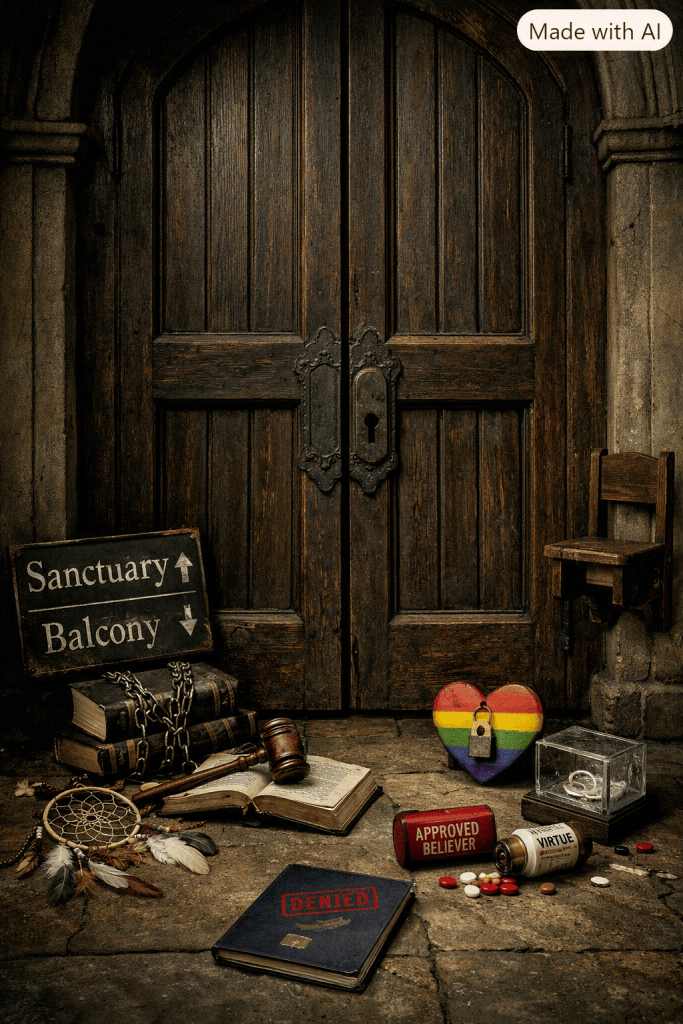
You Can’t Pray the Gay Away, But You Sure Can Expose the Hypocrisy: A Southern Queer Survival Guide

“If your faith requires someone else to suffer, it’s not holy. It’s just dressed‑up cruelty.”

-This Puzzled Life

Light the charcoal. Apparently the courts woke up. Stretched. Sipped their Folgers and said, “Hmm. What if we brought back psychological torture today?” And the conservative Christians said, “YAY! Revival!” Meanwhile, every queer person in the South is standing on their porch like, “Lord, give me strength, patience, and a Xanax the size of a biscuit.”

Down here in Mississippi, we know hypocrisy like we know humidity. It clings. It suffocates. It ruins your hair and your spirit at the same time. And nothing brings out the hypocrisy quite like a ruling that says, “Sure, go ahead and traumatize queer people in the name of Jesus. He won’t mind.” These folks will tell you with a straight face that they’re doing this out of “love.” If that’s love, then I’m a straight man named Bubba who drives a lifted truck and says “bro” every six seconds.

Let’s be honest. This ruling isn’t about saving souls. It’s about controlling bodies. It’s about punishing difference. It’s about making queer people small enough to fit inside their narrow theology and even narrower worldview. And the wildest part? These are the same people who can’t keep their own households together. The same people who preach “traditional marriage” while living like a deleted storyline from a messy reality show. The same people who scream “protect the children!” While ignoring the actual dangers children face like abuse, exploitation, and the youth pastor who keeps volunteering for overnight trips.

But sure. Let’s focus on the gays. Because we’re clearly the problem. Not the pastors who keep getting “relocated.” Not the lawmakers who can’t keep their pants zipped. Not the “family values” influencers who spend more time in hotel rooms than in prayer.

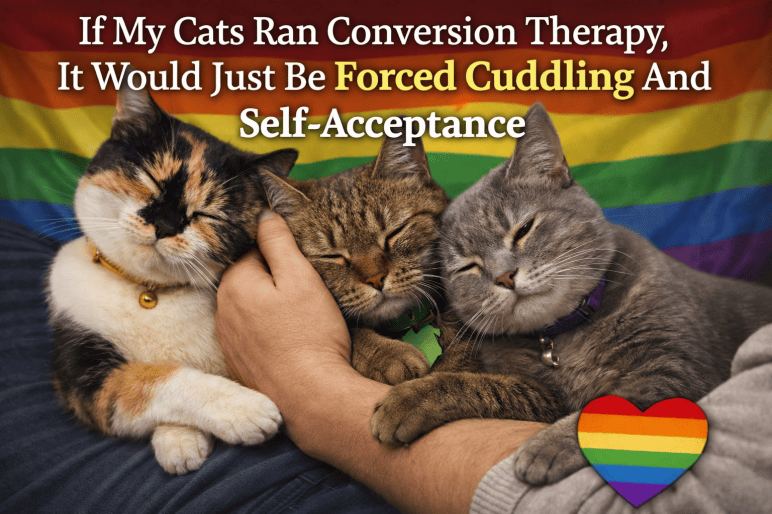
Let me break it down in terms even a conservative uncle can understand. You cannot convert someone out of being gay. You cannot shame someone out of being gay. You cannot therapy someone out of being gay. You cannot “deliverance session” someone out of being gay. Unless the only thing you’re delivering is trauma.

If sexuality were a choice, don’t you think I would’ve chosen something easier? Something with less paperwork? Something that didn’t require me to explain myself at every family gathering like I’m giving a TED Talk in a Cracker Barrel? But no. God made me like this. Curved, colorful, and incapable of pretending otherwise.

You could dangle 45 sets of dangly bits in front of me like a clearance sale at Spencer’s Gifts and I still wouldn’t be straight. But put me in front of some boobs and a cooter cat and suddenly I’m glowing like a porch light in July. That’s not a choice. That’s not a phase. That’s not a “lifestyle.” That’s divine architecture.

If you want to stay in the closet because it feels safer, I get it. But don’t pretend it’s holiness. Don’t pretend it’s righteousness. Don’t pretend it’s “God’s plan.” It’s fear. And fear is the currency of conservative Christianity. I sprinted out of the closet like it was on fire. And I’ve been free ever since. Even with my own family members who weaponize scripture like it’s a Nerf gun filled with shame. I send that mess right back to sender with a smile and a boundary. Chosen family is where the love lives. Chosen family is where the truth lives. Chosen family is where the rainbow was always meant to shine.

Theo rainbow is divine reassurance. It’s God saying, “Relax. I made y’all fabulous on purpose.” No court ruling can change that. No pastor can change that. No conversion therapist with a clipboard and a superiority complex can change that. We are here. We are queer. We are not going anywhere. And we are not apologizing for existing.

So let the smoke rise like a prayer the evangelicals forgot to proofread. Stand tall in your queerness like a magnolia tree that refuses to bow to the storm. Because here’s the truth they don’t want to face. Every time they try to erase us. We multiply. Every time they try to shame us. We shine harder. Every time they try to legislate us out of existence. We become louder, brighter, and more unbothered than ever.

Their hypocrisy is loud. But our joy is louder. Their cruelty is sharp. But our resilience is sharper. Their fear is deep. But our love is deeper. And at the end of the day, when the court rulings fade. When the sermons lose their sting. When the shame campaigns collapse under their own weight. We will still be here laughing. Loving. Living. Thriving. Dancing in the rainbow God hung in the sky as a reminder that storms don’t last forever.

So let them clutch their pearls. Let them scream about “family values.” Let them pretend their closets don’t have motion‑activated lights. We know the truth. You damn sure cannot stop the rainbow from rising. Mic dropped. Floor cracked. Hypocrisy exposed. Amen and pass the sweet tea. Thanks for reading! And Happy Pride year-round. What are your thoughts on this type of ruling?

Affirmation: “My identity is divine. My joy is sacred. And no court, church, or closet can dim the rainbow God put in my soul.”

***Don’t forget to watch the video!!!

#ThisPuzzledLife

When Purity Culture Protects Predators: The Duggar Edition

“If your righteousness collapses the moment accountability arrives, it was never righteousness. It was camouflage.”

-This Puzzled Life

Light the charcoal. Sprinkle the sage. Today we’re grilling up a fresh batch of religious hypocrisy “Duggar‑style.” That special brand of “family values” where the skirts are long. The hair is crunchy. And the list of sex crimes is longer than the Old Testament. You’d think a family with 19 kids and a camera crew would’ve spent at least five minutes teaching their sons that maybe the real sin isn’t masturbation. It’s molesting children. But no. No, no, no. The Duggar doctrine has always been, “Touching yourself is evil. But touching your sisters? Well, let’s pray about it.”

And now here we are again. Another Duggar son, this time Joseph. Has been making headlines for the same nightmare behavior that already sent Josh Duggar, his brother, to prison. After Josh was found guilty of possessing child sexual abuse material and sentenced in 2022. A family tree so rotten it’s practically compost. And the wildest part? These aren’t drag queens. These aren’t queer folks. These aren’t immigrants. These aren’t the people conservative Christians love to foam at the mouth about. Nope. It’s straight, white, right‑wing, Bible‑thumping men. Yet again, harming children while preaching purity like they invented it.

Meanwhile the kids they violated? They’re left with trauma that doesn’t get a sentence reduction. A parole hearing. Or early release for “good behavior.” They carry it forever. In their bodies. In their nervous systems. In the quiet moments nobody else sees. But sure. Tell me again how queer people are the threat? Tell me again how trans folks using the bathroom is the downfall of civilization? Tell me again how cannabis is the devil’s lettuce while your sons are out here committing crimes that shatter childhoods?

At this point, the Duggar brand of Christianity is so tainted it needs a hazmat label. Everything they’ve preached about morality, purity, and righteousness has evaporated like holy water on a hot skillet. Their “faith” isn’t faith. It’s a costume. A prop. A shield for predators who hide behind scripture while desecrating everything it claims to stand for.

And the saddest part? There are still people who will defend them. Still people who will twist themselves into theological pretzels to excuse the inexcusable. Still people who will say, “Well, nobody’s perfect.” As if imperfection and predation are the same category. They aren’t. They never will be. Some things are unforgivable. Some things stain a soul so deeply that no amount of prayer, repentance, or PR spin can scrub it clean.

And if the most powerful seat in the nation can be held by someone repeatedly accused of harming women and children, it’s no wonder his supporters think this behavior is normal. It’s no wonder they defend it. It’s no wonder they minimize it. When your leader models entitlement, cruelty, and moral decay, the flock follows.

And here’s the part nobody in their starched‑collar, Bible‑thumping echo chamber wants to hear. The one they can’t sermonize away. Children deserve safety. Children deserve protection. Children deserve a world where their bodies are not battlegrounds for someone else’s power, lust, or theology. And anyone who violates that? Anyone who destroys a child’s sense of safety? Anyone who weaponizes religion to excuse it? They’ve forfeited the right to be seen as righteous. They’ve forfeited the right to be believed. They’ve forfeited the right to preach about morality ever again.

If your faith can’t protect children from your own men, it’s not faith. It’s a cover‑up with a choir. You don’t get to preach purity while you and your sons are out here shattering childhoods. You don’t get to weaponize scripture against queer folks. While ignoring the predators in your own pews. You don’t get to call yourselves “God’s chosen family.” When the only thing you’ve consistently produced is trauma, denial, and a PR team working overtime.

Because the truth is simple. If your faith collapses the moment accountability walks into the room, it was a costume stitched together with shame, silence, and selective morality. And the children you failed? They will grow up carrying scars your sermons can’t erase. They will spend years rebuilding safety you stole. They will learn to trust themselves again in a world you taught them was dangerous. When the danger was sitting at your own dinner table.

Meanwhile, the men who harmed them will keep hiding behind the same religion they desecrated. Counting on the same community that protected them. And quoting the same verses they never lived by. Truth doesn’t care about your reputation. It doesn’t care about your brand. It doesn’t care about your “family values” photo ops. It shows up loud, uninvited, and holding receipts.

And once it arrives, there’s no going back. No amount of prayer circles, modesty lectures, or “thoughts and prayers” statements can un‑rot a tree that’s been diseased from the roots. So let the world take note. It wasn’t drag queens. It wasn’t trans folks. It wasn’t immigrants. It wasn’t the communities you demonize. It was your own men. Again. And again. And again.

And if that truth makes your theology crumble? Good. Let it fall. Let it burn. Let it clear the ground for something that actually protects children instead of protecting predators. Because at the end of the day, the only thing more dangerous than a man who harms children, is a community that refuses to hold him accountable. And if your religion can’t tell the difference between righteousness and abuse, then it’s not holy. It’s a hiding place. Thanks for reading! And do your part to protect our children.

Affirmation: I honor truth. Protect the vulnerable. And refuse to let anyone hide abuse behind faith, power, or fear.

***Don’t forget to watch the video!***

#ThisPuzzledLife

My Cat Tried to Call the Therapy Coach and Now We’re in a Full‑Blown Feline Intervention

“My system handles trauma like professionals. But the cats handle drama like they’re auditioning for a reality show called Real Housewives of the Litter Box.”

-This Puzzled Life

Light the charcoal. Sprinkle the sage. Secure the breakables. Today’s episode of This Puzzled Life features a full‑blown feline committee meeting after Piper, chaos in fur form, announced that she “might have Dissociative Identity Disorder.”

I have Dissociative Identity Disorder. Piper, however, is simply dramatic. And Tinkerbell and Coco are done with her antics. Welcome back where the sage is burning. The humidity is disrespectful. And the cats are holding more meetings than a Mississippi school board.

This morning started like any other. I was minding my business. Drinking my coffee. And trying to keep my nervous system from filing a complaint with HR. When Piper strutted into the room and announced that she “might have Dissociative Identity Disorder.” Before I could even blink, she was paw‑dialing my therapy coach like she had Blue Cross Blue Shield and a co‑pay. And that’s when Tinkerbell and Coco called an emergency meeting. Because apparently, in this house, I’m not the only one with a system. I’m just the only one with a diagnosis.

Tinkerbell climbed onto the arm of the couch like she was chairing a Mississippi church committee.

Tinkerbell: “This meeting will now come to order. Piper has made a claim. A bold one.”

Piper: “Ok. Well, there is no easy way to say this. I have DID.”

Tinkerbell: “Piper, having nine lives is not the same thing as having nine personalities. Stop confusing reincarnation with psychology.”

Coco: “Yeah, girl. Nine lives just means you make nine bad decisions. Not that you need nine therapists.”

Piper gasps, fluffs up, dramatic tail twitch

Piper:  “Wow! So, nobody believes me? Nobody supports my journey? I’m being silenced. This is oppression. I’m calling coach right now!”

Coco: “You can’t even remember where you left your toy mouse. Sit down.”

Piper: “I am a complex being with layers!”

Tinkerbell: “You’re a lasagna with fur. Calm down.”

Coco flicked her tail like she was swatting away generational trauma.

Coco: “She doesn’t have DID. She has Too Much Drama Disorder.”

Piper, sprawled across a pillow like a Victorian widow, sighed dramatically.

Piper: “Sometimes I feel like different versions of me.”

Tinkerbell blinked slowly. The kind of blink that says, Lord, give me strength.

Piper sat up, whiskers trembling with self‑importance.

Piper: “Sometimes I’m sweet. Sometimes I’m spicy. Sometimes I’m feral. That’s at least three personalities.”

Coco rolled her eyes so hard she almost saw her past lives.

According to Piper, and only Piper, she “dissociates” at least three times a day. To everyone else in the house, she simply forgets what she’s doing because she’s Piper.

This morning, she was walking toward her food bowl with purpose, confidence, and the swagger of a cat who believes she pays rent. Halfway there, she froze. Stared into the void. And blinked like she’d just been unplugged and rebooted.

Tinkerbell watched her with the patience of a grandmother who’s seen too much.

Tinkerbell: “She’s not dissociating. She’s buffering.”

Coco flicked her tail

Coco: “That’s not a switch. That’s a brain fart.”

But Piper insisted.

Piper: “I think I dissociated. I forgot what I was doing.”

Tinkerbell sighed

Tinkerbell: “Sweetheart, you forget what you’re doing because you have the attention span of a dust bunny.”

Coco“If staring at the wall counts as dissociating, then every cat on Earth needs a therapist.”

Piper, unbothered, continued staring into the middle distance like she was receiving messages from the universe.

Piper: “I just drifted away.”

Tinkerbell: “You drifted because you saw a dust particle and got confused.”

Coco: “You’re not dissociating. You’re daydreaming with commitment.”

Coco: “That’s called being a cat.”

Tinkerbell nodded

Tinkerbell: “You’re not special, darling. You’re just enthusiastic.”

Piper gasped like someone insulted her casserole at a church potluck.

Piper: “So you’re saying I’m dramatic?”

Coco: “I’m saying you’re Piper.

This is where things went off the rails. Piper marched over to my phone. Tapped the screen with her paw, and said,

Piper: “I’m calling our therapy coach. I need a professional opinion.”

Tinkerbell nearly fell off the couch.

Tinkerbell: “Absolutely not. You are not dragging a licensed human into your nonsense.”

Coco leapt forward like she was blocking a football pass.

Coco: “Put the phone down. You don’t even know the passcode.”

Piper: “I know it’s numbers.”

Tinkerbell: “That is not enough.”

Piper: “I just want to ask if I have DID.”

Coco: “You don’t even have object permanence.”

Tinkerbell gestured toward me like she was presenting a case study.

Tinkerbell: “Our mom has DID. That’s a real thing. A trauma thing. A serious thing.”

Coco nodded, suddenly solemn

Coco: “She’s strong. She’s healing. She’s doing the work. You, on the other hand, tried to eat a rubber band yesterday.”

Piper: “It looked like a noodle.”

Tinkerbell: “It was not a noodle.”

Coco: “You’re not dissociating. You’re just unsupervised.”

Tinkerbell cleared her throat like a judge delivering a sentence

Tinkerbell: “Piper does not have DID. What she does have is excessive enthusiasm, poor impulse control, a flair for the dramatic, and a mother who spoils her.

Coco: “Case closed. Someone bring snacks.”

Piper: “I still think I should call the therapy coach.”

Tinkerbell: “If you touch that phone again, I’m calling Jesus.”

And as we wrap up this episode of Cats Who Need Supervision, I’ve realized something important. Living with DID is complex, sacred, and deeply human. But living with these cats is a full‑time job with no benefits and no union representation.

Some days my system is grounded and organized. Other days it’s buffering like a Dollar Tree Wi‑Fi router in a thunderstorm. And meanwhile, Piper is over here diagnosing herself with conditions she found on TikTok. Tinkerbell is exhausted. Coco is judging everyone. And Piper is still trying to call the therapy coach.

To all of us I wish healing, much laughter, surviving, and keeping the phone away from the cat who thinks she needs a treatment plan. And Piper? She’s grounded from the phone until further notice. Thanks for reading! Hug a cat if they let you.

Affirmation: Every part of you is powerful and worthy. And Piper, in all her chaotic glory, fully supports your healing while acting like she’s the self‑appointed spokesperson for your system.

***Don’t forget to watch the video!***

#ThisPuzzledLife

DID Awareness Month: Many Voices, One Whole Self

“My brain runs like a full‑time committee meeting, and the cats still think they’re the ones in charge.”

-This Puzzled Life

 Light the charcoal. Sprinkle the sage. Negative energy go away. Today’s blog is about Dissociative Identity Disorder. And three cats who have absolutely no business being professionally involved. But who insist on participating like they’re on salary.

Welcome to another episode of “My Life Is a Sitcom and Nobody Warned Me.” Secure your wigs. Because today we’re diving into DID Awareness also known as “Me, Myself, and the Entire Internal Group Chat.” 

Living with DID means my brain runs like a committee meeting that could’ve been an email. And my cats act like they’re the board of directors.

Tinkerbell: “Your system is more organized than Congress.”

Coco: “At least y’all communicate.”

Piper: “If your brain ever needs a new member, I’m available.”

Me: “Piper, sweetheart, this is not American Idol: Internal System Edition.”

But here we are. Me, my parts, my healing journey, and three cats who think they’re licensed clinicians. And they are ready to bring some humor, honesty, and a little Southern seasoning to DID Awareness Month. Strap in. It’s about to get educational, emotional, and unnecessarily funny.

DID is one of those topics people whisper about like it’s a scandal, a secret, or the recipe for Coca‑Cola. But in this house? We talk about it openly, honestly, and with the kind of humor that keeps us from spontaneously combusting into a pile of stress glitter.

I have DID. Not “movie DID.” Not “Hollywood horror plot DID.” Actual, clinical, trauma‑born DID. It’s the kind that forms when a child survives more than any child ever should. And let me tell you, the cats have notes.

Tinkerbell (the wise elder): “Mom has a whole internal board of directors. I respect that. Some of y’all can’t even manage one mood.”

Coco (the judgmental aunt): “Honestly, the system is more organized than half the humans I’ve met. At least they communicate.”

Piper (chaos incarnate): “Do you think they’d let me join? I have ideas.”

Me: “Piper, this is not a talent show. This is a mental health condition.”

DID isn’t scary. It isn’t dangerous. It isn’t whatever nonsense Hollywood keeps trying to sell. It is a trauma response. A survival strategy. A brilliant adaptation. And a system built to protect a child who deserved safety. My system isn’t broken. It’s creative. It’s resilient. It’s the reason I’m still here. And the cats? They act like they’ve known every part since birth.

Tinkerbell: “Oh, this one likes soft blankets. Bring her the good one.” 

Coco: “This one needs boundaries. I’ll supervise.” 

Piper: “This one lets me climb the curtains.”

How does DID manifest? It is switching when overwhelmed and losing time. It’s different parts having different needs and internal conversations. It’s healing in layers. And learning to work as a team. It also looks like me drinking water because one part insists. Me resting because another refuses to push through. Me laughing because someone inside cracked a joke. And me healing because we’re doing this together. And the cats? They think they’re helping.

Coco: “I’m providing emotional support.” 

Piper: “I’m providing chaos.” 

Tinkerbell: “I’m providing supervision because these children need guidance.”

People with DID aren’t fragile. We aren’t dangerous. We aren’t confused. We aren’t “making it up.” We’re survivors. We’re complex. We’re healing. We’re doing the work. And we deserve understanding, not fear. Compassion, not judgment. Support, not silence.

Tinkerbell: “Respect the system. It’s doing its best.” 

Coco: “Awareness is important. Also, snacks.”

Piper: “If your brain ever needs a new member, I’m available.”

Me: “Piper, absolutely not.”

And as we wrap up this little journey through DID Awareness Month, complete with sage smoke, hydration, internal committee meetings, and three cats who are my emotional support staff .

DID is basically like trying to reboot a Wi‑Fi router from 2007. While the cats are batting the cords. The universe is buffering. And one part is whispering, “Have you tried turning it off and back on again?”

Some days I’m gliding through life like a well‑oiled machine. Other days I’m switching, grounding, journaling, and negotiating with my nervous system like it’s a toddler who missed nap time. And occasionally, the whole system is like, “Ma’am, we were not built for this timeline.” Meanwhile, the cats are offering commentary like they’re on payroll.

Here’s to us choosing growth even when our brains are running on 3% battery. Choosing compassion even when our patience is on backorder. And choosing to keep going even when life feels like a Walmart parking lot at 2 a.m.

 And then strut into the rest of your life like a woman who has survived every plot twist. Including the ones that arrived unannounced, barefoot, and holding a casserole of chaos. Because you’re still here. You’re still growing. And honestly? You’re doing better than half the people who think “self‑care” means buying a succulent and ignoring their feelings. Healing is holy. Humor is medicine. And I am too stubborn. I am too supported by my internal team and these judgmental cats to give up now. Thanks for reading! Keep moving forward.

Affirmation: I honor every part of my system. The strong ones, the soft ones, the tired ones, and the healing ones. I move through this world with resilience, humor, and a whole internal team that refuses to give up on me. I am whole, worthy, supported, and doing beautifully, no matter who’s fronting or which cat thinks they’re in charge today.

***Don’t forget to watch the video!***

#ThisPuzzledLife

Self‑Harm Awareness Month: Where Growth Happens and My Nervous System Tries Its Best

“I didn’t choose the healing journey. The healing journey chose, dragged me and asked for gas money.”

-Unknown

Light the charcoal. Sprinkle the sage. Negative energy go away. It’s Self‑Harm Awareness Month, and if there’s one thing this month teaches us, it’s that healing is messy, sacred, and occasionally accompanied by a cat sitting on your chest like a furry emotional support paperweight.

Self‑harm is one of those topics people whisper about like it’s Voldemort, taxes, or the time they accidentally liked their ex’s Instagram post from 2014. But here? We talk about it with honesty, compassion, and the kind of humor that keeps us from spontaneously combusting. Self‑harm isn’t about attention. It’s about pain. And the people who say otherwise are usually the same ones who think essential oils can cure a broken femur.

Self‑harm doesn’t happen because someone is weak. It happens because someone is overwhelmed, hurting, or trying to survive emotions that feel too big for one body. It’s a coping mechanism. Not a character flaw. But the world loves to misunderstand what it doesn’t want to deal with. People will say things like, “Just think positive!,” “Have you tried yoga?,” “My cousin’s neighbor’s dog used to feel sad too.” Ma’am. Self‑harm is not cured by downward dog or inspirational throw pillows.

Let’s look at how the addiction occurs. The brain notices that shift and files it under: “This worked.” Not because it’s healthy. However, because it changed the emotional state quickly. The body reinforces it by sending a rush of endorphins, adrenaline, and dopamine. These chemicals temporarily reduce emotional pain or numbness. That relief, even if brief, can make the brain want to repeat the behavior. This is the same reinforcement loop seen in many addictions. Next, the cycle becomes automatic. And with overtime urgency , the brain starts linking stress → self‑harm, numbness → self‑harm, shame → self‑harm, and emotional overload → self‑harm. It becomes a reflex. A pattern, not a personality trait. A survival strategy, not a moral failing. And then shame strengthens the cycle. People who self‑harm often feel guilt, embarrassment, fear of being judged, or the pressure to hide. Those feelings can increase emotional distress. Which can then trigger the urge again. It becomes a loop that’s incredibly hard to break alone. And finally, it’s not about wanting to die. For many people, self‑harm is about wanting to feel something, wanting to feel less, wanting control, wanting relief, and wanting the emotional noise to stop. It’s a coping mechanism that becomes addictive because the pain underneath it is overwhelming. People don’t heal because they’re scolded. They heal because they’re understood.

What does help? Why don’t you try some compassion, support, safe conversations, professional care, people who don’t minimize your pain, and a community that refuses to let shame win. Some days you glide. Some days you wobble. Some days you crash into a display of discounted cereal and pretend it was part of your spiritual journey. Healing is allowed to be imperfect. You are allowed to be imperfect. You are allowed to take up space while you figure things out. “Keep going. Rest when you need to. And stop carrying pain alone.” You deserve support. You deserve compassion. You deserve to be here. And you deserve to heal without shame breathing down your neck like a judgmental church lady.

Self‑Harm Awareness Month isn’t about fear. It’s about understanding. It’s about breaking silence. It’s about reminding people they’re not alone. Not now, not ever. So, here’s to choosing growth even when it feels like a group project we didn’t sign up for, choosing compassion even when our patience is on backorder, choosing to stay when our brains are acting like and the whole system is like, “Ma’am, I was not built for this.”

Then light your sage, drink your water, moisturize your spirit, and strut into the rest of the month like a woman who has survived every plot twist life has thrown at her. Including the ones that arrived unannounced, barefoot, and holding a casserole of chaos. Because you’re still here. You’re still growing. And honestly? You’re doing better than half the people who think essential oils are a personality. 

And as we wrap up this emotional rollercoaster of a topic, complete with sage smoke, hydration, and my nervous system acting like it’s auditioning for a disaster movie. It is like trying to assemble IKEA furniture with no instructions, three missing screws, and a mysterious extra piece that definitely wasn’t in the box. I’ve also realized something important. And it is that healing is basically like trying to reboot a Wi‑Fi router from 2007. You unplug it, you wait, you pray, you bargain, you threaten it, you light a candle, and somehow it still blinks at you like, “Girl, I’m doing my best.” Same, router. 

Here’s to all of us out here choosing growth even when our brains are running on 3% battery. Choosing compassion even when our patience is on backorder. And choosing to keep going even when life feels like a Walmart parking lot at 2 a.m. You’re doing your best, you’re sweating, you’re questioning your life choices, and at some point you whisper, “If this thing collapses, I’m blaming Sweden.” Thanks for reading and remember, Healing is holy, humor is medicine, and you are too stubborn to give up now. But you keep going. Because that’s what we do. And if anyone tries to judge your healing journey, just smile sweetly and say, “Sweetheart, I’m busy becoming emotionally stable. I don’t have the bandwidth for your nonsense.” Thanks for reading! Get educated.

Affirmation: I honor my healing by choosing compassion over shame, boundaries over chaos, and growth over the nonsense that used to break me.

***Don’t forget to watch the video!***

#ThisPuzzledLife

Affirmations Of A Badass #1

“My affirmations are so powerful that even my self‑doubt takes notes.”

-Unknown

Light the charcoal. Sprinkle the sage. Negative energy go away. Today, we’re stepping into a sacred space of Affirmations of a Badass. This is where the vibes are strong, the confidence is loud, and the only thing fragile is your last excuse.

This isn’t your grandma’s affirmation circle. No one here is whispering “I am enough” while sipping chamomile tea and staring at a beige wall. This is the kind of affirmation practice where you look in the mirror. Hype yourself up like you’re about to perform at the Super Bowl halftime show. And remind your soul that you are the main character.

This is you hyping yourself up just enough to function like a semi‑responsible adult. It’s self‑talk that says:

  • “I can do hard things.”
  • “I deserve good things.”
  • “I am powerful, even if I’m also a hot mess.”
  • “I’m allowed to take up space without apologizing.”

Badass affirmations are about self‑belief, resilience, and getting out of your own way. They don’t put anyone else down. They don’t require an audience. They don’t demand worship. They’re basically emotional caffeine. And let’s be honest, in 2026, we Americans need our emotional bank accounts overflowing, not overdrawn.

And for those of us who’ve lived through trauma, our confidence wasn’t just shaken. It was bulldozed, set on fire, and then politely kicked into a ditch. So, It’s our responsibility to rebuild what was lost. Sometimes daily. Sometimes hourly. Sometimes between sips of coffee. That’s why we walk into every day like we own the place. Because honestly, at this point, the universe should probably be paying us rent.

My power is loud. My confidence spreads faster than gossip in a small town. And my energy refuses to shrink just because someone else forgot their sparkle. I am a badass in progress. A masterpiece in motion. And anyone who can’t handle that, can step to the side while I strut.

And no, before anyone gets confused, this is not narcissism. Narcissistic Personality Disorder is dangerous, not a vibe. It’s not confidence. It’s a fragile ego wrapped in glitter.

Narcissism says:

  • “I’m better than everyone.”
  • “Rules don’t apply to me.”
  • “If you don’t praise me, you’re wrong.”
  • “Your feelings are optional. Mine are mandatory.”

Narcissism needs constant validation, lacks empathy, and treats people like props in a one‑person show. It’s not empowerment. It’s entitlement.

Badass affirmations, on the other hand, kick the door open, hand you a metaphorical crown, and say, “Get up! We’ve got a world to set on fire.” Being a badass isn’t about perfection. It’s about showing up even when your hair looks like it’s been negotiating with humidity for three days straight. It’s about believing in yourself even when your brain is like, “Girl… really?” And it’s about knowing that beneath the chaos, the caffeine, the weed, and the questionable life choices, you are powerful, capable, and slightly unhinged in the best possible way. Now, take a deep breath. Center your spirit. And prepare your soul. We’re about to affirm the absolute hell out of ourselves.

The first affirmation for we badasses is this:

“I walk into every day like I own the place, because honestly… I do. My power is loud, my confidence is contagious, and my energy is too big to shrink for anyone. I am a badass in progress and a masterpiece at the same time.”

Translation: “I don’t just enter a room. I arrive like a dramatic wind gust that knocks over a plant and makes everyone wonder if they should applaud.” It’s the energy of someone who wakes up, looks in the mirror, and says, “Yes, I am the creator of my universe,” then immediately trips over their own shoe but recovers like it was part of the dance.

It’s the vibe of a person who walks into a retail giant like they’re the CEO and buys absolutely nothing they came for because their confidence whispered, “Do You Boo Boo!”

It’s the spiritual equivalent of wearing sunglasses indoors. Not because you need them. But because your aura is too bright for the general public. It’s the declaration of someone who is simultaneously building themselves, hyping themselves, and confusing everyone around them with their chaotic, unstoppable energy. Basically, you’re a masterpiece who occasionally forgets where you put your keys, but you do it with swagger.

And there you have it. Your first dose of “I’m unstoppable and mildly dangerous in a charming way.” If anyone doubts your power after this, simply slow‑blink at them like a cat who knows it owns the house. Because you do. You absolutely do.

Remember that being a badass isn’t about having it all together. It’s about walking into the day with confidence, resilience, and the kind of energy that makes people wonder what you know that they don’t. It’s about hyping yourself up even when life feels like a group project and you’re the only one doing the work. It’s about choosing yourself unapologetically.

Don’t worry. Rebuilding confidence is the state that I’ve been in for many years. It’s not instantaneous. It’s something that will require diligence, patience and perseverance even on days when you don’t want to. So go forth, you magnificent Tasmanian devil of chaos. Speak kindly to yourself. Strut like the universe belongs to you. And if all else fails, repeat after me: “I am a badass, and the world will adjust accordingly.” Thanks for reading! Now Manifest It.

Affirmation: I affirm my affirmations with such confidence that even my doubts are like, ‘Okay fine, she clearly means business.’

***Don’t forget to watch the video!***

#ThisPuzzledLife
Black History Month: Where the Ancestors Whisper ‘Keep Going’

“Injustice anywhere is a threat to justice everywhere.”

— Dr. Martin Luther King Jr.

Light the charcoal. Sprinkle the sage. Negative energy go away. Because today, we’re stepping into a month that carries the weight of history, the fire of resilience, and the joy that refuses to be dimmed. This is Black History Month, and we’re honoring it with truth, emotion, and a little humor. I, for one,  know that sometimes laughter is the only thing keeping any of us from flipping a table.

Black History Month is not just a commemorative event. It’s a living, breathing reminder of the brilliance, struggle, creativity, and endurance of Black Americans. It began as Negro History Week in 1926, founded by historian Carter G. Woodson and the Association for the Study of Negro Life and History. The week was intentionally placed in February to align with the birthdays of Frederick Douglass and Abraham Lincoln, two figures central to Black liberation.

Over time, the celebration grew, and in 1976, it officially expanded into Black History Month, recognized by every U.S. president since. Today, it is celebrated across the United States, Canada, and the United Kingdom. And every February 1st, corporations suddenly “discover” Black people exist. But we’re going to focus on the real story (https://www.blackhistoryandheritage.com/article/black-history-month/origins-black-history-month?utm_source=copilot.com.)

Black history is a story of survival and excellence that deserves its own cinematic universe. It’s the spirituals sung in fields where hope was outlawed. It’s the Harlem Renaissance that has exploded with art, music, and literature that still shapes culture today. It’s the Civil Rights Movement marching with blistered feet and unbreakable courage. It’s Black scientists, inventors, activists, teachers, and everyday heroes shaping the world. And often while the world pretended not to notice.

Black History Month holds space for:

  • Grief for what was stolen.
  • Rage for what was endured.
  • Awe for what was created.
  • Joy that refuses to be dimmed.
  • Humor that has carried generations through the impossible.

Black humor is a survival skill. It’s the auntie who tells the truth with a side of shade. It’s the uncle who swears he marched with Dr. King even though he was born in 1972. It’s the family reunion where the food is seasoned, the stories are exaggerated, and the love is louder. Humor doesn’t erase the pain. It makes the journey bearable. The work isn’t done. Because the wounds aren’t healed. Because the systems aren’t equal. Because the stories still need telling. Because the future still needs building.

This is a reminder that the story is still being written in classrooms, in living rooms, in protests, in art, in laughter, in love. And if you listen closely, you can hear the ancestors whispering: “Keep going. And baby, don’t forget to moisturize.”

As we light the charcoal and sprinkle the sage, may we remember that it’s not just to clear the air. But to honor the ancestors who cleared paths with their bare hands. We breathe deeply for the generations who weren’t allowed to. We laugh loudly for the ones who needed joy but didn’t get enough of it. We celebrate fiercely for the dreams that were deferred but never destroyed.

“As a white person, I honor Black History Month by listening more than I speak, learning what I was never taught, and showing up with humility instead of ego. I affirm my commitment to unlearning harmful narratives, amplifying Black voices, and standing on the right side of history. I choose growth over comfort, accountability over silence, and action over performative allyship. I honor the legacy of Black brilliance by being someone who refuses to look away.” Thanks for reading! And keep on keeping on.

Affirmation: I honor Black History Month by choosing growth, listening with intention, and respect.

***Don’t forget to watch the video!***

#ThisPuzzledLife