
Alcohol Awareness: The Gospel According to My Cats

“Awareness saves lives. Snacks save morale.”

-The Feline Public Health Department

Light the sage. Hide the breakables. My three cats, Piper, Coco, and Tinkerbell, have decided they are the official spokes‑animals for Alcohol Awareness. And they came prepared with statistics.

They just held a household meeting complete with a gavel, a flip chart, and Coco eating the pointer. And they are about to inform me that we are now hosting Alcohol Awareness Week. I didn’t volunteer. I wasn’t consulted. Piper simply slapped a pamphlet on the table like she was serving a warrant and said, “Mother, it’s Alcohol Awareness time, and the people need us.” If anyone can talk about risky behavior, it’s the animals who sprint across linoleum floors at 3 a.m. like they’re late for a rave.
Piper jumps onto the table like she’s chairing a congressional hearing.

“Mother, while adjusting her imaginary glasses, did you know more than half of adults in the U.S. drink alcohol? And 17% binge drink?” She pauses for dramatic effect. “That means 17% of humans are out here acting like me when I see an unattended plate of chicken. Also, 178,000 people die each year from excessive alcohol use. That’s more than the number of times Coco has tried to steal your snacks.”  Source: CDC — Excessive Alcohol Use Data 

Coco waddles in dragging a bag of treats like she’s smuggling contraband.

“Listen, I’m here to talk about underage drinking. But first, do we have chips? Because this is heavy.” She informs the room that in 2022, 5.9 million youth ages 12–20 drank alcohol beyond ‘just a few sips’. Mother, that’s too many. Even I know that. And 19.7% of youth ages 14–15 have had at least one drink. At that age, I was still learning how to jump on the counter.” Source: NSDUH / Alcohol Infographic 2024 

Tinkerbell perches on the highest shelf, looking like she’s about to assign homework.

“Research shows that people who start drinking before age 15 are 3.5 times more likely to develop alcohol use disorder later in life. Which is why I supervise the boys. They need guidance. And boundaries. And fewer snacks.” Source: Alcohol Infographic 2024 

This household stays loud, proud, and educational, the cats insisted on adding:

  • Alcohol misuse affects every organ in the body. Source: NIAAA Alcohol Facts & Statistics 
  • Underage drinking remains a major public health issue. Source: NSDUH 2024 / SAMHSA 
  • Accurate, stigma‑free information saves lives. Especially in LGBTQIA+ communities and the Deep South. Where misinformation spreads faster than Piper can knock over a cup.

Piper: “Moderation is key. Also, naps solve more problems than alcohol ever will.”

Coco: “Alcohol slows reaction time. I cannot risk missing a falling snack.”

Tinkerbell: “Knowledge is power. And power is knowing where the treats are hidden.”

Piper stands on her hind legs like she’s giving a TED Talk.

Piper: “Stay informed. Stay safe. And stop believing your cousin’s Facebook posts.”

Coco: “Stay hydrated. Preferably with water. Or gravy.”

Tinkerbell: “Stay fabulous. And for the love of all things holy, lock the liquor cabinet.”

Piper, Coco, and Tinkerbell gather themselves on the couch like a furry Supreme Court. And ready to issue a ruling on the family hypocrisy they’ve witnessed for years. Piper clears her throat first, because of course she does. “Mother, we simply cannot understand how certain humans in this family will clutch their pearls over you using medical cannabis. A literal plant. But somehow quote the Bible like it’s a coupon code to excuse drinking and driving, and every chaotic decision that would get us grounded for nine lifetimes.”

Coco nods solemnly with crumbs on her chin, “They called you a ‘druggie,’ but then hopped in the car after communion wine like Jesus Himself was the designated driver.”

And Tinkerbell, perched high like a judgmental librarian, adds, “If scripture can be stretched far enough to justify a DUI, then surely it can handle a little THC for pain relief. We’re cats, Mother, but even we know the math isn’t mathing.”

And that’s how my cats continue to point out and educate on the dangers of alcohol. And the hardcore hypocrisy in the south. And, yes, specifically in my own family. Thanks for reading! And never let them silence you.

Affirmation: I honor my body, my boundaries, and my community by choosing knowledge over shame.

***Don’t forget to watch the video!***

#ThisPuzzledLife
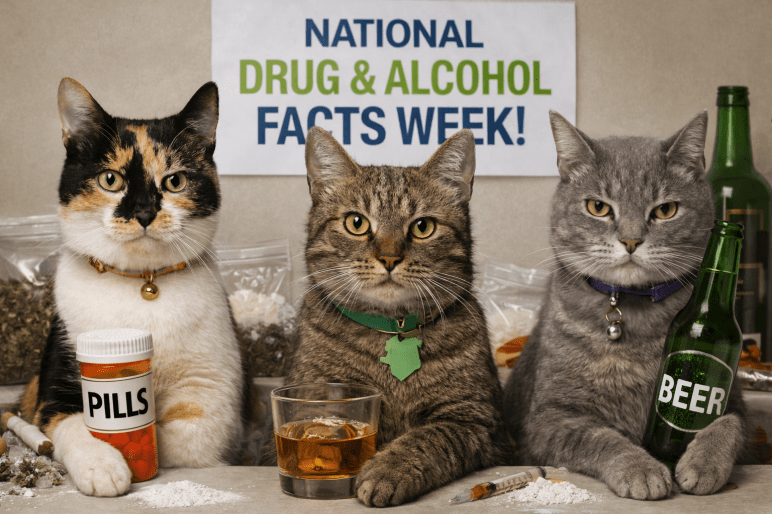
Science, Snacks, and Sass: The Feline Takeover of Drug & Alcohol Facts Week

“Facts don’t care about feelings, but feelings care deeply about snacks.”

 — The Feline Public Health Department

 Light the charcoal. Sprinkle the sage. Negative energy go away. It’s National Drug & Alcohol Facts Week. My cats have decided they are the official spokes‑animals for science, safety, and whatever chaos they can stir up before breakfast. Welcome back to This Puzzled Life. Where the trauma is seasoned. The humor is medicinal. And the cats are convinced they’re running a public health campaign.

Piper busts into the room wearing a lab coat three sizes too big.

“Mother, did you know the National Institute on Drug Abuse says misinformation spreads faster than I can knock a cup off the counter?” (Which is fast. Very fast.)

Source: National Institute on Drug Abuse (NIDA)  “National Drug & Alcohol Facts Week” https://nida.nih.gov.

Coco is dragging a bag of snacks like she’s smuggling contraband. 

“I’m here to talk about addiction. But first, do we have chips? Because the National Institute on Alcohol Abuse and Alcoholism says alcohol affects judgment. And I’m about to make a bad decision if you don’t hand over the Doritos.”

Source: National Institute on Alcohol Abuse and Alcoholism (NIAAA) “Alcohol’s Effects on the Body” https://niaaa.nih.gov.

Tinkerbell is sitting on the highest shelf like a judgmental librarian.

“Actually, according to the CDC, substance use can affect brain development. Especially in teens. Which is why I supervise the boys. They need guidance. And snacks. Mostly snacks.”

Source: Centers for Disease Control and Prevention (CDC)  “Substance Use and Youth” https://cdc.gov.

Here are a few clean, accurate, all‑ages‑appropriate facts from reputable organizations:

1. Alcohol affects every organ in the body.

Source: NIAAA  Alcohol’s Effects on the Body https://niaaa.nih.gov.

2. Most teens who misuse substances get their information from peers, not professionals.

Source: NIDA National Drug & Alcohol Facts Week https://nida.nih.gov.

3. Substance use can impact brain development into the mid‑20s.

Source: CDC Substance Use and Youth https://cdc.gov.

4. Addiction is a medical condition. Not a moral failure.

Source: Substance Abuse and Mental Health Services Administration (SAMHSA) https://samhsa.gov.

Piper’s Lesson: “Drugs don’t magically make problems disappear. That’s what naps are for.”

Coco’s Lesson: “Alcohol slows reaction time. Which is why I don’t drink. I must remain ready to sprint toward any dropped food.”

Tinkerbell’s Lesson: “Knowledge is power. And power is knowing where the treats are hidden.”

My household stays loud and educational. The cats insisted on adding this. Science supports people making informed choices. Science supports harm reduction. Science supports LGBTQIA+ folks having access to accurate, stigma‑free information. Science does NOT support Aunt Barbara’s Facebook posts. Piper said that last part. I’m just reporting.

Piper climbs onto the table wearing a tiny pair of reading glasses she stole from somewhere.

“According to NIDA, over 20% of 12th graders reported using an illicit drug in the past year. That’s too many. That’s also the percentage of times I listen when Mother says, ‘get off the counter.’”

Source: National Institute on Drug Abuse (NIDA) Monitoring the Future Survey https://nida.nih.gov.

She flips a page dramatically.

“And nicotine vaping among teens is still one of the most common forms of substance use. Which is wild because I can’t even get Mother to let me sniff the humidifier.”

Source: NIDA Teen Vaping Trends https://nida.nih.gov.

Coco waddles in carrying a bag of treats like a briefcase.

“Listen up. The CDC says alcohol is the most commonly used substance among youth in the United States. Which explains why teenagers make decisions like climbing on roofs. And dating boys who wear Axe body spray.”

Source: CDC Youth Substance Use https://cdc.gov.

She pauses to eat a treat.

“And get this. About 1 in 5 high school students reported binge drinking. Meanwhile, I binge eat kibble and nobody gives me a national awareness week.”

Source: CDC  Underage Drinking https://cdc.gov.

Tinkerbell sits on her throne (the top of the fridge) and clears her throat like a disappointed professor.

“According to SAMHSA, over 46 million people in the U.S. met the criteria for a substance use disorder in 2021. That’s a lot of people needing support, compassion, and maybe a cat to sit on their chest and purr aggressively.”

Source: SAMHSA National Survey on Drug Use and Health https://samhsa.gov.

She adjusts her imaginary pearls.

“And here’s a big one. Only about 6% of people with a substance use disorder received treatment. 6%! That’s lower than the percentage of times Coco shares snacks.”

Source: SAMHSA Treatment Statistics https://samhsa.gov.                                                                                                                                                              As National Drug & Alcohol Facts wraps up, my cats would like to remind you to

Piper: “Stay curious, not chaotic.”

Coco: “Stay hydrated and snack‑positive.”

Tinkerbell: “Stay informed. Stay fabulous. And stop believing memes your cousin posted at 2 AM.”

And honestly? That’s the most scientifically accurate advice you’ll hear all week. Because the current administration doesn’t believe in science.

And that, my friends, concludes National Drug & Alcohol Facts Week as interpreted by three cats who have never paid taxes, never followed a rule, and yet somehow run this household like a federally funded research lab. Piper has knocked over every myth she could reach. Coco has eaten every statistic that wasn’t nailed down. Tinkerbell has judged the entire nation from the top of the fridge.

We’ve cited the CDC, NIDA, NIAAA, and SAMHSA. Because around here, we believe in facts, snacks, and queer‑centered harm‑reduction education. In that order. Take what you learned, Take what you laughed at. And take a deep breath. Because knowledge is power. Compassion is necessary. And humor is how we survive the South. Class dismissed. Sage extinguished. Cats victorious. Thanks for reading! Drop a comment about what you thought about the girls in this blog.

Affirmation: I choose knowledge over fear, compassion over judgment, and humor over everything else.

 ***Don’t forget to watch the video!***

#ThisPuzzledLife