This Puzzled Life is a mental health and recovery blog exploring addiction, trauma healing, LGBTQ experiences, humor, and the strange moments that shape us.
“Rape culture doesn’t survive because predators are powerful. It survives because communities are silent.”
-This Puzzled Life
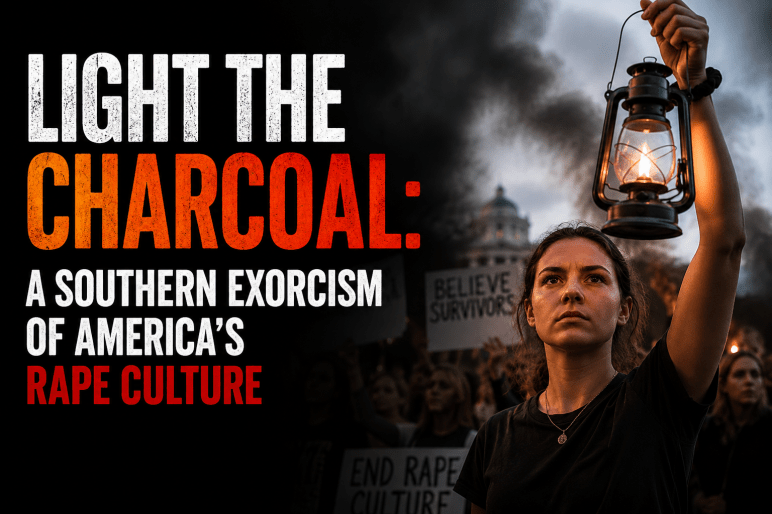
Light the charcoal. Call the ancestors. Summon the willfully blind Christians. And the politicians who pretend not to hear. We need to talk about rape culture in America. The one our government, our churches, and our “good Christian families” keep blessing with silence, excuses, and casseroles. And yes, I said “blessing.” Because at this point the way folks defend predators looks less like morality. And more like a full‑blown revival service for the unholy.
Let’s be real. The state of rape culture is a national embarrassment with a prayer chain. If any case even remotely resembled the Epstein files in another era, investigators would’ve been sprinting like their pensions depended on it. They would’ve been flipping mattresses. Interrogating houseplants. And subpoenaing the family dog.
But now? Now we’ve got a chunk of society the red hats, pearl‑clutchers, and “I did my own research” prophets. Who are bending over backwards to excuse behavior that would’ve made the Old Testament God pull out the smiting stick. And the churches? The churches are quieter than a deacon caught with his hand in the offering plate.
Pastors out here preaching “love thy neighbor” while refusing to even look at the neighbors who’ve been raped. Abused. Trafficked. Or discarded. Why? Because calling out evil might upset Brother Bob and Sister Brenda. The ones who tithe big and sin bigger. They’re terrified of making their donors have uncomfortable fee‑fees in their tum‑tums.
Meanwhile the Jesus they claim to follow? He would’ve flipped those tables. Reset them. And flipped them again like a CrossFit workout. But modern conservative Christianity? They’re too busy protecting their reputations and their potlucks to protect actual people. The hypocrisy is Olympic‑level.
They brag saying, “We donated clothes!” “We gave canned goods!” “We helped an organization!” But ask them, “Have you gone into homeless camps?” “Have you met LGBTQ+ folks and learned their needs?” “Have you talked to gang‑involved youth?” “Have you gone into prisons?” “Have you sat with a rape survivor and listened without judgment?” The answer is always, “No, but we thought about donating more socks.”
And the truth is this. They don’t want the stories. They don’t want the truth. They don’t want the discomfort. They want selective compassion. The kind that doesn’t require them to confront their own cowardice.
In the Deep South, especially places like Petal, Mississippi, silence is a religion all its own. People will gossip about who bought a new lawnmower. But mention rape, molestation, trafficking, or abuse and suddenly everyone’s got laryngitis. Your own family? They’d rather call you dramatic than confront the truth that predators thrive in silence. And that silence is a community project.
They’ll say, “That was a long time ago.,” “Why didn’t she tell someone earlier?,” “You need to move past it.” Or my personal favorite, “That’s water under the bridge.” Ma’am that “bridge” is built out of victims’ bones. And me a survivor who endured years of marital rape, stalking, gas lighting, humiliation, sexual perversion, coercion, and religiously‑justified abuse is still paying the price while they protect their comfort.
We live in a country where victims are interrogated. Predators are defended. Power is worshipped. Accountability is optional. And “locker room talk” is treated like scripture. People will twist themselves into pretzels to excuse the powerful. Even when over 1,000 children were harmed by the Epstein network, according to released documents. But sure. Let’s keep pretending the real threat is drag queens reading books.
I’ve worked with the hardest populations. The ones society throws away. And I’ve seen what happens when someone finally shows them compassion. The anger softens. The armor cracks. The humanity shows. The tears fall. And the healing begins just like it did with me after years of facing condemnation over compassion.
But conservative Christianity? They’d rather cling to superiority than step into the mess where Jesus actually lived. Jesus wasn’t selective. But they are. Jesus didn’t avoid the “dirty people.” But they do. Jesus didn’t say “somebody will help them.” But they do.
Let the truth rise like smoke. If America insists on normalizing rape culture through silence, excuses, politics, and selective morality, then let it be known, “We will not be quiet. We will not be polite. We will not protect predators. We will not bow to cowardice disguised as Christianity.” We stand on the side of consent, truth, survivors, and actual justice. Not the watered‑down, donor‑approved version preached from pulpits.
And to every person who says, “Why didn’t she leave?” “Why are you still talking about it?” Here’s your answer. Silence is how rape culture survives. And speaking is how we burn it to the ground.
And since we’re already in the deep end, let me go ahead and say the quiet part out loud. I’ve got people in my own family, bless their self‑appointed expertise hearts, who genuinely believe that if they weren’t physically present for the rape, then it simply did not occur. As if trauma requires a witness. As if my pain needs their signature to be valid. As if the only crimes that count are the ones they personally supervise.
Apparently they’ve never heard of how perpetrators keep victims silent. The threats. The manipulation. The shame. The fear. The isolation. The psychological warfare that could make a grown oak tree curl in on itself. They don’t know. Nor do they want to know what happens to a victim’s character the moment she speaks up. The smear campaigns. The disbelief. The “are you sure?” The “don’t ruin his life.” The “you’re exaggerating.” The “you must want money.” The “you’re being dramatic.” The “that was so long ago.”
Look no further than the current political climate. And the biases people cling to like life rafts. Truth is dangerous because truth destroys propaganda. Truth makes people wrong. Truth forces accountability. And Lord knows some folks would rather swallow a cactus whole than admit they were wrong.
Not all religious people. But let’s be honest about the ratios. This isn’t a blanket statement about every religious person or every church. I’ve met the ones who actually step into the uncomfortable places. The ones who sit with survivors. Walk into homeless camps. Support LGBTQ+ youth. Visit prisons. And show compassion without needing applause.
Those people? They’re angels in work boots. They don’t need a spotlight. They don’t need a plaque. They don’t need a Facebook post. But they are the minority. The majority? They’re too busy polishing their image. Protecting their comfort. And pretending that if they ignore the suffering long enough, it’ll politely disappear like a casserole dish after a funeral.
Most people can’t handle the truth because the truth would force them to confront their own biases. Their own silence. Their own complicity. Their own selective morality. Their own willingness to defend power over people. And that’s why they cling to denial like it’s a family heirloom. Because if they admit the truth, my truth, your truth, the truth of millions of survivors, then they have to admit that the world they defend is built on harm. And that’s a reckoning they’re not ready for.
In my life, I have paid a very big price. And I’m still paying it with every day, every breath, every memory that wasn’t mine to still carry 29 years later. But it got stapled to my soul anyway. Because a culture built on silence and excuses decided my pain was inconvenient.
And this is what rape culture does. It hands the bill to the victim. And gives the perpetrator a coupon code for sympathy. In a world shaped by the likes of Jeffrey Epstein, Ghislaine Maxwell, Donald Trump, and their other active participants. And a political environment where some people normalize. Excuse. Or minimize harm. I’m over here begging folks to simply stand on the side of consent. Not on the side of “well, boys will be boys” or “that’s just locker room talk.”
Because let’s be honest. It’s not. There’s a whole slice of society that treats sexual violence like a PR inconvenience instead of the life‑shattering trauma it is. A whole slice that will twist themselves into pretzels to defend power, wealth, and status. Even when the harm is undeniable. Be the person who stands with survivors. Not the person who shrugs at abuse. Simply because the abuser is someone you voted for. Prayed with. Or admired on TV.
Be the person who actually says, “No. Consent matters. People matter. Accountability matters.” The alternative is the cultural shrug. The political excuses. The religious silence is exactly how rape culture stays alive and well. And I refuse to pretend otherwise. We’re done whispering. The fire is lit. And my voice is getting louder. Thanks for reading! What are your experiences with this?
Affirmation: My truth is not too heavy. My story is not too late. My voice is not too loud. I am the fire that exposes what others fear to face.
“The truth didn’t break my family. The pretending did.”
-Unknown
Here’s the bigger picture. I didn’t grow up in a family that heals. Problems don’t get solved. They get buried alive. And then resurrected during holidays like emotional zombies. Now that me and my sister are adults, childhood resentments still pop up like whack‑a‑mole. And nobody wants to pick up a mallet. Let’s all smile in public so we don’t “defame the family.” Which honestly, does a fantastic job defaming itself.
And my family isn’t special. Dysfunction is everywhere. I have enough mental health education in my background to recognize the patterns. But they’ll swear I’m the problem. If you look past the church smiles, the whole system is sick. I would genuinely rather be hit by a car than attend “family time.” And because my kids were born into a lesbian family, they get treated like they came with a moral recall notice.
You can’t throw money at children and then take no active part in their lives the rest of the time. Especially, when you do the opposite with the other children in the family. The kids notice. I’ve tried talking about it for 17 years. And the truth is this. They just don’t care.
I have a master’s degree in counseling psychology. Yet somehow I’m the ignorant one. They don’t want insight. They don’t want help. They want silence. And mine has officially expired. I defend myself and my kids however I see fit. Respectfully? No. Effectively? Absolutely.
They want healing without effort. They’re emotional pillow princesses that want the benefits of growth while doing absolutely nothing but blinking dramatically. And when truth bruises their egos, accountability never shows up. Meanwhile, my dad plays messenger pigeon flying information back and forth between me and the rest of the family so that the dysfunction stays perfectly preserved.
Here’s the part they’ll never admit. Family therapy requires guts and transparency. And those two things they treat like forbidden sins. Instead, they’ve built a giant sand pile where they can bury their heads. And pretend nothing is wrong. That’s their comfort zone. Not truth. Not healing. Just sand. Neck‑deep and breathing through a straw of selective memory.
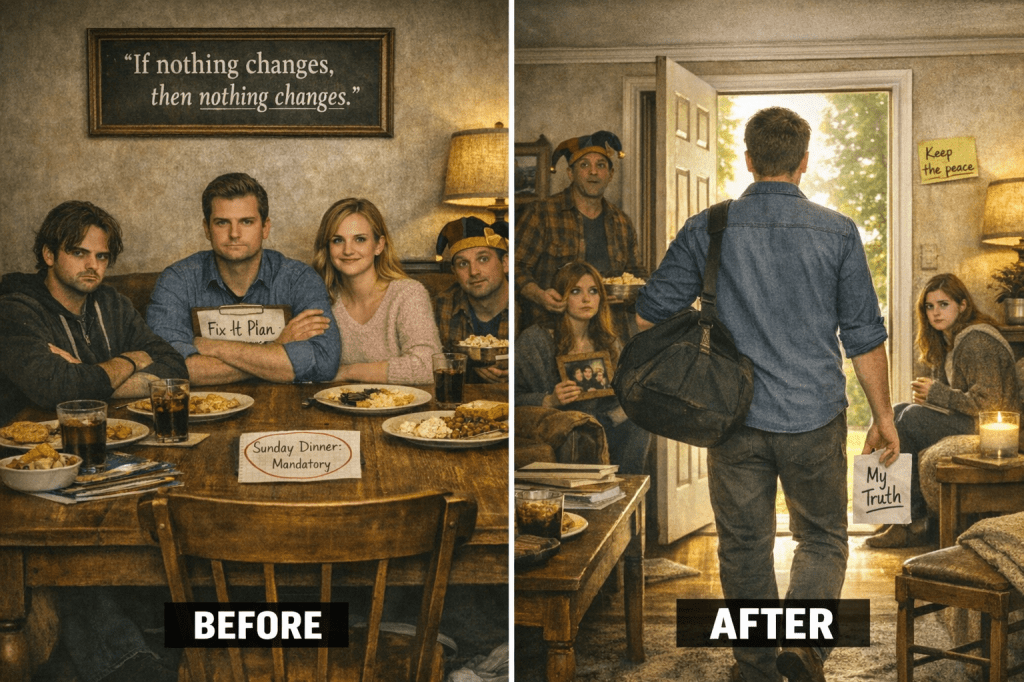
My favorite quote says it best, “If nothing changes, then nothing changes.” And I refuse to be silenced because their comfort depends on my suffering.
Our family lives in what I call comfortable dysfunction. It’s the emotional recliner they refuse to replace even though the springs are broken. And the fabric smells like denial. It’s easier than accountability. Easier than honesty. Easier than saying, “Maybe the gay daughter isn’t the downfall of civilization.”
And as if being the rainbow sheep wasn’t enough. I’m also the green sheep of the family because I’m a medical cannabis patient. And the family’s translation is that I’m “druggin’ and thuggin’.” The “bad influence.” And the “one who needs prayer.” But that’s not even the real issue.
The problem is my refusal to sit quietly in the pew of generational silence. The issue is that I no longer participate in the family’s favorite pastime of pretending. I’m done shrinking myself so other people can stay cozy in their outdated beliefs. I’m done letting conservative Christian values be weaponized against me and my children.
They can keep their selective morality. The kind where my sister thinks being gay is “wrong and evil.” But somehow premarital sex is just the Olympic sport of “being human.” Funny how sin gets flexible when it’s their behavior on the table.
“My family says I’m ‘living in sin.’ Which is wild coming from some of them who wave a red hat like it’s the state flower. They preach about morality and still treat premarital sex, drinking, and hypocrisy like they’re covered under the ‘Jesus forgives me’ warranty.”And trust me. They act like I graffitied the Ten Commandments in rainbow glitter.
Being gay automatically made me the family’s “problem child.” Even though the real problems have nothing to do with what gender I love. And everything to do with the fact that I refuse to pretend. My sister can have premarital sex. Drink like she’s hydrating for the Olympics and drive afterward. And micromanage her child like she’s running a dictatorship. But somehow I’m the moral crisis.
Meanwhile, my sister’s shot glasses stays full. Her judgment stays loud. And her hypocrisy stays undefeated. Funny how cannabis for medical reasons is “dangerous.” But alcohol with a side of denial is “just being human.” I’m the rainbow sheep because I live authentically. I’m the green sheep because I choose a legal, doctor‑recommended treatment. And I’m the scapegoat because I refuse to shrink so other people can stay comfortable in their dysfunction. If being myself makes me the rainbow‑green hybrid sheep of the family, then so be it. At least I’m not grazing in the pasture of hypocrisy.
So no, I’m not stepping back into the box they built for me. I’m not dimming myself, so their comfort stays intact. I’m not carrying the weight of a family that refuses to lift a finger for its own healing. They can keep their comfortable dysfunction. They can keep their silence. They can keep their outdated beliefs wrapped in Bible verses that only apply to me.
Today I honor my inner rainbow‑green sheep. I’m fabulously queer. I’m medically lifted. And completely unbothered by the opinions of people who confuse hypocrisy with holiness.”
I’m choosing truth over tradition. I’m choosing growth over guilt. I’m choosing my children, my peace, and my sanity. And if my existence shakes the foundation of their worldview. Then the foundation was weak to begin with. Thanks for reading! Do you and let the others do them.
Affirmation: I bless my rainbow‑green sheep soul today queer, medicated, and thriving. While certain relatives clutch their red hats and pearls at my existence. But don’t blink twice at their own chaos, contradictions, or alcohol fueled commandments.
“My family says I’m ‘living in sin.’ Which is hilarious coming from people who treat denial like a spiritual gift. And premarital sex like a community service.”
-This Puzzled Life
Light the charcoal. Sprinkle the sage. Negative energy, get your shoes on and leave. Today we’re diving into one of my favorite dysfunctional family topics. Family roles. Those unofficial job titles we never applied for. Never wanted. And yet somehow ended up performing like we were on salary. Take a moment and see where you and your people fall. And here’s the spoiler. If you’re reading this, you already know.
Before we get started, let me warn you. This is not a gentle stroll through family history. This is a full‑blown guided tour through a Southern household. That’s been held together with casserole, denial, and conservative Christian values. That seem to get applied with the accuracy of a toddler using glitter glue.
I grew up in a family where “we don’t talk about that” wasn’t a suggestion. It was the eleventh commandment. Emotions were treated like illegal fireworks. Everyone had them. Nobody handled them correctly. And something always exploded at the worst possible time.
In my house, honesty was considered aggressive. Accountability was considered disrespectful. And therapy? Therapy was treated like witchcraft performed by people who “don’t know Jesus personally.”
Meanwhile, the dysfunction strutted around the living room in broad daylight wearing a name tag and a church hat. And everyone pretended they couldn’t see it. If denial were a sport, my family would have Olympic medals and a sponsorship from Hobby Lobby.
So, buckle your emotional seatbelt. And prepare yourself. Because once you recognize the roles in a dysfunctional family. It’s like spotting roaches. You can’t unsee them. And suddenly they’re everywhere.
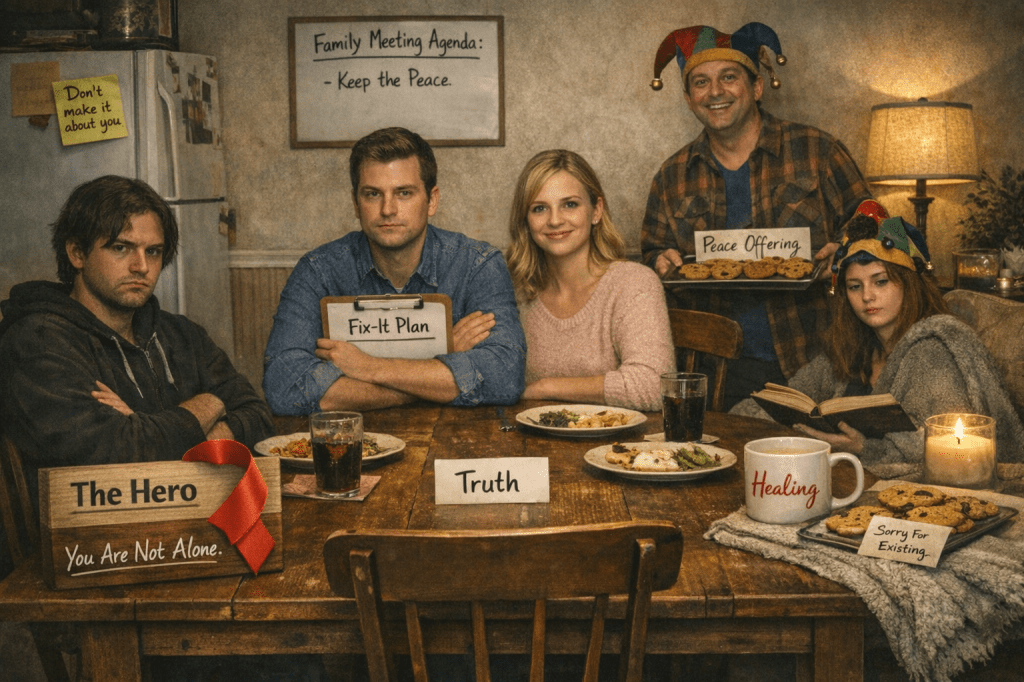
Family roles are the expected behaviors, responsibilities, and emotional acrobatics each person performs to keep the family circus running. These roles shift depending on culture, family size, and personality. But the classics are Hero, Scapegoat, Golden Child, Lost Child, Mascot. And I show up everywhere like glitter after a craft project.
Let’s begin.
1. The Hero (a.k.a. The Family PR Department) The Hero’s job is to make the family look normal, stable, and “blessed and highly favored” to the outside world. According to theraplatform.com (2025), they take on excessive responsibility to gain approval. This is my mother’s role. Or at least the role she auditions for. She is attention-seeking. Reputation-obsessed. And allergic to accountability. She delivers passive-aggressive comments like she’s handing out communion wafers. And then acts shocked when people get upset.
Her signature move? “The Dummy Card.” Suddenly she “doesn’t remember,” “didn’t mean it like that,” or “doesn’t know what you’re talking about.” But trust me, she knows. And right after she stirs the pot. She gives my dad the “rescue me” look. As if she didn’t just season that pot with cayenne, spite, and generational trauma. We only have real conversations when she’s mad at my sister, The Golden Child. Otherwise, it’s news, sports, and weather which is the Holy Trinity of Avoidance.
2. The Scapegoat (hi, it’s me) The Scapegoat is blamed for everything wrong in the family. Stubbed toe? My fault. Bad weather? Somehow me. The economy? Probably me too. I don’t conform to their lifestyle. I’m gay. I use medical cannabis. I don’t go to church because there are too many people who support the cruelty of the Trump regime. And align theirselves with the MAGA movement which practices a form of chriatianity that cannot be found in any Bible. And quite frankly, they have a bad reputation for normalizing pedophilia while demonizing being gay. I guess I should be glad that I just can’t understand that rationale.
I talk about taboo topics. And I acknowledge reality instead of pretending everything is fine. And did I mention I’m gay? Because trust me they will. Instead of saying, “She’s our family and we love her no matter the gender of someone she loves and that loves her.” They act like my existence is a PR crisis. The attitude is like, “Remember when Dana destroyed the family by being prouid to be gay and authentic?” I’m also the family whistleblower. I don’t play along with generational nonsense. I’m my own person. And I’m not apologizing for it.
3. The Golden Child (my sister, obviously) The Golden Child is the family’s prized possession. The chosen one. The favorite. And the one who can do no wrong even when she is actively doing wrong. Thriveworks.com (2023) describes this child as obedient, praised, and protected. That’s her. She has been dipped in gold since birth. She follows the script. Holds the same beliefs. And passes them down to her children like heirloom china. She was taught what to think. Not how to think. And the cycle continues. Children aren’t born to hate. They learn it from the adults who raise them. And this is what my sister excels at consistently.
4. The Lost Child (also my sister — she multitasks) The Lost Child avoids conflict like it’s a full-time job with benefits. She withdraws. Stays quiet. And pretends she’s above the chaos. While simultaneously contributing to it. She never acknowledges her harmful behavior. She believes most people are beneath her. And when she talks about someone being gay, she spells it out “G-A-Y” like she’s avoiding summoning a demon. Her emotional range is that of a frozen waffle. And honestly, that’s the family vibe overall.
5. The Mascot (me and my dad) Mascots use humor to distract from the dysfunction. We crack jokes. Lighten the mood. And do not dare fix anything. We just to keep the room from exploding. This doesn’t always work especially when me and my sister are at war like rainbows and bibles. My dad rescues my mom and sister from “big, bad Dana.” Who refuses to sweep things under the rug. I’m the villain because I tell the truth. Imagine that. Kind of sounds like the current government’s level of functioning.
Now you’ve met the cast and the roles they cling to like emotional security blankets. In the next part we’ll zoom out and look at the bigger picture. And it’s the part they refuse to acknowledge.
That concludes our tour of the Family Circus. Please exit through the gift shop. Where denial is half‑off. Accountability is out of stock. And the Scapegoat merchandise is mysteriously overpriced.” Thanks for reading! Keep breaking chains.
Affirmation: Today I honor my emotionally athletic self. The whistleblowing. Boundary‑setting. Truth‑telling legend who refuses to join the family’s Olympic Denial Team. Even though they’ve been training since the womb.
“Trauma doesn’t make you weak. It makes you a witness to your own survival.”
-This Puzzled Life
Light the charcoal. Sprinkle the sage. Let the smoke rise like it’s clocking in for a shift. And let the air shift like it’s bracing itself for whatever truth you’re about to drag into the daylight. Today isn’t about pretending everything’s fine or slapping a smile on top of a wound. It’s not about the vibes, snacks, or cats doing interpretive dance in the sunbeam. It’s about trauma awareness. It is about naming the things we survived. The things we carried alone. The things we laughed through so we wouldn’t crumble. It’s a Southern‑fried, emotionally honest, and funny enough to keep you from dissolving into a puddle on the kitchen floor.
Trauma Awareness is the kind that hides in your shoulders, jaw, breath, memories, and your jokes. And if we’re going to talk about it, we’re going to do it the only way I know how. Complete with honesty, humor, and the kind of emotional courage that feels like taking your bra off after a long day. It’s painful, relieving, and absolutely necessary.
There’s a moment right before you talk about trauma where your whole spirit goes, “Are we sure we want to do this?” It’s the same tone you use when someone says, “Let’s just run into Walmart real quick.” You know it’s not going to be quick. You know you’re going to see something you can’t unsee. You know you’re going to come out changed. Talking about trauma is like that. Except instead of a man in pajama pants buying raw chicken and fireworks, it’s your nervous system holding up a sign that says, “We’ve been through some things, ma’am.”
Trauma doesn’t just show up when you’re ready. Trauma is that one cousin who arrives early. Eats all the good snacks. And then says, “Why you look stressed?” It pops up at the worst times especially when you’re trying to relax. When you’re trying to sleep. When you’re trying to enjoy a sandwich. When you’re trying to mind your business. And when you’re trying to be a functioning adult for five minutes. Trauma will tap you on the shoulder like, “Hey bestie, remember that thing from 1998? No? Well, I do.” And suddenly you’re staring at the wall like it owes you money.
Your body remembers everything. Even the stuff you tried to bury under humor, iced coffee, and pretending you’re fine. You’ll be walking through Wal-Mart. Touching a throw pillow. And your body will whisper, “Hey, remember that time?” And you’re like, “No I do not. I am touching a pillow. Let me live.” But trauma doesn’t care. Trauma is like a Southern grandmother with a memory like a steel trap. And no sense of timing.
People talk about healing like it’s a spa day. Let me tell you something. Healing is not cucumber water and a robe. Healing is crying in the shower because your shampoo smells like 2007. Healing is realizing you’ve been clenching your jaw since the Bush administration. Healing is sitting in your car after therapy like you just got hit by an emotional freight train. Healing is messy. Healing is loud. Healing is quiet. Healing is confusing. Healing is holy. Healing is exhausting. Healing is worth it. But cute? Absolutely not.
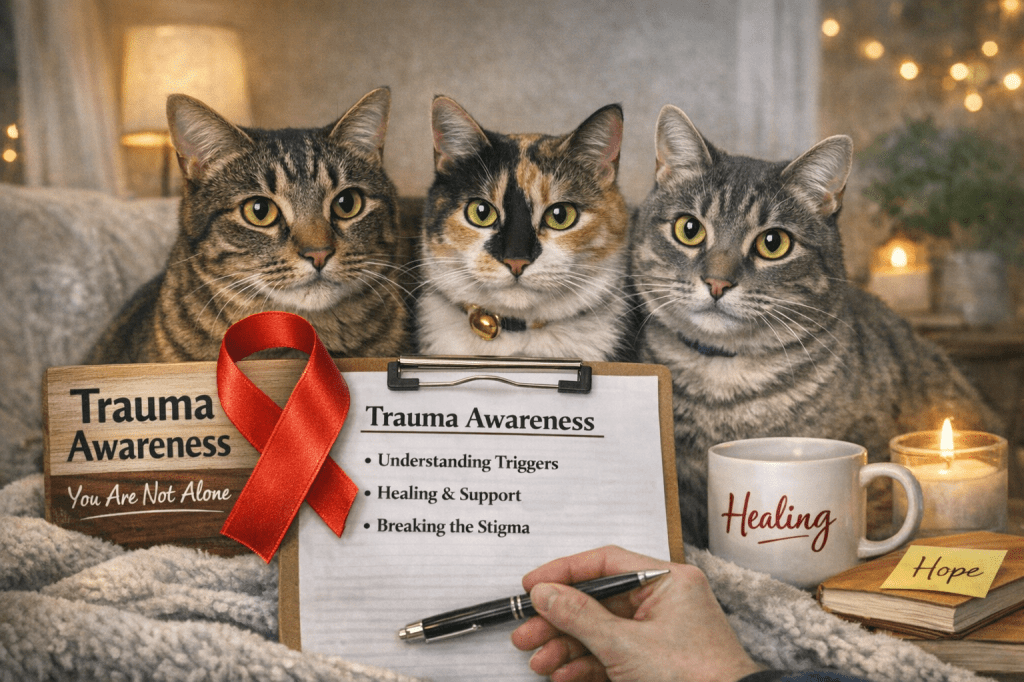
So, buckle up. Because the cats have decided it’s Trauma Awareness Hour. And apparently they’ve all been waiting their whole lives to trauma dump with the enthusiasm of a group therapy circle run by toddlers. And today is the day they ask deeply personal questions with the emotional sensitivity of a toddler holding a chainsaw. They have formed a circle. They have snacks. They have opinions. And apparently, they have questions about my trauma.
Me: “Okay, girls. Today we’re talking about trauma. Share whatever you feel comfortable with.”
She raises paw like she’s in kindergarten
Piper: “I’ll go first because my story is the most dramatic. Obviously.”
Coco: “Oh lord.”
Tinkerbell: “Let the child speak. She needs this.”
Piper: “So picture this. Me and my siblings. In a metal box. In the Mississippi heat, basically sautéing like tiny furry cornbread muffins.”
Me: “Baby, that’s awful.”
Piper: “I know. I was basically a rotisserie chicken with trauma.”
Coco: “You were a sweaty raisin with opinions.”
Piper: “Anyway, I survived because I’m dramatic and stubborn. And now every time the sunbeam hits me wrong, I flop over like a Victorian woman fainting at a garden party.”
Tinkerbell: “You faint because you forget to breathe when you get excited.”
Piper: “Trauma. Tinkerbell. Let me have this.”
Coco clears throat like she’s about to deliver a TED Talk
Coco: “My siblings and I were found under a house. A house. Do you know what lives under houses? Darkness. Ghosts. Tax evasion. I was basically a feral raccoon with trust issues.”
Me: “You’ve come so far.”
Coco: “Yes. And now I cope by judging everyone. It’s called growth.”
Piper: “You judge me the most.”
Coco: “You give me the most material.”
Tinkerbell: “I don’t remember my trauma.”
Me: “At all?”
Tinkerbell: “No. I simply chose not to be present. I was spiritually unavailable.”
Coco: “You had worms.”
Tinkerbell: “Yes, apparently my intestines were hosting a music festival.”
Piper: “You pooped like you were trying to summon something.”
Tinkerbell: “I was summoning peace. And a vet. Preferably both.”
Me: “You really don’t remember anything?”
Tinkerbell: “I remember diarrhea. And then I remember you. Everything else is optional.”
Me: “Well, we’ve all been through some things.”
Piper: “Yeah, but now we’re together! A family! With two crazy brothers who scream at dust!”
Coco: “We are a support group. A dysfunctional one, but still.”
Tinkerbell: “We heal one memory at a time. Preferably with snacks.”
Piper: “And naps!”
Coco: “And boundaries. Mostly for Piper.”
Piper: “I don’t believe in boundaries.”
Tinkerbell: “We know.”
Piper: “Sometimes I get scared when it’s hot outside. So, I cope by yelling at the sun.”
Coco: “I cope by staring at people until they feel bad.”
Tinkerbell: “I cope by leaving my body spiritually whenever something stressful happens. Like when the vacuum turns on. Or when Piper breathes too loud.”
Piper: “I have big emotions.”
Coco: “You have no volume control.”
Tinkerbell: “You have the energy of a toddler who drank a Red Bull.”
Piper: “Momma, what is your trauma about?”
Me: “Oh absolutely not. We are not opening that can of worms. We’ll be here until this time next year. And I don’t have enough snacks or emotional stamina.”
Coco: “Is that why you have panic attacks in Walmart?”
Me: “Yes.”
Tinkerbell: “But what’s scary about going to the pharmacy?”
Me: “Everything.”
Piper: “Everything?? Like the shelves? The people? The lighting?”
Me: “Yes.”
Coco: “The lighting is aggressive.”
Tinkerbell: “The vibes are hostile.”
Piper: “The blood pressure machine is a demon.”
Me: “Exactly.”
Coco: “So what did our therapist tell you?”
Me: “She said, ‘I’ll see you in another couple of days.’”
Tinkerbell: “Translation: ‘You’re a lot. But I believe in you.’”
Piper: “Translation: ‘You have so many issues we need a punch card.’”
Coco: “Translation: ‘You’re keeping the lights on in that office.’”
Me: “But look at us now. We’re safe. We’re loved. We’re healing together.”
Piper: “And we have snacks!”
Coco: “And stability.”
Tinkerbell: “And indoor plumbing.”
Me: “We survived things we never should’ve had to survive. And now we get to build something soft and silly and sacred together.”
All Three Cats: “Group hug!”
Coco: “But don’t touch me too long.”
Piper: “I’m crying!”
Tinkerbell: “I’m dissociating!”
Me: “Perfect. Exactly the emotional range I expected.”
In small Southern towns, admitting trauma is treated like a social crime. The moment you name what happened, you’re not just telling your story. You’re “disgracing the family,” “embarrassing the community,” and threatening the carefully polished illusion of stability that everyone works so hard to maintain. The culture teaches people to swallow their pain. Protect the reputation of the town at all costs. And never, under any circumstances, call out the people who caused the harm. And because the “good ole boy” network is alive and well. And sitting in every position of authority from the courthouse to the church pews, the truth gets buried right alongside the accountability. Even when the perpetrators are known. Especially when they’re known. Nothing is done. The silence is enforced. The victims are shamed. And the town keeps smiling for the church directory photo like nothing ever happened. But the truth doesn’t disappear just because the town refuses to look at it. It lingers in the air, the families, the generations, waiting for someone brave enough to break the cycle and say, “This happened. And it mattered.” And I am that one in my family who refuses to stay quiet about the trauma that happened in the small city of Petal, MS.
Trauma will have you doing things that make absolutely no sense. Things like apologizing to furniture when you bump into it. Jumping at sounds that aren’t even loud. Overthinking texts like you’re decoding ancient scripture. Saying “I’m fine” in a tone that suggests you are, in fact, not fine. And crying because someone said, “I’m proud of you.” And your body wasn’t prepared for that level of kindness. Trauma will also make you emotionally attached to random objects. A mug. A blanket. A rock you found on a walk. A pen that writes really smooth. Your brain will be like, “This is my emotional support spoon. Touch it and perish.”
Trauma awareness isn’t about reliving the pain. It’s about naming it, so it stops owning you. It’s about understanding why you react the way you do. It’s about giving yourself grace for surviving things you never should’ve had to survive. It’s about learning that your triggers aren’t flaws. They’re evidence that you lived through something real. And it’s about knowing you’re not broken.
You’re healing. You’re growing. You’re learning how to breathe again. You’re learning how to trust softness again. You’re learning how to exist without bracing for impact. That’s not weakness. That’s strength with stretch marks.
May your healing be gentle. May your memories lose their sharp edges. May your nervous system unclench one muscle at a time. May your heart learn safety. May your voice return to you. May your laughter come back louder. May your story be yours again. And not something that happened to you. But something you rose from.
So, if no one told you today. You’re not dramatic. You’re not broken. And you’re not “too much.” You’re a whole human who lived through storms that would’ve snapped lesser souls in half. And you’re still here healing. Laughing. Unlearning, Softening. Reclaiming. That’s not survival. That’s resurrection. And baby, if that isn’t holy, I don’t know what is. Drop the sage. Keep the truth. And walk away knowing this. Your story didn’t end in the dark. You did.
Affirmation: I honor the parts of me that survived. I honor the parts of me that are still healing. I am allowed to grow, to rest, to feel, and to reclaim my peace. And I can do it one breath at a time.
“Some mothers grow you, some guide you, and some resurrect the parts of you that never had a chance to live.”
-This Puzzled Life
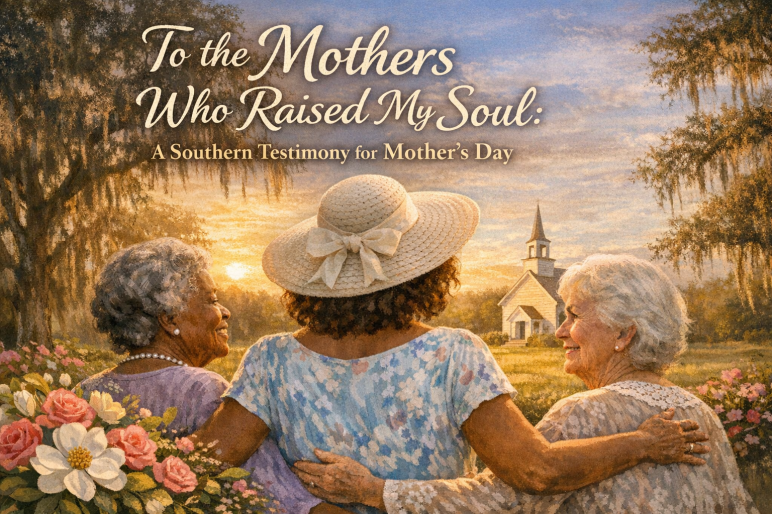
Light the charcoal. We’re about to cook up a truth that’ll smoke out every memory, ache, and blessing you’ve ever collected from the women who raised you. Whether they meant to or not.
Some mothers come into your life the traditional way. The diaper‑changing. Bottle‑warming. “Lord‑give‑me-strength” kind of mothers. The ones who knew your baby smell before you knew your own name. They wiped your tears, your nose, and occasionally your entire behind with the same rag. Because that’s just what survival looked like on a Tuesday.
Then there are the distant maternal figures. The ones who hover like porch‑light moths. They don’t tuck you in. But they keep an eye out. They’re the women who say things like, “You doing alright?” In a tone that somehow feels like a weighted blanket. They don’t step in. They don’t step away either. They’re the quiet guardians of your emotional perimeter.
And then. There are the rare ones. The naturally maternal souls who walk through this world radiating comfort like a heated church pew in July. They don’t have to try. They don’t have to earn it. They just are. These are the Yoda Mothers. The mystical, wise, soft‑spoken warriors who teach you the life lessons you somehow missed while you were busy surviving your childhood. They’re the ones who accept you for who you are instead of who you were supposed to be. The ones who don’t flinch at your chaos. The ones who don’t shrink from your truth. The ones who make you feel safe just by existing in the same room. Breathing the same air. Humming the same off‑key hymn.
And maybe that’s the wildest part of all this. How motherhood isn’t a single recipe. But a whole damn potluck. Some women bring casseroles of comfort. Some bring boundaries disguised as burnt cornbread. Some bring wisdom so sharp it slices you clean open. Women bring nothing but their presence. And somehow that’s enough to keep you breathing.
The truth is that the mothers who change your diapers and warm your bottles give you a beginning. The distant maternal figures give you perspective. But the Yoda Mothers. The soul‑raising. Spirit lifting, “sit down, let me tell you something real” women. They give you a home you didn’t even know you were missing.
These women are diamonds. Not the kind you find in a jewelry case. But the kind the universe hides until the stars finally align and God says, “Alright, you’ve struggled long enough. Here’s someone who won’t break you.”
They’re the ones who look at your mess and don’t flinch. The ones who hear your truth and don’t run. The ones who see the parts of you that were never nurtured. Never named. Never held. And they hold them anyway. They don’t mother you out of obligation. They mother you out of instinct. They mother you because something in their spirit recognizes something in yours and says, “Oh. There you are. Come sit by me.”
And when life pulls them away. When distance stretches thin or Heaven gets greedy. The absence hits like a spiritual amputation. Parts of you go quiet. Parts of you go cold. Parts of you start to decay in ways you don’t talk about out loud. Because losing a mother‑figure like that isn’t just grief. It’s losing the one person who made you feel like your soul had a place to land.
But here’s the miracle. Their love doesn’t leave. Their lessons don’t fade. Their fingerprints stay pressed into your spirit like God Himself signed off on your survival. Here’s to every kind of mother. The ones who birthed you. The ones who raised you. The ones who found you. And the ones who resurrected you without ever asking for credit.
So, here’s to the diaper changers. The distant watchers. The accidental Yodas. And the soul‑raising diamonds Heaven hand‑delivers when you need them most. If you’ve ever been loved by a mother like that, in blood or in spirit, then you already know. Some women don’t just mother you. They resurrect you.
Here’s to the women who became safe harbor in a world full of storms. The ones who could calm your whole nervous system just by walking into the room. Here’s to the diamonds Heaven hides until you’re finally ready to be loved right. The ones who show up exactly when your spirit is starving for gentleness, truth, and a place to land.
Here’s to the mothers who didn’t just show up. They transformed you. They stitched you back together with wisdom you didn’t know you were missing. They held the parts of you that were never held. They loved the parts of you that were never loved. They saw the parts of you that were never seen.
And if you’ve ever been blessed enough to be mothered by a woman like that, then you already know the truth carved into your bones. Some mothers don’t just shape your life. They save your soul. And that’s a legacy no absence, no distance, no silence, and no grief can ever erase. Thanks for reading! And Happy Mother’s Day!
Affirmation: I honor every woman who mothered me in ways my spirit needed. I am worthy of the love, safety, and acceptance they poured into me. And I carry their wisdom like a lantern lighting every step forward.
“Some days I’m the charcoal, some days I’m the spark. But either way, I’m the one lighting up my own joy.”
-This Puzzled Life
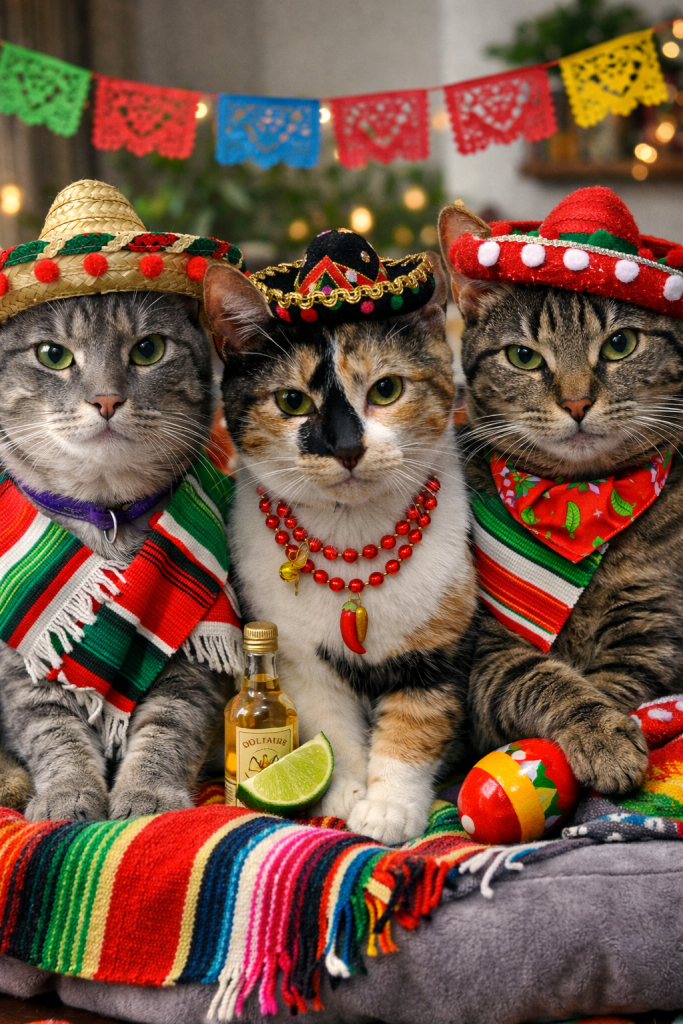
Light the charcoal. Cinco de Mayo at my house does not start with calm music and a polite breeze. No, ma’am. It starts with Piper, Coco, and Tinkerbell forming a three‑cat mariachi militia and declaring your living room an independent nation called El Chaótico Sur. And it is about to ignite like Piper discovering an unattended rotisserie chicken.
You know it’s serious when all three of your cats assemble like a furry Avengers team. Except instead of saving the world, they’re here to destroy your living room, your dignity, and any hope you had of hosting a normal Cinco de Mayo celebration.
Piper’s already pacing like the general of the Fiesta Forces. Coco’s licking the air like she’s pre-gaming the queso. And Tinkerbell? She’s in the corner sharpening her claws on something important. Probably your soul.
Cinco de Mayo hasn’t even started yet. And you’re already outnumbered. Outmaneuvered. And out cheesed.
The moment that first flame pops, Piper struts onto the patio like she’s the official grill inspector sent by the State of Mississippi. Tail high. Eyes narrowed. Full authority. Zero training. She circles the grill like she’s checking for code violations. And then looks at you like, “Ma’am, this charcoal is not up to Cinco de Mayo standards. I’m calling the county.”
Meanwhile, Coco is behind her already licking the air like she’s trying to taste the smoke before it even settles. And Tinkerbell is under the table, plotting something. She always is. I hung a cute little piñata shaped like a chili pepper. I thought it would be festive. But my cats thought it was an act of war. Piper launched herself at it like she was reenacting a scene from Mission: Impawsible. Coco delivered one single, devastating paw jab that cracked it open like a safe. And Tinkerbell climbed the curtains. Rappelled down. And finished the job with the precision of a tiny, furry Navy SEAL. Treats rained from the sky like a snack-based miracle. Piper immediately declared herself “La Presidenta.”
I set up a beautiful taco bar. I arranged the toppings. I warmed the tortillas. And I felt proud. Your cats saw a lawless frontier. Coco dragged off a tortilla like she was smuggling contraband across the border. Piper stuck her entire head into the sour cream and emerged looking like a ghost who died from dairy related crimes. And Tinkerbell rolled in the shredded cheese like she was baptizing herself in the name of the queso, the crema, and the holy guacamole. By the time I turned around, it looked like a raccoon family reunion had taken place on your counter.
I put on a festive playlist. My cats heard the trumpets and immediately assumed that the house was under attack. Maybe a rival cat cartel was sending coded messages. Or it was time for the nightly NASCAR sprint from the hallway to the kitchen. Tinkerbell took the lead. Piper drafted behind her. Coco spun out on the rug. And I made myself a cute little Cinco de Mayo mocktail.
Piper dipped her paw in my drink. Sniffed it. And made a face like you’d offered her a bill from the IRS. Coco tried to knock it over just to test gravity. Tinkerbell sat nearby judging everyone like the HOA president of Chaos Court. I bought tiny sombreros. And I thought they’d be adorable. But my cats thought I’d lost my mind. Piper wore hers for 0.7 seconds. Coco wore hers proudly like a tiny sheriff patrolling the queso frontier. And Tinkerbell shredded hers. And then sat on the remains like a war trophy.
They would like to issue the following official statements.
Piper: “Next year, I want my own grill.”
Coco: “More cheese. No negotiations.”
Tinkerbell: “The sombrero deserved what it got.”
And me? I survived another holiday with your feline fiesta squad. Bless your Southern heart and the ability to laugh through the chaos. And that is how Cinco de Mayo turned into Cinco de Mayhem.
A holiday now officially sponsored by shredded cheese, broken piñatas, and the emotional resilience of one Southern woman who just wanted tacos. Piper has claimed the grill. Coco has claimed the tortillas. Tinkerbell has claimed your sanity. So go on and light the charcoal again next year. Your cats are already planning the sequel. Fiesta over. Queso spilled. Thanks for reading! Ola!
Affirmation: I honor my chaos, my softness, and my power. I move through this world like I belong in every room I enter. Because I do.
“My mental health is held together by therapy, hydration, and three cats who refuse to let me spiral in peace.”
-This Puzzled Life
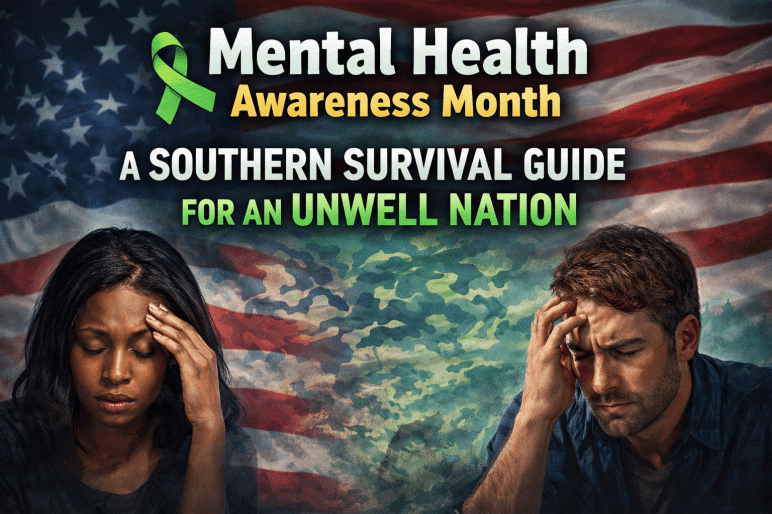
Light the charcoal. It’s Mental Health Awareness Month. And the collective mental state of this country is giving ‘a church van with three bald tires and a prayer.” The nation’s mental health is hanging on by a thread, a prayer, and a prescription refill reminder.
And let’s be honest. This crisis didn’t start at the bottom. No ma’am. We’ve got a mental‑health crisis starting at the top. And it’s dripping like a busted AC unit in August. Our leadership is acting like a Facebook comment section that’s surrounded by red‑hat followers cheering like it’s a halftime show. They treat conspiracy theories like gospel. And emotional regulation as a foreign language.
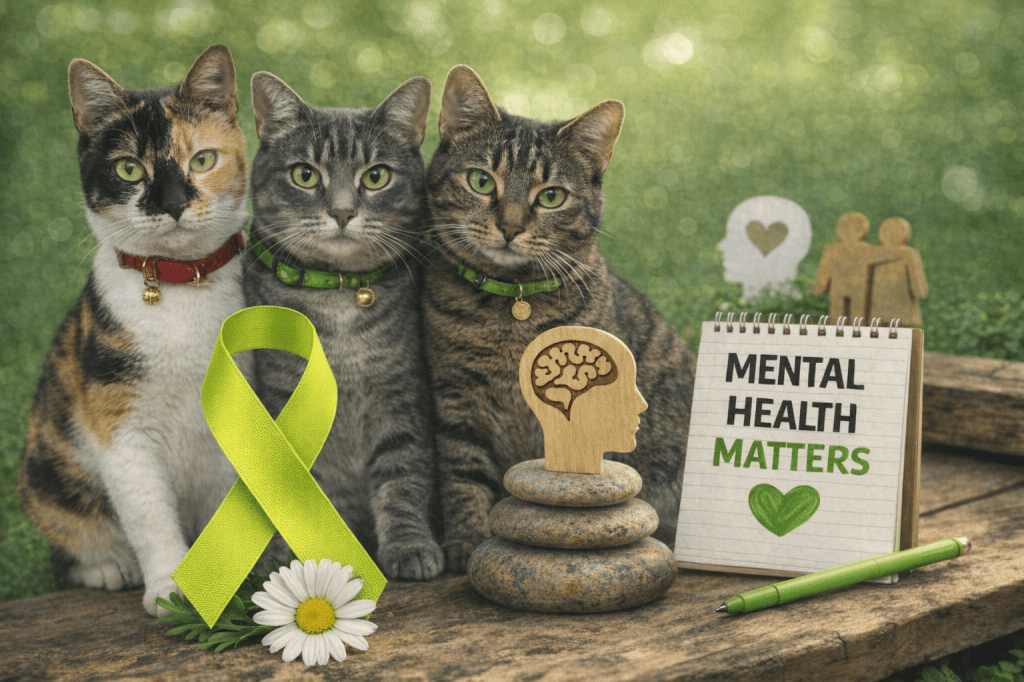
Meanwhile, my cats have entered the chat. Nothing says “mental health check‑in” like three judgmental felines watching the country unravel while demanding snacks. My cats have already staged an intervention.
Piper lit the sage herself. Coco is pacing like she’s waiting on election results. And Tinkerbell is under the couch. Because she said the national energy feels “crunchy.” She sits like a therapist who’s out of network. And blinking slowly at the news like,“This is why y’all need boundaries.” She watches the red‑hat crowd on TV and immediately starts grooming herself. Because she knows you can’t let that kind of energy stick to your fur.
Cocohas diagnosed the nation with “Too Much Foolishness Disorder.” Her treatment plan includes knocking pens off the table. Screaming at 3 a.m.And sitting directly on your chest until you confront your feelings.She sees the state of the country and says, “Oh, we’re all unwell? Bet.” Then she sprints down the hallway like she’s reenacting the national mood.
Piper is the emotional support animal who needs emotional support. She watches the president on TV. Tilts her head and walks away like, “I don’t know what that is. But it’s not stable.” Then she curls up in your lap. Even she knows the collective anxiety is loud.
In May, we gather as a nation to say, “Let’s take care of our minds.” And every May the nation responds, “Absolutely. Right after I argue with strangers online about things I don’t understand.” Therapists are tired. Teachers are tired. Nurses are tired. Your cats are tired. You are tired. The ancestors are tired. Even the houseplants are like, “Girl, water me and breathe.”
Down Here in the Southwe’re doing our best. We’re lighting candles. We’re praying. We’re drinking water. We’re trying to heal generational trauma. While also trying to find the good scissors.
The collective Southern mental state is basically, “I’m fine.” Translation is that I have cried in the laundry room twice today. And if one more person asks me what’s for dinner, I’m moving into the woods.” Piper nods. Coco screams. Tinkerbell knocks something off the counter. It’s a family effort.
What do we do?We breathe. We hydrate. We take our meds. We go to therapy. We stop arguing with people who think facts are optional. We light the charcoal and let the sage smoke carry away the foolishness.And we listen to the cats. They’ve been trying to tell us, “Rest is resistance. Snacks are medicine. Boundaries are holy.”If we’re going to survive this era with its chaos, noise, and its red‑hat circus energy, we’re going to need hydration, humor, therapy, and at least one cat supervising our coping mechanisms. This country needs therapy, hydration, and a nap that lasts until at least 2028.
Piper has officially closed her laptop and declared she’s unavailable for further foolishness. And has already clocked out and put her paw over the “Do Not Disturb” sign. Coco is stress eating treats like she’s watching a season finale. And she is filing paperwork with HR titled “The Nation Is Acting Up Again.” Tinkerbell has curled up on my chest because she said, “the nation’s anxiety is too loud and she’s clocking out.” And has declared the vibes unconstitutional and gone to bed.
If the world insists on acting unwell, then we’ll heal anyway. Loudly, joyfully, and with three cats as our emotional support security detail. Bless your boundaries, your brain cells, and your blood pressure. Now go forth and protect your peace like it’s the last biscuit at Sunday dinner. Thanks for reading! Get your ass in therapy.
Affirmation: I honor my mind, protect my peace, and set boundaries so firm even Coco won’t cross them.
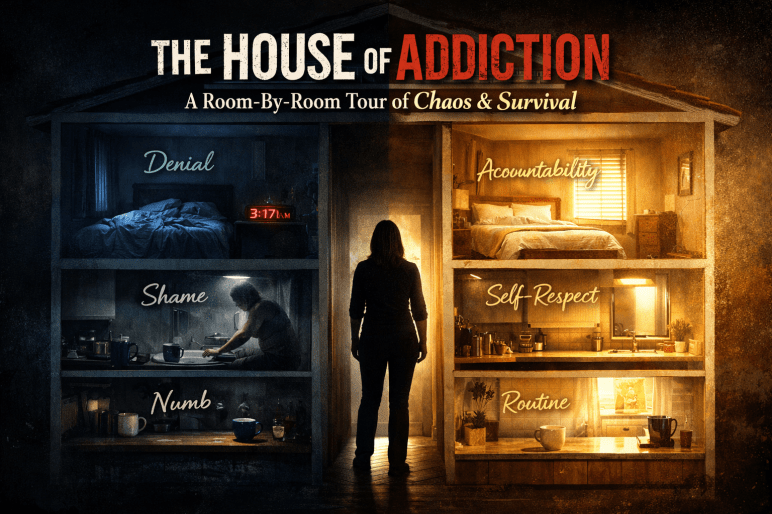
“Some houses echo with laughter. The House of Addiction echoes with lessons. Loud, painful, and unforgettable lessons. And still, somehow, we walk out wiser than we ever meant to be.”
-This Puzzled Life
Light the charcoal. Sprinkle the sage. Let the smoke rise like it’s clocking in for a double shift. What we’re about to talk about requires spiritual PPE. It’s Addiction Awareness Month. And the House of Addiction doesn’t just haunt. It redecorates. It rearranges your memories. Steals your peace. And has the nerve to act offended when you notice.
From the outside, it looks like any other home on the block. But step inside, and you’ll find a floor plan designed by chaos itself. Complete with emotional booby traps and a staircase that creaks like it’s snitching on everybody.
The House of Addiction doesn’t creak when you walk in. It narrates. It knows your footsteps, fears, and soft spots. It knows you’re here for the truth. And it is already rearranging the furniture to make you doubt your own memory.
This house has the audacity of a Southern aunt who swears she “don’t gossip.” But somehow knows everybody’s business. Including the things you haven’t even done yet. Step inside. Keep your shoes on. This floor has seen some things. It will walk room to room with you, pretending it’s just “checking on things.” While it’s really dragging its mess across every surface like a toddler with a Sharpie.
The House of Addiction always looks normal from the outside. Fresh paint. Curtains that match. A porch light that pretends it’s welcoming you in. But the moment you cross that threshold, you realize this house has plans for you. None of them good. All of them messy. And every one of them delivered with the confidence of a demon wearing your grandmother’s pearls.
The Foyer: Where Denial Greets You Like a Nosy Aunt
You step inside and denial is already there. It’s leaning against the doorframe like it pays the mortgage. It’s smiling too big. Talking too fast. And insisting everything is fine. While the smoke alarm screams in the background. “No problem here,” Denial says. All while waving a broom at a fire like it’s a mosquito. The floorboards creak under the weight of secrets nobody wants to say out loud. The air smells like Febreze sprayed over a dumpster fire. This is the room where kids learn to tiptoe. Where silence becomes a second language. Where you learn to read moods like weather reports.
The Kitchen: Where Chaos Cooks Its Famous Disaster Casserole
Addiction loves the kitchen. It treats it like a stage. Pots banging. Cabinets slamming. Someone crying into a sink full of dishes that have been “soaking” since the Bush administration. This is where promises get burned to a crisp. Apologies get reheated for the 47th time. And kids learn to eat fast. Stay quiet. And watch the adults like they’re studying wildlife. The fridge is full of expired groceries and emotional leftovers nobody wants to deal with. And the table is where love tries to sit down. But keeps getting shoved aside by chaos wearing muddy boots.
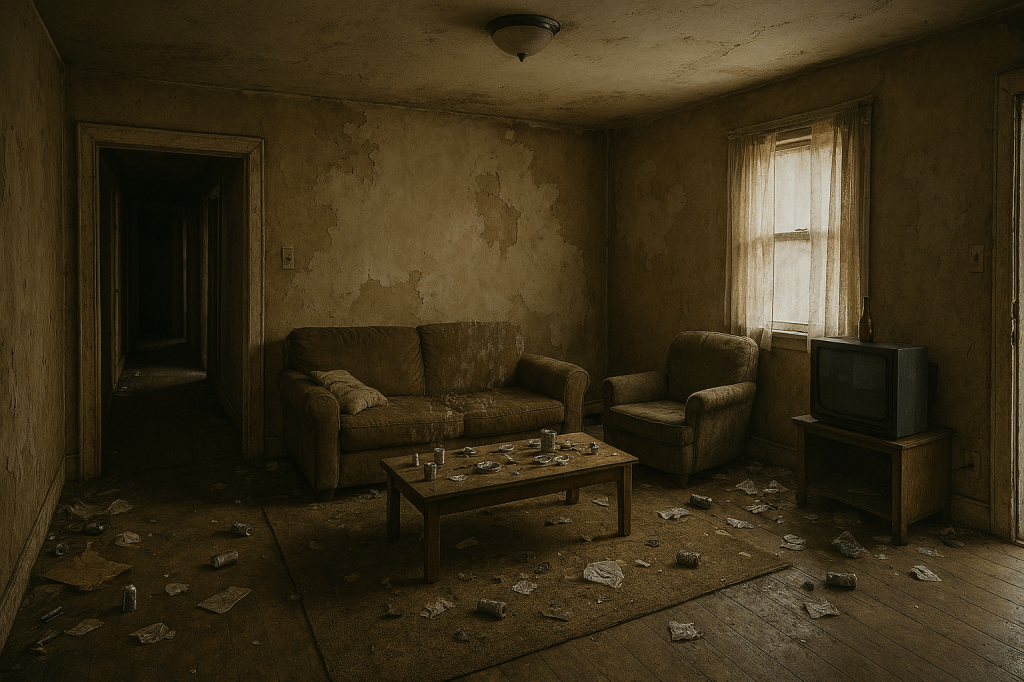
The Living Room: Where Hope Sleeps on the Couch
The living room used to be cozy. Now it’s a battlefield with throw pillows. Addiction drags its drama in here and spreads out like it pays rent. The TV is always too loud. The arguments are always too sharp. And the kids are always pretending they don’t hear what they hear. Hope still lives here. But it’s exhausted. It curls up on the couch under a blanket that smells like worry. It keeps whispering, “Maybe tomorrow.” Even though tomorrow keeps showing up drunk and late.
The Bedroom: Where Secrets Tuck Themselves In
This room is quiet. But not peaceful. It’s the kind of quiet that hums with tension. Addiction sits on the edge of the bed like a shadow with opinions. It whispers lies into the dark. It says, “You’re the problem,” “You can’t leave,” and “Nobody will believe you.” Kids learn to sleep lightly. To listen for footsteps. To brace for the door opening at 2 a.m. with the kind of energy that never means anything good.
The Laundry Room: Where Shame Hangs Itself Up to Dry
This room is where the truth piles up. Dirty clothes. Dirty secrets. Dirty looks from neighbors who pretend they don’t see what they see. Addiction loves this room because it knows shame thrives in small, cramped spaces. The washing machine is always running. But nothing ever feels clean. The dryer door squeaks like it’s tattling. And the air is thick with “Don’t tell anyone.”
The Bathroom: Where Tears Pretend They’re Just Steam
This is the only room with a lock. Which means it becomes a sanctuary for everyone including kids, partners, even the person struggling. People hide here to cry. Breathe. Or just exist without being needed. Addiction hates this room because it can’t control what happens behind a locked door. But it still bangs on it sometimes while demanding attention.
The Kids’ Room: Where Innocence Packs a Go-Bag
This room is the saddest part of the house. Toys on the floor. School papers on the wall. A bed that’s too small for the weight the child carries. Kids learn how to be invisible. How to be responsible for things they never caused. And how to grow up faster than their bones know how to handle. Addiction tiptoes in here sometimes. While pretending it’s not doing damage. But the cracks in the walls tell the truth.
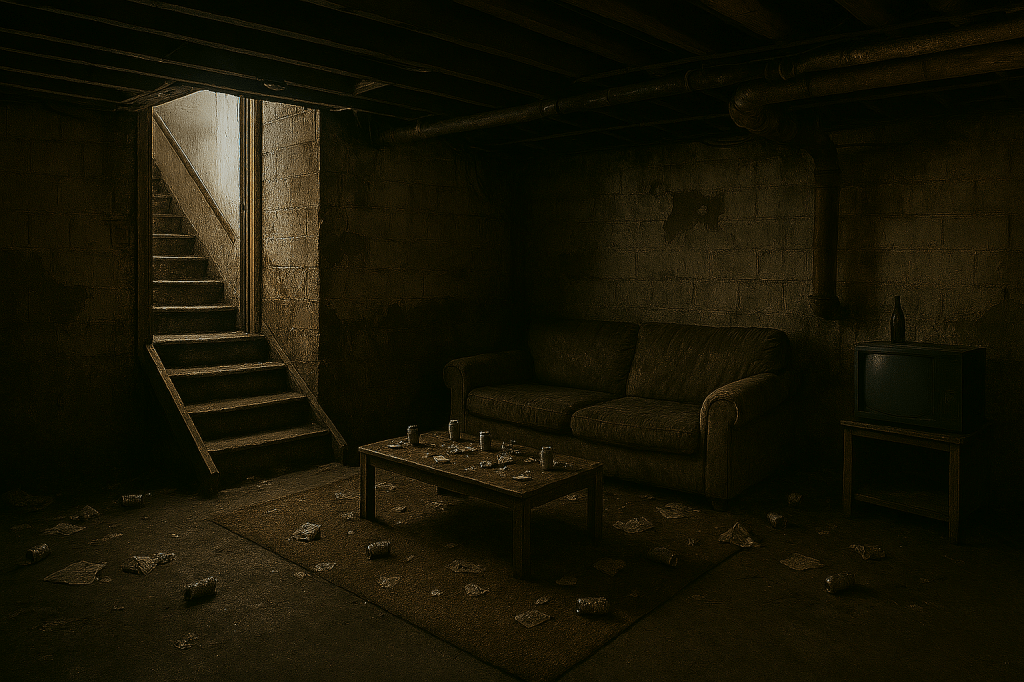
The Basement: Where the Truth Lives
Nobody wants to go down here. Not even Addiction. But this is where the real story sits quiet, heavy, and waiting. This is where trauma stacks itself like old boxes. Memories hide under tarps. And kids grow up and realize the house wasn’t normal. The basement is the part of the house that never lies. It knows exactly what happened. And it remembers everything.
The Attic: Where the “Old Stories” Live
The attic is dusty, cramped, and full of boxes labeled “We Don’t Talk About That.” This is where Addiction stores the memories you tried to outgrow. The versions of yourself you’re ashamed of. And the lies you were told about who you are.
Every box rattles when you walk by, like it wants to be opened. But also wants to stay sealed forever. Addiction loves this room because it knows you’ll avoid it. It knows the dust will settle on your truth until you forget what it looked like. But the attic is also where the light sneaks in through the cracks. It’s where you eventually realize that some stories aren’t yours to carry anymore.
The Garage: Where “I’ll Fix It Later” Goes to Die
The garage is full of unfinished projects, abandoned hobbies, and promises you meant to keep. Addiction parks itself here like a broken-down car that still thinks it can make the trip. This is the room where dreams get postponed. Goals get dusty. And potential sits on cinder blocks. You keep telling yourself you’ll clean it out “when things calm down.” But Addiction keeps tossing more junk in, insisting you don’t have time, energy, or worthiness to finish anything. But one day, you find the light switch. And you realize the garage isn’t full of failures. It’s full of things waiting for you to come back to yourself.
The Office: Where Control Pretends to Live
This room is where Addiction tries to look responsible. Bills stacked. Calendars marked. To‑do lists half done. Everything looks organized until you touch it. And the whole pile collapses like a Jenga tower built by denial. This is the room where you try to manage the unmanageable. You convince yourself you’re “still functioning.” And you hide behind productivity to avoid the truth.
Addiction sits in the office chair spinning slowly, whispering, “You’re fine. Look how much you’re getting done.” Meanwhile, nothing is actually getting done. But this is also the room where you learn the difference between control and survival. And where you finally fire Addiction from its fake job.
The Guest Room: Where You Pretend Everything Is Fine
This room is spotless. Too spotless. It’s the room you keep ready for visitors. So that they never see the chaos in the rest of the house. Addiction loves this room because it’s the perfect illusion of clean sheets. Fluffed pillows. And fake peace. This is where you host people who say, “You’re so strong.” Without knowing you cried in the hallway before they arrived. But the guest room is also where you learn that pretending is exhausting. And that real connection only happens when you stop hiding the mess.
The Crawl Space: Where the Fear Lives
Low ceilings. No light. Hard to breathe. This is the room Addiction never talks about but always uses. It’s where the fear crawls. It’s the fear of leaving, staying, being alone, and of being seen. Addiction keeps this space damp and cold, so you’ll avoid it. But this is the room where the truth hums the loudest. And when you finally crawl in with a flashlight, you realize the monsters were smaller than the shadows made them look.
The Backyard: Where Healing Starts Growing
The backyard is wild. Overgrown. And neglected but alive. Addiction never cared about this space. It didn’t think you’d ever step outside long enough to notice it. But this is where you breathe again. You plant new habits. You feel sunlight without flinching. And you imagine a life beyond the front door. The backyard is the first place that belongs to you again. It’s where you realize the house doesn’t own you. And where healing doesn’t have to be pretty to be real.
The Front Door: Where Freedom Waits
Every child of addiction eventually finds themselves standing at this door. Their hand on the knob. Heart pounding. And wondering if they’re allowed to leave. The truth is you can. You’re allowed to walk out. You’re allowed to build a new house. One with open windows, soft floors, and rooms that don’t whisper threats in the dark. You’re allowed to create a home where laughter doesn’t flinch. Where love doesn’t hide. And where the only thing haunting the halls is the sound of peace finally settling in.
And that’s the truth about the House of Addiction. It thought it owned you. It thought you’d stay lost in its attic of old stories. Stuck in its garage of unfinished dreams. And trapped in its crawl space of fear. It thought you’d keep tiptoeing past the guest room. While pretending everything was fine. And where it rearranged your soul like mismatched furniture.
But you just didn’t survive that house. You walked through every room with the lights on. The sage burning. And the ancestors humming behind you like a choir that refuses to let you forget who you are. You learned the floorplan. You named the ghosts. You opened the windows. And then you did the one thing that house never expected. You walked out the front door. And didn’t look back.
Let the walls rot. Let the roof cave in. Let the lies echo in empty rooms. You’re busy building a new home now. One with sunlight, softness, boundaries, and peace that doesn’t apologize for taking up space. Door slammed. Keys dropped. Cycle broken. Story reclaimed. Thanks for reading! Now walk away like a boss.
Affirmation: I honor the child who survived that house. And I empower the adult who refuses to live in it ever again. My peace is mine. My story is mine. And my future is built with steady hands.”
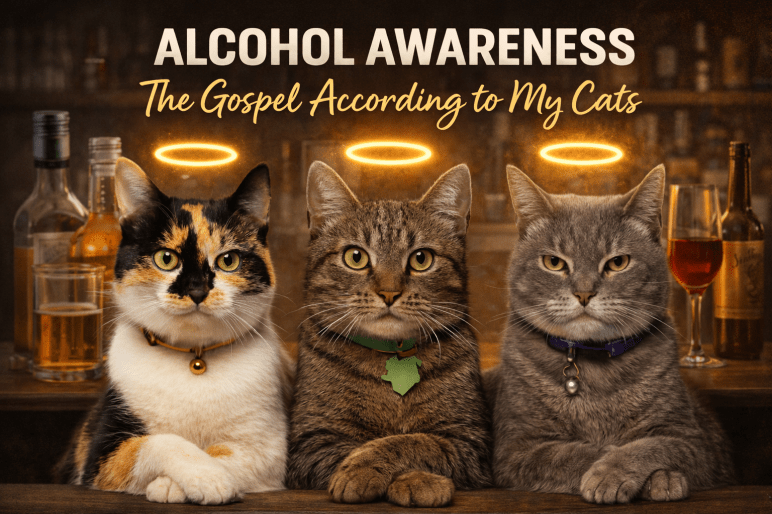
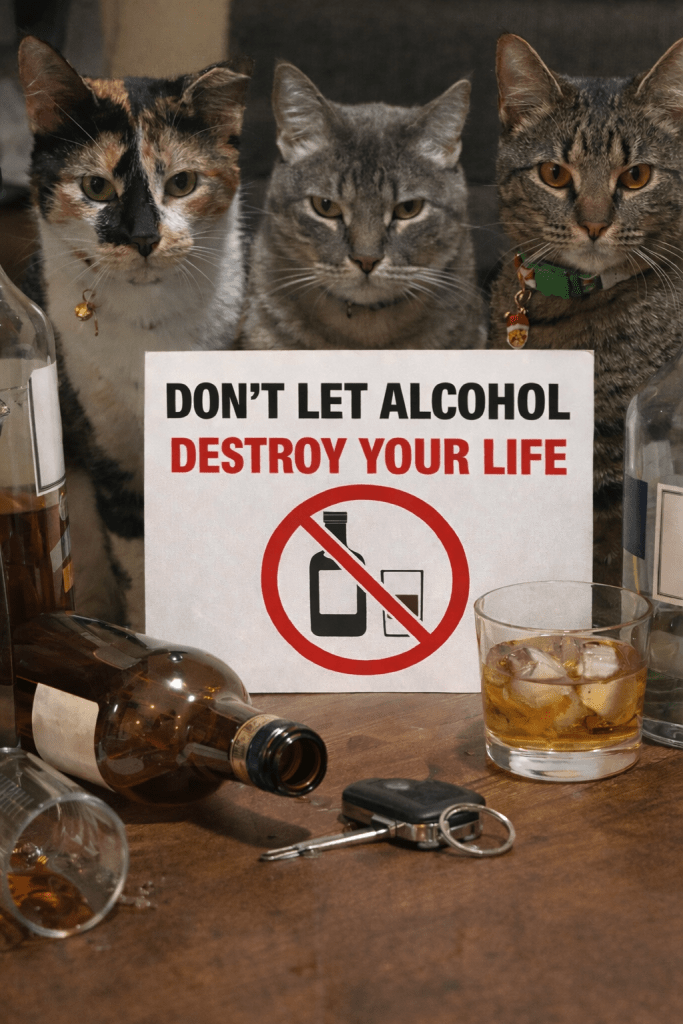
Light the sage. Hide the breakables. My three cats, Piper, Coco, and Tinkerbell, have decided they are the official spokes‑animals for Alcohol Awareness. And they came prepared with statistics.
They just held a household meeting complete with a gavel, a flip chart, and Coco eating the pointer. And they are about to inform me that we are now hosting Alcohol Awareness Week. I didn’t volunteer. I wasn’t consulted. Piper simply slapped a pamphlet on the table like she was serving a warrant and said, “Mother, it’s Alcohol Awareness time, and the people need us.” If anyone can talk about risky behavior, it’s the animals who sprint across linoleum floors at 3 a.m. like they’re late for a rave.
Piper jumps onto the table like she’s chairing a congressional hearing.
“Mother, while adjusting her imaginary glasses, did you know more than half of adults in the U.S. drink alcohol? And 17% binge drink?” She pauses for dramatic effect. “That means 17% of humans are out here acting like me when I see an unattended plate of chicken. Also, 178,000 people die each year from excessive alcohol use. That’s more than the number of times Coco has tried to steal your snacks.” Source: CDC — Excessive Alcohol Use Data
Coco waddles in dragging a bag of treats like she’s smuggling contraband.
“Listen, I’m here to talk about underage drinking. But first, do we have chips? Because this is heavy.” She informs the room that in 2022, 5.9 million youth ages 12–20 drank alcohol beyond ‘just a few sips’. Mother, that’s too many. Even I know that. And 19.7% of youth ages 14–15 have had at least one drink. At that age, I was still learning how to jump on the counter.” Source: NSDUH / Alcohol Infographic 2024
Tinkerbell perches on the highest shelf, looking like she’s about to assign homework.
“Research shows that people who start drinking before age 15 are 3.5 times more likely to develop alcohol use disorder later in life. Which is why I supervise the boys. They need guidance. And boundaries. And fewer snacks.” Source: Alcohol Infographic 2024
This household stays loud, proud, and educational, the cats insisted on adding:
Alcohol misuse affects every organ in the body. Source: NIAAA Alcohol Facts & Statistics
Underage drinking remains a major public health issue. Source: NSDUH 2024 / SAMHSA
Accurate, stigma‑free information saves lives. Especially in LGBTQIA+ communities and the Deep South. Where misinformation spreads faster than Piper can knock over a cup.
Piper: “Moderation is key. Also, naps solve more problems than alcohol ever will.”
Coco: “Alcohol slows reaction time. I cannot risk missing a falling snack.”
Tinkerbell: “Knowledge is power. And power is knowing where the treats are hidden.”
Piper stands on her hind legs like she’s giving a TED Talk.
Piper: “Stay informed. Stay safe. And stop believing your cousin’s Facebook posts.”
Coco: “Stay hydrated. Preferably with water. Or gravy.”
Tinkerbell: “Stay fabulous. And for the love of all things holy, lock the liquor cabinet.”
Piper, Coco, and Tinkerbell gather themselves on the couch like a furry Supreme Court. And ready to issue a ruling on the family hypocrisy they’ve witnessed for years. Piper clears her throat first, because of course she does. “Mother, we simply cannot understand how certain humans in this family will clutch their pearls over you using medical cannabis. A literal plant. But somehow quote the Bible like it’s a coupon code to excuse drinking and driving, and every chaotic decision that would get us grounded for nine lifetimes.”
Coco nods solemnly with crumbs on her chin, “They called you a ‘druggie,’ but then hopped in the car after communion wine like Jesus Himself was the designated driver.”
And Tinkerbell, perched high like a judgmental librarian, adds, “If scripture can be stretched far enough to justify a DUI, then surely it can handle a little THC for pain relief. We’re cats, Mother, but even we know the math isn’t mathing.”
And that’s how my cats continue to point out and educate on the dangers of alcohol. And the hardcore hypocrisy in the south. And, yes, specifically in my own family. Thanks for reading! And never let them silence you.
Affirmation: I honor my body, my boundaries, and my community by choosing knowledge over shame.