

“Child abuse doesn’t lose its cruelty just because it hides in a small town, a school hallway, a church pew, or any place adults pretend is safe. The truth is simple. Harm is harm. And its echoes outlive every secret kept to protect the wrong people.”
-This Puzzled Life
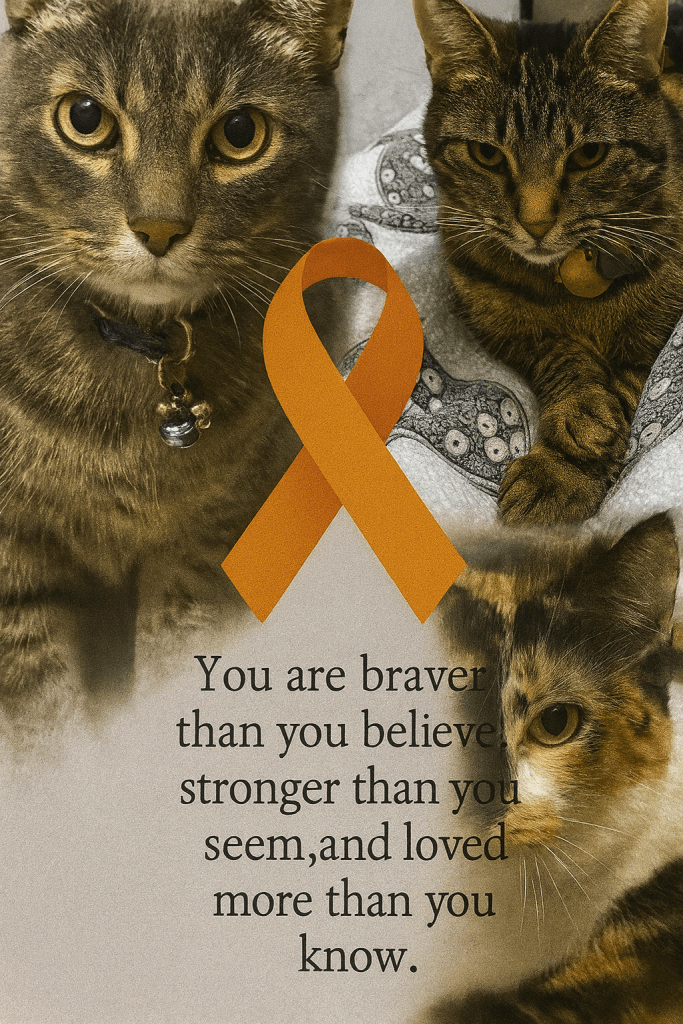
Light the candles. Hide the breakables. Tell the ancestors we’re not sugarcoating anything this month. And somebody hold your childhood diary. Because it’s Child Abuse Awareness Month. My internal system is doing the emotional equivalent of a protest march. While my cats are organizing a full‑blown intervention in the laundry basket.
Piper opened the morning by knocking over a framed photo of my childhood and announcing, “This energy is off.” Coco dragged a blanket into the hallway like she was staging a reenactment of emotional neglect. And Tinkerbell, the voice of clarity with zero tolerance for dysfunction, sat on the windowsill and whispered, “We don’t protect abusers here.” And they’re right.
This month isn’t about tiptoeing around secrets. It’s about naming what happened. Honoring the children who survived. And refusing to let silence win. It’s not about polite conversations. It’s about truth. It’s about healing. It’s about refusing to let ignorance dress up as tradition.
It’s about the children who were told to “respect their elders.” While those elders, both in their homes and communities, disrespected their humanity. It’s about the survivors who still flinch when someone says, “family first.” And the ones whose abuse didn’t happen in their family at all. It happened in schools, churches, programs, and institutions that were supposed to protect them. It’s about the ones who were gaslit. Scapegoated. Silenced. And then told they were “too sensitive.”
And let’s be very clear about the fact that ignorance is no longer a valid excuse for misunderstanding abuse. Education exists. Compassion exists. If someone chooses denial over growth, that’s not confusion. That’s commitment to dysfunction.
Has anyone ever been told, “That wasn’t abuse. It was just discipline”? Ah yes, the classic Southern remix of denial. If I had a dollar for every time someone said, “Well, my parents hit me and I turned out fine.” I’d have enough money to fund a national trauma‑education tour complete with snacks, therapy dogs, and a PowerPoint titled “Fine Is Not a Personality.”
Intent doesn’t erase impact. You can mean well and still cause harm. You can love someone and still traumatize them. And if your version of love includes fear, shame, manipulation, or control, it’s not love. It’s a power imbalance with a decorative throw pillow.
And then there’s the classic statement, “That was a long time ago.” So was slavery. So was the invention of mayonnaise. We still talk about both. Time doesn’t heal what’s never been acknowledged. Trauma doesn’t expire just because the calendar flipped.
This month, I light candles for the child I was. For the children still living in fear. For the adults still trying to make sense of it. For the truth that refuses to stay buried. For the ones who were told they were “too sensitive.” When they were actually just emotionally literate.
And for the cats who remind me daily that boundaries are sacred. Naps are healing. And knocking over symbols of dysfunction is a legitimate coping skill. So, if you came here for comfort, grab a weighted blanket and a snack. We’re lighting candles for the truth and the truth doesn’t whisper.
Let’s be crystal clear about something. Ignorance is no longer a valid excuse for misunderstanding abuse. We have books. We have therapists. We have podcasts, articles, survivors, and entire systems screaming for change. If someone chooses denial over education, silence over accountability, and tradition over truth. That’s not confusion. That’s complicity. And we don’t protect dysfunction here. We name it. We heal from it. We build something better. Because the truth is staying.
And this is the part nobody wants to talk about. But I’m going to do it anyway. And since we’re telling the truth about this month, let me go ahead and say the part that makes people shift uncomfortably in their church pews and PTA meetings is that I wasn’t abused at home. I was abused at school. The place where children are supposedly “safe.”
Yes, the institution covered in inspirational posters about kindness and responsibility. Yes, the adults who were trained. Certified. And paid to protect children. Yes, the environment where parents assume their kids are supervised by people with functioning moral compasses. Turns out, though, perpetrators don’t check IDs at the door. They don’t limit themselves to “bad homes.” They show up wherever power goes unchecked. Which include classrooms and government.
And the tactics used against me? Let’s just say they were the kind of psychological warfare that could flatten most adults. Much less a child who still believed recess was the highlight of the day. The cruelty was calculated. The gaslighting was Olympic‑level. The humiliation was public. And the message was clear “You don’t matter.”
That’s the part people don’t want to hear. It ruins their tidy narratives about “good schools” and “trusted educators.” It forces them to confront the uncomfortable truth that abuse doesn’t need a broken home. It just needs an adult who knows they can get away with it.
And the damage? It didn’t stay in childhood. It built an unstable foundation that I had to grow up on like trying to build a life on emotional quicksand. The scars left a crater in my soul. And it was one filled with conflicting messages. Their responsibilities as adults versus the impossible responsibilities they shoved onto me as a child. Their power versus my powerlessness. Their choices versus my survival.
And no matter how many years pass or how many therapy hours I stack up like emotional frequent‑flyer miles, the wound still carries a vivid truth. I didn’t choose. I was forced to decipher safety was an illusion. Adults weren’t always protectors. And when I screamed for help, no one heard me. So, I did what children do when every exit is blocked. I survived. Not because I was strong. But because I had no other option.
And if anyone wants to dismiss that with, “Well, that was a long time ago.” I invite them to sit down. Hydrate. And stop embarrassing themselves. Trauma doesn’t expire like a coupon. It stays. It shapes. It echoes. And the message I was left to decode? The one carved into my childhood like a warning label was painfully simple. I didn’t matter to the people who were supposed to protect me.
And before anyone tries to twist the conversation into knots, let’s make something unmistakably clear. It doesn’t matter where the abuse happens. A small‑town public school with a football‑field budget and a gossip‑mill PTA. A home that looks picture‑perfect from the outside. A religious school hiding behind scripture. A church where adults confuse authority with immunity. A state‑sponsored facility that claims to “rehabilitate.” Or the most infamous island on the planet.
Abuse is abuse. Location doesn’t soften the crime. Power doesn’t excuse it. Silence doesn’t erase it. And the impact doesn’t stop with the child who endured it. It echoes. It spreads. It roots itself in families, communities, and generations that follow. When a child is harmed, the wound doesn’t stay in childhood. It becomes a legacy. One that survivors spend years, sometimes lifetimes, trying to rewrite. No matter how hard people try to hide it. Minimize it. Or dress it up in excuses. The truth stands firm. Child abuse is a crime. And its mark lasts far longer than the lies told to cover it.
Let’s just go ahead and say the quiet part loudly. Child abuse doesn’t just happen in “bad homes.” It happens anywhere adults hold power and children are expected to stay silent. Including the places that swear they exist to protect them.
What happened to me wasn’t a misunderstanding. It wasn’t “discipline.” It wasn’t a “tough lesson.” It was abuse that was carried out by adults who weaponized authority and abandoned their responsibility the moment it became inconvenient. And the fallout wasn’t small. It shaped my future. It rewired my trust. It carved a crater in my soul that therapy can help me navigate. But will never pretend didn’t exist.
The message I was forced to decode as a child through cruelty, gaslighting, humiliation, and silence was that I didn’t matter. Here’s the part they never planned for. I matter now. My voice matters now. And I’m telling the truth they hoped I’d never survive long enough to speak. Their power ends where my truth begins. Silence only ever protected them, not me. Thanks for reading! And protect children.
Affirmation: My truth matters. My voice matters. I honor the child who survived what no child should face. And I rise today with the strength of someone who refuses to carry silence that never belonged to me.
***Don’t forget to watch the video!***
#ThisPuzzledLife

 This Puzzled Life