This Puzzled Life is a mental health and recovery blog exploring addiction, trauma healing, LGBTQ experiences, humor, and the strange moments that shape us.
“The best way I could describe the effect of the marijuana and hashish is that it would make me relaxed and creative.”
-Steve Jobs
Light the charcoal. Sprinkle the sage. Negative energy go away. I’m going to tell you about a strain that will be the perfect “get up and go” that you need to help make it through this Thanksgiving Holiday and beyond.
Green Crack was the name that Snoop Dogg gave to the strain Green Cush. It is a sativa hybrid that will give you a shot of energy and a calmness for dealing with all of the crowds surrounding Thanksgiving. I will warn you about this strain being known to cause an increase in anxiety. For those that enjoy sativas, I will not fight you for this one. But for people like us who have panic attacks, this is an arch nemesis.
This strain’s genetics are a cross between Skunk #1 x and an unknown indica. It’s a 65/35 sativa dominant. And trust me, it’s very sativa. The top terpenes in this strain are myrcene, caryophyllene, and pinene. Pinene is the big anxiety terpene. The other two are used with pain which is usually seen in indica-dominant strains. Don’t get too brave with this one if you have anxiety.
The taste is one that is a mixture of fruity, pine and sweet. And if I’m honest, I would tell you that the taste is actually pretty good compared to heavy indicas that taste hazy. Medical benefits include depression, ADHD, migraines, fatigue, bipolar, chronic pain, appetite, and stress.
The opinion about the effects of this strain are mine only. However, it might work differently for you. The beauty of cannabis is that there is no “one size fits all.” What works for me might not work for you and vice versa. Thanks for reading! Keep blazin’!
Affirmation: I love that I love weed as much as I love weed.
“Weed taught me patience. Mostly because I forget what I was doing.”
-Unknown
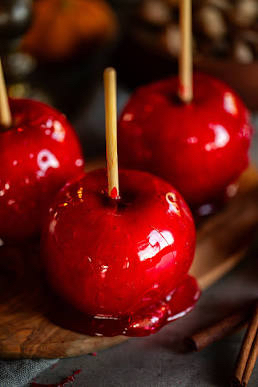
Light the charcoal. Sprinkle the sage. Negativity energy, go away. Today, I want to tell you about the strain known as Candied Apples. This one fits the time of year perfectly.
Candied Apples is a sativa-dominant hybrid that is a cross between Blueberry x Pineapple x Afghan. Blueberry is an indica-dominant hybrid cross between Purple Thai x Thai. Pineapple also known as “Pineapple OG” hybrid of possible genetics between OG Kush x Golden Goat x Pineapple Kush. Afghan is a naturally occurring stain in the Hindu Kush area of Afghanistan with minimal human influence. Thank you to the indica-dominant strains for taming the sativa influence.
Top terpenes include Pinene, Myrcene and Limonene. And it has been known to provide relief from depression, stress, and anxiety. Even though this strain shows a slight dominance of sativa in the terpenes, I didn’t have to worry about the additional anxiety. Another great lunchtime strain. Keep blazin.’ And stay safe.
Affirmation: I am using cannabis mindfully to achieve my goals, whether it’s focus, relaxation, or creativity.
“Some of my finest hours have been spent on my back veranda, hemp and observing as far as my eye can see.”
-Thomas Jefferson
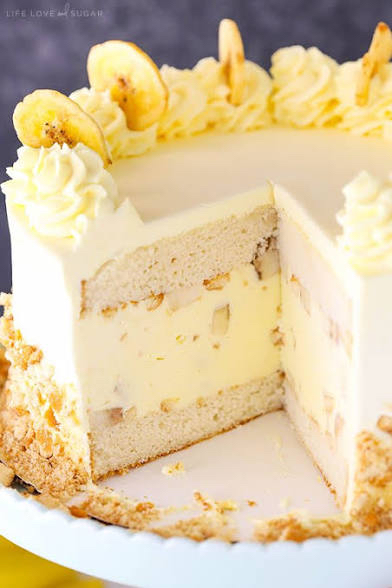
Light the charcoal. Sprinkle the sage. Negativity energy, go away. Today, I want to review the strain Banana Cream Pie. Yep, doesn’t it sound like a strain that would go well during the Thanksgiving holiday? Sit tight, while I describe this nice add to the holidays.
Banana Cream Cake a.k.a Banana Cake is a sativa-dominant hybrid. This strain is made by crossing Wedding Cake x Monkey Banana. This has become one to add to my list of likes. With it being a sativa-dominant strain, I was a little skeptical about whether I would like it. But this little girl is a nice strain.
This strain hit me directly in the eyes like a prized fighter. But it’s not too anxiety provoking. I would be cautious with novice users. Because it will sneak up on you with it’s powerful kick. Patients choose this strain to help with symptoms of chronic depression, anxiety, and pain. I know. There is enough indica in it to tame that anxiety associated with sativas.
This strain was on Leafly’s top 12 strains of 2022 harvest. And what a sweet beauty she is. The sweetness of vanilla combined with chestnuts give this strain a sweet and hardy flavoring. Dominant terpenes are Limonene, trans-Caryophyllene and Linalool. Those with anxiety issues can enjoy but need to be careful and not overdo it.
Thanks for reading! Keep smilin’ and blazin.’
Affirmation: I am grateful for how cannabis expands my creative ability.
Light the charcoal. Sprinkle the sage. Negative energy go away. Today, I want to tell you about a strain called Soul Assassin. As domestic violence awareness month winds down and seeing the damage that abuse can do to someone, I thought that the cannabis strain for today was absolutely perfect. Because of being trapped mentally or physically from seeking freedom, often times for years, it feels like the perpetrator has literally assassinated your soul.
Soul Assassin is a heavy indica-dominant hybrid. Domestic violence is something heavy that is like a wrecking ball in the victim’s life. But this strain is heavy in regard to healing. It’s just what the doctor order for the overstimulation of PTSD. The genetics of this strain is a cross between OG Kush x Sour Diesel. Most like myself, who have been in the cannabis community for many years, know that these are a couple strains that many would consider staples. OG Kush is a cross between Hindu Kush x Lemon Thai x Chemdawg. Sour Diesel is a cross between Northern Lights x Chemdawg.
The medical benefits associated with this strain include relief from insomnia, anxiety, mood disorders, stress, chronic pain, depression, and inflammation. The top terpenes are B-myrcene, terpinolene, B-Pinene. I got a lot of relief with this strain. I would also encourage you to plan on not going anywhere. As “couchlock” can be a reality. Thanks for reading! Keep blazin.’
Affirmation: I smoke my weed and mind my business.
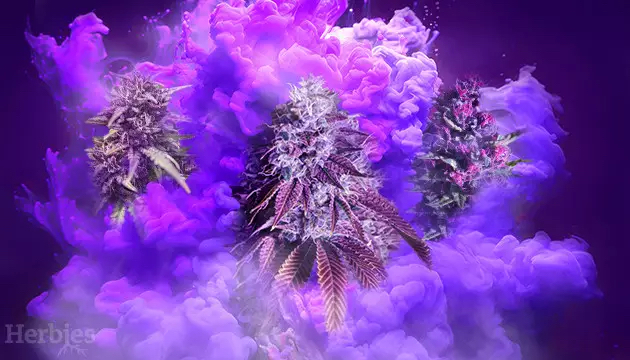
Light the charcoal. Sprinkle the sage. Negativity energy, go away. Today, I want to review the strain known as “Purp Fiction.” This purple strain stays in-line with the purple awareness color.
Purp Fiction is an equal hybrid cross between Melonade X Kong’s Kush. Melonade is a cross between Watermelon Zkittlez x Lemon Tree. Kong’s Kush is a cross between Banana Punch x Wonder Pie. On inhale this strain tastes like wine with a berry and nutty combination.
The major terpenes are B-Caryophyllene, b-Myrcene, Limonene, Humulene and Linalool. And the medical benefits provide relief from stress, anxiety, headaches, insomnia, and pain. I would save this one for when you don’t need to worry about the next couple of hours. This is a strain that helps me out just enough to manage some of my chronic pain for a nice nighttime rest. Keep blazin’ and stay safe.
Affirmation: My cannabis use supports my well-being and helps me connect with my inner peace.
“You know you’re a stoner when your bong gets washed more than your dishes.”
-Unknown
Light the charcoal. Sprinkle the sage. Negativity energy, go away. Staying in-line with the purple awareness color, I’m going to tell you about a strain called Purple Canyon.
Purple Canyon is an indica-dominant hybrid that is a cross between Topanga Canyon x Purple Punch. Topanga Canyon is an equal hybrid of Topanga x Sweatband. Purple Punch is a cross between Larry OG x Grandaddy Purple. And this strain has a “hazy” taste that is typical of purple strains. The “hazy” taste is one that reminds me of a “mold and mildew” smell of an older house.
The main terpenes in this strain are trans-Caryophyllene, Myrcene and Linalool. And the medical benefits include anxiety, body aches, appetite stimulation, chronic pain, and insomnia. This is a very average potency. It is mild enough for a lunchtime break and regrouping. And not strong enough to give you “couch lock.” Keep blazin.’ And stay safe.
Affirmation: I embrace the moments of calm and creativity that cannabis brings to my day.
“Grit your teeth and let it hurt. Don’t deny it. Don’t be overwhelmed by it. It will not last forever.”
-Harold Kushner
Light the charcoal. Sprinkle the sage. Negative energy go away. Keeping in line with suicide awareness, I thought I would talk about a couple of groups that reflect awareness and prevention. There are so many groups out there that stay along these same lines. And I wish that I could spotlight them all.
To Write Love On Her Arms
This group is a nonprofit group dedicated to presenting hope and finding help for people struggling with depression, addiction, self-injury, and suicide. Jamie Tworkowski set out only to help a friend and to tell her story. When he met Renee Yohe, she was struggling with addiction, self-injury, and suicidal thoughts. He wrote about spending five days with her prior to her entering a treatment facility. And he began selling t-shirts to help fund her treatment by posting them on Myspace. Soon people from all over the world began contacting him and telling him about their struggles and heartbreaks. And in 2007, TWLOHA became an official organization.
Here are some numbers associated with their organization:
· 210,000 messages from individuals in over 100 countries.
· 3.8 million miles have been traveled to meet people in their communities.
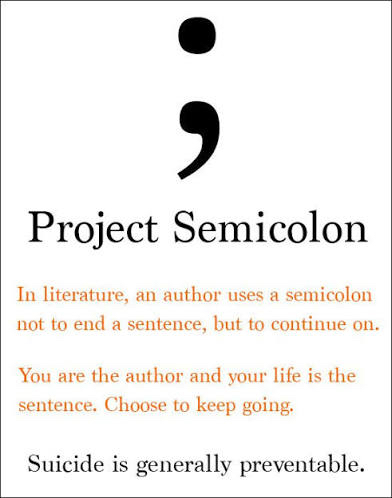
It is an online community that began in 2013, when Amy Bleuel created it to honor her father, who died by suicide. The organization centers around mental health awareness and suicide prevention. The World Health Organization (WHO) reports a 25% increase in anxiety and depression during the first year of COVID-19. That combined with the nation’s political instability characterized by protectionism and unilateralism has led to strained international relations. And the stress funnels down to our families and personal stories.
The semicolon represents a continuance of life where a period could have easily ended the story. There have currently been over 89,000 assessments completed. 5,336 journal entries shared. And have provided direct support to 214 individuals. Semicolon badges in Apex Legends and Call of Duty has reached over 1.3 million gamers and additionally 50 new chapters. And 84% of Project Semicolon members report that the organization has saved with lives in times of crisis (www.projectsemicolon.com, 2025).
Mission Statement
Our mission is to empower individuals with mental health experiences to embrace their journey and recognize that their story is far from over.
I hope that you can take something from this information. Please take what you can use and leave the rest. And please pass along the information to someone who can benefit. Even if that someone is you. Keep smiling! And do not be afraid to reach out for help.
Affirmation: There are other ways to end my pain, even if I cannot see them right now.
“Our country is grappling with a youth mental health crisis, and it is particularly pronounced for LGBTQ+ youth.”
-Ronita Nath
Light the charcoal. Sprinkle the sage. Negative energy, go away. Today, keeping in line with the topic of suicide, I want to discuss suicide in the LGBTQ+ community.
The prevalence of suicide in the LGBTQ+ community is nothing new. The risk for suicide attempts and suicidal ideation can be 3 to 6 times greater for lesbian, gay and bisexual adults according to the National Institutes of Health. But there are also other statistics to keep in mind.
In 2024, 39% of LGBTQ+ youth considered attempting suicide according to The Trevor Project’s national survey. 1 in 10 of LGBTQ+ youth attempted suicide in the past year. And LGBTQ+ youth are more than four times likely to attempt compared to heterosexual youth. I can tell you that personally, I’ve been suicidal many times because of rejection from my family as a lesbian woman.
Transgender and Nonbinary identified individuals are at an even higher rate of suicide. And almost half seriously considered suicide in the past year. In 2022, 80% of transgender people had considered suicide and 40% had attempted. These statistics while staggering are not surprising. These demographic struggles are way more than they should be with little compassion from society.
Bisexual identified individuals are 1.5 times more likely to report thoughts and attempts compared to gay and lesbian individuals. And 2.98 times more likely to have a suicide-related event compared to heterosexuals according to a 2022 study. And the LGBTQ+ youth of color report higher rates of suicidal ideation and attempts compared to white peers (www.therevorproject.org, 2025). And there are several contributing factors such as:
· Discrimination and Prejudice:discrimination, harassment and violence due to sexual orientation or gender identity increases the risk of suicide.
· Lack of Support Systems: Limited social support from family, peers and community exacerbates the mental health challenges.
· Mental Health Disparities: LGBTQ+ individuals are more likely to experience depression and may face barriers to accessing mental health services (https://mhanational.org, 2025).
For someone who is a member of the LGBTQ+ community, I can tell you that I’ve considered suicide many times. The rejection from family and friends are sometimes more than I can bare. And having worked with someone in therapy many years ago, who was not sensitive to the needs of someone in these communities, there was little progress made. Mainly, because I couldn’t trust her. And she was extremely judgmental.
Since collaborating with coach for almost a decade, I can tell you that I have been able to fully accept the fact that I’m gay, despite my family’s disapproval. And then the religious communities also seem to greet us with bible verses telling how many ways we are going to hell. We all know that “choosing” to be gay is such an easier way of life. There the secret is out.
With the current political administration taking away the rights and freedoms that the Stonewall riots stood against, and the lack of funding for suicide hotlines for LGBTQ+ youth, these rates will only climb. Our families, friends, churches, and government should be ashamed of standing by people who are ok with the policies set in place. We are the same as we ever were. We just wear rainbows now.
There are those beautiful allies out there who remain the strength and backbone of our continual fight for equality. We are youth, parents, aunts, uncles, cousins, husband, and wives who just want to be recognized as equals in the eyes of the law. But where reputations and political agendas are from the far right, we must be even more solidified as a community. If someone is for rights with some and not others, I have no room for them in my life. But it’s taken me years to come to this conclusion.
Is it lonely? At times, yes. However, I want people in my life who not only support me but also my friends. The suicide hotline is something that our community not only wants but needs. Many of us have non-supporting families and mine is no different. But I do have a place to live currently. But that does not constitute me putting up with homophobia or fragile masculinity and femininity.
The very few “true” friends I have, understand that being gay is not a “choice.” It’s who I am. And if that’s too much for someone to manage, that’s just too damn bad. To my fellow allies and community members, keep up the good fight. We must take up the original Pride flag are carry on. I love our colors. And I’m proud to call myself a member of the LGBTQ+ community.
Keep smiling. Keep shining. Knowing you can always count on me, for sure. That’s what friends are for. We are seen. And we are heard. And….WE ARE FABULOUS! Thanks for reading. Take what you can use and leave the rest.
Affirmation: I am proud of myself and will continue to strive to do well.
“Real heroes don’t wear capes. Real superheroes wear uniforms and badges and stethoscopes! Real superheroes are members of our military, law enforcement, and first responders. Pretend superheroes wear capes.”
-Dean Cain
Light the charcoal. Sprinkle the sage. Negativity energy, go away. Today, I want to talk about first responder suicide. This is another group that seems to be looked over when discussing this topic. Having worked in the EMS field, I can tell you that sometimes I saw things that continue to haunt me to this day.
Individuals, who have also worked in the field, have told me, “they just left work at work.” And it was simple. In that case, “Congrats! You are the winner! And you were much stronger mentally, I guess.” But in my situation, I was trapped in a domestic violence situation where emotional abuse was normal. So, working myself to death while experiencing trauma in both my private and professional life, my mind was so overloaded that I developed PTSD from both situations.
Maybe it was the 7-year-old who was hit by a drunk driver and left for dead. Maybe it was the car wreck where sister and boyfriend we both killed. And older sister’s face was ripped off in the wreck. Maybe it was the murder that left a body with half a head from a shotgun blast. Maybe it was the screaming mother, who I had to tell that her child was dead. Maybe it was the mother on Mother’s Day that was told that her law enforcement son was killed in a drunk driving accident. Maybe it was the woman who was ejected from a vehicle after falling asleep behind the wheel, whose legs were pinned behind her head. Maybe it was the suicide scenes. Maybe it was putting a child in a body bag in front of a mother. Maybe it was the person hit by a train where chunks of meat were the only thing that remained. Maybe it was the disabled individual in a wheelchair who was raped by her cousin. Maybe it was the woman who was cut from ear to ear, because she was cheating on her boyfriend with a white man. Maybe it was working hard on a grandmother, in front of the family, begging for us to save her when we couldn’t. Maybe it was the male body that was found in a house that had been dead for several days. And the only way the neighbors knew something was wrong was because they smelled him through the walls. Maybe it was the little girl who innocently climbed up in her daddy’s pickup truck only to find a loaded gun and accidentally pulled the trigger leaving one of the bullets lodged in her brain. Maybe it was the little boy who was handed to a good Samaritan from inside his father’s eighteen-wheeler, only for the truck to explode because the jaws of life were not available. Maybe it was the car wreck where I had to sit in the dead passenger’s lap to work on the dying driver. Maybe it was the mother who died from a seizure and her little girl was left in the home alone for over 8 hours before the body was found. Maybe it’s the smells of decaying bodies that I continue to smell almost 30 years later. Maybe it was telling my boss that I was having flashbacks from a gruesome scene only to be told, “If you can’t handle it, pick a different profession. Maybe it’s the incessant scenes that I continue to replay beyond my control with questions about if we did enough. Maybe, Maybe, Maybe.
In the time that I worked, I saw enough trauma to last me a lifetime. There was no one to talk to about anything. Like I was told that there would be. Getting shifts covered was more important than the safety and well-being of employees. And somehow, sexual harassment and a near rape by a co-worker was viewed as though I brought it on myself. And eventually, trying to survive by living in my car and attempting to distance myself from the domestic violence situation led me to a level of depression and despair that was somehow new to me. I was forced to keep unethical secrets which was “normalized behavior.”
A lot of people that I worked with were dealing with problems through narcotic diversion, sex with random partners, alcohol and drugs were seen as “off-day or working” coping skills. And the level of compassion for another human being “hitting the skids” to a level that was disturbing. There was not just one reason that I was having suicidal thoughts. But I had nowhere to turn for help that was “safe.” And the work environment was just as toxic.
Life said, “Here are the pieces. Figure it out.” And I tried to bury them so far down that I never wanted to revisit those fears and feelings again. For a long while, I was able to do just that. But when you have unresolved trauma there’s only one thing that you can be sure of, it will surface again. And almost 20 years later it would come forth vigorously. And it almost killed me.
First responders include police officers, firefighters, paramedics, EMTs, and telecommunicators. Due to the unique occupational stressors, the risk for mental health issues and suicide are at a much higher rates of depression, PTSD, suicidal ideations, and behaviors (www.cdc.gov, 2021). And due to consistent exposure to traumatic events can impact the brain’s ability to process the experiences.
The Impact on Mental Health:
· PTSD, depression, and anxiety: first responders are at a significantly higher risk of developing these.
· Cognitive Issues: Trauma can lead to difficulties with memory, attention, planning, problem solving, which can affect daily functioning and relationships.
· Secondary Traumatic Stress (STS) and Vicarious Trauma (VT): first responders can experience emotional and/or psychological distress from observing or hearing about the trauma of others. And can lead to the symptoms of emotional numbness, irritability, sleep disturbances, and physical complaints.
· Burnout and Compassion Fatigue: Demanding nature of the job and frequent exposure to suffering can lead to emotional exhaustion and reduce capacity for empathy (https//extension.usu.edu, 2025).
It has been said too many times, “Well you chose the profession.” And to that I respond, “Yes, I did. Who else would’ve done it? You?!” And then, of course, the sound of crickets followed. To this day I can say that I loved working in the field of EMS. But my brain took a beating. The trauma of the event doesn’t happen at that exact moment. It creeps. And if you are running back-to-back traumatic calls, then the brain never has a chance to recover. Also, when therapeutic help is seen as shameful or weak, this further ostracizes the employee to thinking that there is no way out. There are those “trauma junkies” as they are called that seem to enjoy the trauma. However, from working with those types of individuals, I have found that there is also a higher rate of alcohol and drug use.
Reducing the stigma will only happen when senior management are supportive of mental health efforts to keep all employees safe. And in the environment where I worked, the stigma couldn’t have been any stronger. People were allowed to work an extreme amount hours without sleep, which was very dangerous. In fact, an EMT who was in paramedic school, was allowed to work without adequate sleep and he wrecked an ambulance with a patient on board, because he fell asleep at the wheel striking a telephone pole. And sadly, there are currently no federal laws that regulate this. This problem is still left up to the digression of private companies.
A national organization known as the National Association of Emergency Medical Technicians have issued guidelines for managing fatigue in EMS personnel. This sets guidelines such as limiting shifts to less than 24 hours in duration and providing access to caffeine to help counteract fatigue. And offering naps. However, I can tell you that the only “nap” I was offered was during the time it took for a red light to change to green. And there is a recognized concern about EMS worker fatigue for both workers and the public. Research also shows that more than half of EMS workers report severe mental and physical fatigue, poor sleep quality, and inadequate recovery between shifts (www.ems.gov, 2019).
I can only hope that those entities that have an ambulance or some other type of EMS service abides by this. However, I can almost guarantee that senior administrators are more concerned with the dollar amount that is acquired at the end of the month. Because the low pay rate of EMS workers makes the individual “a dime a dozen.” And they will just be replaced if they can’t handle the stress. And this attitude combined with the difficult nature of the job is why I would still consider this working environment dangerous for the worker, as well as patients.
If you are or know someone in this profession, it is imperative that you and they both know the importance of “healthy” self-care. Asking for help is not a weakness. It’s the personal responsibility of the employee and the companies that employ them. Please make use of services that are provided. Thanks for reading! Stay safe.
“The soldier above all others prays for peace, for it is the soldier who must suffer and bear the deepest wounds and scars of war.”
-Douglas McArthur
Light the charcoal. Sprinkle the sage. Negativity energy, go away. Today, I want to discuss veteran suicide. I know that this topic has seemed to get old and fast. However, I believe that the more we talk about the harshness of life, the more the stigmas will begin to disappear.
In 2022, the most recent year for the current data, 6,407 veterans and 41,484 nonveteran adults died by suicide. The rate among veterans was 34.7 per 100,000 compared to 17.1 per 100,000 for nonveterans. Since 2005, veteran suicide has risen faster than any other group. And these rates are unacceptable.
The veterans who died by suicide in that year, 40% were under the care of the Veterans Health Administration. Among those patients, who were also diagnosed with a mental health disorder or substance abuse disorder, there were 56.4 per 100,000, which was twice the rate of those without a diagnosis. And among 1,548 veterans who died by suicide 64% were diagnosed with depression, 43% had an anxiety disorder, 40% had PTSD, and 32% had an alcohol use disorder. However, the highest suicide rates were associated with veterans who had sedative use disorder which include benzodiazepines, barbiturates, and opiates (www.rand.org, 2025). And the stigma about mental health in the military further increase this problem.
Aspects of Veteran Mental Health stigma:
· Fear of judgment and perception: Veterans worry about how seeking help will affect all areas of their lives and especially on career repercussions.
· Military culture: The “warrior ethos” which emphasizes self-reliance and stoicism create barriers to seeking help.
· Loss of security clearance: Some fear that seeking mental health treatment will lead to revocation of security clearances.
· Impact on treatment: stigmas can lead to untreated mental health conditions, substance abuse and increased risk of suicide.
· Self-stigma: Veterans may internalize negative societal views about mental health which can lead to shame, self-blame, and more reluctance to seek help (https://oxfordtreatment.com, 2025).
As an advocate for medical cannabis, I believe that our veterans should be given an ounce of cannabis the minute their feet hit US soil upon returning from active duty. As I personally deal with PTSD, there is not another medication on the planet that can bring me relief like cannabis can. And it’s such a safer alternative to alcohol, opiates, and benzodiazepine medications.
Currently, the Safe Healing Act, which was introduced on February 4, 2025, is designed to prohibit the Secretary of Veterans Affairs from denying a veteran benefit administered by the Secretary by reason of the veteran participating in a State-approved marijuana program and other purposes. But unfortunately, there is only a 3% chance of being enacted (www.govtrack.us, 2025). And I consider this utterly ridiculous. There is an unmistakable problem with veteran suicide. It appears Big Pharma is still in the way of progress. I wonder how many people who oppose this bill must suffer, daily, with the horrible effects of PTSD, anxiety, and chronic pain that “Big Pharma” can’t seem to help?
Our returning soldiers are faced with horrors that no one understands until they’ve been there. And though I have never served our country, I can tell you that the above-mentioned mental health disorders have also almost taken my life many times. The symptoms are horrific in nature. Put chronic pain in the mix and suicide often seems like the only answer to have a break, though it be permanent, for even a moment of peace.
Veterans, in my eyes, should be held to the utmost respect. They should be the highest paid employees before professional athletes. And we as a country should make sure that the best treatment is available to them for the rest of their lives. Some have paid the price of their lives on the battlefield. And a high percentage of others pay with their lives when they return home. But instead of treating them like the heroes like they are, they are often discarded by the government that they so proudly serve.
Is cannabis the only answer? Not at all. However, while they find the modality that works for them, I think that cannabis could lighten the load and make their futures seem a little brighter. Discarding them along with all the judgmental stigmas only adds to the problem. And until this is rectified, we will continue to lose those beautiful people who are willing, at any moment, to lay down their lives for our freedoms. Shame on the United States of America for treating them like that!
I know reading this is not easy. But we as a nation must stand up for these individuals who continue to pay the price every time, they open their eyes. Let’s get past the “reefer madness” ignorance and allow our veterans the opportunity to extend their lives at home. A special thanks and salute to one of my favorite veterans who I’ll call Joe. Thanks for reading! And God Bless America!












 This Puzzled Life