
“Always remember, if you have been diagnosed with PTSD, it is not a sign of weakness; rather, if is proof of your strength, because you have survived!”
-Unknown
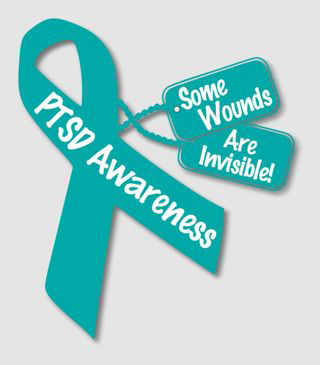
Light the charcoal. Sprinkle the sage. Negative energy go away. Today, I want to take time out from celebrating Pride, to give light to National PTSD Awareness Day. This one hit hard as I’ve lived with PTSD longer than I’ve lived without it. And there are so many of us who don’t make it to the other end of the tunnel. It’s an incredibly dark place to wake up to and go to sleep with every night.
Post Traumatic Stress Disorder (PTSD) dates back to ancient civilizations and military conflicts. Terms used early on included “combat-related stress,” “shellshock,” “combat fatigue,” and “railway spine.” In the 1800s and early 1900s, the “talking cure: was popularized by Sigmund Freud and introduced in medical literature. And the treatment went from psychoanalysis to electric shock treatment. By the 1950s, the treatments had become more humane. However, now people would not admit to any traumatic symptoms due to the stigma. So, group therapy and psychotropic medications were introduced (blackbearrehab.com, 2025).
In the 1970s Vietnam veterans began experiencing a lot of psychological problems that persisted even after returning home. And survivors of domestic abuse were also included. In the 1980s, PTSD was officially recognized as a mental health problem. Diagnostic and Statistical Manual of Mental Disorders adopted the diagnosis where it has remained (blackbearrehab.com, 2025).
PTSD is a developed from a traumatic event. C- PTSD when a traumatic event continues for months and years or multiple events occur. The intrusive thoughts, flashbacks, insomnia, avoidance, memory problems, detachment from friends and family, feeling emotionally numb, hyper startle, irritability, trouble concentrating, impulsive behavior, paranoia, severe anxiety, nightmares, suicidal ideations and actions and uncontrollable thoughts about the event. And over time, these symptoms completely devour who you once were (MayoClinic.org, 2025).
I know that PTSD is typically related to soldiers. I am here to tell you that I never went into the military. But the PTSD that I deal with, as a result of domestic violence, grabbed hold of me and has never let go. It has completely stripped me of everything that I used to enjoy. I don’t care about relationships. I question people about their intentions, even if they’re pure and good. I’m constantly waiting for the next shoe to drop. I don’t have typical reactions to being scared. I could see a moth out, of the corner of my peripheral vision, and then jump and scream like Jeffery Dahmer was staring at me and about to take the first bite. I face the stigmas of both friends and family mainly due to a lack of understanding. However, the reasearch information is everywhere. Sometimes others just need to their own leg work. I have come to realize that instead of trying to find out how PTSD affects someone that you love, it’s “the easy way out” to just to be dismissive, embarrassed and judgmental instead. The attitude is “just change X behavior.” Without having a solution, the resounding message of “just make it go away” further ostracizes the person that you say you care about. And so the anticipated glimmer of hope dissipates further isolating the individual. And sadly, can lead to suicide.
PTSD is not about you, it’s about them. It’s just a diagnosis until it’s “you” that experiences it every day. It has taken me down to the point of putting a gun in my mouth. And because living in the abuse was so severe, I actually pulled the trigger after pointing the gun at my torso. It missed my heart by only a few centimeters. Nothing was messed up to the point of needing surgery. But self-harm is something that I’ve dealt with since I was a 13-year-old child. And I had no idea how to deal with all the overwhelming emotions of abuse. In that cold, dark closet where I began to self-harm, and as maladaptive as the behavior is, it worked. It was the only thing that worked to bring me back to complete balance. But the problem is that it became a true addiction issue that I continue to struggle with. And before you ask, yes I’ve done a lot of therapy. It’s not that the therapy doesn’t. It’s that the addiction is that strong.
PTSD is a true injury on the brain. The brain’s job is to help you survive in any way possible. So, we reach for anything to help calm the barrage of intrusive thoughts, memories, smells and sounds. And once it’s been damaged through a traumatic event, it creates a “work around” solution. What typically works? Self-harm and substance abuse creates almost instant comfort. You don’t have to wait for 6-8 weeks to reach your therapeutic dose efficacy to begin working. It’s an immediate fix that some of have to use just to stay alive.
Cannabis was recommended when all other “Big Pharma” medications failed. And it has saved my life on a daily basis ever since. Cannabis seems to put a cloud over my brain saying, “Settle just for a moment.” And for that moment, I can take a break from the constant paranoia and overstimulation of a brain that wanted to do nothing more than survive. And that, is my battlefield. It wasn’t in Iraq, Afghanistan or Vietnam. My battlefield is everywhere I go. I fear people and social situations in a way that most cannot understand.
It literally takes me about a week in advance to start prepping to leave my house just to go to pick up medications,that I,unfortunately have to take. But I don’t take anymore psych meds. I was extremely sick, coming off all the meds that I had been begging for over two years to be tapered off. And I got tired of waiting, so I did it myself. I don’t advise this way because it was a really miserable process. However, I was at a point of desperation. And now about 6 months later, I feel like a new human being after the toxic feeling of all the medications. All of my true feelings and emotions have awakened, and I really like feeling somewhat comfortable at times.
My personal opinion is that anyone returning home from the active duty should be handed an ounce of weed the minute they step off the plane to do with as they wish. And it would be perfectly ok if they gave it away. That’s like paying it forward in “Weed-O-Nomics.” As it stands, soldiers come home from a war that never ends. And they are committing suicide at a rate of 22 soldiers a day. And that is less than unacceptable.
As the topic of cannabis continues to circulate among social circles and national politics, I hope that veterans from our military will step out against the shame that is felt from social stigmas. And reach for the plant that can “help take the gun out of your mouth.” Cannabis doesn’t cure PTSD because it wasn’t the one who caused it. But it does make things much more tolerable.
Thanks for reading! Happy Pride everyone!
Affirmation: I am resilient and capable of healing.
***Don’t forget to watch the video!***
#Thispuzzledlife


 This Puzzled Life