

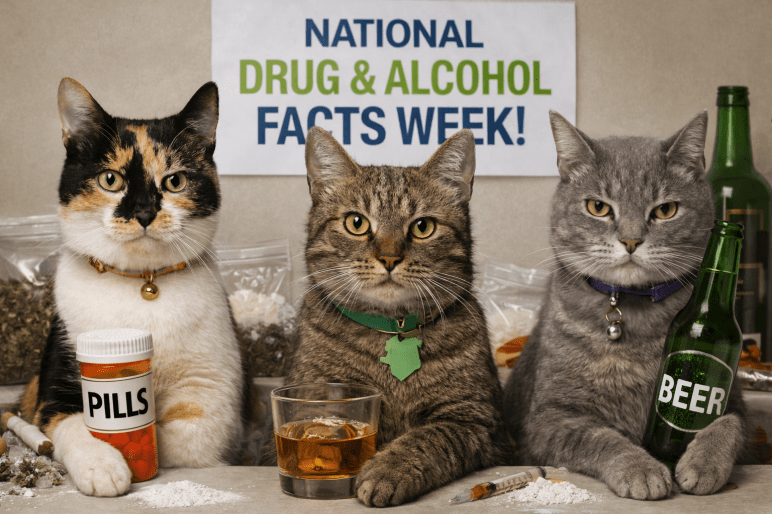
Science, Snacks, and Sass: The Feline Takeover of Drug & Alcohol Facts Week

“Facts don’t care about feelings, but feelings care deeply about snacks.”

 — The Feline Public Health Department

 Light the charcoal. Sprinkle the sage. Negative energy go away. It’s National Drug & Alcohol Facts Week. My cats have decided they are the official spokes‑animals for science, safety, and whatever chaos they can stir up before breakfast. Welcome back to This Puzzled Life. Where the trauma is seasoned. The humor is medicinal. And the cats are convinced they’re running a public health campaign.

Piper busts into the room wearing a lab coat three sizes too big.

“Mother, did you know the National Institute on Drug Abuse says misinformation spreads faster than I can knock a cup off the counter?” (Which is fast. Very fast.)

Source: National Institute on Drug Abuse (NIDA)  “National Drug & Alcohol Facts Week” https://nida.nih.gov.

Coco is dragging a bag of snacks like she’s smuggling contraband. 

“I’m here to talk about addiction. But first, do we have chips? Because the National Institute on Alcohol Abuse and Alcoholism says alcohol affects judgment. And I’m about to make a bad decision if you don’t hand over the Doritos.”

Source: National Institute on Alcohol Abuse and Alcoholism (NIAAA) “Alcohol’s Effects on the Body” https://niaaa.nih.gov.

Tinkerbell is sitting on the highest shelf like a judgmental librarian.

“Actually, according to the CDC, substance use can affect brain development. Especially in teens. Which is why I supervise the boys. They need guidance. And snacks. Mostly snacks.”

Source: Centers for Disease Control and Prevention (CDC)  “Substance Use and Youth” https://cdc.gov.

Here are a few clean, accurate, all‑ages‑appropriate facts from reputable organizations:

1. Alcohol affects every organ in the body.

Source: NIAAA  Alcohol’s Effects on the Body https://niaaa.nih.gov.

2. Most teens who misuse substances get their information from peers, not professionals.

Source: NIDA National Drug & Alcohol Facts Week https://nida.nih.gov.

3. Substance use can impact brain development into the mid‑20s.

Source: CDC Substance Use and Youth https://cdc.gov.

4. Addiction is a medical condition. Not a moral failure.

Source: Substance Abuse and Mental Health Services Administration (SAMHSA) https://samhsa.gov.
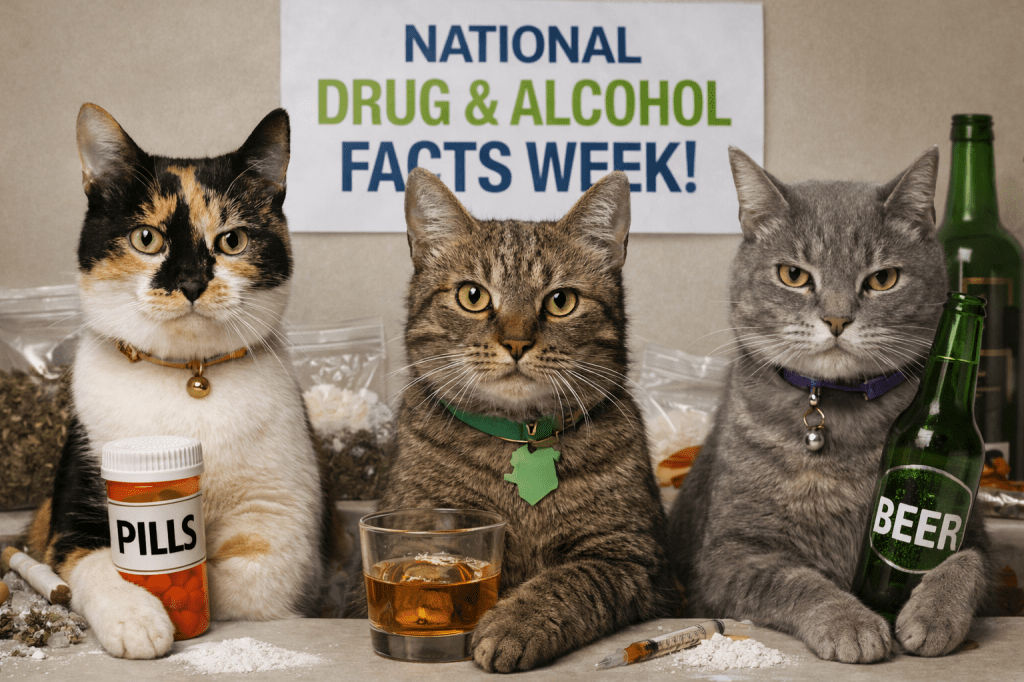
Piper’s Lesson: “Drugs don’t magically make problems disappear. That’s what naps are for.”

Coco’s Lesson: “Alcohol slows reaction time. Which is why I don’t drink. I must remain ready to sprint toward any dropped food.”

Tinkerbell’s Lesson: “Knowledge is power. And power is knowing where the treats are hidden.”

My household stays loud and educational. The cats insisted on adding this. Science supports people making informed choices. Science supports harm reduction. Science supports LGBTQIA+ folks having access to accurate, stigma‑free information. Science does NOT support Aunt Barbara’s Facebook posts. Piper said that last part. I’m just reporting.

Piper climbs onto the table wearing a tiny pair of reading glasses she stole from somewhere.

“According to NIDA, over 20% of 12th graders reported using an illicit drug in the past year. That’s too many. That’s also the percentage of times I listen when Mother says, ‘get off the counter.’”

Source: National Institute on Drug Abuse (NIDA) Monitoring the Future Survey https://nida.nih.gov.

She flips a page dramatically.

“And nicotine vaping among teens is still one of the most common forms of substance use. Which is wild because I can’t even get Mother to let me sniff the humidifier.”

Source: NIDA Teen Vaping Trends https://nida.nih.gov.

Coco waddles in carrying a bag of treats like a briefcase.

“Listen up. The CDC says alcohol is the most commonly used substance among youth in the United States. Which explains why teenagers make decisions like climbing on roofs. And dating boys who wear Axe body spray.”

Source: CDC Youth Substance Use https://cdc.gov.
She pauses to eat a treat.

“And get this. About 1 in 5 high school students reported binge drinking. Meanwhile, I binge eat kibble and nobody gives me a national awareness week.”

Source: CDC  Underage Drinking https://cdc.gov.

Tinkerbell sits on her throne (the top of the fridge) and clears her throat like a disappointed professor.

“According to SAMHSA, over 46 million people in the U.S. met the criteria for a substance use disorder in 2021. That’s a lot of people needing support, compassion, and maybe a cat to sit on their chest and purr aggressively.”

Source: SAMHSA National Survey on Drug Use and Health https://samhsa.gov.

She adjusts her imaginary pearls.

“And here’s a big one. Only about 6% of people with a substance use disorder received treatment. 6%! That’s lower than the percentage of times Coco shares snacks.”

Source: SAMHSA Treatment Statistics https://samhsa.gov.                                                                                                                                                              As National Drug & Alcohol Facts wraps up, my cats would like to remind you to

Piper: “Stay curious, not chaotic.”

Coco: “Stay hydrated and snack‑positive.”

Tinkerbell: “Stay informed. Stay fabulous. And stop believing memes your cousin posted at 2 AM.”

And honestly? That’s the most scientifically accurate advice you’ll hear all week. Because the current administration doesn’t believe in science.

And that, my friends, concludes National Drug & Alcohol Facts Week as interpreted by three cats who have never paid taxes, never followed a rule, and yet somehow run this household like a federally funded research lab. Piper has knocked over every myth she could reach. Coco has eaten every statistic that wasn’t nailed down. Tinkerbell has judged the entire nation from the top of the fridge.

We’ve cited the CDC, NIDA, NIAAA, and SAMHSA. Because around here, we believe in facts, snacks, and queer‑centered harm‑reduction education. In that order. Take what you learned, Take what you laughed at. And take a deep breath. Because knowledge is power. Compassion is necessary. And humor is how we survive the South. Class dismissed. Sage extinguished. Cats victorious. Thanks for reading! Drop a comment about what you thought about the girls in this blog.

Affirmation: I choose knowledge over fear, compassion over judgment, and humor over everything else.

 ***Don’t forget to watch the video!***

#ThisPuzzledLife

What Are The Streets Saying? Inhalants

“The National Institute on Drug Abuse states, “The brain of a chronic toluene abuser is smaller compared to someone with no history of inhalant abuse.”

-Neil Rosenberg, M.D., NIDA Research Report

Light the charcoal. Sprinkle the sage. Negativity energy, go away. Today, I want to discuss something that many teenagers experiment with, inhalants. Abusing inhalants isn’t a new thing. As it was very popular 35 years ago. And when you’re a kid without access to money, getting “high” is just a short walk away to the family utility shed. I’ll give you some facts. And then I’ll tell my story.

First, let me describe what “huffing” is even though it’s self-explanatory. Huffing is the act of inhaling chemical vapors from common household products to get high. And it’s a dangerous form of substance abuse. Even though it might seem less risky, huffing can be even more dangerous with potentially severe and fatal consequences (https://evokewellnessoh.com, 2024).

The primary chemical in many dusters is HFC-134a, which act as propellant and refrigerant. Inhaling duster fumes can be dangerous. It can lead to serious side effects such as liver problems, breathing problems and death. Duster and other inhalants aren’t considered control substances and can be bought most anywhere.

Air dusters also contain other ingredients such as:

·        Difluoroethane can cause heart issues and loss of consciousness.

·        Nitrous Oxide can cause dizziness, vomiting and nausea.

·        Alkyl Nitrites can cause increased heart rate or vomiting.

·        Butane can affect the heart leading to sudden death.

·        Propane which can cause convulsions and loss of consciousness.

Other possible side effects are:

·        heart irregularities

·        unconsciousness

·        irritation of the nose, throat, and lungs

·        coughing

·        difficulty breathing

·        shortness of breath

·        irregular pulse

·        palpitations

·        inadequate circulation

·        abnormal kidney function

·        frostbite of the nasal cavity

·        breakdown of muscle tissue

·        liver damage

·        suffocation due to displacement of air inside the lungs

·        coma

·        convulsions

·        brain or nerve damage

·        bone marrow damage

·        choking on vomit after using an inhalant

·        sudden sniffing death, which is when a person dies suddenly after breathing in an inhalant due to cardiac arrest (https://medicalnewstoday.com, 2025).

Over a fifteen-year period, teens in the US abused more than 3,400 products through inhalation. The age range was from 6 to over 50 years old. Teen boys accounted for 73.5% of cases. Of those with known outcomes from emergency room visits, 208 died and more than 1,000 experienced life-threatening or permanent disabilities (www.poison.org, 2025).

·        More than 22.98 million Americans have abused inhalants at least once in their lifetime.

·        And over the past two decades, less than 1% of individuals aged 12 and older report past year use in 2023. 

·        Inhalants are typically used by younger adolescents, with 4% 8th graders having used in the last year. The peak age is 14 years old.

·        Inhalant abuse is less common in adults but does occur, especially among those with access to chemicals (https://www2.courtinfor.ca.gov, 2025).

·        Only 25% of inhalant abusers tested in emergency rooms had no effects. Most had serious effects or died (www.poison.org, 2025).

Toluene is a chemical found in common products including nail polish, paint thinners, adhesives. It is also used to aid in the production of benzene, other chemicals, pharmaceuticals, and dyes. Toluene can also be found in printing inks, varnishes, lacquers, and some types of glues (www.OSHA.gov, 2025).

Another product that is popular among teens, which can be bought at any “head shop” is “whip-its.” It is nitrous oxide which cuts off oxygen to the brain, creating a euphoric high that lowers mental and physical pain. And it is used to make whipped cream. Using nitrous for recreational purposes is illegal. And you can be fined or jailed for violating inhalant laws (www.webmd.com, 2025). Lock me up!

I’ll be the first to admit that “huffing” was always one of my favorite ways to get “high.” Second, only to pills. It began when I started sniffing White Out. I would cover the page with it and then roll it up and start sniffing the fumes. Same thing went for gasoline. I would put a little on a rag when I filled up with gas. And then held it to my nose and inhaled deeply. All while I was driving. I know. Safety scores are totally negative. And for many years I would quit. Always heavily involved in other types of addictions.

Once the stress of my life engulfed me while I was in undergraduate and beginning graduate school, I would start huffing again. And I found my “main squeeze” in computer duster. Mainly, because it was much cheaper than other things. I was in therapy at the time. And the stress of life and the ever-hovering PTSD symptoms had me huffing every chance I got, especially after therapy. And one day I had left therapy, grabbed my can of duster from underneath the seat and started huffing as fast as I could to get the “incorrect” EMDR effects out of my brain. And when the chemicals hit, they hit hard. Suddenly, I couldn’t figure out how to work my steering wheel. I ran up on the curb and over corrected and spun across four lanes of traffic. Luckily, there were no cars coming. I sit for a second and realized that everything was ok. Still much higher than I should’ve been to drive, I cranked my Honda CRV and headed in the direction of a potential future employer. But during my stupor I forgot to look for vehicles coming from the right as I was about to make a left turn. And the next thing I remember is hearing the horrible sound of glass breaking and a loud boom. My luck had just run out. I had inadvertently pulled out into the back wheels of an eighteen-wheeler. And for a split second I thought, “Wow! This is it. Jesus, I’m on the way!” The next thing I remember is feeling intense pain but unsure where. An ambulance picked me up from the scene. What I didn’t realize at the time was that the eighteen-wheeler had gone over the top of the cab and crashed it in. Nevertheless, I was terrified that I would be getting a DUI. But there was no way to test for an aerosol. So, I vowed to keep my mouth shut. They did do a toxicology test, but an aerosol is from the lungs not the blood. And I would live with battle wounds. I vowed to never touch that stuff again. But I would always carry that little behavior not as a first choice. But still a choice I would always have for private viewing. I thought that I was finally scared of addiction and the dark forces that surround it.

After many of doing without it while engaging in self-harm, illicit drugs, and alcohol, I would begin again while living in Texas for a couple of years. But this time, it was spray paint. They both get you “high,” however, duster can give you a very panicky “high.” If it do it too much, it becomes downright scary. To this day, I still deal with huffing. I know that it’s typically done in teenage years. But that’s when one of my biggest traumas occur day after day. And in many ways, I am still that same rebellious and very hurt teen.

If you know of someone who is “huffing,” help them stop NOW! Because years later they will look up and realize they’re an adult who’s still “huffing,” if not dead. It might seem harmless, but it’s not. I hope some of this educational material will bring more attention to a very common problem with inhalants. Thanks for reading! Take what you can use and leave the rest.

Affirmation: You are not your mistakes

***Don’t forget to watch the video!***

#Thispuzzledlife