
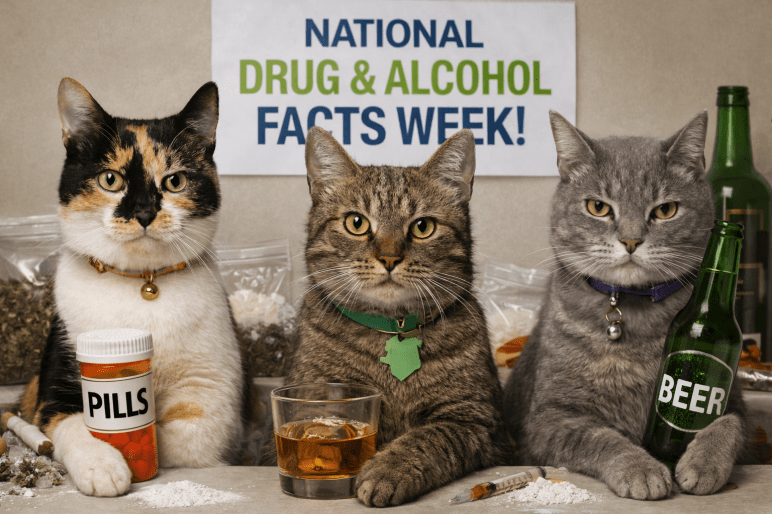
Science, Snacks, and Sass: The Feline Takeover of Drug & Alcohol Facts Week

“Facts don’t care about feelings, but feelings care deeply about snacks.”

 — The Feline Public Health Department

 Light the charcoal. Sprinkle the sage. Negative energy go away. It’s National Drug & Alcohol Facts Week. My cats have decided they are the official spokes‑animals for science, safety, and whatever chaos they can stir up before breakfast. Welcome back to This Puzzled Life. Where the trauma is seasoned. The humor is medicinal. And the cats are convinced they’re running a public health campaign.

Piper busts into the room wearing a lab coat three sizes too big.

“Mother, did you know the National Institute on Drug Abuse says misinformation spreads faster than I can knock a cup off the counter?” (Which is fast. Very fast.)

Source: National Institute on Drug Abuse (NIDA)  “National Drug & Alcohol Facts Week” https://nida.nih.gov.

Coco is dragging a bag of snacks like she’s smuggling contraband. 

“I’m here to talk about addiction. But first, do we have chips? Because the National Institute on Alcohol Abuse and Alcoholism says alcohol affects judgment. And I’m about to make a bad decision if you don’t hand over the Doritos.”

Source: National Institute on Alcohol Abuse and Alcoholism (NIAAA) “Alcohol’s Effects on the Body” https://niaaa.nih.gov.

Tinkerbell is sitting on the highest shelf like a judgmental librarian.

“Actually, according to the CDC, substance use can affect brain development. Especially in teens. Which is why I supervise the boys. They need guidance. And snacks. Mostly snacks.”

Source: Centers for Disease Control and Prevention (CDC)  “Substance Use and Youth” https://cdc.gov.

Here are a few clean, accurate, all‑ages‑appropriate facts from reputable organizations:

1. Alcohol affects every organ in the body.

Source: NIAAA  Alcohol’s Effects on the Body https://niaaa.nih.gov.

2. Most teens who misuse substances get their information from peers, not professionals.

Source: NIDA National Drug & Alcohol Facts Week https://nida.nih.gov.

3. Substance use can impact brain development into the mid‑20s.

Source: CDC Substance Use and Youth https://cdc.gov.

4. Addiction is a medical condition. Not a moral failure.

Source: Substance Abuse and Mental Health Services Administration (SAMHSA) https://samhsa.gov.
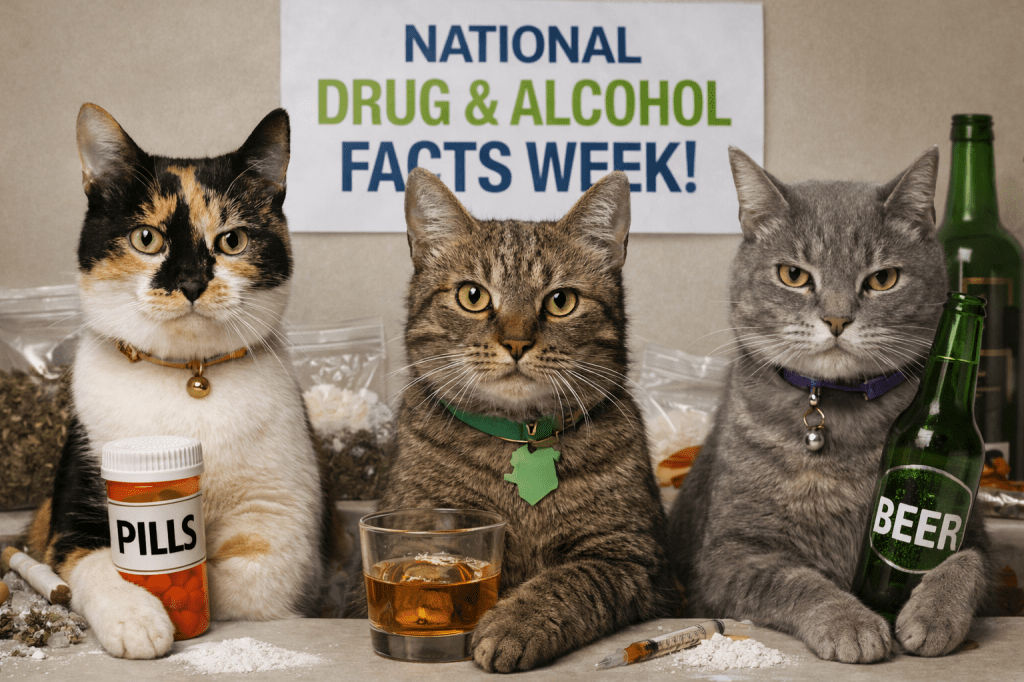
Piper’s Lesson: “Drugs don’t magically make problems disappear. That’s what naps are for.”

Coco’s Lesson: “Alcohol slows reaction time. Which is why I don’t drink. I must remain ready to sprint toward any dropped food.”

Tinkerbell’s Lesson: “Knowledge is power. And power is knowing where the treats are hidden.”

My household stays loud and educational. The cats insisted on adding this. Science supports people making informed choices. Science supports harm reduction. Science supports LGBTQIA+ folks having access to accurate, stigma‑free information. Science does NOT support Aunt Barbara’s Facebook posts. Piper said that last part. I’m just reporting.

Piper climbs onto the table wearing a tiny pair of reading glasses she stole from somewhere.

“According to NIDA, over 20% of 12th graders reported using an illicit drug in the past year. That’s too many. That’s also the percentage of times I listen when Mother says, ‘get off the counter.’”

Source: National Institute on Drug Abuse (NIDA) Monitoring the Future Survey https://nida.nih.gov.

She flips a page dramatically.

“And nicotine vaping among teens is still one of the most common forms of substance use. Which is wild because I can’t even get Mother to let me sniff the humidifier.”

Source: NIDA Teen Vaping Trends https://nida.nih.gov.

Coco waddles in carrying a bag of treats like a briefcase.

“Listen up. The CDC says alcohol is the most commonly used substance among youth in the United States. Which explains why teenagers make decisions like climbing on roofs. And dating boys who wear Axe body spray.”

Source: CDC Youth Substance Use https://cdc.gov.
She pauses to eat a treat.

“And get this. About 1 in 5 high school students reported binge drinking. Meanwhile, I binge eat kibble and nobody gives me a national awareness week.”

Source: CDC  Underage Drinking https://cdc.gov.

Tinkerbell sits on her throne (the top of the fridge) and clears her throat like a disappointed professor.

“According to SAMHSA, over 46 million people in the U.S. met the criteria for a substance use disorder in 2021. That’s a lot of people needing support, compassion, and maybe a cat to sit on their chest and purr aggressively.”

Source: SAMHSA National Survey on Drug Use and Health https://samhsa.gov.

She adjusts her imaginary pearls.

“And here’s a big one. Only about 6% of people with a substance use disorder received treatment. 6%! That’s lower than the percentage of times Coco shares snacks.”

Source: SAMHSA Treatment Statistics https://samhsa.gov.                                                                                                                                                              As National Drug & Alcohol Facts wraps up, my cats would like to remind you to

Piper: “Stay curious, not chaotic.”

Coco: “Stay hydrated and snack‑positive.”

Tinkerbell: “Stay informed. Stay fabulous. And stop believing memes your cousin posted at 2 AM.”

And honestly? That’s the most scientifically accurate advice you’ll hear all week. Because the current administration doesn’t believe in science.

And that, my friends, concludes National Drug & Alcohol Facts Week as interpreted by three cats who have never paid taxes, never followed a rule, and yet somehow run this household like a federally funded research lab. Piper has knocked over every myth she could reach. Coco has eaten every statistic that wasn’t nailed down. Tinkerbell has judged the entire nation from the top of the fridge.

We’ve cited the CDC, NIDA, NIAAA, and SAMHSA. Because around here, we believe in facts, snacks, and queer‑centered harm‑reduction education. In that order. Take what you learned, Take what you laughed at. And take a deep breath. Because knowledge is power. Compassion is necessary. And humor is how we survive the South. Class dismissed. Sage extinguished. Cats victorious. Thanks for reading! Drop a comment about what you thought about the girls in this blog.

Affirmation: I choose knowledge over fear, compassion over judgment, and humor over everything else.

 ***Don’t forget to watch the video!***

#ThisPuzzledLife
Designer Drugs: The Chemical Experiments

“People will continue to die. People will continue to have adverse reactions. People will continue to live with the consequences of their choices down the road.”

-Jan Rozga, a mother whose son committed suicide after smoking synthetic marijuana

Light the charcoal. Sprinkle the sage. Negative energy go away. Today, I want to dive into a subject that most have heard of but don’ t know a lot about. The topic is designer drugs.

You don’t need to be a scientist to understand designer drugs. You just need to know this. Designer drugs are chemicals made to look harmless, but they can be far more dangerous than the drugs they imitate. They show up in places parents don’t expect. They’re marketed in ways that feel safe. And they’re evolving faster than most families can keep up with. Designer drugs are created by changing the chemical structure of existing drugs just enough to make them.

  • Harder to detect
  • Harder to regulate
  • Easier to sell

They’re often sold as:

  • Vape cartridges
  • Edibles
  • Pills that look like Xanax, Adderall, or Percocet
  • “Herbal incense” (K2/Spice)
  • “Bath salts”
  • Powders labeled “not for human consumption”

The packaging looks harmless. The chemicals inside are anything but harmless. Most young people who encounter designer drugs don’t realize they’re using something synthetic. But designer drugs are often mixed into these products without the user’s knowledge. That’s why overdoses happen even when someone thinks they’re being careful.

Designer drugs can be more dangerous than the ones they’re attempting to mimic. According to the National Institute on Drug Abuse, these substances can be:

  • More potent
  • More unpredictable
  • More toxic

Some new synthetic opioids (like nitazenes) are so strong that a few grains can be fatal. Some synthetic cannabinoids (fake weed) can cause:

These reactions can happen on the first use, even in small amounts.

The 2024 Synthetic Cannabinoid/Designer Drug Listing identifies several new chemicals now appearing in toxicology screens, including:

To the average person like myself, these letters are meant to confuse, not to inform. Parents don’t need to memorize the names. They just need to know new chemicals appear constantly, and they’re often more dangerous than the ones before. The signs of designer drug use aren’t always obvious. Because these drugs vary so much, symptoms can look like:

If something feels “off,” trust your instincts. Designer drugs don’t follow predictable patterns. And as parents, we must listen to our gut about our children and their behavior.

What Can Parents Do Right Now?

  • Stay curious, not judgmental. Kids talk more when they feel safe.
  • Learn the basics. You don’t need to be an expert only informed.
  • Watch for sudden changes. Mood, sleep, appetite, or behavior shifts matter.
  • Talk early and often. Not just during crises.
  • Normalize asking questions. “If you ever see something weird, you can always ask me.”

You don’t need perfect answers. You just need presence. The goal isn’t fear. It’s awareness. You don’t have to lecture. You don’t have to scare. You don’t have to know every chemical name. What matters most is creating a space where your child feels safe saying:

  • “I saw this at school.”
  • “Someone offered me this.”
  • “I don’t know what this is.”

Open conversations save lives. Shame and silence do the opposite.

At the end of the day, every conversation about designer drugs comes back to one simple truth: we’re all just trying to keep the people we love safe in a world that changes faster than any of us can track. These substances aren’t just chemical formulas or scary headlines. They’re real risks that touch real families, often without warning.

But knowledge is a kind of light. And when we shine that light into the shadows, fear loses its power.

If you’re a parent, a guardian, a mentor, or simply someone who loves a young person, your presence matters more than you know. You don’t have to be perfect. You don’t have to have all the answers. You just have to stay open, stay curious, and stay willing to talk about the hard things before they become emergencies. Because the truth is this: Connection protects. Conversation protects. Awareness protects.

And remember, you’re not alone. Every step you take toward understanding is a step toward safety, compassion, and a future where the people you love feel seen, supported, and empowered to make choices that honor their lives. Thanks for reading! Keep moving forward. 

Affirmation: I am in control of my decisions.

***Don’t forget to watch the video!***

#Thispuzzledlife

Children of Addiction: The Invisible Story

“What cannot be communicated to the mother cannot be communicated to the self.”

     -John Bowlby

Light the charcoal. Sprinkle the sage. Negative energy go away. Some topics require us to slow down, breathe deeper, and open our hearts a little wider. Children of Addiction Awareness is one of those topics that are tender, urgent, and often hidden in plain sight. When we talk about addiction, the conversation usually centers on the person struggling. But in the quiet corners of those stories are children who carry the weight of what they cannot name.

They are not statistics. Not headlines. Not “someone else’s problem.” They are real kids. Real families. Real hearts trying to grow in soil that isn’t always steady. You don’t need a degree or special training to understand this. However, you just need to know this. When addiction lives in a home, children feel it in their bones. Even when they don’t have the words. Even when they pretend everything is fine.

Children growing up in homes affected by addiction often learn to read emotional weather patterns before they learn to read books. They become experts at sensing tension, anticipating conflict, and adjusting themselves to survive unpredictable environments.

They are the kids who:

  • Tiptoe around moods.
  • Become caretakers far too young.
  • Hide their fear behind perfection or silence.
  • Carry secrets that feel too heavy for their age.
  • Love their parents fiercely, even when life feels chaotic.

These children are not defined by the addiction around them. But they are shaped by it in ways that deserve understanding, compassion, and support.

Kids who grow up around addiction often learn to:

  • Stay quiet
  • Stay small
  • Stay out of the way
  • Stay “strong” even when they’re hurting

They become experts at reading moods, hiding feelings, and pretending everything is okay even when it’s not.

Growing up with addiction in the home can create emotional landscapes that are confusing and overwhelming. Many children experience:

  • Unpredictability: never knowing what version of a parent will appear.
  • Emotional neglect: not from lack of love, but from addiction’s consuming nature.
  • Role reversal: becoming the “adult” in the home.
  • Isolation: believing no one else lives this way.
  • Hypervigilance: always on alert for the next crisis.

And yet, these same children often develop extraordinary strengths: empathy, intuition, resilience, and emotional intelligence. They learn to survive in ways that would humble most adults.

But survival is different from thriving. Awareness is the bridge between the two. These children don’t need perfect parents. They don’t need someone to “fix” everything. They don’t need pity.

They need:

  • Consistency
  • Predictability
  • A safe adult who listens without judgment
  • Reassurance that none of this is their fault
  • Permission to feel their feelings — all of them

Sometimes the most healing words a child can hear are: “You didn’t cause this. You can’t control this. You are not alone.”

Whether you’re a teacher, neighbor, mentor, family member, or simply a caring human, you can make a meaningful difference.

  • Create safe spaces for conversation.
  • Model healthy coping skills.
  • Offer stability and routine.
  • Validate their emotions.
  • Connect them to supportive resources.

You don’t need a degree to change a child’s life. You just need to show up consistently, compassionately, and without judgment.

For the parents struggling with addiction, this conversation is not here to shame you. It’s here to remind you that healing is possible for you and for your child. Your effort matters. Your recovery matters. Your presence matters more than perfection ever could. Children don’t need flawless parents. They need honest ones. They need parents who try, who apologize, who grow, who keep coming back to love. Every step you take toward healing is a step toward breaking generational cycles.

Children of Addiction Awareness is not just a month, it’s a movement toward visibility, compassion, and collective responsibility. When we acknowledge these children, we give them language. When we give them language, we give them power. And when we give them power, we give them hope. So, take a breath and hold this truth close: Awareness opens the door. Connection keeps it open. Love walks a child through. Thanks for reading! Keep HOPE alive.

Affirmation: I didn’t cause it, I can’t control it, but I can take care of myself.

***Don’t forget to watch the video!***

#Thispuzzledlife