
I Stand Up Because Too Many Still Can’t

“I don’t raise my voice because I’m angry. I raise it because whispering never changed a damn thing except how fast people ignore you.”

-This Puzzled Life

Light the charcoal. Let it crackle like it knows the truth is about to get told. Let the smoke rise slowly and dramatic, the way my ancestors intended. Curling through the room like it’s searching for the lies we’re about to burn out. This is the moment where the air shifts, the spirits lean in, and even the cats pause mid‑chaos because they know Mama’s about to say something real. This is my “brace yourself, I’m done being polite” announcement to the universe. It’s the Southern version of rolling up your sleeves. Except with more sage, more attitude, and a whole lot more intention. When that charcoal glows, so do I. And whatever truth I’ve been holding in my chest finally gets permission to walk out the front door like it pays rent.

I write the way I live. Loud enough to be heard, honest enough to be felt, and Southern enough to confuse anyone who’s never survived a family reunion with both potato‑salad politics and generational trauma. I stand up and speak out because silence never saved me. And it sure as hell never protected the people I love. So, if you’re here for polite whispers, bless your heart. But if you’re here for truth with humor, grit, and a little Holy‑Ghost side‑eye, pull up a chair. You’re in the right place.

I’ve been asked many times, “Why Do I Stand Up And Speak Out?” And here’s my explanation. There’s a moment in every Southern woman’s life when she realizes she has two choices:

  1. Sit quietly and let the world run wild with foolishness.
  2. Or stand up, speak out, and let the church fans flutter in shock.

I chose the second one. Mainly because the first option has never worked for me a day in my life. I didn’t grow up planning to be “the outspoken one.” I was raised in the Deep South, where you’re expected to smile politely, keep your voice at a respectable whisper, and only speak your truth if it fits neatly between a cobbler and a prayer request. But life has a way of handing you a microphone when you least expect it. It’s usually right after you’ve sworn you’re done talking. So, here’s the truth I carry deep in my bones. I was that child who screamed in silence that no one heard.

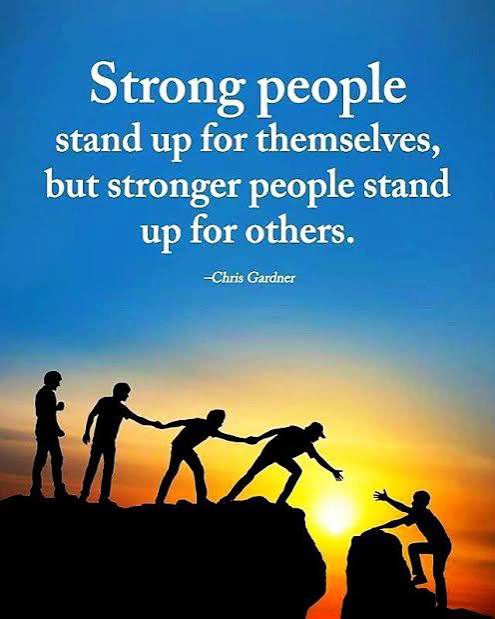
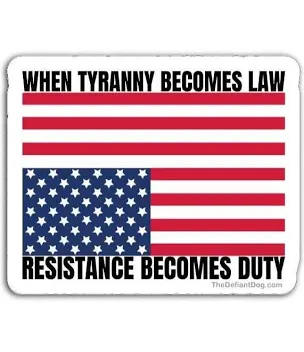
And now? I stand up for those who don’t have the power to stand up. Or who have been intimidated into swallowing their truths whole. I will absolutely be a voice for Immigrants, LGBTQIA+ (my home group), Native Americans, Canada, Venezuela, Mexico, Greenland, Venezuelan fishermen, Gazans, the homeless, the victimized, Black and Brown communities, and anyone who needs support through solidarity. I can’t get away from this calling because I will always stand up against tyranny, crimes against children, religious scapegoating, hypocrisy, racism, and oppression. And especially here in the South, where silence is expected and resistance is treated like a character flaw.

But I am not built for quiet compliance. I have never been. I speak out because silence never saved me. Silence never protected me or my kids. Silence never made the world kinder. Silence protected the perpetrators with fragile egos and made the wrong people louder. And Lord knows the wrong people do not need a volume boost. Their voice is almost as big as their unfinished golden ballroom. Their headquarters are located at 1600 Pennsylvania Ave.

I stand up because I’ve lived through enough chaos to qualify for a punch card. After your tenth traumatic event, you should legally get a free smoothie or something. But instead, I got a voice. And the realization that if I don’t use it, someone else will use theirs to rewrite my story in a way that makes them comfortable. Absolutely not.

I was forced as a child to watch adults do absolutely nothing about the abuse they knew was happening. They didn’t want to “rock the boat.” They didn’t want to challenge the system. They didn’t want to stand up for what was right. They stood up for what was popular. What was convenient. And what kept the illusion intact. And while they protected their comfort, I was left to protect myself.

As a child, my only way to survive was by fighting back. Not just against the adults who caused the harm. But also, against the complicit bystanders who saw everything and chose silence. That kind of abandonment teaches you something. And it is this, “if you don’t stand up for yourself, no one else will.” And that lesson, painful as it was, is exactly why I refuse to be quiet now.

But here’s the part they never planned for. I didn’t stay small. It took years and years to claw my way back to myself. To unlearn the lies. To rebuild a voice that had been broken, bent, and boxed in. To stand in my own truth without shaking. To speak without apologizing. To breathe without asking permission.

For years, my voice wasn’t quiet. It was taken. Stolen by abuse. Smothered by “be nice” expectations. Buried under the weight of family roles I never agreed to play. And when I finally stumbled into adulthood, those lessons didn’t magically disappear. They clung to me like wet clothes, heavy and suffocating, convincing me that silence was survival and shrinking was safety.

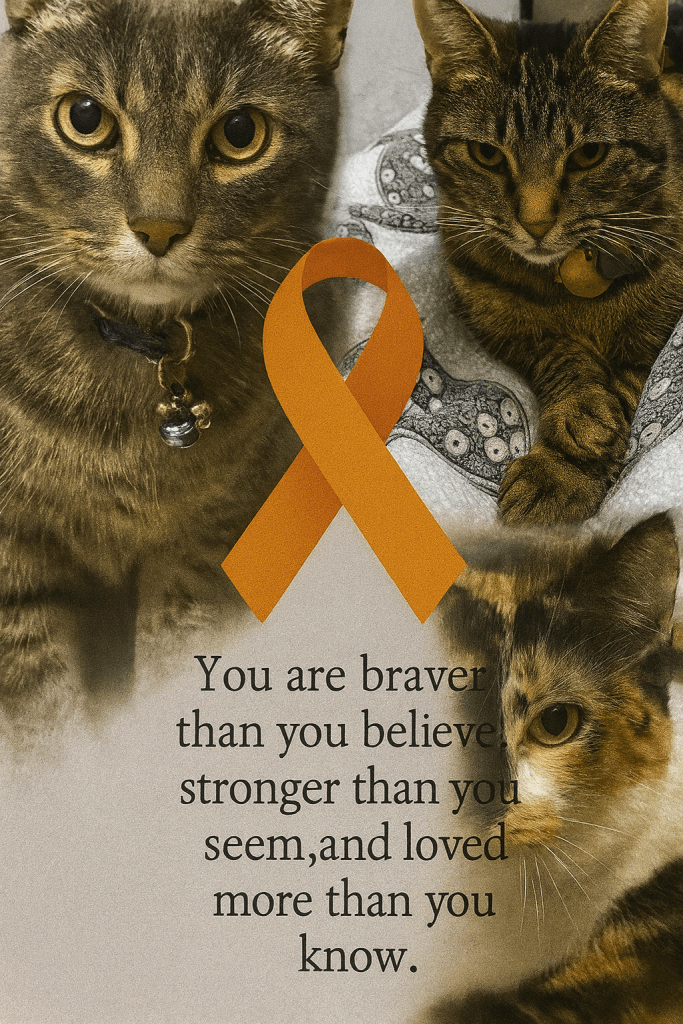
I speak out because my kids are watching. I speak out because my community deserves better. I speak out because our nation can do better. I speak out because my cats already assume I run the world, and honestly, who am I to disappoint them. But mostly, I speak out because my voice is not a liability. It’s a legacy. A tool. A torch. A refusal to let the world slide backward while I sit politely on the porch pretending not to notice. I speak out because I know what it feels like to be unheard. And I refuse to let anyone else sit in that silence alone.

So let the world adjust its volume, because I’m done shrinking to fit inside anyone’s comfort zone. I was born with a backbone. I earned this voice. And I’m using it whether the room is ready or not. If standing up makes some folks uncomfortable, they can go ahead and shift in their seats. I’m not sitting back down. This is my line in the sand, my truth on full display, and my promise carved in stone. I will not be silent, I will not be small, and I will not stop.

I have learned the beauty and the necessity of boundaries. I am absolutely, unequivocally, and in no universe responsible for anyone else’s feelings about my truth, my choices, or my existence. I was raised to believe that people‑pleasing was practically a family requirement. And that we should disguise what was really going on for fear someone might realize our family wasn’t the picture‑perfect postcard we pretended to be. But those lessons didn’t protect me. They imprisoned me. And to feel strong enough, grounded enough, and whole enough to speak my truth after being silenced for so long is a miracle in itself.

But once I broke free from the expectations, the abuse, and the boundary‑less people who benefitted from my quiet suffering, something in me locked into place. I will never be silenced again. Not for family. Not for comfort. Not for tradition. Not for anyone. I earned this voice. I fought for this voice. And now that I have it back, I’m using it. Loudly, clearly, and without hesitation. Thanks for reading! And stand up.

Affirmation: My voice is not too much. It is exactly enough and it was built to be heard.

***Don’t forget to watch the video!***

 #ThisPuzzledLife
Children of Addiction: The Invisible Story

“What cannot be communicated to the mother cannot be communicated to the self.”

     -John Bowlby

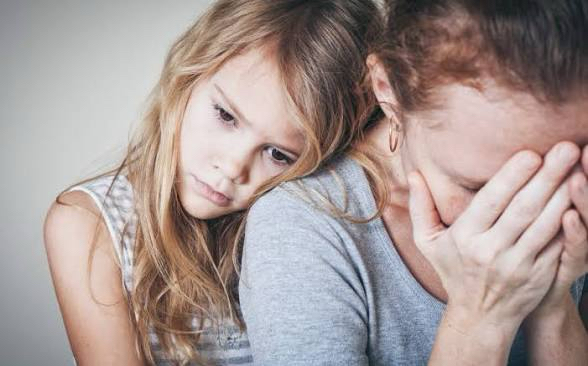
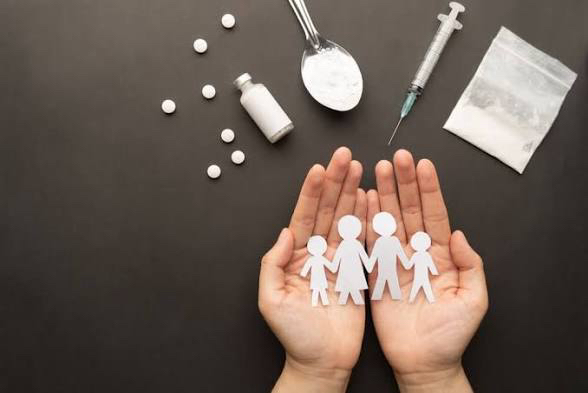
Light the charcoal. Sprinkle the sage. Negative energy go away. Some topics require us to slow down, breathe deeper, and open our hearts a little wider. Children of Addiction Awareness is one of those topics that are tender, urgent, and often hidden in plain sight. When we talk about addiction, the conversation usually centers on the person struggling. But in the quiet corners of those stories are children who carry the weight of what they cannot name.

They are not statistics. Not headlines. Not “someone else’s problem.” They are real kids. Real families. Real hearts trying to grow in soil that isn’t always steady. You don’t need a degree or special training to understand this. However, you just need to know this. When addiction lives in a home, children feel it in their bones. Even when they don’t have the words. Even when they pretend everything is fine.

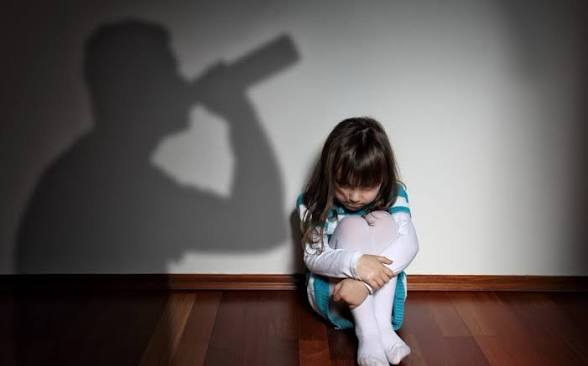
Children growing up in homes affected by addiction often learn to read emotional weather patterns before they learn to read books. They become experts at sensing tension, anticipating conflict, and adjusting themselves to survive unpredictable environments.

They are the kids who:

  • Tiptoe around moods.
  • Become caretakers far too young.
  • Hide their fear behind perfection or silence.
  • Carry secrets that feel too heavy for their age.
  • Love their parents fiercely, even when life feels chaotic.

These children are not defined by the addiction around them. But they are shaped by it in ways that deserve understanding, compassion, and support.

Kids who grow up around addiction often learn to:

  • Stay quiet
  • Stay small
  • Stay out of the way
  • Stay “strong” even when they’re hurting

They become experts at reading moods, hiding feelings, and pretending everything is okay even when it’s not.

Growing up with addiction in the home can create emotional landscapes that are confusing and overwhelming. Many children experience:

  • Unpredictability: never knowing what version of a parent will appear.
  • Emotional neglect: not from lack of love, but from addiction’s consuming nature.
  • Role reversal: becoming the “adult” in the home.
  • Isolation: believing no one else lives this way.
  • Hypervigilance: always on alert for the next crisis.

And yet, these same children often develop extraordinary strengths: empathy, intuition, resilience, and emotional intelligence. They learn to survive in ways that would humble most adults.

But survival is different from thriving. Awareness is the bridge between the two. These children don’t need perfect parents. They don’t need someone to “fix” everything. They don’t need pity.

They need:

  • Consistency
  • Predictability
  • A safe adult who listens without judgment
  • Reassurance that none of this is their fault
  • Permission to feel their feelings — all of them

Sometimes the most healing words a child can hear are: “You didn’t cause this. You can’t control this. You are not alone.”

Whether you’re a teacher, neighbor, mentor, family member, or simply a caring human, you can make a meaningful difference.

  • Create safe spaces for conversation.
  • Model healthy coping skills.
  • Offer stability and routine.
  • Validate their emotions.
  • Connect them to supportive resources.

You don’t need a degree to change a child’s life. You just need to show up consistently, compassionately, and without judgment.

For the parents struggling with addiction, this conversation is not here to shame you. It’s here to remind you that healing is possible for you and for your child. Your effort matters. Your recovery matters. Your presence matters more than perfection ever could. Children don’t need flawless parents. They need honest ones. They need parents who try, who apologize, who grow, who keep coming back to love. Every step you take toward healing is a step toward breaking generational cycles.

Children of Addiction Awareness is not just a month, it’s a movement toward visibility, compassion, and collective responsibility. When we acknowledge these children, we give them language. When we give them language, we give them power. And when we give them power, we give them hope. So, take a breath and hold this truth close: Awareness opens the door. Connection keeps it open. Love walks a child through. Thanks for reading! Keep HOPE alive.

Affirmation: I didn’t cause it, I can’t control it, but I can take care of myself.

***Don’t forget to watch the video!***

#Thispuzzledlife

A Life, A Name, A Nation’s Failure: Renee Nicole Good

“Some stories break you. Some stories change you. And some stories demand you stand up, speak up, and refuse to look away. Renee Nicole Good deserved to grow old.”

— Dana, This Puzzled Life

Light the charcoal. Sprinkle the sage. Negative energy go away. Today’s story is heavy, holy, and heartbreaking. And it deserves to be told without flinching.

There are moments when the world tilts. Moments when a headline hits you in the chest because you know this isn’t just news. This is someone’s daughter. Someone’s mother. Someone who laughed, cried, loved, lived, and deserved to grow old.

And this time, her name was Renee Nicole Good. She was a 37‑year‑old mother of three who was shot and killed by an ICE agent in Minneapolis on January 7, 2026, as reported by CBS News and NBC News. She was unarmed. She was shot three times including once in the head. And it was the wound that killed her according to the Hennepin County Medical Examiner’s report, cited by MPR News.

I didn’t know Renee personally. But I know the shape of injustice. I know the sound of a system cracking under its own weight. I know what it feels like to be trapped in a place where the people with power insist they’re “keeping you safe” while your body tells you otherwise.

When I read about Renee and about how the fatal shot was to her head. And about how the agent claimed “self‑defense,” about how the body‑camera footage released by ICE shows her backing away when the shots were fired. I felt that familiar ache. The one that says, This should not have happened. The one that says, This keeps happening. The one that says, How many more?

The world saw the moment she died. Millions watched the video, replayed it, argued about it. But Renee was more than the last seconds of her life. She was a whole human being. She was a mother. A woman trying to survive. Someone who deserved to be seen in her fullness. And not just her final frame. Another woman gone. Another family shattered. Another official statement claiming “self‑defense,” as reported by The Associated Press. Another community calling bullshit.

I’ve spent enough time in psychiatric, legal, and medical systems to know how quickly institutions protect themselves. How fast the narrative shifts. How easily a person becomes a problem instead of a person. But Renee wasn’t a problem. She was a life.

When I say her name, Renee Nicole Good, I feel the heaviness of it. The way a name becomes a headline. The way a headline becomes a debate. And the way a debate becomes noise. But behind that noise is a family who will never be the same. Children who will grow up with a before and after. A community that will remember the day everything changed.

And I think about how often marginalized people are told to “comply,” “calm down,” “cooperate,” “not escalate,” “not resist,” “not move,” “not breathe wrong.” And still they die. Grief like this doesn’t fade when the headlines do. It lingers. It haunts. It becomes part of the landscape of a community. And it should. Forgetting is how injustice survives.

Renee deserves better than to be forgotten. She deserves better than to be reduced to a political talking point. She deserves better than to be a momentary outrage. She deserves to be remembered as a woman whose life mattered.

When I read that her death was ruled a homicide, even if the system refuses to call it a crime, I felt that familiar sting. The one that says, We see what happened. We just refuse to name it. And when I read that she was unarmed. And that she posed no threat, and that the fatal shot was to her head, I felt the anger rise. Not the wild, chaotic anger. The quiet kind. The kind that sits in your chest like a stone. The kind that says, This is not justice. This is not safety. This is not okay.

I don’t have a neat ending for this. There isn’t one. But I can say this, Renee, your life mattered. Your story matters. Your name will not be swallowed by the noise. To her family, I am holding you in the softest part of my heart. To her children, I hope the world becomes gentler for you than it was for your mother. To her community, keep speaking, keep fighting, keep remembering. And to anyone reading this who feels the weight of it, you’re not imagining it. You’re not overreacting. You’re not alone.

Some stories demand to be told. Some losses demand to be honored. Some names demand to be spoken. Renee Nicole Good. We see you. We remember you. We will not look away. Thanks for reading! And from the bottom of my heart I say, “Fuck ICE!”

Affirmation: I honor Renee by telling the truth, holding the grief, and refusing to let her name fade.

***Don’t forget to watch the video!***

#ThisPuzzledLife
National Eating Disorders Awareness: The Hurt We Don’t Talk About

“Eating disorders are so incredibly complex. And they are not about the food.”

-This Puzzled Life

Light the charcoal. Sprinkle the sage. Negative energy go away. Today, I want to talk about something that sits quietly in the corners of so many lives. And it’s also something we don’t talk about nearly enough because it’s wrapped in shame, silence, and misunderstanding. And the topic is eating disorders.

This isn’t just a national awareness week to me. It’s a reminder of how many people walk through the world carrying a pain that no one sees. A reminder that the strongest people you know might be fighting battles with food, with their bodies, with their own reflection. A reminder that healing is possible. But it’s not easy. And it’s never linear.

Eating Disorders are not about vanity. They’re about survival. People love to reduce eating disorders to “wanting to be skinny,” but that’s not the truth. Not even close. Eating disorders often grow out of trauma, anxiety, perfectionism, or the desperate need to feel in control when everything else feels chaotic. They’re coping mechanisms that become cages. They’re ways of surviving will eventually start to suffocate.

And the cruelest part is that most people suffering look “fine” on the outside. They smile. They function. They pretend. They hide. Because the world has taught them that their pain is embarrassing, dramatic, or self‑inflicted.

We Live in a culture that worships self‑punishment. And we’re surrounded by messages that tell us to shrink, restrict, cleanse, detox, earn our food, burn our calories, and hate our bodies until they fit someone else’s idea of “acceptable.” We praise people for losing weight without ever asking if they’re okay. We compliment discipline without knowing it might be self‑destruction.

Awareness means calling out the culture that normalizes harm. It means refusing to participate in conversations that shame our own bodies or anyone else’s. It means unlearning the lies we were raised on.

Recovery isn’t a straight line. It’s not a single moment of clarity or a dramatic breakthrough. It’s a thousand tiny choices. It’s eating when you don’t want to. Resting when your mind screams at you to move. Speaking kindly to yourself when the old voice whispers cruelty.

It’s crying in the grocery store. It’s celebrating the days you nourish yourself without guilt. It’s forgiving yourself when you slip. It’s learning to trust your body again, even when it feels impossible. And recovery is not weakness. It is strength in its purest form.

The person who always says they “already ate.” The friend who jokes about needing to “earn” their dinner. The coworker who never joins for lunch. The family member who avoids mirrors. The person who seems confident but is quietly unraveling inside.

Awareness means choosing compassion over assumptions. It means listening without judgment. It means creating space where people feel safe enough to be honest. If you are struggling, you deserve nourishment, and rest. You deserve a life that isn’t ruled by fear, shame, or numbers. You deserve to feel at home in your body not at war with it.

You are not broken. You are not alone. And you are not defined by the hardest thing you’ve survived.

National Eating Disorders Awareness isn’t just a date. It’s a call to soften. To speak gently. To challenge the toxic norms, we’ve accepted for far too long. To check on the people we love. To check on ourselves. To build a world where bodies are respected, not judged. Where food is nourishment, not punishment. Where healing is celebrated, not hidden.

As someone who has battled with eating disorders for more years than I haven’t, I know what it means to live inside a cycle that feels impossible to break. My struggles were born out of trauma but just like so many of my other survival behaviors and even now, after all this time, the echoes of that pain still follow me.

My body isn’t as depleted or fragile as it once was. But the thoughts haven’t magically disappeared. They still show up every day, whispering the old rules, the old fears, and the old lies. I still avoid eating in front of people whenever I can. I still feel that familiar tightening in my chest when food becomes a spotlight instead of nourishment.

Eating disorders are a quiet trap, consuming, and cruel. They take root in the mind long before they show up in the body. They convince you that you’re in control while slowly taking that control away. They drain you mentally and physically, piece by piece, until you feel like there’s nothing left but the disorder itself. And the hardest part is how invisible it can all be. How easy it is to smile, to function and to pretend. How easy it is for the world to miss the pain entirely.

This isn’t weakness. It’s something that grows out of hurt, out of fear, out of the desperate need to feel safe in a world that hasn’t always been safe. And even though the thoughts still come. Even though the habits still tug at me. I’m here. I’m still fighting. I’m still choosing to stay. That matters more than anyone on the outside will ever understand. Thanks for reading! And reach out for help.

Affirmation: My body is not my enemy. I deserve compassion, nourishment, and peace.

***Don’t forget to watch the video!***

#Thispuzzledlife