
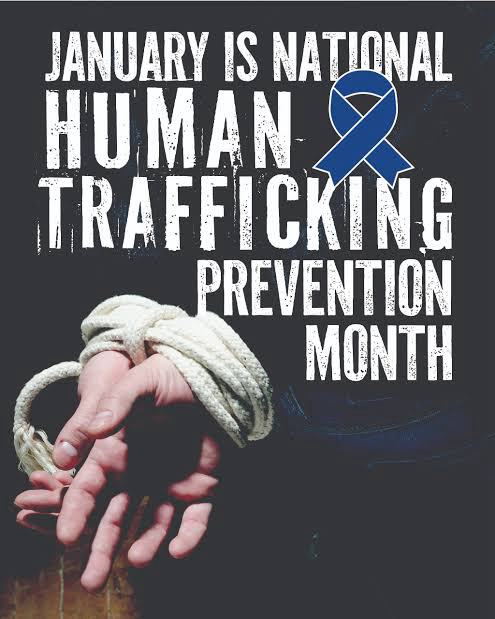
Human Trafficking Prevention Month January

“You cannot look away when human beings are bought and sold.”

— Unknown

Light the charcoal. Sprinkle the sage. Negative energy go away. Today, I want to talk to you about human trafficking prevention month.

Human trafficking is a serious crime and a violation of human rights. It involves the use of force, fraud, or coercion to exploit a person for profit.

It most commonly takes two forms:

  • Sex trafficking: When a person is forced, tricked, or coerced into performing commercial sex acts. Any minor involved in commercial sex is considered trafficked, regardless of force or coercion.
  • Labor trafficking: When a person is forced to work through threats, debt, or manipulation in jobs such as agriculture, construction, domestic work, factories, or hospitality.

Human trafficking can happen anywhere homes, workplaces, online, and across borders. Traffickers often target vulnerable individuals, including children, migrants, people experiencing poverty, and those facing abuse or instability. There are several myths that circulate about this type of crime.

Myth: Human trafficking always involves kidnapping.
Reality: Many victims are coerced, manipulated, or deceived, not abducted (Human Trafficking | National Human Trafficking Hotline).

Myth: It happens only overseas.
Reality: Trafficking occurs in all 50 U.S. states and U.S. territories. (Department of Homeland Security).

Myth: Victims will simply ask for help.
Reality: Fear, debt, threats, or trauma may prevent victims from seeking assistance.

Who Are the Most At Risk?

Human trafficking can happen to anyone regardless of age, gender, nationality, or background. But certain factors can increase vulnerability, including:

  • Poverty or economic instability
  • Unstable housing or homelessness
  • History of trauma or abuse
  • Recent migration or lack of legal status
  • Social isolation or limited support networks

Traffickers often manipulate trust, use deception, or exploit unmet needs to gain control. (Home | National Human Trafficking Hotline)

What Are the Signs of Possible Trafficking?

There’s no single indicator, but the FBI and other authorities list red flags such as:

  • Victims lacking control over their own identification or finances
  • Restricted freedom of movement
  • Excessive work hours with little or no pay
  • Signs of fear, control, or physical abuse
  • Living where they work or in isolated conditions
  • Limited ability to speak for themselves or interact freely with others FBI

Not all victims will show obvious signs, and every situation is different. It is not the same as human smuggling. Smuggling involves consent and ends once a border is crossed, while trafficking is about ongoing exploitation and does not require movement. If you or someone you know may be at risk in the U.S., the National Human Trafficking Hotline is available 24/7 at 1-888-373-7888 or by texting 233733 (BEFREE).

I have personally spent time with women who survived sex trafficking. I have listened to their stories, and the cruelty they endured is beyond words. No one should ever have to survive what they are forced to do. This must be a top priority for law enforcement and our communities. While rescues do happen, freedom is only the beginning. The wounds both visible and unseen run deep, and the scars left behind are so profound they leave you stunned, struggling to comprehend the depth of what was taken from them. Thanks for reading!

Affirmation: Every person deserves safety, autonomy, and acceptance.

***Don’t forget to watch the video!***

#Thispuzzledlife
Types of Domestic Violence

“If you aren’t silent about your pain, they’ll kill you and say you enjoyed it.”

-Zora Neale Hurston

Light the charcoal. Sprinkle the sage. Negative energy go away. Today, I want to talk to you about some of the behaviors that fit under the umbrella of domestic violence. It wasn’t until I  was out of the relationship for a while before I began to see  information validating  what I always knew. This is not comprehensive list by any means. 

COERCIVE CONTROL OR CONTROLLING BEHAVIOR

·        Control who a person sees, wears and where they go. 

v  This was considered normal in my relationship. He dictated everything that I wore. If I chose what I wanted to wear, he would tell me to,  “go change. You look ridiculous.” And I was afraid to go somewhere without asking his permission.

·        Monitor or track what a person does. 

v  This was also something that was done on a daily  basis. He would call me wherever I was supposed to be and verify it by employees.

·        Control a person’s finances, medicine, food, or exercise.

v  He always told me that I was not allowed food that he didn’t approve. And I was required to be at the gym at 5:30 am every morning. And he would call and speak with those employees about what type of exercise I was doing. I was also not allowed to spend any money without permission.

·        Force someone to have sex or do sexual things.

v  I was never given the option to make that choice. I was threatened if I even spoke about that.

PHYSICAL VIOLENCE

·        Hitting, punching, kicking, bashing, shoving, or pushing.

This happened more times than I can count. He did kick me in the face. But when he and his brother teamed up together, it was worse. The main reason is because my husband didn’t want to say that he participated. And because they always threatened and intimidated me into silence, I never said anything. His brother was his “yes man.” And my husband pulled the strings.

·        Spitting on someone or pulling hair.

·        Choking or suffocating.

v  This typically happened during forced sex. Or whenever his brother would get mad at me, he would choke me as a form of intimidation.

·        Throwing things at or near someone.

·        Using a weapon.

v  This was always pointed at me or laid out somewhere as a form of threats and intimidation.

·        Locking someone in or out of space.

v  This was often done to show control.

·        Stopping someone from eating, sleeping, or having medication they need.

v  Every piece of food had to be given an account. One of his favorite things he would allow me to have for a snack was ten olives and ten pistachios. He would come home from work and completely berate me if I weren’t already up. And it didn’t matter that I had just worked a 24-48 shift. He always told me that medication was a crutch. He got mad because I had been given muscle relaxers for a hurt back and proceeded to kick me in the face and throw my medication out into the rain. I was also not allowed to take any psychiatric meds for depression or mood stabilization because, “why do you need anti-depressants when I’m so good to you? And what if someone finds out that you’re taking this? I don’t want anyone knowing that my wife is crazy. Then it makes me look bad. Why don’t you care about that?”

·        Forcing someone to drink or take drugs.

v  I did this on my own to help deal with being under his crazy world of control.

SEXUAL VIOLENCE

·       Touching or kissing someone without their consent.

I was made to accept his advances

·       Pressuring or forcing someone to have sex or do something sexual without their consent.

v  I was told, “Either you give it to me, or I’ll take it. Either way, I’m getting what I want. Make your decision.” Many times, I was bruised or bleeding by the time he was done with me. I had no voice in any matter. He was the “warden,” and I was his “prisoner.” My whole sexual relationship with him was simply RAPE.

·       Pressuring or forcing someone to have sex without protection such as a condom.

I was told early on, “I’m not using protection because it burns my dick. If you really loved me, you wouldn’t  put stipulations on how I fuck you.”

*I know this is explicit. However, I want you to get an accurate description of the situation.*

IMAGE-BASED ABUSE

·        Sharing private images of a person without their consent, for example images of them undressing or showering.

·        Sharing culturally inappropriate images of a person, for example images in which they do not wear items of clothing that they would normally wear in public.

·        Sharing intimate or sexualized images of a person without their consent.

·        Producing and sharing images that have been digitally altered to suggest a person is nude or engaged in sexual activity.

·        Threatening to do any of these things.

        *I found out later on that his brother would secretly be filming or watching us having sex.*

EMOTIONAL OR PSYCHOLOGICAL ABUSE

·        Criticizing a person and their choices or actions.

v  In his mind, he thought that I was too stupid to make decisions that were considered “correct.” All he ever told me what how stupid and retarded I was.

·        Isolating a person form their friends or their family.

v  Some friendships I lost forever because they just thought that I abandoned them. What they failed to see was that I would get accused of all kinds of stuff if I disobeyed him. Those who have never been in an abusive situation can’t comprehend losing your power to stand up for yourself. It was just easier to do what he said. Some former friends haven’t even talked to me since that time. And that is about them not me.

·        Threatening to harm a person, their family, their friends, their pets, or their belongings.

v  He always made threats about things he would and could do with keepsakes or my innocent animals. And if he and his brother didn’t feel that I was getting the picture, they would show up at my parents’ house and start harassing them.

·        Threating them to share personal or private information, such as sexuality, gender identity, personal health, or visa status (https://www.act.gov.au/community/domestic-family-and-sexual-violence/types-of-domestic-and-family-violence, 2025).

This topic will be spread over a few blogs. As you can see, when I add personal experience, the blog gets much longer. Stay patient and learn from this. It’s a hell that most people can’t understand. And I’m telling you that it’s all true. I was living in a prison without visible bars. Thanks for reading! And watch for the second part in the coming days.

Affirmation: I remember that it is ok to ask for help and receive support.

***Don’t forget to watch the video!***

#Thispuzzledlife